
The consistency rule is the silent account killer most traders do not even know about until it denies their payout. You hit the profit target. You stayed under drawdown. You followed every rule.
And then your prop firm says your best day was too big relative to your total. Challenge not passed. Try again.
That is the consistency rule. Your single best trading day cannot exceed a certain percentage of your total profit. This prop firm consistency calculator tells you exactly where you stand before your firm does.
How This Prop Firm Consistency Calculator Works
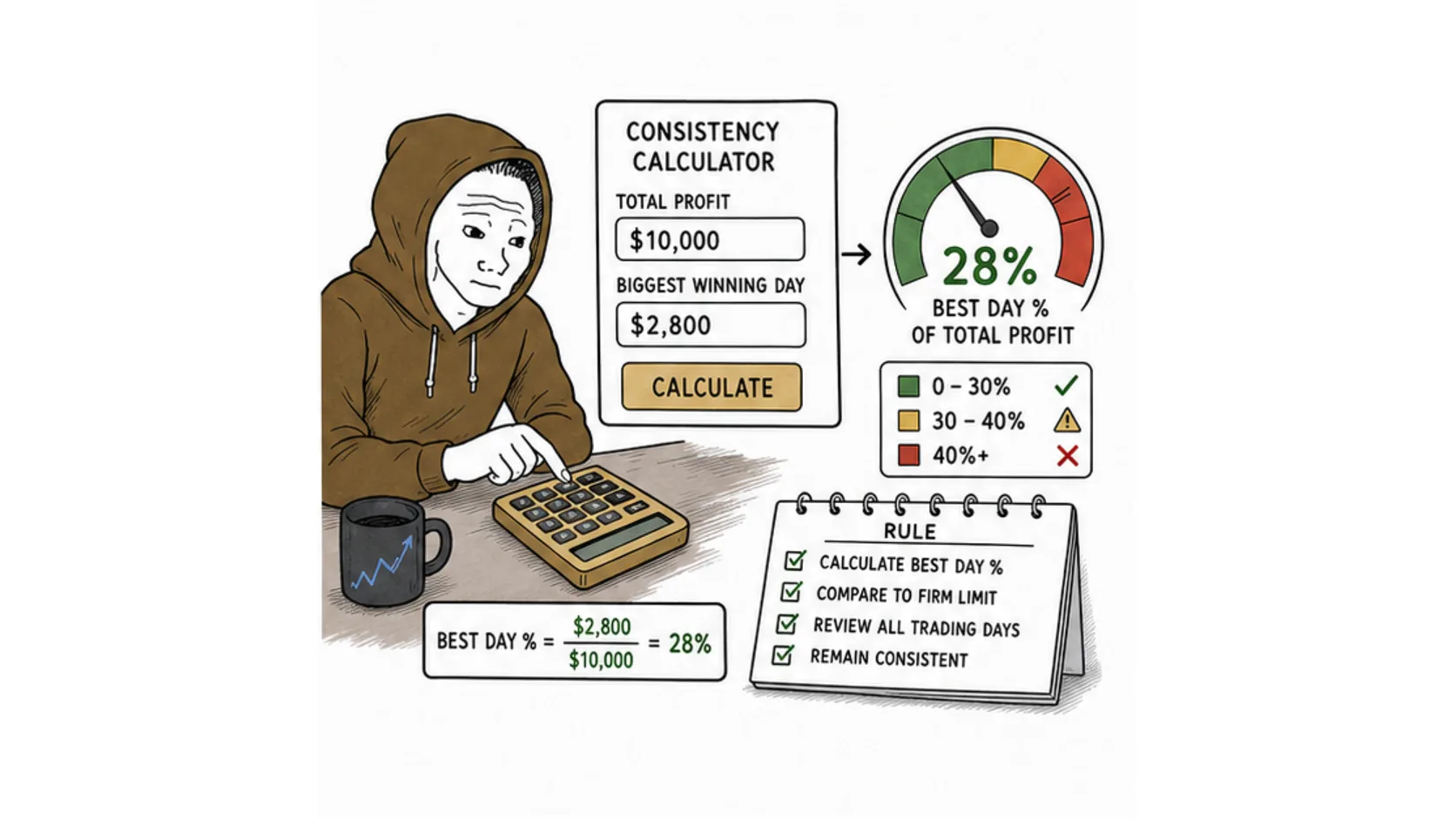
The math behind this prop firm consistency calculator is simple. Your prop firm sets a consistency threshold, usually between 20% and 35%. Your best single day profit divided by your total profit must be at or below that threshold.
If your best day accounts for 40% of your total profit and your firm enforces a 30% consistency rule percentage, you have a consistency rule breach. The calculator runs this exact calculation for you.
Most traders understand the rule conceptually but never actually run the numbers until the challenge is over. By then it is too late. The consistency rule does not care that your setup was perfect that day.
It does not care that you sized correctly. It only cares about the ratio.
Think of it as a built-in anti-luck filter. Prop firms use the consistency rule to weed out traders who got lucky on one massive trade versus traders who grind out profit consistently.
Whether that is fair depends on your perspective, but the rule exists and you have to work within it. This prop firm calculator exists so you never get caught off guard.
Before using this tool, make sure you know which consistency rule percentage your firm enforces. Firms that enforce consistency usually check it at payout time, so you need to be compliant before requesting any withdrawal.
Real Examples: Pass vs Breach
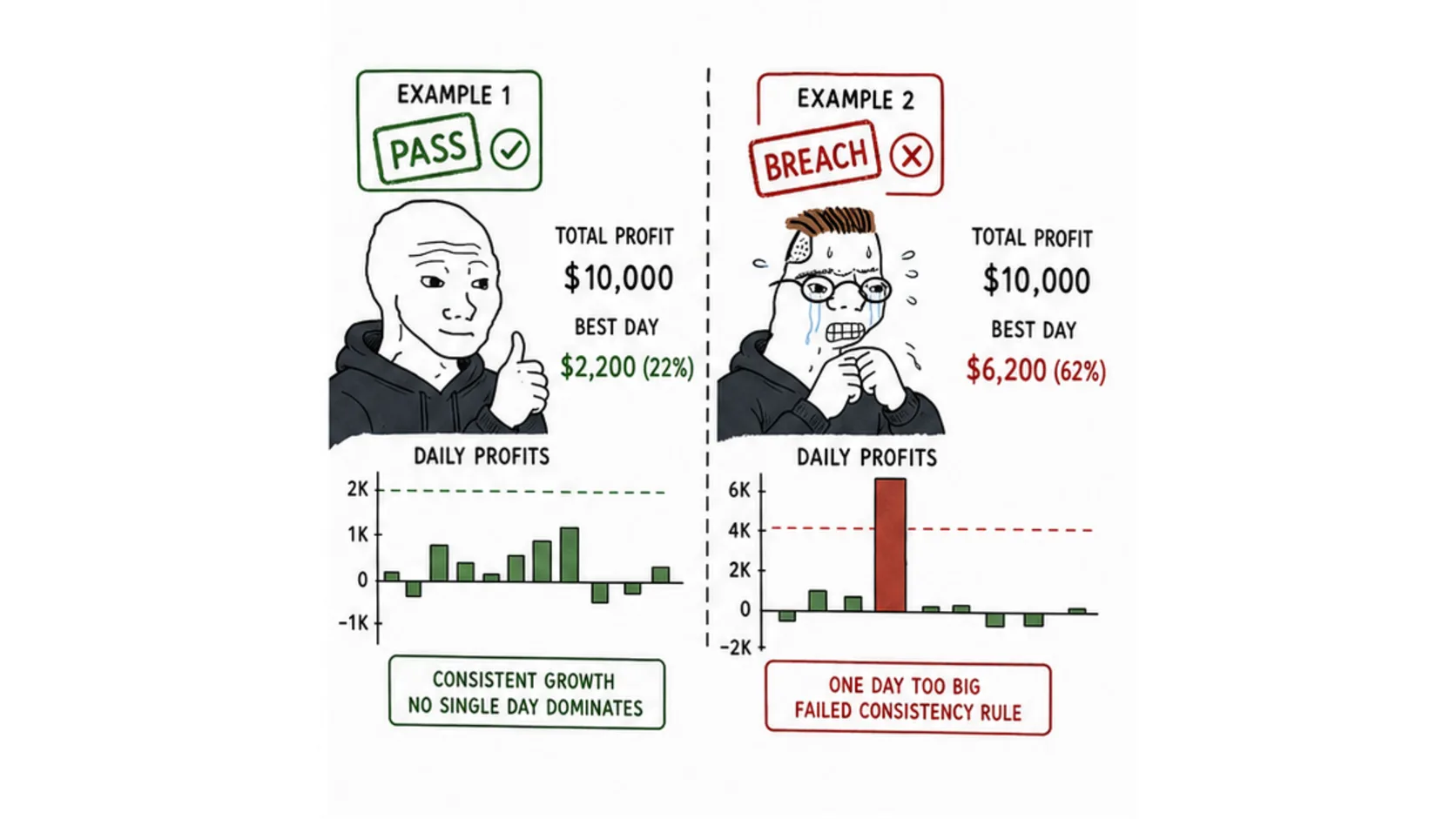
Trader A has $2,000 total profit over 15 trading days. Their best day was $500. The firm uses a 30% consistency rule. The prop firm consistency calculator says: best day share is 25%. Well under 30%. This trader passes the consistency check comfortably.
Trader B has the same $2,000 total profit. But they had one monster day where they made $900. The firm uses a 30% consistency rule. The calculator says: best day share is 45%. Even a challenge that looks like a pass on paper can fail if you do not track all the rules.
That is a consistency rule breach by a wide margin. Even though Trader B hit the profit target, the consistency rule blocks the pass.
The difference between these two traders is not skill. It is distribution. One trader spread their profit across many days. The other had one outlier. The consistency rule punishes the outlier, every single time.
How to Fix a Consistency Breach
Here is the good news. A consistency rule breach during an active challenge is usually fixable. You do not need to start over. You need to make more profit on other days so that your best day becomes a smaller percentage of the total.
The prop firm consistency calculator shows you the exact number. If your best day is $900 and your firm uses a 30% rule, you need a total profit of $3,000 for $900 to be exactly 30%.
If you already have $2,000 total, you need another $1,000 from your remaining trading days. The strategy is simple.
- Stop trying to hit big days immediately after a breach
- Trade small, consistent sizes to grind out $50 to $100 per day
- Each day of small profit dilutes your best day's percentage
- Check the calculator after every session to track your fix progress
It is not exciting, but it works. It is the only reliable way to fix a consistency breach without risking a drawdown breach at the same time.
The European Securities and Markets Authority has warned about retail traders misunderstanding complex trading terms. Consistency rules are one of those terms, so calculate the threshold before you place the trade.
On This Page
Consistency Rule Thresholds by Firm
Not all prop firms enforce the same consistency threshold. Some do not enforce one at all. Here is a breakdown of the most common thresholds across major prop firms.
| Prop Firm | Consistency Rule | Applies To |
|---|---|---|
| FTMO | 30% | Evaluation phase |
| FundedNext | 20-25% | Evaluation and funded |
| The 5%ers | 30% | Evaluation phase |
| Alpha Futures | 25% | Evaluation phase |
| The Funded Trader | 25% | Evaluation phase |
| Apex Trader Funding | None | Not applicable |
| Topstep | None | Not applicable |
The firms with no consistency rule, like Apex and Topstep in the futures space, tend to attract traders who want the freedom to have breakout days.
The firms with stricter rules want proof you can generate steady returns. Neither approach is inherently better. They just suit different trading styles.
Use the prop firm consistency calculator with your specific firm's consistency rule percentage to see exactly where you stand at any point during your challenge.
The Strategy to Never Breach Consistency
You have three missions when trading a prop firm account with a consistency rule.
Mission one: hit the profit target. This is obvious. You need to be in the green.
Mission two: keep any single day below the consistency threshold. If your firm uses 30%, no single day should be more than 30% of your running total at any point.
The easiest way to do this is to trade similar sizes every day. Consistent daily profits make the consistency rule almost impossible to breach.
Mission three: if you do have a big day, immediately check the prop firm consistency calculator. Know exactly how much more profit you need to dilute it.
Then trade small until the ratio comes back down. Never ignore it and hope it works out, because it rarely does.
The traders who struggle with the consistency rule are the ones who have wildly different daily results. One day they make $800, the next day they make $20, then they lose $150, then they make $600.
That pattern is a consistency rule breach waiting to happen. Proper risk management with consistent position sizing prevents it entirely.
When to Check Your Consistency Status
Check after every trading day. Not once a week. Not when you are close to the profit target. Every single day.
The consistency ratio changes every time you close a profitable day, and a day that was fine yesterday might push you into breach territory tomorrow. This prop firm calculator gives you the answer instantly.
Pay extra attention after your best day. That is when the ratio spikes hardest. If you just had a career day and made $1,200 on a $3,000 total with a 30% rule, you are at 40%.
You need to get that total up to $4,000 before the challenge ends. The consistency calculator tells you this in five seconds.
Also check before requesting a payout. Some firms evaluate consistency at the payout request stage, not during the challenge itself. Traders who understand all the rules before payout time have a much higher success rate.
You think you passed everything, submit your payout request, and then get denied because your best day was 32% of total and the limit is 30%. Two percent. That is the margin between getting paid and getting nothing.
