
Prop firm challenges are the gateway between you and a funded trading account. You pay a fee, trade on a simulated account, and if you hit the profit target without breaking any rules, you get funded.
The reality is that roughly 90% of traders fail these evaluations. Most failures come from rule breaches and emotional decisions, not bad trading.
Here is everything you need to know about how challenges work, what types exist, and how to actually pass one.
Key Takeaways
- Prop firm challenges require hitting a profit target, typically 8-10%, while staying within strict risk rules over 10-30 days.
- About 90% of traders fail challenges, with most failures caused by rule breaches rather than bad trading.
- One-step and two-step evaluations have different rule structures, costs, and difficulty levels.
- The key to passing is risk management first, strategy second, and patience always.
- Starting with a smaller account size gives you the same learning experience at lower cost.
On This Page
- What Are Prop Firm Challenges?
- How Challenges Work: The Rules That Matter
- One-Step vs Two-Step vs Instant Funding
- How to Pass a Prop Firm Challenge
- Strategy and Tips for Passing
- Challenge Costs and Account Sizes
- Passing Rates and Realistic Timelines
- Why Most Traders Fail Challenges
- Choosing Your First Challenge
What Are Prop Firm Challenges?
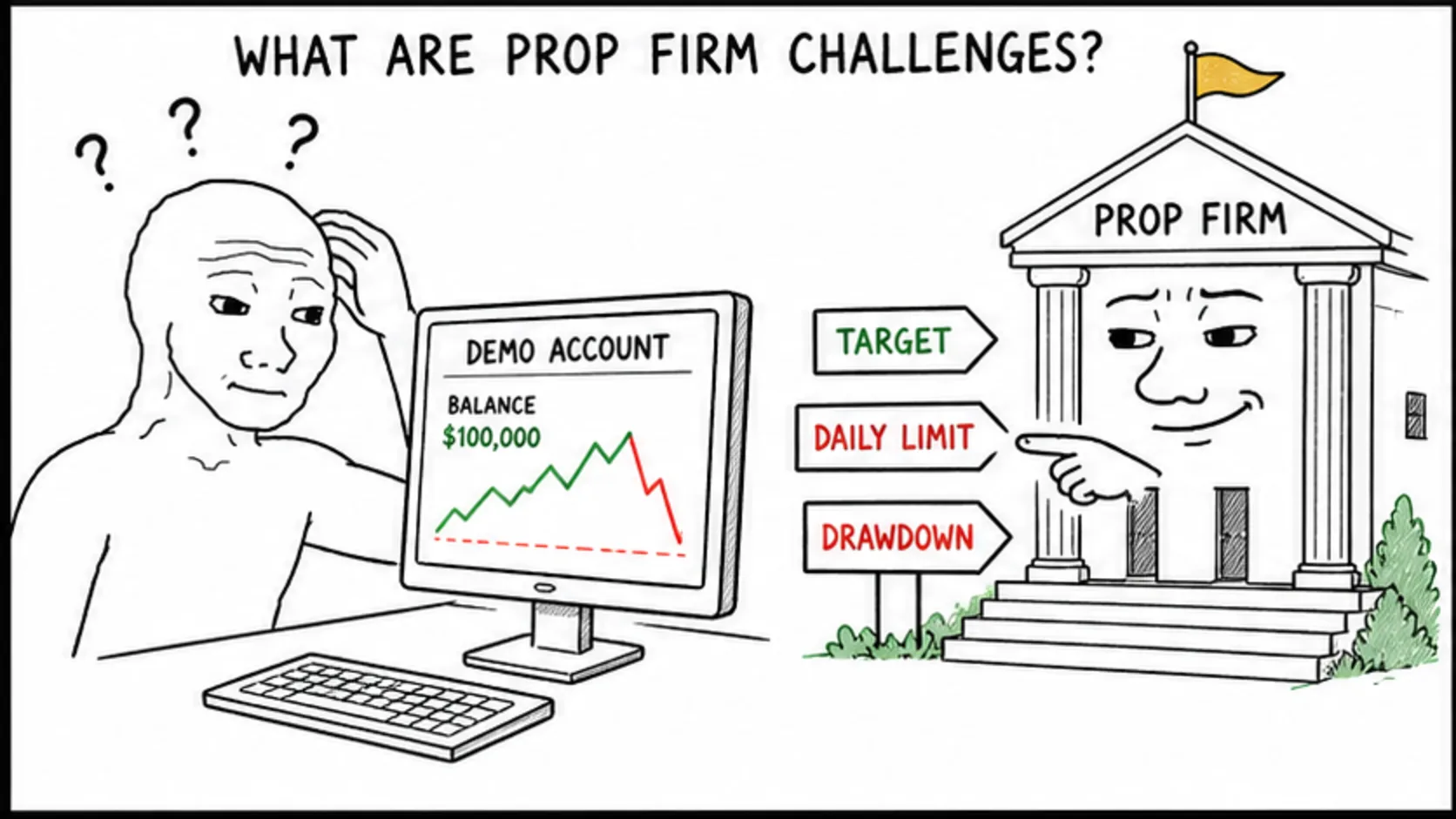
A prop firm challenge is an evaluation that tests whether you can trade profitably with discipline. You pay a fee, receive trading credentials, and try to hit a profit target while staying inside the firm's risk parameters.
The profit target is usually 8-10% of the account balance. On a $50,000 account, that means making $4,000 to $5,000 in profit.
Most firms give you 30 calendar days to complete the challenge. Some offer unlimited time, though most traders who pass do it within 15-20 trading days anyway.
The challenge is not a demo account where you can experiment freely. It is a monitored evaluation where every trade you place is measured against the firm's risk parameters.
Think of it as an extended job interview where your trades are the answers. The firm watches your position sizes, timing, consistency, and how you handle losing streaks.
Pass the challenge and you move to a funded account. Fail and you lose the fee, with the option to buy another attempt.
The binary nature of the challenge is what makes it stressful. There is no partial credit for almost making the target.
The prop firm evaluation industry has grown rapidly since 2020. According to the Commodity Futures Trading Commission, the growth of retail proprietary trading has attracted regulatory attention in the United States.
This growth means more firms, more options, and more competition for your evaluation fee. It also means more variation in rules, quality, and legitimacy across the market.
How Challenges Work: The Rules That Matter
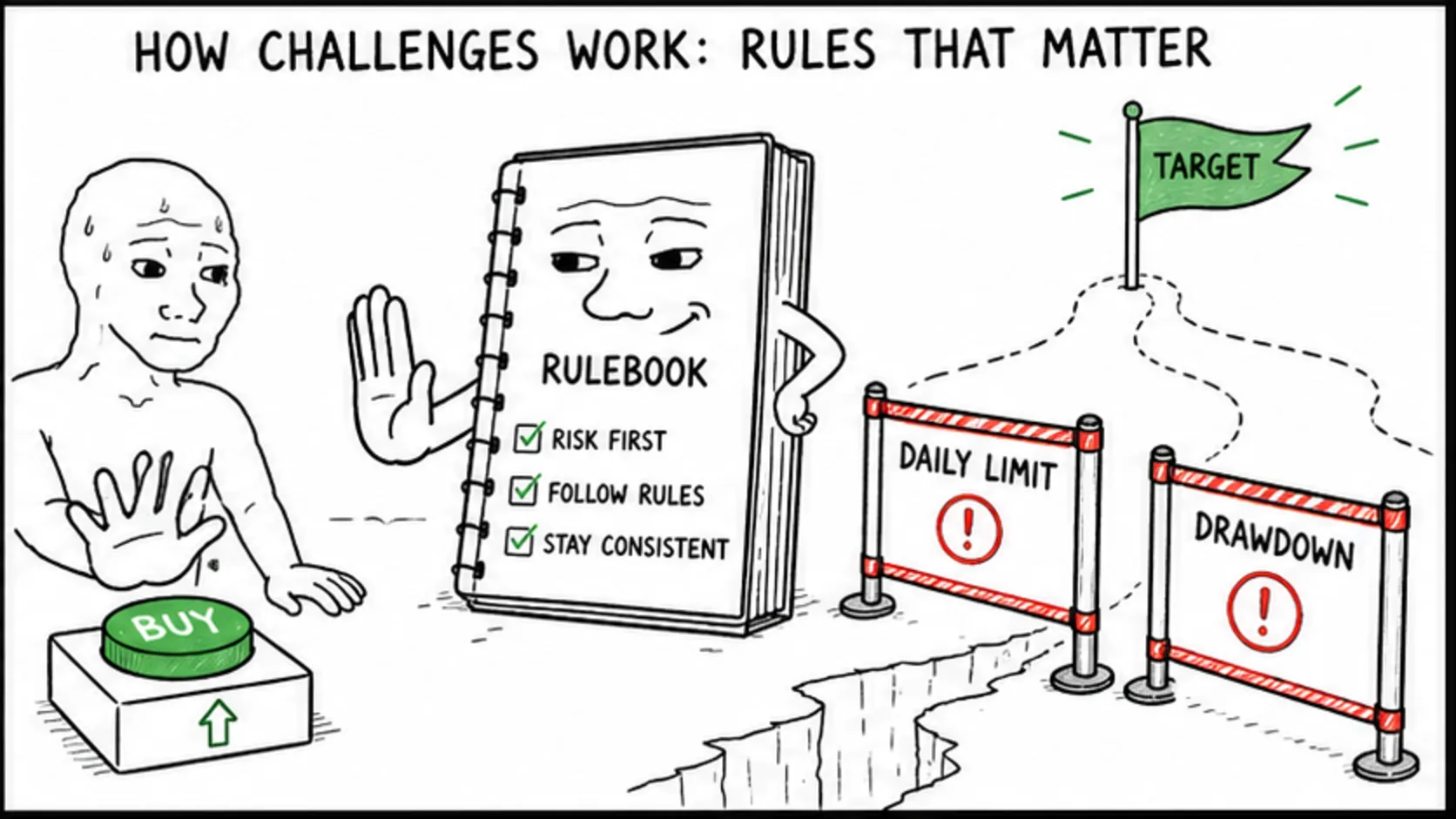
Every challenge has a core set of rules that you must follow from the first trade to the last. Violating any of them ends the challenge immediately, regardless of profitability.
The daily loss limit caps how much you can lose in a single day, usually 4-5% of the account balance. On a $50,000 account, that is up to $2,500 per day.
Exceed the daily loss limit by even one dollar and the challenge is over. No warnings, no second chances.
The maximum drawdown is your total leash. Typically 10-12% of the account, it is the maximum distance your equity can fall from its starting point or highest peak.
This includes floating losses, not just closed trades. Your unrealised drawdown counts against you at all times, which catches many traders off guard.
The trailing drawdown is the nastier version of max drawdown. It follows your highest equity point, meaning every dollar you earn pushes the drawdown limit higher behind you.
The consistency rule prevents you from passing with one lucky trade. Most firms require that no single day accounts for more than 30-40% of your total profit.
Additional restrictions vary by firm. Common ones include no trading during major news events, no weekend holding, no hedging, and no copy trading.
News trading restrictions are the most commonly overlooked rule. Many firms close trading 30 minutes before and after major economic announcements like Non-Farm Payrolls or CPI data.
If you accidentally place a trade during a restricted news window, the firm will detect it. The challenge will be terminated, and there is no appeal process.
Weekend holding rules are equally strict. If your firm prohibits holding positions over the weekend and you forget to close a trade before Friday's market close, that single oversight can cost you the entire challenge.
One-Step vs Two-Step vs Instant Funding
The three main challenge structures are one-step, two-step, and instant funding. Each has different costs, rules, and difficulty levels.
One-step evaluations have a single phase. Hit the profit target with one set of rules and you are funded. The rules are stricter, but you only need to pass once.
Two-step evaluations split the process into Phase 1 and Phase 2. Phase 1 has stricter rules and a higher target, while Phase 2 has relaxed rules and a lower target.
Two-step challenges cost more but the Phase 2 relaxation gives you a psychological breather. Think of Phase 2 as the firm saying they believe you can trade, now show them twice.
Instant funding skips the evaluation entirely. You pay a higher fee and receive a funded account immediately. Direct funding sounds appealing but carries significantly more financial risk.
Some firms also offer trial challenges, which are cheap or free evaluations with very short time limits. These let you test the platform and rules before committing to a full challenge.
How to Pass a Prop Firm Challenge
Passing a challenge comes down to three missions, in this exact order of priority.
Mission one: do not blow the account. Non-negotiable. Protecting the account is your primary job at all times.
Mission two: hit the profit target. If you have to choose between protecting the account and chasing the target, you protect the account every single time.
Mission three: do it within the time limit. Last priority, and never worth rushing. A slow pass is still a pass.
The math on most challenges is straightforward. A 10% target on $50,000 is $5,000, which is $250 per day over 20 trading days.
That is not a home run. That is grinding out small, consistent profits while never breaching the risk rules.
Plan your trades before each session. Know your maximum position size for the day. Use the free calculators on this site to map out your risk parameters before you open your platform.
Strategy and Tips for Passing
The best strategy for passing is the one you have already practised. This is not the time to experiment with new setups.
Risk 1-2% of the account per trade maximum. On a $50,000 account, that is $500 to $1,000 of risk per trade.
Five consecutive losses at 5% risk per trade puts you down 25%, which blows through most max drawdown limits. That is why position sizing matters more than entry timing.
The best challenge traders do not aim for big winners. They aim for consistent small profits that accumulate over time without ever threatening the risk rules.
A 2% daily return sounds modest until you compound it. Two percent per day for 20 days on a $50,000 account would be over $24,000 in profit, far exceeding any challenge target.
The point is not to hit 2% every day. The point is that you do not need to take massive risks to pass. Small and steady wins the challenge.
Trade during your best session. If you trade the London open, do not suddenly start trading the New York afternoon because you are impatient.
The tips that actually matter are simple: track your drawdown in real time, take breaks after two consecutive losses, and never add to a losing position.
The traders who pass consistently are not the ones with the best strategies. They are the ones who never violate their risk parameters.
Challenge Costs and Account Sizes
Challenge costs vary by account size and firm. A $10,000 account costs $80-$150, a $50,000 account costs $200-$400, and a $100,000 account costs $400-$600.
The fee is not a deposit. You pay it and it is gone whether you pass or fail. Some firms offer discounted resets for $50-$100 to restart the same challenge.
Account size selection matters more than most traders realise. A $200,000 account has a 10-12% max drawdown, giving you only $20,000-$24,000 of actual risk room.
Start small with a $10,000 or $25,000 account. It costs less, carries less psychological pressure, and teaches you the same lessons as a larger account.
The profit target on a $10,000 account at 10% is $1,000. That is the same percentage challenge as a $100,000 account, just with smaller dollar amounts that feel less intimidating.
When you pass the small account and get your first payout, you will have the confidence and track record to justify scaling up. Many traders skip this step and regret it.
The biggest mistake beginners make is buying the largest account they can afford, then losing it in three days because the dollar amounts create unbearable pressure.
Passing Rates and Realistic Timelines
Industry estimates suggest that 5-10% of traders pass prop firm challenges. That number varies by firm and account size, but it is the most commonly cited range.
The timeline depends on your strategy and market conditions. A day trader might pass in 10-15 trading days, while a swing trader might need the full 30 calendar days.
The low passing percentage does not mean it is impossibly difficult. Most failures are preventable and come from rule breaches, emotional trading, and poor preparation.
Most successful funded traders failed at least one challenge before passing. Failing is common. Failing the same way twice is what you need to avoid.
The fastest passes happen when a well-prepared trader enters during favourable market conditions. The slowest happen when a trader grinds out small daily profits over the full time limit.
Both results end the same way: funded. How you get there matters less than whether you get there without breaking the rules.
Some firms publish their passing statistics publicly. If a firm claims a 20% pass rate, read the fine print. The actual rate is often lower when you account for traders who pass but then breach rules before receiving their funded credentials.
Keep a journal of every challenge attempt. The traders who improve fastest study their own behaviour, not just their charts.
Why Most Traders Fail Challenges
Understanding why people fail is more useful than studying how people pass. Here are the top reasons traders lose their challenge fees.
Reason one: revenge trading after a stop-out. You get stopped out twice and immediately enter a third trade with double the size.
That oversized revenge trade blows your daily loss limit and ends the challenge. This single mistake accounts for more failures than any other cause.
Reason two: ignoring the daily loss limit. You lose 3% in the morning and decide to trade your way back in the afternoon.
The afternoon goes worse. You hit 5% daily loss and the challenge closes with no chance to recover.
Reason three: overleveraging on a single trade. You see a setup you are certain about and size up to 5% risk instead of your normal 1%.
The trade goes against you and your max drawdown is breached in a single position. Challenge over, fee gone.
Reason four: not reading the rules. Every firm has different rules about news trading, weekend holding, and position sizes.
Traders who skip the terms get disqualified for violations they did not know existed. Read the full terms before you pay anything.
Reason five: forcing trades near the finish line. You are at 9% profit with a 10% target and force setups because the goal is so close. You give back 3% and fail.
The pattern across all these failures is clear. Most failures are psychological. The traders who pass are the ones who stay calm when the market tests their discipline.
Choosing Your First Challenge
Your first challenge should be small, affordable, and from a reputable firm. Do not overthink this part.
Pick a firm with documented payout history and clear rules. Look for vague language about strategy violations that could give the firm discretion to deny your pass.
Start with a firm known for reasonable rules. Some firms have 5% daily loss and 10% max drawdown, while others have 3% daily loss and 6% max drawdown. The difference matters enormously.
Choose an account size where the fee will not hurt if you lose it. If $200 would cause financial stress, you should not be buying a challenge at that price point.
Prepare properly before you start. Demo trade for at least a month. Have a written trading plan with entry criteria, exit criteria, and risk parameters for every trade.
The challenge is just a test. You already know the questions. Study the material, follow the instructions, and trust your preparation when it counts.
Remember that the firm wants you to pass. Every funded trader is a potential long-term revenue source through profit splits. They are not trying to trick you into failing, but they are not making it easy either.
The challenge exists because it works as a filter. Traders who can follow rules and manage risk during the evaluation tend to be the same traders who generate consistent profits as funded traders. Pass the filter, and you have earned your place.
