
Prop firm trading strategies are not about finding the perfect entry. They are about finding a strategy you can execute with discipline while managing risk within strict drawdown and daily loss limits.
The best strategy for passing a prop firm evaluation is the one you have already practised, understand deeply, and can trade without second-guessing yourself under pressure.
Here is everything you need to know about trading strategies, risk management, psychology, and the specific approaches that actually help traders pass evaluations and stay funded.
Key Takeaways
- Risk management is more important than strategy for passing prop firm evaluations.
- Position sizing at 1-2% risk per trade is the single most impactful decision you can make.
- Scalping, day trading, and swing trading all work for prop firms if you manage risk properly.
- Psychology causes more challenge failures than any technical strategy issue.
- The London and New York sessions offer the best liquidity and opportunity for most prop traders.
On This Page
Risk Management: The Only Strategy That Matters
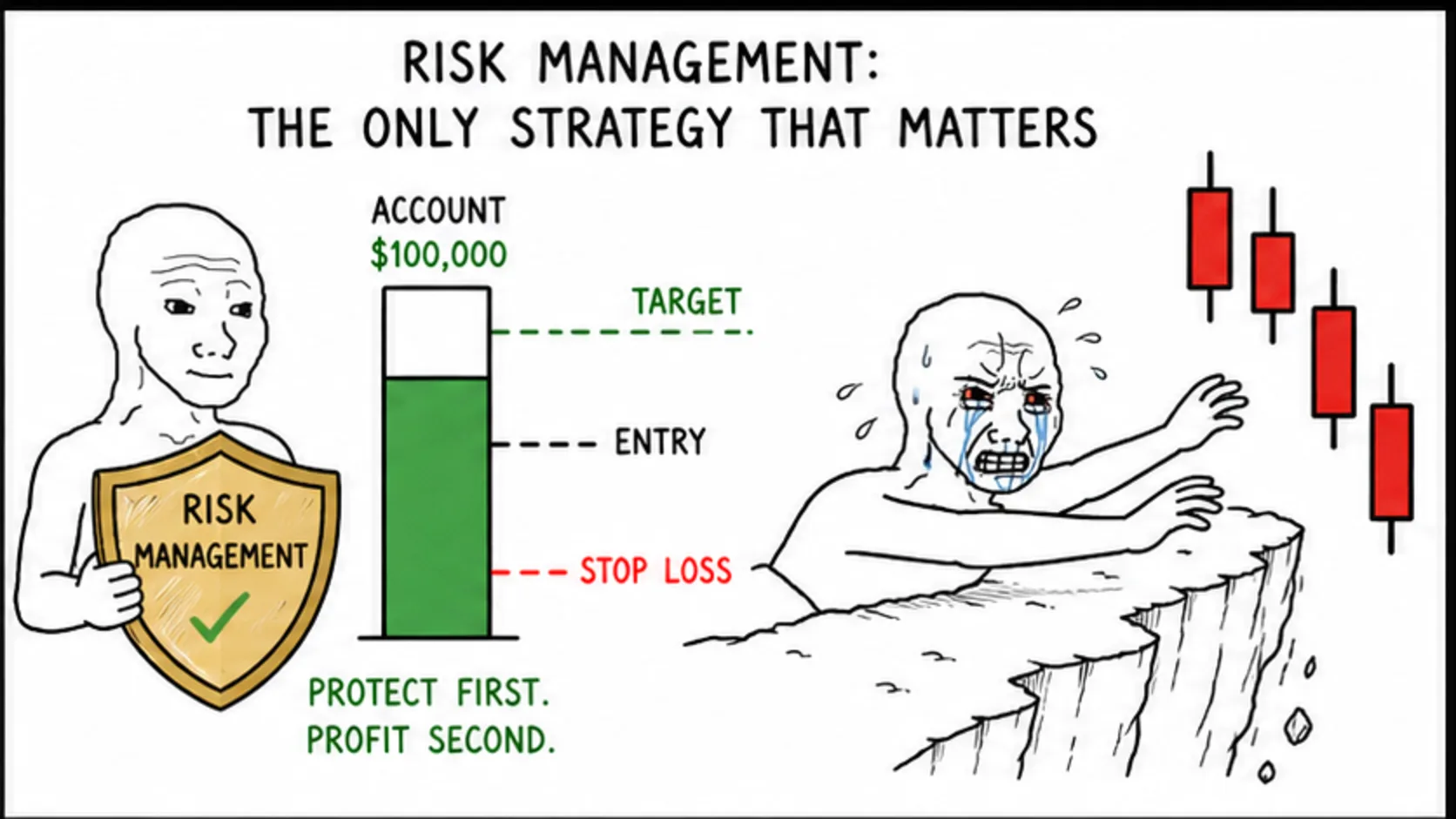
Risk management is not the boring part of prop trading. It is the only part that separates funded traders from people who keep buying evaluations and wondering why they keep failing.
The prop firm challenge is essentially a risk management test. Can you generate profits while keeping your losses within strict boundaries over an extended period?
Most traders can be profitable for a few days. Most traders cannot be profitable for 20 consecutive days without blowing through a risk limit. The difference is risk management.
Your risk management plan should be written down before you start any challenge. It should specify your maximum risk per trade, maximum trades per day, and your walk-away point.
If you do not have a written risk management plan, you are not ready for a prop firm evaluation. That is not an insult. It is a fact that will save you money.
Position Sizing for Prop Firm Accounts
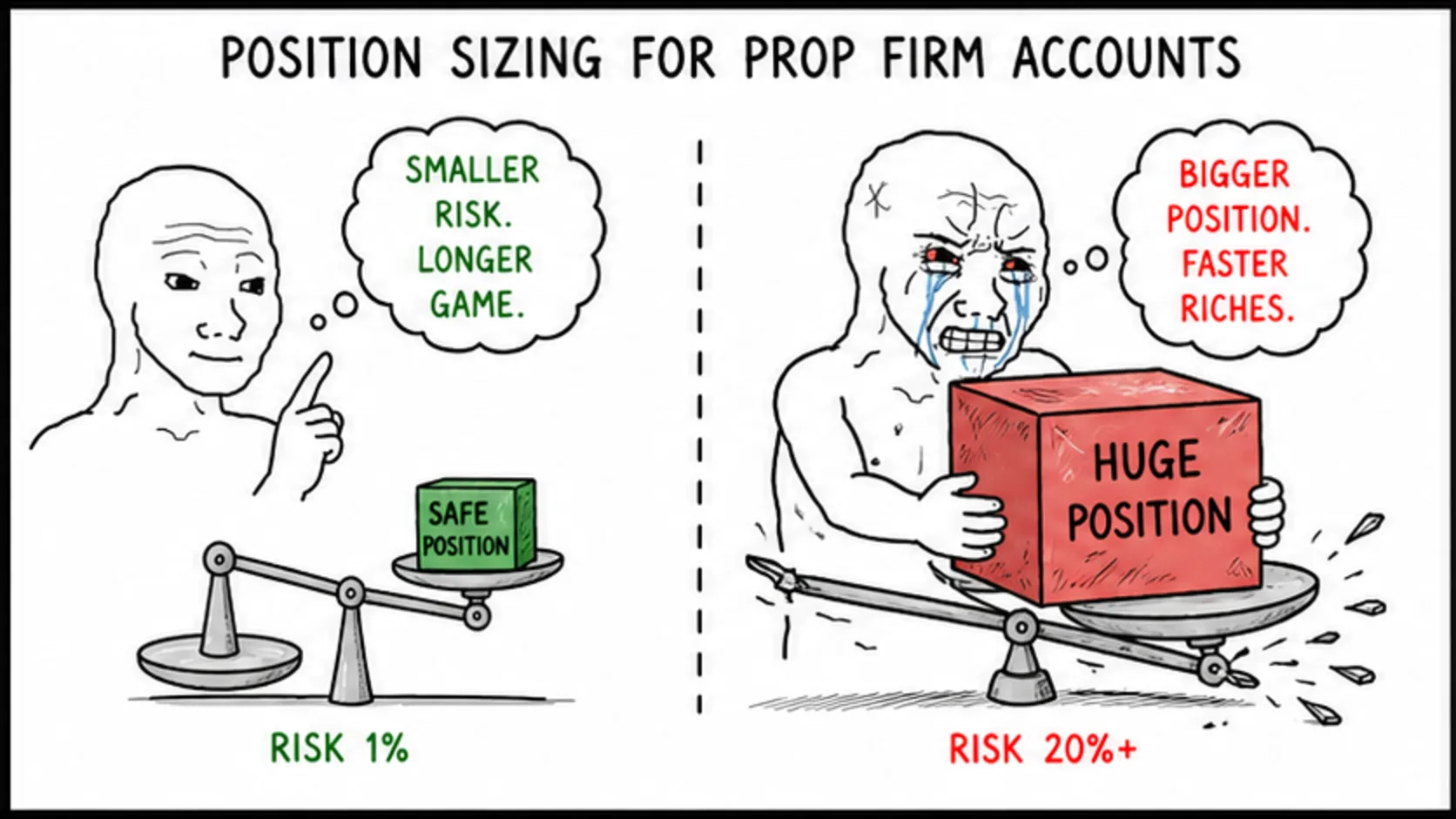
Position sizing is where most prop traders go wrong. The percentages feel small until you translate them into dollar amounts.
On a $50,000 account, risking 1% per trade means $500 maximum risk. Risking 2% means $1,000. Risking 5%, which many beginners do, means $2,500 per trade.
Five consecutive losses at 5% risk equals $12,500, which is 25% of the account. Most prop firm max drawdowns are 10-12%. You would have blown the account before the fifth loss.
The same five losses at 1% risk equal $2,500, which is 5% of the account. You are annoyed but still trading. The account is intact.
Use a position size calculator before every trade. The free calculators on this site let you input your account size, risk percentage, and stop loss distance to determine the exact lot size you should use.
Never eyeball position sizes during a challenge. The mental math under pressure leads to oversized positions that blow accounts.
Scalping Strategies for Prop Firms
Scalping is a high-frequency strategy where you take many small profits throughout the day. It can work for prop firm evaluations if you have the discipline to keep your losses equally small.
Scalpers typically hold positions for seconds to minutes. The profit per trade is small, often 5-20 pips, but the volume of trades means profits accumulate over the session.
The risk with scalping is that one bad trade can wipe out ten good ones if you do not cut losses immediately. Scalpers who move their stops or hold losing positions are the fastest way to blow a prop account.
Scalping works best during the London and New York overlap when liquidity is highest and spreads are tightest. It does not work well during quiet sessions when spreads widen.
Scalping is aggressive, fast, and completely wrong for most people. If you are not already a profitable scalper on a demo account, do not try to learn it during a prop firm evaluation.
Day Trading Strategies for Prop Firms
Day trading is the most popular approach for prop firm evaluations. You open and close positions within the same trading session, avoiding overnight risk and swap fees.
Day traders typically hold positions for minutes to hours. They look for setups at key support and resistance levels, trend continuations, or breakout opportunities.
The advantage of day trading for prop firms is control. You can set your stop loss, take profit, and walk away from the computer knowing your risk is defined before the trade is placed.
The disadvantage is that day trading requires patience. You might sit for two hours waiting for a setup, then take one trade and be done for the day.
Day trading works well within prop firm rules because you are not holding positions overnight, which many firms restrict. You also have clear daily PnL boundaries.
The best day trading strategies for prop firms share common characteristics. They have clear entry and exit rules, defined stop losses, and limited exposure per trade.
Trend following during active sessions is one approach. You identify the market direction on a higher timeframe, then enter on pullbacks to key levels on a lower timeframe.
Breakout trading is another popular choice. You wait for price to break through a significant support or resistance level with momentum, then enter in the direction of the breakout.
Range trading works during quieter periods when the market moves between clearly defined boundaries. You buy at support and sell at resistance, with tight stops on both sides.
The specific strategy matters less than your ability to execute it consistently with proper risk management. A simple strategy executed perfectly beats a complex strategy executed poorly.
Swing Trading Strategies for Prop Firms
Swing trading involves holding positions for days to weeks, capturing larger market moves than day trading. It can work for prop firms but requires careful attention to overnight and weekend rules.
Swing traders look for setups on higher timeframes like the 4-hour or daily chart. The profit targets are larger, often 100-300 pips, but the risk per trade is also larger.
The main challenge with swing trading on prop firms is the daily loss limit. A swing trade that goes against you can accumulate significant floating loss over several days.
If your firm has a 5% daily loss limit and your swing trade is down 4% in floating loss, you are effectively locked out of trading until that position recovers or you close it.
Swing trading works best on firms with unlimited time challenges and lenient overnight holding rules. It is a poor fit for firms with strict daily time limits.
If you choose to swing trade during a challenge, use wider stop losses on higher timeframes and smaller position sizes to accommodate the larger floating drawdowns that come with holding positions overnight.
Many swing traders use the daily and 4-hour charts for their analysis. They look for setups at the end of each trading day, place their orders, and let the market work while they sleep.
The benefit of swing trading is that it requires less screen time. You are not staring at charts for six hours. You analyse, plan, and execute in shorter focused windows.
Trading Psychology for Prop Firms
Trading psychology is the hidden factor that determines whether you pass or fail. Most traders have the technical skill to pass evaluations but lack the emotional control.
The average funded trader blows their first funded account within six weeks. Not because the market destroyed them. Because they started trading differently the moment they got the funded credentials.
Revenge trading is the most destructive psychological pattern. You get stopped out, feel angry, and immediately enter another trade with a larger size to "make it back."
That revenge trade is the one that ends your challenge or funded account. The market does not care that you are frustrated. Your daily loss limit does not care either.
Overconfidence after a winning streak is equally dangerous. Three consecutive winning trades do not mean you have figured out the market. They mean you had three winning trades.
The solution is routine. Trade at the same time each day. Use the same position size. Follow the same setup criteria. Consistency of process leads to consistency of results.
Before each trading session, spend five minutes reviewing your rules. Remind yourself of your maximum daily loss, your maximum trades, and your walk-away point. This mental preparation prevents emotional decisions during live trading.
After each session, spend five minutes journaling. What did you trade? Why? How did you feel? What would you do differently? This reflection builds self-awareness that prevents the same mistakes from recurring.
Handling losses is a skill that separates funded traders from everyone else. The ability to accept a loss, close the platform, and come back the next day with a clear head is worth more than any trading strategy you will ever learn.
Trading the London Session
The London session is the most popular trading window for prop traders. It runs from 8:00 AM to 5:00 PM London time and handles roughly 35% of global forex turnover.
The London open is particularly active because it overlaps with the end of the Asian session and the beginning of European business hours. Volatility and liquidity both increase significantly.
London breakout strategies are among the most popular for prop firm challenges. You identify the Asian session range, then trade the breakout when London opens with momentum.
The key advantage of the London session for prop traders is that it gives you the entire New York session to manage or close positions before the daily cutoff.
Trading the New York Session
The New York session runs from 8:00 AM to 5:00 PM Eastern time. Its biggest advantage is the overlap with the London session between 8:00 AM and 12:00 PM Eastern.
During this overlap, the forex market sees its highest volume and tightest spreads of the day. The Bank for International Settlements reports that London and New York together account for roughly 60% of global forex turnover.
New York is also when major US economic data is released, including Non-Farm Payrolls, CPI, and Federal Reserve announcements. If your firm restricts news trading, you need to be aware of the economic calendar.
The New York afternoon session tends to quiet down significantly after the London close. Many prop traders stop trading after 12:00 PM Eastern because liquidity drops and spreads widen.
Risk-Reward Ratios for Prop Firm Trading
Risk-reward ratio determines how much you stand to gain versus how much you risk on each trade. A 1:2 ratio means you risk $1 to make $2.
A higher risk-reward ratio means you can be wrong more often and still be profitable. With a 1:3 ratio, you only need one winning trade out of three to break even.
For prop firm challenges, a minimum 1:2 risk-reward ratio is recommended. This gives you room to have losing trades without blowing through your drawdown limit.
Many beginners focus on win rate instead of risk-reward. A trader with a 40% win rate and 1:3 risk-reward is more profitable than a trader with a 60% win rate and 1:1 risk-reward.
The combination of conservative risk-reward with strict position sizing is what gets traders through evaluations. Focus on the mathematics of probability, not the excitement of individual trades.
How Not to Blow Up Your Prop Firm Account
Account blowups follow a predictable pattern. They are not random events. They happen when traders abandon their rules under emotional pressure.
The pattern goes like this: you have a few losses, you feel frustrated, you increase your position size to recover faster, and then one bad trade eliminates your remaining drawdown room.
Every funded trader who has blown an account recognises this pattern. The difference is whether you catch yourself at step two or let it run to completion.
The solution is a circuit breaker. Set a personal rule that after two consecutive losses, you close your platform for the day. Not for an hour. For the entire day.
This sounds overly cautious. It is not. Two losses per day is your maximum, and any additional trading is statistically more likely to increase losses than recover them.
The traders who pass without overtrading are the ones who treat the challenge as a marathon. They take fewer trades, manage risk meticulously, and let the target come to them.
Your funded account is worth protecting. The prop firm evaluation industry estimates that fewer than 5% of traders who pass evaluations maintain consistent profitability for six months or more. The ones who do are the ones who stopped treating risk management as optional.
