Affiliate Disclosure: FYI - this site contains affiliate links to services I think may suit you. If you make a purchase through these links, I may earn a commission at no extra cost to you. Some offers include discounts I have negotiated specifically for you.
Position sizing in prop firm challenges is not the same as position sizing on your personal account. You are not trying to maximize returns. You are trying to survive long enough to hit a profit target without breaching any rules. The math is different. The constraints are different. The consequences of getting it wrong are immediate and final.
Get your position size wrong by even a small amount and a normal losing streak can breach your daily loss limit or max drawdown. Game over. No appeal. Done.
Key Takeaways
Position size equals risk amount divided by stop distance in pips times pip value. This is the only formula you need.
Risk 0.5-1% of your account per trade. This gives you enough room for normal losing streaks without approaching drawdown limits.
Percentage-based sizing beats fixed lot sizing because it adjusts as your account changes. Fixed lots get riskier as your balance drops.
Your position size must be calculated so that 3-5 consecutive losses do not breach your daily loss limit. If they can, your size is too large.
Never change your position size mid-challenge based on emotions, confidence, or proximity to the profit target. Lock it in and leave it alone.
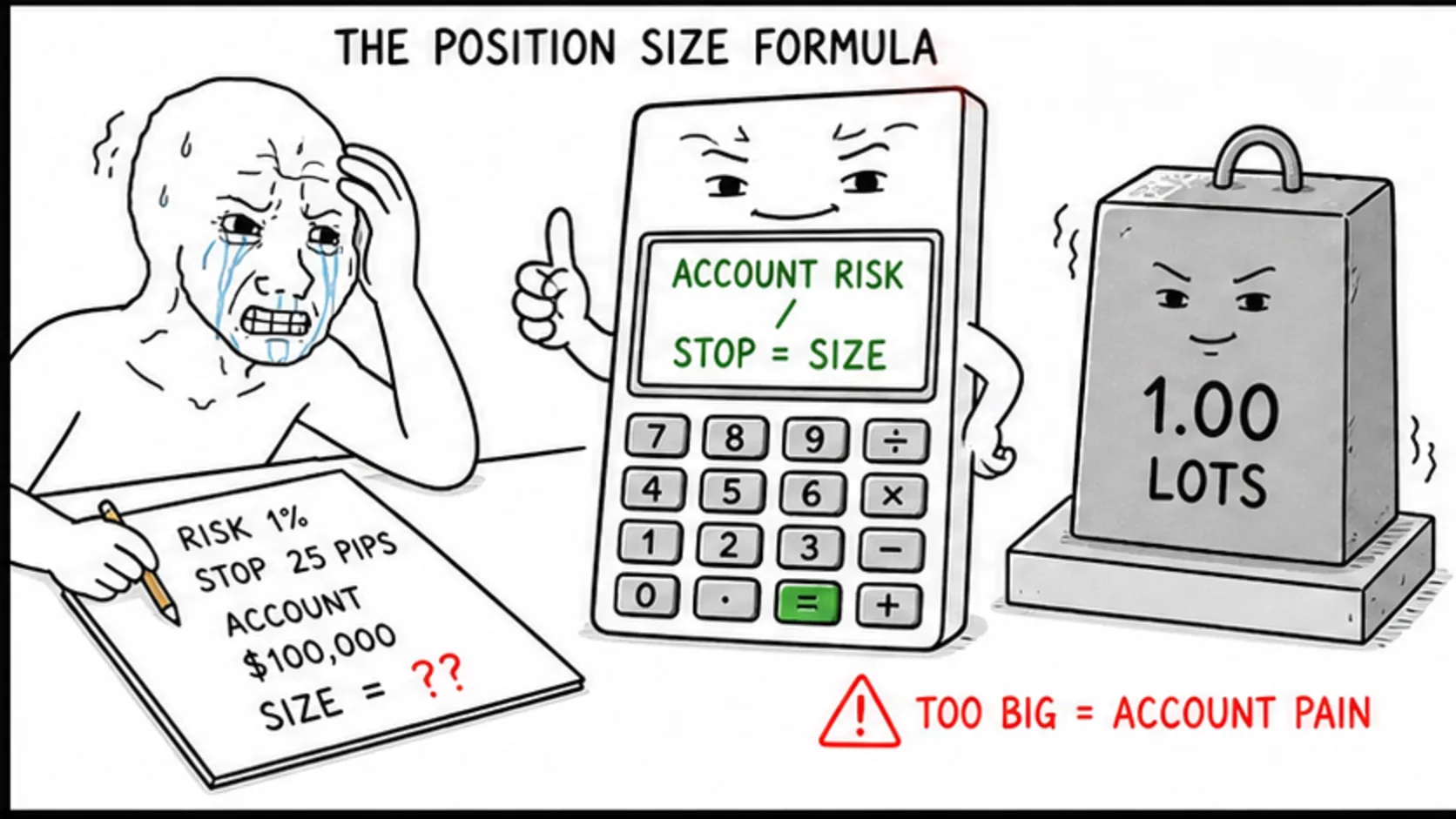
Here is the formula. Memorize it. Tattoo it on your hand if you need to.
Position Size = Risk Amount / (Stop Distance in Pips x Pip Value)
Where:
Risk Amount = Account Balance x Risk Percentage
Stop Distance = the number of pips between your entry and your stop loss
Pip Value = the dollar value of 1 pip for 1 standard lot on your chosen pair
That is it. Three inputs. One formula. Every trade.
The Commodity Futures Trading Commission warns that leveraged trading can move against you quickly, which is exactly why position sizing matters more in a prop challenge than the entry signal itself.
Affiliate Ad — 300×250
Affiliate Ad — 300×250
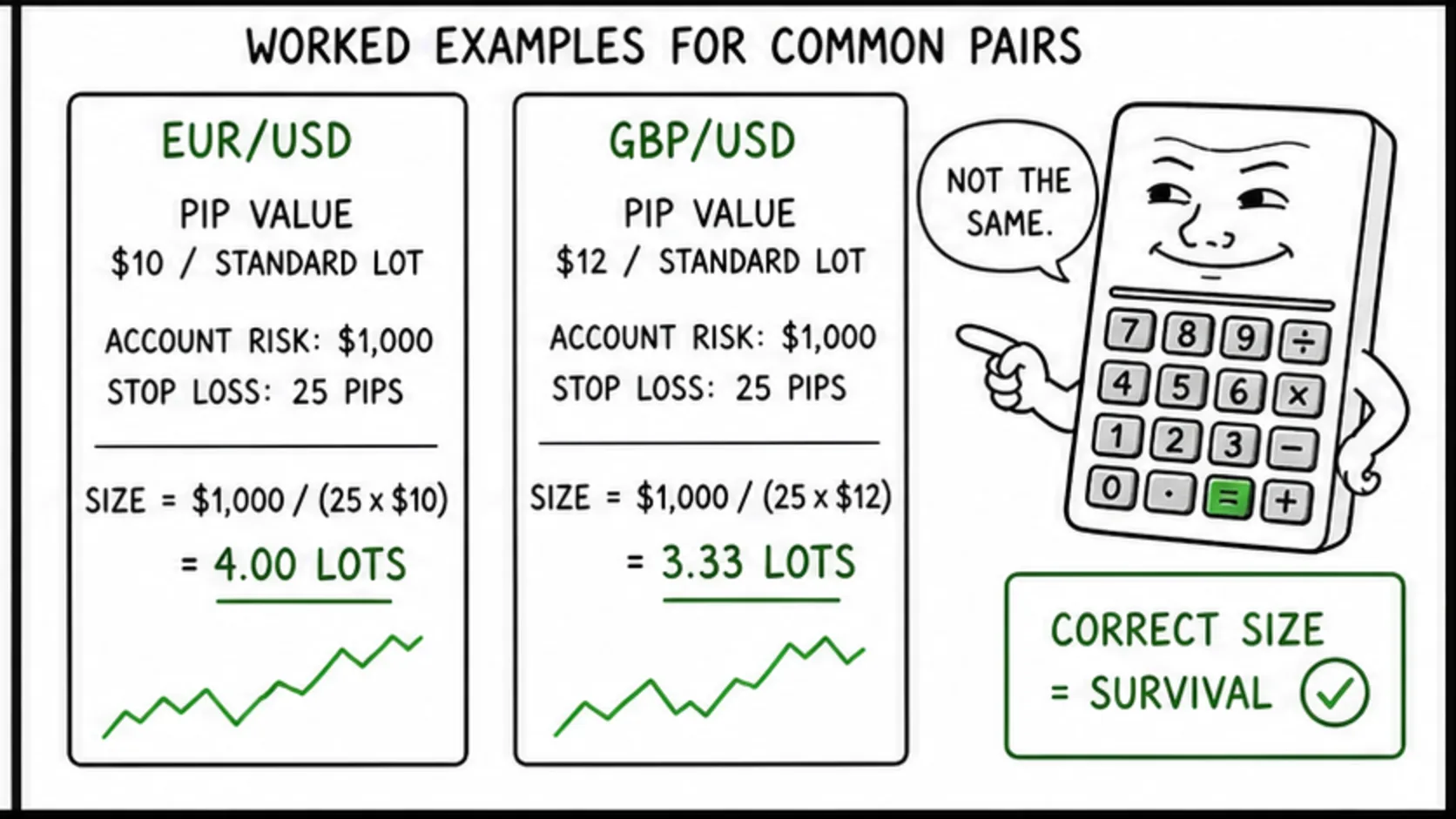
Worked Example: EURUSD on a $100,000 Account
Let us walk through a full calculation.
Account: $100,000
Risk per trade: 0.75%
Pair: EURUSD
Stop distance: 25 pips
Pip value for 1 standard lot on EURUSD: $10
Step one: calculate your risk amount.
$100,000 x 0.0075 = $750
Step two: calculate your pip cost for the stop distance.
25 pips x $10 = $250 per standard lot
Step three: divide risk amount by pip cost.
$750 / $250 = 3 standard lots
If your stop gets hit, you lose exactly $750. That is 0.75% of your account. Clean, controlled, predictable.
Affiliate Ad — 300×250
Affiliate Ad — 300×250
Worked Example: GBPJPY on a $50,000 Account
Different pair, different pip value, different math. This is why you need to calculate every time.
Account: $50,000
Risk per trade: 0.75%
Pair: GBPJPY
Stop distance: 40 pips
Pip value for 1 standard lot on GBPJPY: approximately $6.50 (varies with USDJPY rate)
Step one: risk amount.
$50,000 x 0.0075 = $375
Step two: pip cost.
40 pips x $6.50 = $260 per standard lot
Step three: position size.
$375 / $260 = 1.44 standard lots
Round down to 1.4 lots. Never round up. Rounding up means you are risking slightly more than your planned percentage, and over 50 trades those small overages add up.
If your stop hits, you lose $364. That is 0.73% of your account. Close enough to your 0.75% target. Safe.
Fixed Lot Sizing vs Percentage-Based Sizing
Two approaches. One is clearly better for prop firm challenges.
Fixed lot sizing: you decide to trade 2 lots every trade regardless of your account balance or stop distance.
Problem one: if your stop distance varies, your risk varies. A 20-pip stop with 2 lots risks $400 on EURUSD. A 40-pip stop with 2 lots risks $800. Same trade size, double the risk. You are not controlling anything.
Problem two: as your account balance drops during a losing streak, 2 lots represents a larger percentage of your remaining balance. On a $100,000 account, 2 lots with a 25-pip stop is 0.5% risk. After losing $10,000, your balance is $90,000, but 2 lots with a 25-pip stop is now 0.56% risk. The worse you do, the riskier each trade becomes. This is the opposite of what you want.
Percentage-based sizing: you decide to risk 0.75% of your current balance every trade. As your balance drops, your position size automatically drops too. As it grows, your size grows. This is self-correcting. It protects you when you are losing and rewards you when you are winning.
For prop firm challenges, percentage-based sizing is the clear winner. It keeps your risk consistent relative to your current balance and your drawdown budget.
How Daily Drawdown Limits Affect Your Position Size
This is the part most traders get wrong. Your position size is not just about risk per trade. It is about how many losing trades you can absorb in one day before you breach the daily loss limit.
On a $100,000 account with a 5% daily loss limit ($5,000):
At 1% risk per trade ($1,000), you can take 5 consecutive losses before breaching the limit
At 0.75% risk per trade ($750), you can take 6 consecutive losses
At 0.5% risk per trade ($500), you can take 10 consecutive losses
But wait, some firms calculate the daily loss limit from the previous day's closing equity, not the starting balance. If you had a bad day yesterday and closed at $95,000, your daily loss limit today might be 5% of $95,000 ($4,750), not 5% of $100,000 ($5,000).
Pay attention to your firm's calculation method. Read the rules before you start. And always set your personal daily stop at half the firm's limit. If the firm allows 5%, you stop at 2.5%. This buffer accounts for slippage, spread widening, and the fact that your unrealized losses count toward the daily limit in real time.
Maximum Position Size Rules
Some prop firms impose a maximum position size as an additional risk control. This is separate from your risk per trade calculation.
A firm might say: "$100,000 account, maximum 15 lots per position." This means even if your risk calculation says you should trade 20 lots, you cannot. The firm caps you at 15.
This is rarely a problem if you are sizing correctly at 0.5-1% risk. On a $100,000 account at 1% risk with a 10-pip stop on EURUSD, your position size would be 10 lots. Well within the 15-lot cap.
But if you are trying to risk 3% per trade with tight stops, you might hit the cap. In that case, the cap is saving you from yourself. Listen to it.
Adjusting Position Size Through Challenge Phases
There are three phases to any prop firm challenge, and your position sizing should reflect where you are.
Phase one: the setup (days 1-5). Start at your planned risk percentage. No changes. This is where you establish your rhythm and prove to yourself that the system works under real conditions.
Phase two: the grind (days 6-20). Same size. Same rules. This is where most traders fail because they get bored or frustrated. Do not change anything. If you are in drawdown, reduce to half size until you recover. If you are profitable, do not increase. Stay the course.
Phase three: the finish (days 20+). Same size. I know you want to size up because you are close to the target. Do not. The target is not going anywhere. One oversized trade that stops out can undo a week of careful progress. Finish the same way you started.
Common Position Sizing Mistakes
Mistake one: calculating position size based on the profit you want, not the loss you can afford. "I need $200 profit per trade to hit my target in 20 days" is not a position sizing strategy. It is wishful mathematics. Size based on what you can afford to lose, not what you hope to make.
Mistake two: forgetting that pip values differ between pairs. A 25-pip stop on EURUSD costs $250 per standard lot. A 25-pip stop on GBPJPY costs approximately $162.50 per standard lot. Same pips, different dollars. If you use the same lot size across different pairs without recalculating, your actual risk varies wildly.
Mistake three: rounding up instead of down. Your calculation says 2.7 lots. You round to 3. Now you are risking 11% more than planned on every single trade. Over a 30-day challenge, that 11% compounds. Always round down.
Mistake four: sizing up after a losing streak to recover faster. This is how challenges end. You lost 3 trades at 0.75%, so you are down 2.25%. You think "let me go 1.5% on the next one to make it back." The next trade loses. Now you are down 3.75% and approaching your personal daily limit. Reduce size during losing streaks. Never increase.
The Quick Reference Table
Here are pre-calculated position sizes for common scenarios at 0.75% risk on a $100,000 account ($750 risk per trade).
EURUSD, 20-pip stop: $750 / (20 x $10) = 3.75 lots. Round to 3.75 or 3.7.
USDJPY, 30-pip stop: $750 / (30 x $6.50) = 3.85 lots. Round to 3.8.
XAUUSD (Gold), $8 stop ($80 for 1 lot): $750 / $80 = 9.37 lots. Round to 9.3.
Notice how the wider the stop, the smaller the position. This is the formula working exactly as intended. Your dollar risk stays constant. Your lot size adjusts to your stop distance.
The Sizing System for Your Next Challenge
Here is the complete system. Copy it.
Set your risk per trade at 0.75% of current account balance.
Before each trade, calculate your risk amount: Balance x 0.0075.
Measure your stop distance in pips (or dollars for gold/crypto).
Know the pip value per standard lot for your pair.
Divide risk amount by (stop distance x pip value). Round down.
Place the stop before entering the trade.
Never change your risk percentage during the challenge.
If you hit a 3-trade losing streak, reduce to half size for the next 3 trades, then resume normal size.
Eight steps. Every trade. No shortcuts. No "I will just eyeball it." The traders who pass their challenges are the ones who treat this math like it matters. Because it does. This is the difference between a funded account and another failed attempt.
Frequently Asked Questions
How do you calculate position size for a prop firm challenge?
Position size equals your risk amount divided by your stop distance in pips multiplied by the pip value. Risk amount is your account balance times your risk percentage. On a $100,000 account at 0.75% risk with a 25-pip stop on EURUSD: risk = $750, position size = $750 / (25 x $10) = 3 standard lots.
What is the 1% rule for position sizing in prop firms?
The 1% rule means you never risk more than 1% of your account on a single trade. On a $100,000 account, your maximum risk per trade is $1,000. Your position size is then calculated so that if your stop loss hits, you lose no more than $1,000.
Should I use fixed lot sizing or percentage-based sizing?
Percentage-based sizing is better for prop firm challenges because it automatically adjusts as your account balance changes. Fixed lot sizing does not account for drawdowns, meaning each consecutive loss represents a larger percentage of your remaining balance.
How do daily drawdown limits affect position size?
Your position size must be small enough that multiple losing trades in one day cannot breach the daily loss limit. If your daily loss limit is 5%, you should risk no more than 0.75-1% per trade, giving you room for 3-5 losing trades before approaching the limit.
What do prop firms mean by maximum position size?
Some prop firms set a maximum lot size per trade as an additional risk control. For example, a $100,000 account might have a maximum position size of 15 lots. This prevents traders from taking oversized positions even if their risk calculation would allow it.
Should I change my position size during a losing streak?
Yes, reduce your position size to half your normal size during a losing streak. This preserves your drawdown budget while keeping you in the market. Never increase your position size to recover losses. That is how challenges end.
PropTrader1
Funded trader with 15+ years of experience trading forex and futures. CISI qualified. Formerly worked in London's Square Mile before going solo.
Risk Disclaimer: Prop firm trading carries significant risk and may not be suitable for all traders. The examples in this guide are for educational purposes only and do not constitute financial advice. Past performance does not guarantee future results. PassPropTradingFirms does not accept any liability for any loss or damage arising from the use of or reliance on any content published on this website. You act on the information provided at your sole risk. Always verify firm rules and terms before purchasing an evaluation.