
Trading communities are where prop traders go to learn faster, avoid expensive mistakes, and find accountability partners who understand the specific pressures of funded trading. The right community accelerates your progress. The wrong one is an echo chamber of bad advice and signal-selling spam.
Not all trading communities are created equal. Some are genuinely educational spaces run by experienced traders. Others are marketing funnels designed to sell you courses, signals, or affiliate links. Knowing the difference before you join saves time and money.
Key Takeaways
- Trading communities range from free Discord servers to paid mentorship programs with varying quality and value.
- The best communities focus on education and accountability, not signals and trade calls.
- Whop and Discord are the two main platforms for prop trading communities in 2026.
- Paid communities are worth it only if the education is structured and the mentors are verified funded traders.
- Red flags include guaranteed results, pressure to buy upgrades, and communities that silence criticism.
On This Page
- Types of Trading Communities
- Best Trading Communities for Prop Traders
- Best Whop Groups for Traders
- Best Trading Discord Servers
- Best Prop Trading Courses
- Prop Firm Mentorship Programs
- Signals vs Education
- Are Trading Communities Worth It?
- Red Flags in Trading Communities
- How to Choose the Right Community
Types of Trading Communities
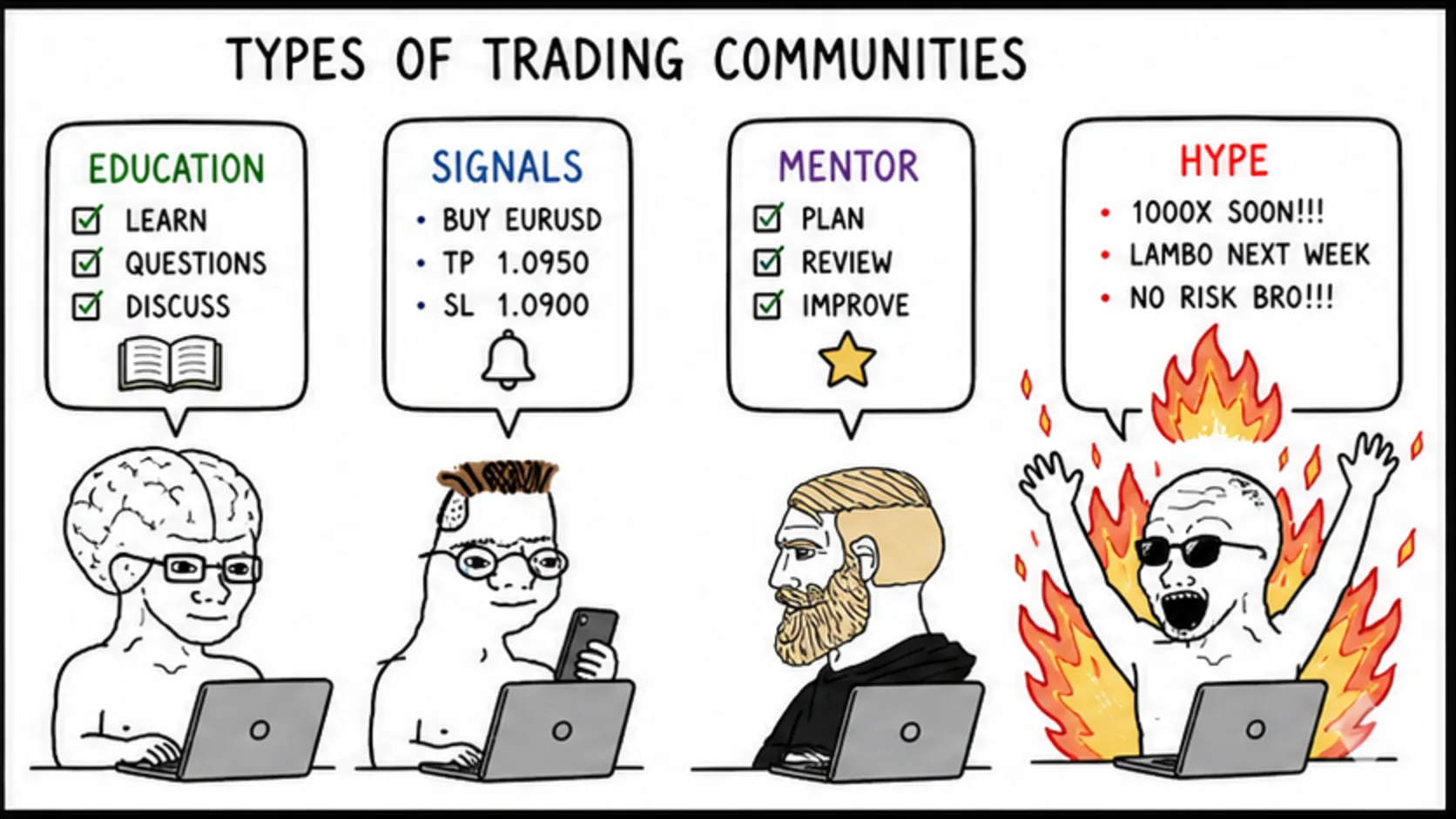
Trading communities fall into three broad categories: free communities, paid educational communities, and signal groups. Each serves a different purpose and carries different risks.
Free communities are usually Discord servers or Telegram groups open to anyone. The quality varies wildly. Some are genuinely helpful spaces where traders share analysis and support each other. Others are chaotic with unmoderated advice from traders of unknown skill level.
Paid educational communities charge a monthly or lifetime fee for structured learning, mentorship access, and accountability groups. The best ones are run by verified funded traders who teach from personal experience.
Signal groups are communities built around trade alerts. Someone calls out entries and exits, and members copy the trades. These are the most controversial type because they teach dependency rather than skill.
Best Trading Communities for Prop Traders
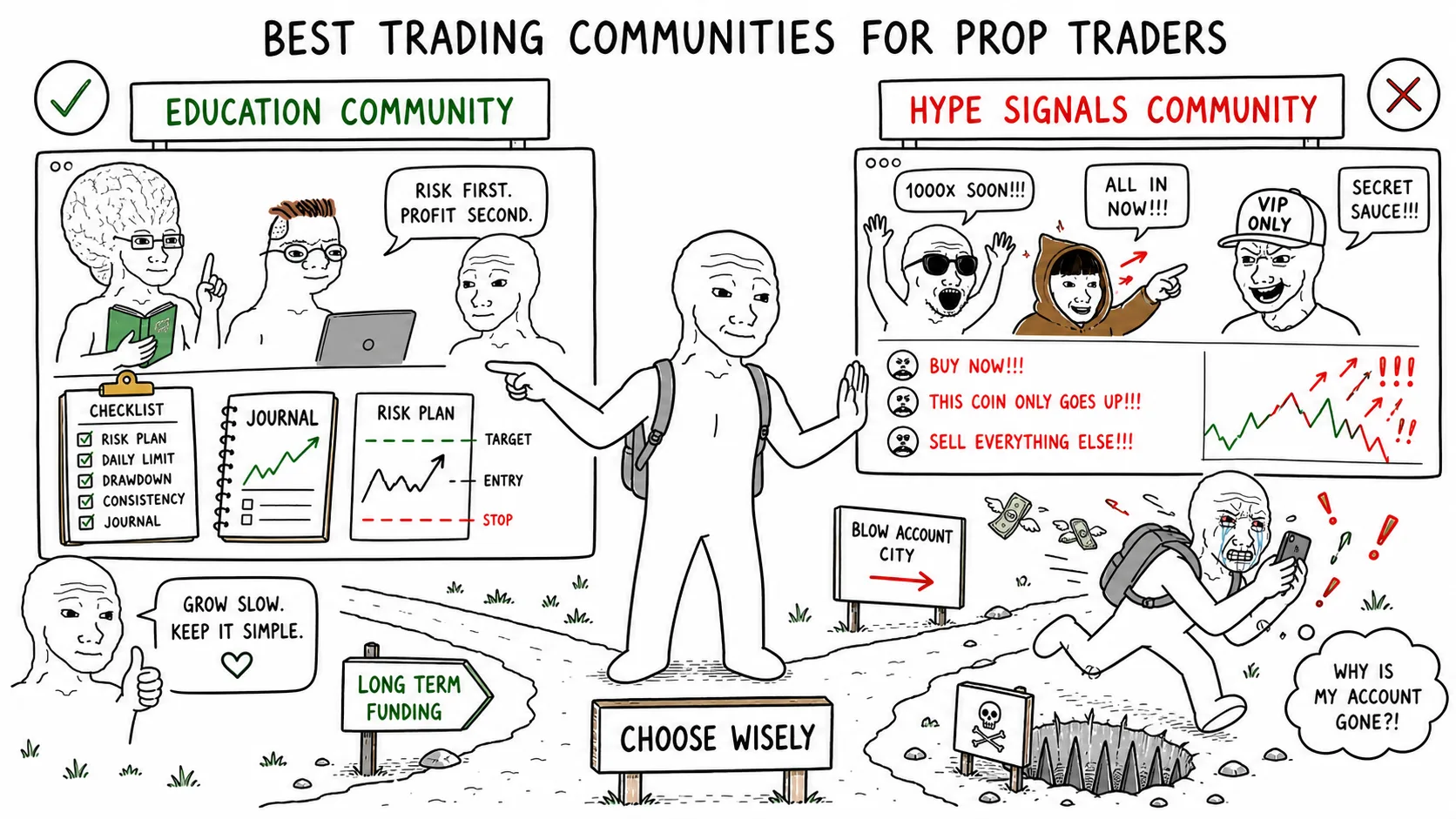
The best communities for prop traders share certain characteristics. They are moderated, the leaders have verified track records, and the focus is on education rather than hype.
Look for communities where the leaders are active and responsive. If you are paying for mentorship, you should be able to ask questions and get answers within a reasonable timeframe.
The best communities also have structured curricula or learning paths. Random educational content thrown into a Discord channel is not the same as a step-by-step programme designed to take you from beginner to funded.
Community size matters less than quality. A group of 200 engaged traders with a dedicated mentor is more valuable than a group of 10,000 where your questions get lost in the noise.
Best Whop Groups for Traders
Whop has become the dominant platform for paid trading communities in 2026. It handles payments, content delivery, and community management in one place.
The best Whop groups for prop traders combine educational content with live trading sessions and accountability features. Look for groups that offer structured modules covering risk management, strategy development, and challenge preparation.
Whop groups typically charge $30-$200 per month. The higher-priced ones should include direct mentor access, live trading rooms, and personalised feedback on your trades.
Be cautious of Whop groups that spend more time marketing their community than actually teaching in it. The best groups let their educational content speak for itself.
Best Trading Discord Servers
Discord remains the most popular platform for trading communities because of its real-time chat, voice channels, and organisation features.
The best trading Discords have separate channels for different topics, moderated discussion spaces, and active voice channels during market hours. You should be able to find help quickly when you need it.
Free Discord servers are worth trying first before committing to paid communities. They give you a feel for the community culture and the quality of discussion without financial risk.
Some prop firms run their own Discord communities for funded traders. These can be excellent resources because everyone in the group trades under the same rules and platform.
Best Prop Trading Courses
Prop trading courses range from free YouTube series to comprehensive paid programmes. The right course depends on your experience level and budget.
A good prop trading course should cover risk management extensively, include live trading examples, and teach you how to read and follow firm rules. If a course promises guaranteed passes, it is a scam.
The most valuable courses teach you how to think about trading, not just what trades to take. They build your analytical skills and emotional resilience, not your dependency on someone else's signals.
Look for courses created by traders who have passed multiple evaluations and maintained funded accounts for at least six months. Recent success matters more than credentials from five years ago.
Prop Firm Mentorship Programs
Mentorship programs offer the most personalised learning experience available. You work directly with an experienced funded trader who reviews your trades, identifies weaknesses, and holds you accountable.
The best mentorship programs include one-on-one sessions, trade reviews, and customised development plans. They are expensive, typically $200-$1,000 per month, but can dramatically accelerate your progress.
Before committing to a mentorship, ask for references from current or former students. A legitimate mentor should be able to connect you with traders who have benefited from their programme.
The most effective mentorships are structured with clear milestones. You should know what you are working toward each week and how your mentor measures progress.
Avoid mentors who promise specific results. A good mentor teaches you a process and helps you develop skills. They cannot guarantee you will pass a challenge or become profitable, and any mentor who makes that claim is not being honest.
The best time to join a mentorship is after you have basic trading knowledge and have practised on a demo account. Mentorship refines existing skills, it does not teach you from absolute zero.
The value of mentorship is in the feedback loop. You trade, your mentor reviews, and you improve based on specific, personalised guidance rather than generic educational content.
A good mentor should be able to explain why they are making specific recommendations, not just tell you what to do. If your mentor cannot articulate their reasoning, find a different mentor.
Signals vs Education: Which Approach Works?
The signals versus education debate is straightforward once you understand the incentives. Signal groups make money from subscriptions. Educational communities make money from helping you develop skills.
Signal groups create dependency. You follow the signals because you cannot trade without them. When the signal provider has a bad month, you have no skills to fall back on.
Educational communities build independence. You learn to analyse markets, manage risk, and make your own decisions. When you have a bad month, you have the skills to diagnose and fix the problem.
The choice depends on your goals. If you want to copy trades and hope for the best, signals are fine. If you want to become a consistently profitable funded trader, education is the only path worth taking.
Are Trading Communities Worth It?
Trading communities are worth it if you choose the right one and actively participate. Joining a community and never engaging with the content is the same as not joining at all.
The accountability factor is the most underrated benefit. When you have to report your daily trades to a group, you are less likely to take impulsive, emotional trades because you know someone will ask about them.
The networking benefit is equally important. Many funded traders find their first prop firm opportunities through community connections, not through marketing.
However, no community can make you a profitable trader if you do not put in the work. The community provides the environment. You provide the effort.
Red Flags in Trading Communities
Red flags in trading communities are easy to spot once you know what to look for. The biggest one is guaranteed results.
No legitimate trading community can guarantee you will pass a prop firm evaluation or become profitable. Markets are uncertain and trading involves risk. Anyone who promises otherwise is lying.
Other red flags include pressure to upgrade your membership, deleting negative reviews or critical messages, and leaders who never show their actual trading results.
A community that silences criticism is a community that has something to hide. The best communities welcome questions and challenge their own ideas regularly.
Be wary of communities where the leader is treated like a guru who cannot be questioned. This creates a cult-like dynamic that discourages independent thinking and critical analysis.
Legitimate community leaders show their losses alongside their wins. They discuss mistakes openly and use them as teaching moments. Leaders who only show winning trades are curating a misleading picture.
Check how the community handles losing streaks. A good community discusses drawdown management, emotional regulation, and recovery strategies. A bad community ignores losses and pretends everything is fine.
The Financial Conduct Authority in the UK has warned about unregulated financial influencers promoting trading communities. Always verify claims independently before paying for any service.
How to Choose the Right Community
Start with free communities before paying for anything. Spend a few weeks in free Discord servers and Telegram groups to understand what kind of support you actually need.
When you are ready for a paid community, look for one that offers a free trial or money-back guarantee. Reputable communities stand behind their content.
Test the community culture before committing long-term. Are members supportive or competitive? Do experienced traders help beginners or gatekeep information? The culture tells you everything about whether the community will help you grow.
Most importantly, remember that a community is a supplement to your own practice, not a replacement. The traders who benefit most from communities are the ones who spend hours on their own charts and use the community for feedback and accountability.
TradingView is a great platform for sharing analysis within communities. Many groups use TradingView charts as the basis for their educational discussions and trade reviews.
Match the community to your trading style. If you are a scalper, join a community led by scalpers. If you swing trade, find a community that focuses on higher timeframe analysis.
Check the community's track record. How many of their members have passed evaluations? How many are consistently funded? Ask for verifiable payout proof from community leaders.
The right community can cut months off your learning curve. The wrong one can reinforce bad habits and cost you money in both fees and wasted time. Choose carefully, engage actively, and remember that the community is a tool, not a substitute for your own development as a trader.
