
The best trading communities are not the ones with the slickest marketing. They are the ones where you actually get better at trading. That sounds obvious, but you would be amazed how many people pay $100 a month for a Discord server that posts three trade alerts a day and calls it education.
I have been in trading communities since before Discord existed. I remember when trading forums were the main gathering place. The fundamentals of what makes a good community have not changed, even if the platforms have.
Key Takeaways
- The best trading communities are usually free. Reddit, TradingView, and prop firm Discords consistently outperform paid alternatives.
- A good community teaches you to think independently. A bad one creates dependency on alerts.
- Paid communities are worth it only if they provide structured education, not just trade signals.
- The most valuable community feature is honest discussion of failures, not celebration of wins.
- Realistic day trading income for beginners is closer to $50 to $200 per day on a funded account, not $1,000.
On This Page
- What Is a Trading Community?
- The Tier List: Best Trading Communities
- Legendary Tier
- Solid Tier
- Mid Tier
- Garbage Tier
- Free vs Paid Communities
- Can You Actually Make Money Day Trading?
- Communities by Trading Style
- Platform Comparison
- Red Flags: How to Spot a Scam Community
- How to Choose the Right Community for You
What Is a Trading Community?
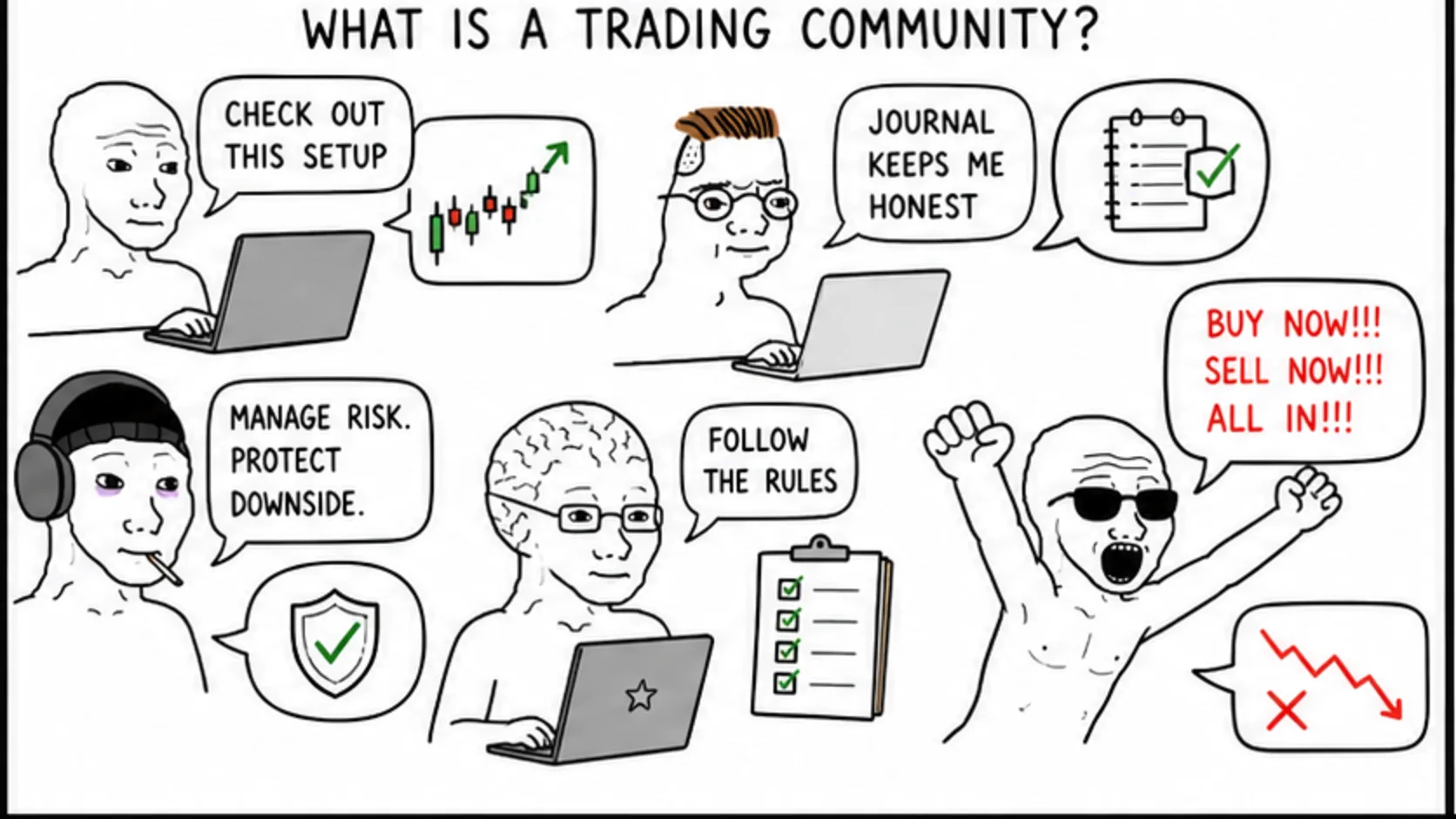
A trading community is any group of traders who share ideas, discuss markets, and learn from each other. This covers everything from Reddit subreddits to paid Discord servers, from Twitter trading circles to formal mentorship programmes.
The key distinction is between communities that teach you to fish and communities that hand you a fish. One makes you self-sufficient. The other keeps you subscribed.
Trading communities serve different purposes for different stages. Beginners need education and structure. Intermediate traders need accountability and feedback. Advanced traders need peer discussion and idea validation. The best communities serve one or two of these purposes well. The worst try to serve everyone and serve nobody.
The Tier List: Best Trading Communities
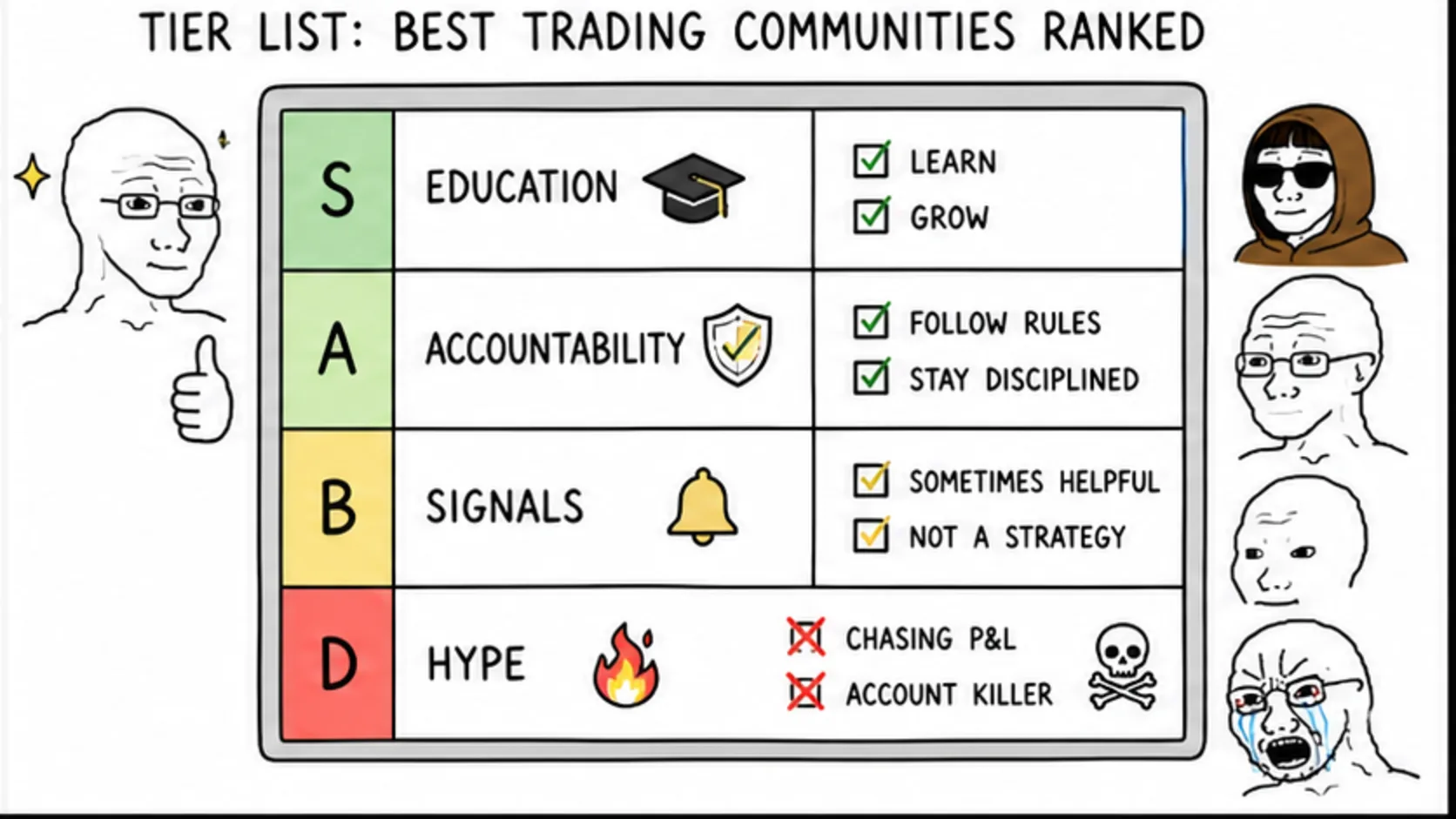
Here is the ranking. Criteria: educational value, honesty, community engagement, and cost-to-value ratio.
Legendary Tier
Reddit Trading Communities. r/Daytrading, r/Forex, r/FuturesTrading, r/Options, r/PropFirms. Free. Active. Sharp. You will get better advice from a thread of experienced traders dissecting your trade idea than you will from most paid services. The culture of accountability in these communities is strong because there is no financial incentive to tell you what you want to hear.
TradingView Social Network. The charting platform's community features are genuinely excellent. Published ideas come with track records. You can follow traders who actually prove their methodology over time. The comment sections on charts contain real analysis. Free with a TradingView account.
Prop firm official communities. For prop firm traders specifically, the communities run by the firms themselves are the gold standard. Real funded traders discussing real rules. Free access. Direct support from firm staff. This is as practical as community learning gets.
Solid Tier
Investors Underground. One of the longest-running trading communities. They have been around since the chat room days and adapted to modern platforms. The educational content is structured, the moderators are experienced, and the community is active. Not free, but the value is there if you are a serious stock or options trader.
Humbled Trader Community. Run by an actual verified profitable trader. The content is grounded, the community is well-moderated, and the focus is on education rather than hype. A good option for newer traders who want structured learning in a community setting.
Warrior Trading. Large, established community with a significant educational library. The chat room is active and moderated. Some people find it too commercial, but the educational foundation is solid for beginners willing to work through the material.
Mid Tier
Generic Discord trading servers. Thousands of these exist. Some are decent. Most are mediocre. The problem is quality control. Without a strong moderator and clear educational focus, Discord trading servers devolve into noise, hype, and people posting their winning trades while hiding their losses.
Telegram signal groups. Functional but limited. You get alerts. You follow them. You learn nothing about why the trade was taken. For some traders, this is exactly what they want. But if your goal is to improve as a trader, signals alone will not get you there.
Facebook trading groups. Facebook's algorithm is not kind to trading education. The groups tend to fill with spam, affiliate links, and beginners giving other beginners advice. There are exceptions, but you have to dig hard to find them.
Garbage Tier
Any community that guarantees returns. Trading has no guarantees. If a community needs to promise returns to attract members, the returns are not real. This applies to every platform, every format, and every market.
Communities that exist to sell you things. If the primary purpose of the community is to funnel you into buying courses, evaluations, or tools, you are not a member. You are a lead. Legitimate communities may sell things on the side, but the community itself should provide standalone value.
Communities where the owner is never present. A trading community led by someone who posts once a week and never engages is not a community. It is a broadcast. And you are paying for a broadcast you could get for free on YouTube.
Free vs Paid Communities: The Full Breakdown
Reddit asks this question constantly. "Is there any reputable free trading community?"
Yes. Several. The idea that you have to pay to get good trading education is one of the most successful lies in this industry.
Free communities win on honesty because nobody is incentivised to keep you subscribed.
When r/Daytrading tells you your trade idea is bad, they mean it. When a paid Discord tells you your trade idea is bad, they risk losing a subscription.
Paid communities win on structure and speed. A well-run paid community gives you a curriculum, a mentor, and a feedback loop that would take months to build on your own.
The problem is separating the well-run ones from the cash grabs.
Here is the rule. Never pay for a community until you have spent at least 60 days in free communities and can articulate exactly what you are missing. If you cannot name your specific gap, you are not ready to pay for anything.
Can You Actually Make Money Day Trading?
You have seen the PAA questions. "Can you make $1000 a day day trading?" "Can I make $100 a day daytrading?"
Let me answer both honestly, because the answer matters for which community you join and what expectations you bring.
Can you make $1,000 a day? Some traders do. They are not beginners.
They have years of screen time, tested strategies, and enough capital that $1,000 represents a reasonable daily move on their positions. According to the CFTC, most retail traders lose money. The ones making $1,000 daily are statistical outliers, not the norm.
You know what is more realistic for someone on their first or second funded prop firm account? $50 to $200 per day.
That is not exciting. That is not going to make you a YouTube star. But on a $50,000 funded account, $100 per day is 0.2%. That is one reasonable trade. That is achievable.
Here is what $100 a day actually looks like on a prop firm account. You take one to three trades.
You risk 0.5% to 1% per trade. You hit your risk management targets. You close your platform. You do it again tomorrow.
The calculators on this site can show you exactly what that looks like for your account size and strategy.
The $2.4 million in 28 minutes story that keeps floating around? That is a headline, not a strategy.
One-off windfall trades happen. They are not repeatable, they are not teachable, and no community can help you replicate them. What communities can do is help you build consistency, which is what actually keeps you funded.
If a community promises you $1,000 days, leave. If a community teaches you to protect your capital and grind out consistent small wins, stay. That is the only difference that matters.
Communities by Trading Style
Not all trading communities serve all traders. Here is where to go based on what you actually trade.
Forex traders. Start with r/Forex on Reddit. The wiki alone is worth more than most paid courses.
Then check out BabyPips for structured education. For prop firm specific forex discussion, look at prop firm official Discords where funded forex traders share rule-specific insights.
Futures traders. r/FuturesTrading is your starting point. The community skews more experienced than most trading subreddits.
For real-time futures discussion, look at Discord servers attached to futures-focused prop firms like Topstep.
Options traders. r/Options is solid for strategy discussion. The community tends to be more analytical and less hype-driven than some other trading groups.
For options-focused courses and communities, look for ones that teach risk-defined strategies rather than naked selling.
Algorithmic traders. r/algotrading is the gold standard for free algo trading discussion. The community shares code, backtesting frameworks, and honest results.
If you are building automated strategies for prop firm challenges, this is where you want to be.
Prop firm traders. This is where it gets specific. Prop firm communities understand things that generic trading groups do not.
Trailing drawdowns. Daily loss limits. Consistency rules. The constraint-based trading that prop firms require is a different skill than unrestricted personal account trading.
Platform Comparison
Where you participate matters. Each platform has strengths and weaknesses for trading communities.
Reddit is best for asynchronous, text-based discussion with accountability. Upvotes and downvotes filter bad advice naturally.
Anonymous handles encourage honesty. Start here if you want unfiltered opinions.
Discord is best for real-time chat, voice channels, and screen sharing. Good for active trading sessions and immediate feedback.
Bad for long-form educational content. The quality ranges wildly depending on who runs the server.
TradingView is best for chart-based learning and idea validation. Published ideas have track records that are hard to fake.
If you learn visually, this platform gives you the most transparent community experience.
YouTube is best for structured educational content. Comment sections can function as communities for channels with engaged creators.
The catch is that YouTube rewards sensationalism, so filter creators by substance over thumbnails.
Red Flags: How to Spot a Scam Community
Reddit threads on this topic repeat the same warnings, and for good reason. The trading education space is packed with people selling things that do not work. Here are the red flags that should make you run.
No verifiable track record. If the community leader posts screenshots of wins but never shows a broker statement, verified P&L, or funded account dashboard, those screenshots are worthless.
Anyone can Photoshop a P&L. The SEC regularly warns about unverified trading claims.
Pressure to upgrade. You join a free group and within 48 hours someone is in your DMs explaining why the premium tier will "supercharge" your potential.
This is a sales funnel, not a community. Real communities let their value speak for itself.
All wins, no losses. Every member is apparently crushing it. Nobody ever has a bad week. The community chat reads like a highlights reel.
This is curated reality. Real traders lose. Real communities discuss those losses openly.
Signal-only content. If the community gives you entries and exits but never explains the reasoning, you are not learning to trade.
You are renting someone else's decisions. The day they stop posting, you have nothing.
Affiliate links disguised as recommendations. When every "recommended tool" or "best broker" link is an affiliate link and no alternatives are mentioned, the community's incentives are misaligned with yours.
Check if the community discloses these relationships.
You want a community where people argue about strategy. Where someone posts a losing trade and gets constructive feedback.
Where the moderator occasionally says "I was wrong about this one." That is where real development happens.
How to Choose the Right Community for You
Start free. Spend at least two months in Reddit communities and TradingView before paying for anything.
During that time, you will learn what kind of help you actually need. Then you can evaluate paid options with clear criteria rather than vague hope.
If you trade prop firm challenges, prioritise prop firm specific communities. The generic trading advice that works in a personal account does not always translate to funded accounts with strict rules.
If you are a beginner, prioritise education over alerts. Learning why a trade was taken is worth infinitely more than being told what trade to take.
The community that teaches you to think will outlast any signal service.
If you are already funded, look for communities of other funded traders. The challenges shift once you have capital. You need peers who understand payout processes, scaling plans, and the psychological weight of trading someone else's money.
Check for these five things before joining any community.
Active moderation that removes spam and bad faith actors. Members who explain their reasoning, not just their results. A mix of experience levels, not just beginners. Transparency about costs and conflicts of interest. A culture where asking dumb questions is encouraged, not mocked.
The right community is the one that makes you better, then makes you unnecessary. If you outgrow your trading community, that is not a failure. That is the entire point.
