
Prop firm risk management is not the same as risk management on your personal account. On your own money, you can blow half your account, feel bad about it for a week, deposit more, and try again. In a prop firm, one breach of the rules and your account is gone. Automatically. No appeal. No second chance.
This is why prop firm risk management is not a nice-to-have. It is the entire game. Your strategy is secondary. Your indicators are secondary. How much you risk on each trade and how close you stay to the rules is what determines whether you pass or fail.
Key Takeaways
- Prop firm risk management has hard constraints your personal account does not: daily loss limits, maximum drawdown, trailing drawdown. Breach any one and your account closes automatically.
- Risk 0.5-1% per trade. This gives you 10-20 losing trades before you approach drawdown limits, which is enough room for any normal losing streak.
- The daily loss limit is a ceiling you should never approach. If your daily loss limit is 5%, plan to lose no more than 2-3% in any single session.
- Your position size should be calculated from your risk percentage, not from how confident you feel or how close you are to the profit target.
- The challenge structure itself is a risk filter. Firms use it to find traders who can survive under constraints, not traders who can make the most money.
On This Page
- Why Prop Firm Risk Management Hits Different
- The Daily Loss Limit: Your Hard Ceiling
- Maximum Drawdown: The Long Game
- Position Sizing Within Risk Rules
- The 1% Rule and Why It Works
- Stop Losses: Non-Negotiable
- Risk Management for the Challenge vs the Funded Account
- The Three Risk Traps That End Challenges
- Tracking Your Risk During the Challenge
- The Risk Framework That Actually Works
Why Prop Firm Risk Management Hits Different
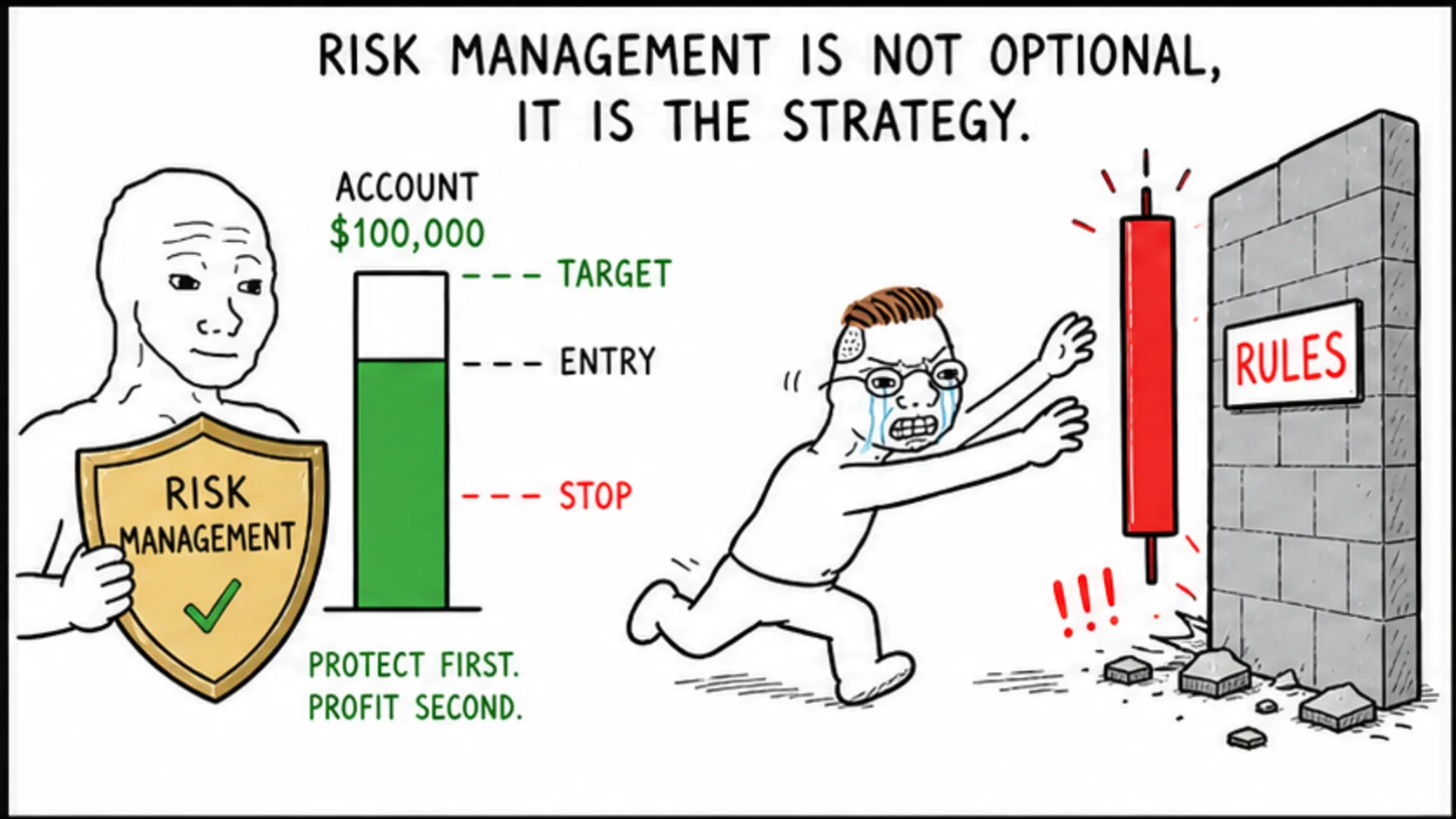
On your personal account, risk management is a suggestion. You should use a stop loss. You should not risk more than 2% per trade. You should have a daily stop. But if you ignore all of those rules, the market will eventually teach you a lesson, you will feel bad, and you will either learn or blow up. Slow feedback loop.
In a prop firm, the feedback is instant and final.
Breach the daily loss limit? Account closed. Breach the maximum drawdown? Account closed. Hold positions over the weekend when the firm prohibits it? Account closed. The rules are enforced by software that watches your equity in real time. There is no "I was close but did not quite breach." The line is the line.
This changes everything about how you approach risk. On your own account, you can afford to be sloppy. In a prop firm, sloppy means immediate termination. The traders who survive are not the ones with the best strategies. They are the ones who never breach a rule.
This is not just prop firm folklore. The Commodity Futures Trading Commission repeatedly warns traders that leveraged markets can produce losses faster than expected, and prop firm rules compress that lesson into a hard daily limit.
The Daily Loss Limit: Your Hard Ceiling
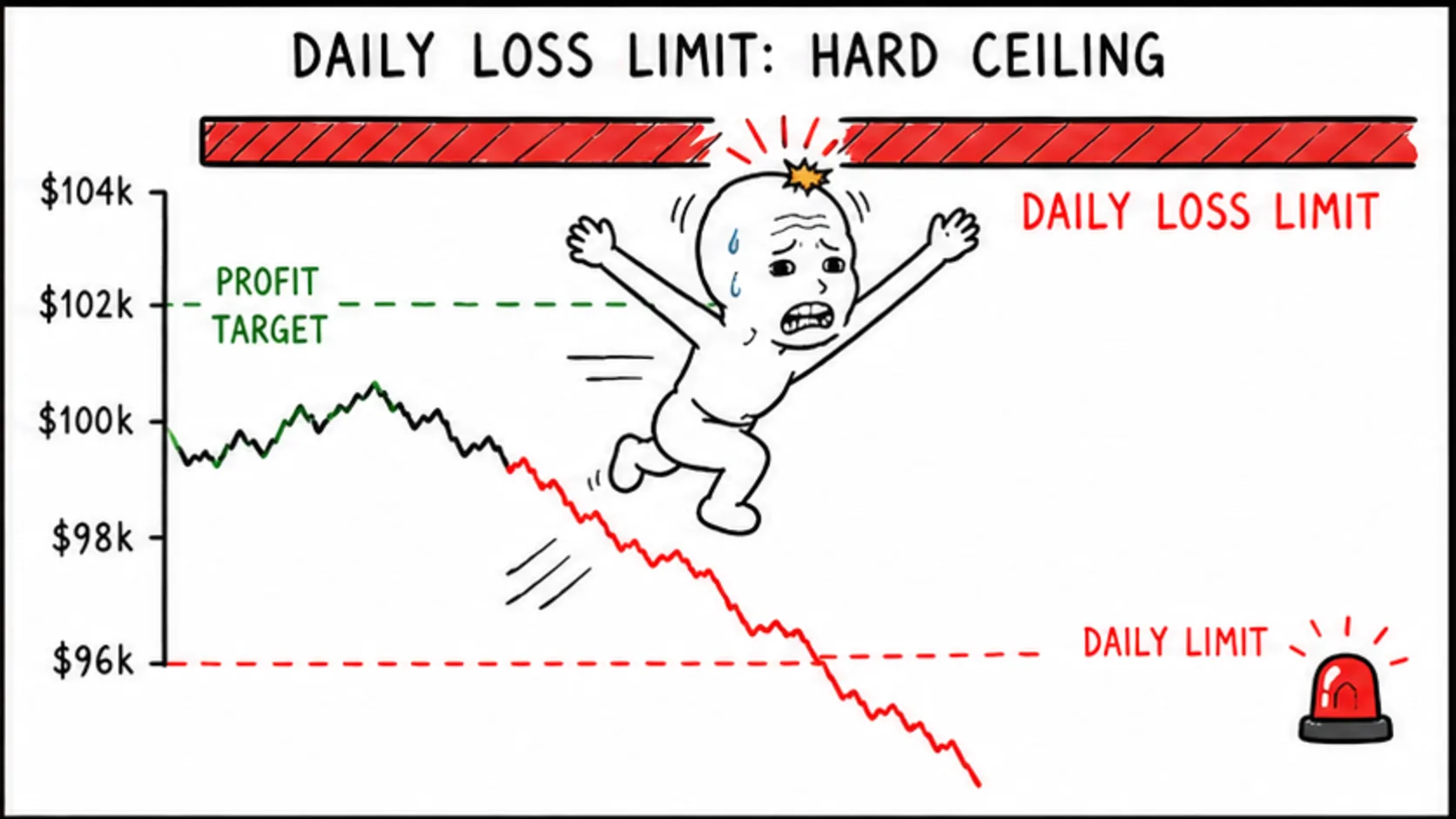
The daily loss limit is the rule that kills most challenges. Most firms set it at 4-5% of the starting balance. Some firms calculate it from the previous day's close, which means it can shrink as you lose money. Pay attention to which calculation your firm uses.
On a $100,000 account with a 5% daily loss limit, you can lose $5,000 in a single day before your account gets closed. That sounds like a lot. It is not.
If you risk 2% per trade, which is what most retail traders consider "conservative," you can take two losing trades and you are at 4% for the day. One more small loss and you are done. Your challenge is over because of three normal losing trades.
Now you see why 0.5-1% risk per trade is the sweet spot. At 1% risk per trade, you can take five consecutive losses and still be within your daily limit. At 0.5%, you have room for ten. That is the difference between surviving a bad day and getting your account terminated before lunch.
Set your personal daily stop at half the firm's limit. If the firm allows 5% daily loss, stop yourself at 2.5%. This gives you a buffer for slippage, spread widening, and the emotional peace of mind knowing you are never close to the edge.
Maximum Drawdown: The Long Game
The maximum drawdown is the total amount your account can lose from its peak before it gets closed. Most firms set this at 8-12% of the starting balance. Some use a static drawdown (fixed from the starting balance) and some use a trailing drawdown (moves up as you make profits). For FTMO-specific drawdown math, see our FTMO drawdown rules explainer.
On a $100,000 account with a 10% max drawdown, you can lose $10,000 total before your account is terminated. Spread that over 20 trading days and you have $500 per day of drawdown budget. That is tight.
Here is the math that matters. If you risk 1% per trade ($1,000 on a $100k account) and you have a bad week with 5 losing trades, you have used half your total drawdown budget in one week. One more bad week and you are done. The challenge is over. Our FTMO challenge walkthrough shows exactly how to pace your drawdown budget across a 30-day evaluation.
At 0.5% risk per trade ($500), the same 5 losses only use 2.5% of your drawdown budget. You can survive two bad weeks back to back and still have half your budget remaining.
The drawdown is not a target. It is a cliff edge. You should never be within sight of it.
Position Sizing Within Risk Rules
Your position size is determined by three things: your account size, your risk percentage per trade, and your stop loss distance in pips.
On a $100,000 account, risking 0.75% with a 30-pip stop on EURUSD:
- Risk amount = $100,000 x 0.0075 = $750
- Pip value for standard lot on EURUSD = $10 per pip
- Position size = $750 / (30 pips x $10) = 2.5 standard lots, or 25 micro lots
That is your size. Not "I feel good about this one, let me go 3 lots." Not "I am close to the target, just one big trade to finish it." 2.5 lots. Every trade. Same calculation. Same process.
If this feels too slow, you are thinking about prop firm trading wrong. The goal is not to get rich. The goal is to survive long enough to hit the target. Survival first, profit second.
The 1% Rule and Why It Works
The 1% rule says you never risk more than 1% of your account on a single trade. In prop firm trading, 1% is the upper bound. Most funded traders operate at 0.5-0.75%.
Here is why.
On a $100,000 account with a 5% daily loss limit and 10% max drawdown:
- At 1% risk per trade, you can lose 5 trades before hitting your daily limit
- At 1% risk per trade, you can lose 10 trades before hitting your max drawdown
- At 0.5% risk per trade, you can lose 10 before your daily limit and 20 before max drawdown
A normal trading strategy has a 40-60% win rate. That means 4-6 losses out of every 10 trades. If you risk 2% per trade, a normal streak of 3 losses puts you at 6% down for the day. You just breached the daily loss limit with a perfectly normal losing streak.
The 1% rule is not conservative. It is mathematically necessary for the constraints of a prop firm evaluation.
Stop Losses: Non-Negotiable
Every trade you take during a prop firm challenge must have a stop loss. Not a mental stop. Not "I will close it if it gets bad." A real, hard stop loss placed in the market before your entry is filled.
Why? Because the firm is monitoring your equity in real time. If your trade runs against you and you do not have a stop, your unrealized loss counts against your drawdown. I have seen traders lose half their drawdown budget on a single trade they "forgot" to put a stop on.
Your stop loss distance determines your position size. Not the other way around. Pick your stop first, calculate your size second. If the stop needs to be wide, your size goes down. If the stop is tight, your size goes up. The risk amount stays the same.
No exceptions. No "I will manage it manually." Every trade gets a stop. Every single one.
Risk Management for the Challenge vs the Funded Account
Here is a mistake a lot of traders make. They use one risk approach for the challenge and a completely different one for the funded account.
During the challenge: conservative, 0.75% risk, strict rules, disciplined execution. They pass. They get funded.
Day one of the funded account: 2% risk, no daily stop, "I can afford to take more risk now because I have a bigger buffer."
This is how funded accounts die. The challenge proved that your risk system works. The funded account is where you apply the same system and collect the profits. Changing anything between the two is a recipe for blowing up.
Keep the same risk percentage. Keep the same position sizing method. Keep the same daily loss cap. The only thing that changes is the target: instead of hitting a fixed profit goal, you are building monthly consistency for payouts.
The Three Risk Traps That End Challenges
Trap one: oversizing to hit the target faster. You are 60% through the challenge. The profit target is within reach. You think, "just two big trades and I am done." So you double your size. One of those trades stops out. Now you are closer to the drawdown limit than you were before. Worse, you have used a big chunk of your daily budget on one trade. Slow down. The target is not going anywhere.
Trap two: revenge trading after a drawdown. You lose two trades in a row. Your drawdown is creeping up. Your brain says "I need to make it back." So you size up, take a mediocre setup, and lose again. Now you have turned a normal 2-loss day into a 4-loss disaster. Revenge trading in a prop firm account is uniquely destructive because the daily loss limit and drawdown ceiling create hard failure points. The fix is the same as always: after two losses, stop for the day.
Trap three: ignoring the daily loss limit because you are "close to being green." You are down 3.5% for the day. Your daily limit is 5%. You think, "one good trade and I am back to breakeven." The market does not care about your breakeven. One more loss and you are at 4.5%, sweating every tick. Set your personal limit at half the firm's limit and never approach it.
Tracking Your Risk During the Challenge
You need to know your numbers at all times during a challenge. Not approximate. Exact.
- Current equity: where your account stands right now, including open positions.
- Drawdown used: how much of your max drawdown you have consumed as a percentage.
- Daily P&L: how much you are up or down today, and how close you are to your personal daily stop.
- Trades remaining today: based on your risk per trade, how many losing trades you can take before hitting your daily stop.
- Profit target progress: how far you are from the target, and at your current pace, how many days it will take.
Track these every day. Review them at the end of every session. This is not optional. If you do not know your numbers, you are flying blind in an environment where the consequences of a mistake are immediate and final.
The Risk Framework That Actually Works
Here is the complete framework. Copy it, print it, stick it to your monitor.
- Risk 0.5-1% per trade. Pick a number and use it every single trade.
- Set a hard daily stop at 50% of the firm's daily loss limit. If the firm allows 5%, your personal stop is 2.5%.
- Every trade has a stop loss before entry. No exceptions.
- After two consecutive losses, stop trading for the session.
- Never increase your position size during the challenge. Not when you are winning, not when you are losing, not when you are one trade away from the target.
- Track your equity, drawdown, and daily P&L after every session.
Six rules. Follow all of them, every day, for the duration of your challenge. That is it. That is the framework that gets you funded and keeps you funded.
The people getting funded are not smarter than you. They are not better traders than you. They just follow a system like this one and they do not deviate from it. The math handles the rest.
