
Trading psychology in prop firm challenges is not the same as trading psychology everywhere else. Your personal account has no clock. No daily loss limit. No trailing drawdown chasing you like a dog that bites when you are winning. A prop firm evaluation is a pressure cooker designed to make you crack.
And most people do crack. Not because they cannot trade. Because the mental game under evaluation conditions is a completely different sport.
Key Takeaways
- Trading psychology for prop firm challenges is fundamentally different from personal account psychology because you are trading under artificial constraints with a ticking clock.
- The three mental traps that destroy most evaluations are revenge trading, FOMO entries, and overconfidence after winning streaks.
- You do not fix psychology with willpower. You fix it with systems: pre-set position sizes, mandatory breaks, and a written trade plan you follow like a robot.
- Most traders who fail report trading well for 18-20 days before self-destructing on a single bad session. The problem is never the strategy.
- The challenge is designed to test your discipline, not your chart-reading ability. If you cannot manage yourself, the prop firm finds out fast.
On This Page
- The Real Problem Is Not Your Strategy
- Revenge Trading: The Account Killer
- FOMO: The Setup That Was Not Yours
- Overconfidence After Winning Streaks
- The Unique Pressure of a Prop Firm Challenge
- The Discipline System That Gets You Funded
- The Pre-Trade Checklist
- How to Handle Losing Streaks Without Panicking
- The Daily Routine for Challenge Trading
- How Psychology Changes After Getting Funded
The Real Problem Is Not Your Strategy
You already know this. Somewhere deep down, you know this. You have a strategy that works. You have backtested it. You have seen it work in live conditions.
And then you start a prop firm challenge and everything falls apart.
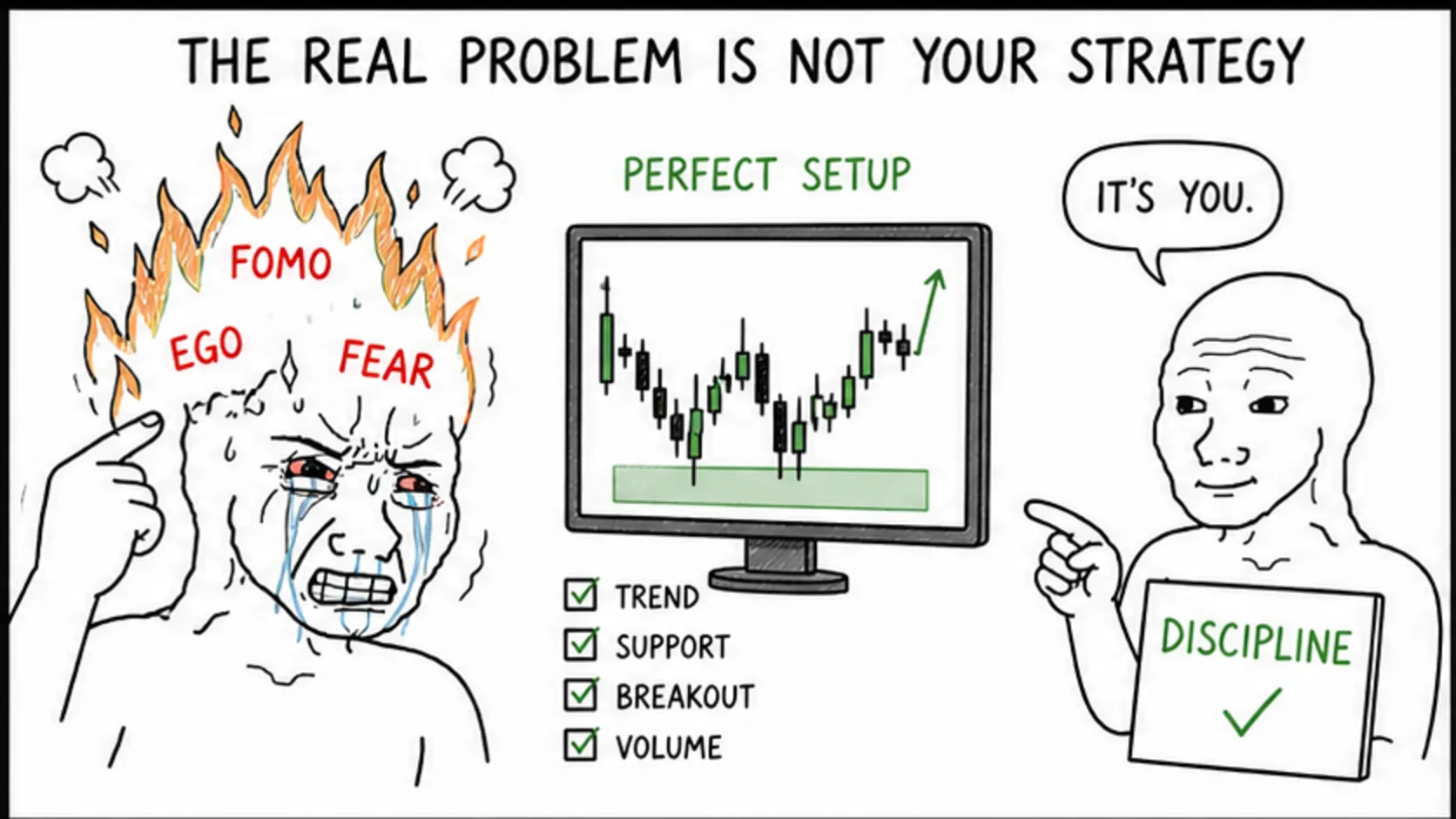
The strategy did not change. The market did not change. You changed. The pressure of a timed evaluation with drawdown limits, profit targets, and real money on the line transformed you from a calm, systematic trader into an emotional wreck making decisions you would never make on your own account.
Prop firm evaluations do not test your ability to read charts. They test your ability to not lose your mind while someone watches.
Reddit is full of posts saying the same thing. "I kept failing prop firm challenges due to psychology." "Why most traders fail prop firm challenges, it is not the strategy." These are not beginners. These are people who can trade. They just cannot trade under pressure.
The European Securities and Markets Authority has repeatedly highlighted how retail traders underestimate risk. Prop firm psychology is that same problem with a countdown timer and an automatic breach rule attached.
Revenge Trading: The Account Killer
You take a loss. Your stop hits. The market moves against you exactly as it was supposed to, because that is what stops are for. Normal. Expected. Part of the game.
And then your brain whispers: "I know where it is going now. I can see it. Let me get back in."
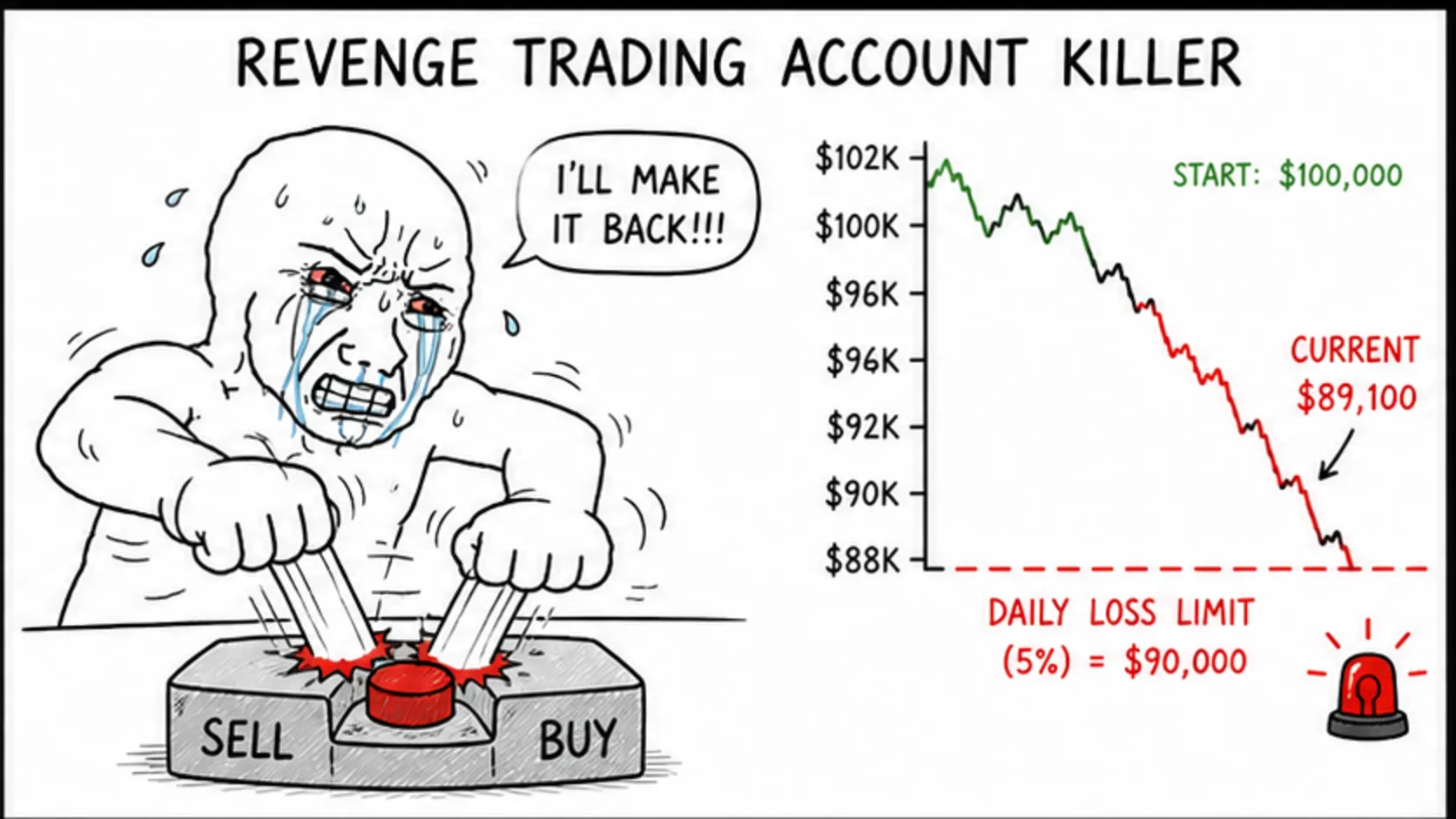
This is the revenge trade. It feels like confidence. It smells like opportunity. It is neither. You are emotional, oversized, and about to make the second worst decision of your challenge. The worst decision was the third revenge trade you take after this one fails too.
Revenge trading in a prop firm challenge is deadlier than in a personal account because your drawdown budget is limited. On your own account, you can absorb five stupid trades and recover over months. In a challenge, three revenge trades can eat half your daily loss limit in 30 minutes.
Here is the fix. Hard rule, no exceptions.
- After any losing trade, close the platform for 30 minutes. Not 5 minutes. Not "let me just check the chart." 30 minutes away from the screen.
- After two consecutive losses, you are done for the session. Close everything. Go do something else. The market will be there tomorrow.
- Pre-write this rule on a sticky note and put it on your monitor before you start the challenge.
The revenge trade lives in the gap between a loss and the next impulsive entry. Close the gap. Problem solved.
FOMO: The Setup That Was Not Yours
You are watching the market move. It is ripping in one direction. Big candles. Clean structure. And you are not in it.
Your brain starts narrating: "I should have taken that. I knew that was going to happen. If I had just entered at the level, I would be up 2R right now."
So you enter. Late. At the worst possible price. Right before the pullback. Because that is what happens when you chase price. You buy the top or sell the bottom and then sit there watching your new position bleed while the market does what it was always going to do, retrace and then continue without you.
FOMO in a prop firm challenge is a certified account-nuke moment because it forces you into trades that were never in your plan. You are not taking your setup. You are taking someone else's setup that already happened without you.
The fix for FOMO is boring but effective.
- Write down your exact entry criteria before the session starts. If the setup does not match the criteria, you do not trade it. Full stop.
- Accept that you will miss good moves. Missing a move costs zero dollars. Chasing a move can cost you your challenge.
- If you feel the urge to chase, say it out loud: "This setup is not mine." Sounds silly. Works every time.
Overconfidence After Winning Streaks
This one sneaks up on you. Day 8 of your challenge. You have hit 6 winning trades in a row. Your equity curve looks beautiful. You are ahead of schedule. You feel like you have cracked the code.
Little do they know, this is the most dangerous moment in your entire challenge.
Overconfidence after winning streaks does not feel like a problem. It feels like competence. You start sizing up a little. You start taking B setups because your A setups are "too conservative" for someone on your hot streak. You relax your entry criteria because you are seeing the market so clearly right now.
And then the market reminds you that it does not care about your hot streak. Three losses in a row, each bigger than they needed to be because you sized up, and suddenly your beautiful equity curve has a crater in it.
The average funded trader blows their first funded account within 6 weeks. Not because the market destroyed them. Because they started trading like they owned the place the second they got the green light. Funded traders fail for reasons that have nothing to do with the market. Staying funded is another. The same thing happens during challenges.
Your position size is your seatbelt. Wear it the same way whether you won your last 5 trades or lost your last 5 trades. Do not change it based on how you feel. Lock it in. Leave it alone.
The Unique Pressure of a Prop Firm Challenge
Let me spell out why trading psychology for prop firm challenges hits different than anything else you have experienced.
You paid money for this evaluation. Real money. If you fail, that money is gone. There is no "it is just a demo" comfort blanket. You have skin in the game.
You have a time limit. Some firms give you unlimited time, but most have a window. That clock ticking in the background changes how you perceive every trade, every drawdown, every missed opportunity.
You have a profit target staring at you. It is a number on your dashboard that goes up when you win and down when you lose. Watching that number move away from the target after a losing session is a special kind of psychological torture.
Your daily loss limit is sitting there, watching you, waiting for you to make one stupid decision that pushes you past it and ends your challenge before the day is over.
The trailing drawdown is literally following you around. You cannot shake it. Every profit you make, it catches up. It is a shadow that gets closer the better you do.
All of these constraints exist simultaneously. They compound on each other. And the worst part? The firms know this. The challenge structure is a filter designed to find traders who can handle pressure. The psychology test is the real test.
The Discipline System That Gets You Funded
Forget willpower. Willpower is a depletable resource. You start the day with a full tank and every decision, every temptation, every "just one more trade" drains it. By 2pm you are running on empty and that is when you make your worst decisions.
You need a system. Rules that are written down, pre-committed to, and non-negotiable. Here is the framework.
Mission one: do not blow the account. Non-negotiable. Every single day, your first priority is to finish the day with your account intact. If that means taking zero trades, fine. Zero trades is better than one stupid trade.
Mission two: hit the profit target. Secondary to mission one. If you have to choose between protecting the account and chasing profit, you protect the account. Every time.
Mission three: do it within the time limit. Last priority. Never rush this one. Rushing leads to oversizing leads to blown accounts.
The Pre-Trade Checklist
Before every single trade during your challenge, run through this list. Not in your head. Out loud or written down. Every time.
- Is this my setup? Not something similar. Not "close enough." My exact setup with my exact entry criteria.
- Is my stop loss set? If you cannot answer this immediately, do not take the trade.
- Is my risk within my daily budget? You should know exactly how much this trade costs if it stops out.
- Am I emotional right now? If you are frustrated, excited, desperate, or bored, close the platform and come back later.
- Have I hit my daily loss limit? If yes, you are done. If you are close, you need to ask whether this trade is worth the risk of ending your day early.
If any answer gives you pause, skip the trade. There will be another setup. There is always another setup. The one you skip will not end your challenge. The one you force might.
How to Handle Losing Streaks Without Panicking
Losing streaks happen. They happen to profitable traders. They happen to funded traders. They happen to everyone who trades for long enough. The streak itself is not the problem.
The problem is what you do when the streak hits.
Most traders respond to a losing streak by changing something. They switch strategies. They switch timeframes. They switch pairs. They switch brokers. They switch everything except the one thing that actually needs to change: their behavior.
Here is what you do instead.
- Reduce your position size to minimum. Half your normal size. One quarter if you need to. The goal is to stop the bleeding without stopping the trading.
- Review your last 5 losing trades. Are you still following your strategy, or did you drift? Most losing streaks are caused by execution drift, not strategy failure.
- Only take A+ setups. The ones you have no doubt about. The ones where the entry, stop, and target are all crystal clear before you click.
- Set a hard cap: if you lose 3 trades in one session, you stop for the day. No exceptions. No "one more to get it back."
Losing streaks are normal. Panicking about losing streaks is what destroys challenges.
The Daily Routine for Challenge Trading
Your routine during a challenge should be boring. Predictable. The same every day. Boring is good. Boring means you are in control.
- Before the session: check the calendar for news events. Note the levels on your chart. Write down your max risk for the day. Read your rules out loud. Yes, out loud. It forces your brain to process them actively.
- During the session: execute your plan. No new ideas mid-session. No "I just noticed this pattern." You trade what you planned, or you trade nothing.
- After the session: log every trade. Write down how you felt. Note any rule violations, even small ones. Track your equity versus the profit target and drawdown limit.
The traders who pass are not smarter than you. They are not calmer than you. They just have a system and they follow it. That is the whole secret.
How Psychology Changes After Getting Funded
Passing the challenge is one thing. Staying funded is another.
The day you get your funded account credentials, something shifts. You made it. You passed. You proved you could do it. And now your brain decides it is time to celebrate by trading three times your normal size on the first day because "it is real money now, let us make it count."
This is how funded accounts die. Not in the challenge. In the first two weeks after passing.
The funded account has different psychology. The profit target is gone, replaced by the pressure to perform every month to earn your payout. The drawdown rules are still there, but the safety net of the challenge clock is not. You can lose money indefinitely as long as you stay within the rules, and that open-endedness is its own kind of pressure.
Keep the same system. Same position size. Same checklist. Same daily routine. The account changed. The rules did not.
Most challenge failures happen in the gap between knowing what to do and actually doing it under pressure. A trader can backtest perfectly, size correctly on demo, and then the moment real drawdown hits during a live challenge, every rule goes out the window. The strategy was fine. The person executing it panicked.
Fix the emotion with systems, not motivation. Write your rules. Follow your rules. Every single day. That is how you pass. That is how you stay funded. Everything else is noise.
