
A prop firm is a company that gives traders access to capital in exchange for a share of the profits. You pay a fee, prove you can manage risk, and they hand you an account to trade. That is the deal.
But there is more to it than that. Understanding what a prop firm actually is, how it differs from a broker, and whether it is right for you requires going deeper than the marketing page.
The mistake I see traders make is treating the evaluation fee like a shortcut to capital. It is not. It is a risk-management exam with marketing wrapped around it, and the firm only needs you to be careless once.
Key Takeaways
- A prop firm provides trading capital in exchange for a profit split. You do not deposit your own money beyond the evaluation fee.
- Retail prop firms are technology companies that sell access to simulated trading environments, not traditional trading desks.
- The evaluation tests your risk management and discipline. Strategy matters, but rule compliance matters more.
- The industry is largely unregulated, so due diligence on each firm is essential before paying for an evaluation.
On This Page
- What Exactly Is a Prop Firm?
- How Prop Firms Differ From Brokers and Hedge Funds
- The Two Types of Prop Firms
- The Evaluation Process
- What You Can Trade at a Prop Firm
- The Rules That Govern Every Account
- How Prop Firms Pay Traders
- Do Prop Firms Use Real Money?
- Who Should Consider Prop Firm Trading?
- Red Flags When Choosing a Prop Firm
What Exactly Is a Prop Firm?
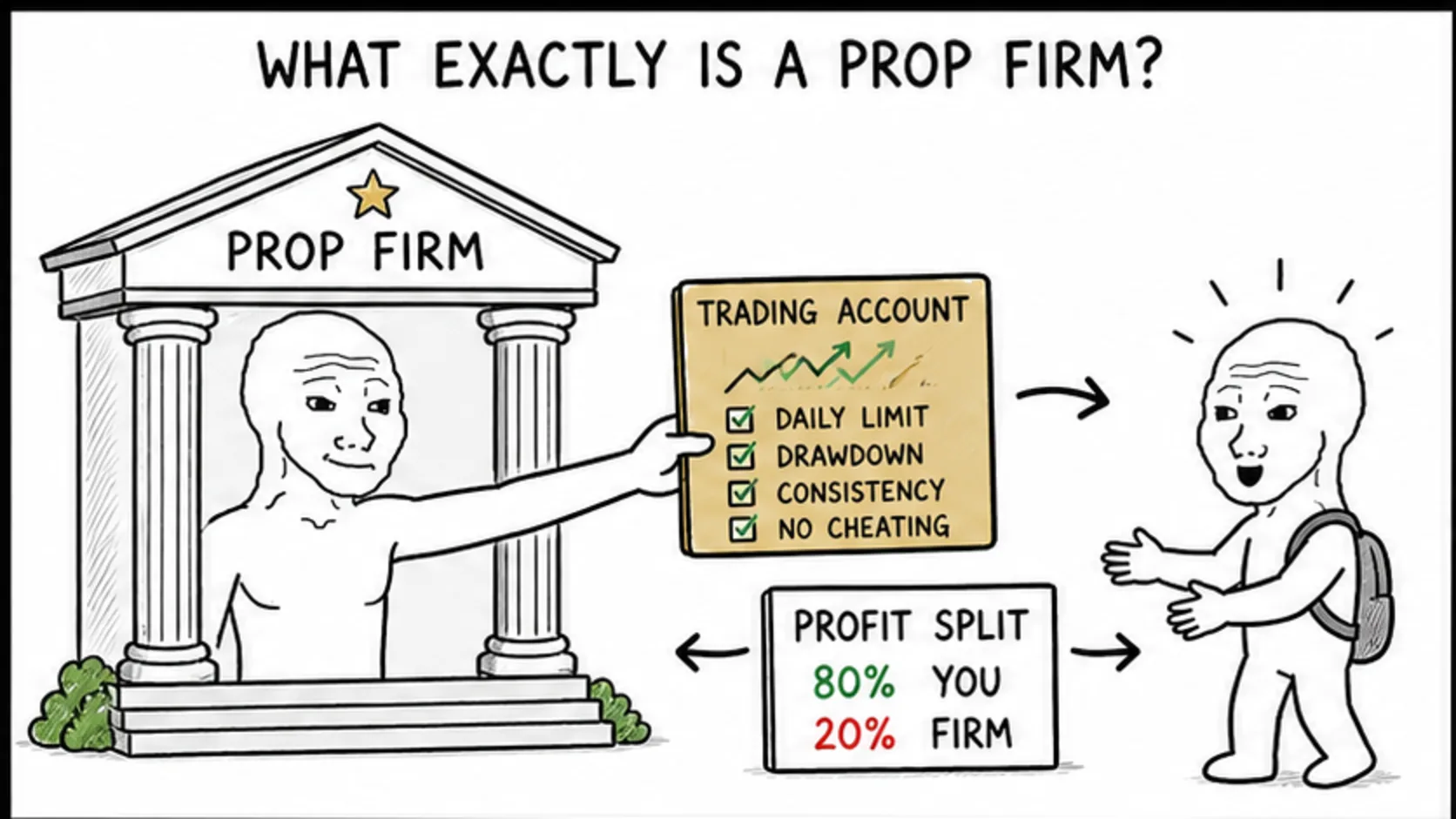
A proprietary trading firm, usually shortened to prop firm, is a company that provides traders with access to capital they would not otherwise have. The trader does not deposit their own money. They pay an evaluation fee, demonstrate their ability to trade profitably within strict risk parameters, and receive a funded account if they pass.
The prop firm business model works because most traders fail the evaluation. The firm collects evaluation fees from the 90-95% who do not pass, which funds the payouts to the 5-10% who do.
You keep a percentage of the profits you generate, typically 70-90%, and the firm takes the rest. The firm absorbs the trading losses, assuming you followed the rules.
Prop firms have existed for decades in the institutional space. Investment banks and hedge funds have run proprietary trading desks since the 1980s. But the version you are looking at as a retail trader is something different.
How Prop Firms Differ From Brokers and Hedge Funds
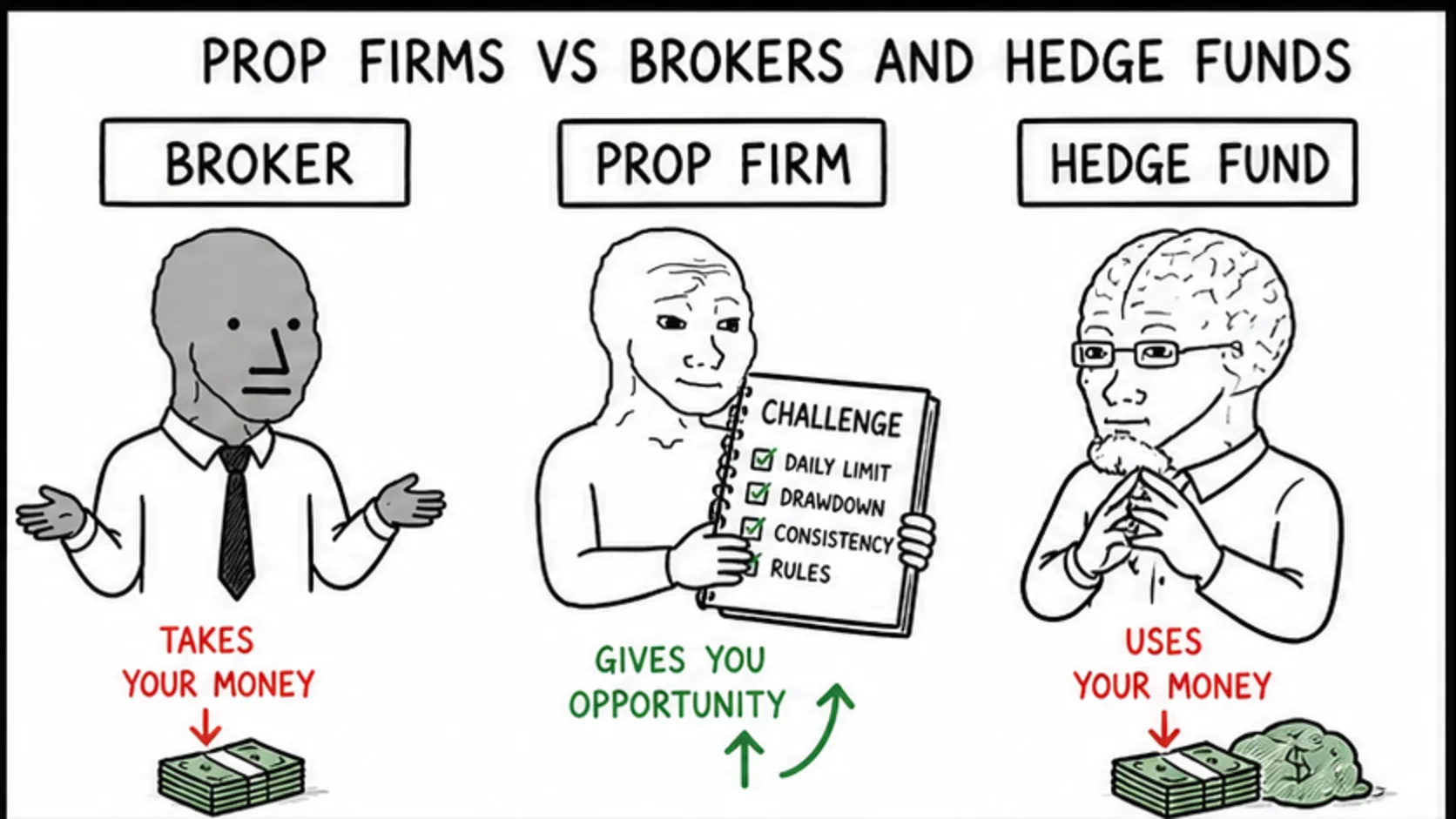
This is where people get confused. A broker, a prop firm, and a hedge fund are three completely different things, and mixing them up will give you wrong expectations.
A broker executes your trades. You deposit your own money, trade with it, and the broker charges commissions or spreads. Your profits are yours. Your losses are yours. The broker does not care whether you win or lose.
A prop firm gives you capital. You pay an evaluation fee, not a deposit. If you pass, you trade their money under their rules and split the profits. The firm absolutely cares about your risk management because their capital is on the line.
A hedge fund manages outside investor money. Hedge fund traders are employees who trade the fund's portfolio according to its strategy. They earn salaries and performance bonuses.
Prop firms occupy a middle ground. You are not a customer of a broker, you are not an employee of a hedge fund. You are an independent contractor who trades firm capital under agreed terms.
The Two Types of Prop Firms You Need to Know
There are two fundamentally different types of prop firms, and the distinction matters.
Institutional prop firms are the original version. These are actual trading businesses based in financial centres like London, New York, and Chicago.
They hire traders as employees, pay salaries, and give them access to the firm's real balance sheet. The SEC and the FCA regulate these firms. They trade billions of dollars in real capital.
You are not joining one of these by paying $200 online.
Retail prop firms are the internet-era version. They sell access to simulated trading accounts through an evaluation process. You pay a fee, trade on a demo, and if you pass, you get a funded account with a profit split.
These firms are technology companies, not trading desks. Their revenue comes primarily from evaluation fees, not from trading profits.
Both types are technically prop firms. But the experience, the risk, and the entry requirements are completely different.
The Evaluation Process: Your Gateway to Funding
The evaluation is the gatekeeping mechanism that stands between you and a funded account. Understanding it is non-negotiable.
You choose an account size, pay the fee, and receive trading platform credentials. The firm sets a profit target, usually 8-10% of the account value, and a set of risk rules.
The challenge is not testing your ability to pick winning trades. It is testing whether you can follow rules under pressure. Risk management, discipline, and emotional control are what they are actually evaluating.
Most firms use a two or three stage process. You pass the evaluation, possibly complete a verification phase with a smaller target, and then receive your funded account.
The failure rate is 90-95% across the industry. Most failures come from rule breaches, not from failing to hit the profit target.
What You Can Trade at a Prop Firm
What you can trade depends on the firm. The main markets are forex, futures, crypto, and stocks.
Forex is the most common. You trade currency pairs like EUR/USD, GBP/USD, and USD/JPY on platforms like MetaTrader 4, MetaTrader 5, or cTrader.
Forex prop firms dominate the landscape because of the $7.5 trillion daily foreign exchange turnover reported by the Bank for International Settlements. That liquidity makes forex ideal for prop trading.
Futures prop firms are the second largest category. You trade contracts on indices, commodities, and interest rate products. These tend to have lower evaluation costs and faster payouts at some firms.
Crypto and stocks are available at a growing number of firms but come with smaller account sizes and tighter rules.
The Rules That Govern Every Prop Firm Account
The rules are the most important part of any prop firm. Break one and your account is terminated, no exceptions.
The daily loss limit caps how much you can lose in a single day, typically 4-5% of the account. Hit it and trading stops for the day.
The maximum drawdown sets a floor on how far the account can fall from its starting balance or peak. Touch it and the account closes permanently.
The trailing drawdown follows your highest balance upward, meaning your safety net shrinks as you make money. It is a dog that bites you when you are winning.
The consistency rule limits how much of your profit can come from a single trade. The firm wants distributed gains, not one lucky hit.
These rules exist to protect the firm's capital, and they are enforced automatically by software. There is no human judgment involved.
How Prop Firms Pay Traders
Once funded, you trade profitably and submit payout requests on a regular schedule.
Most firms pay every 14 to 30 days. You request a withdrawal, the firm verifies your compliance with all rules, calculates the profit split, and sends you your share.
The split is usually 80/20 in your favour, though some firms offer up to 90/10. On a $50,000 account earning $2,000 in a month at 80/20, you receive $1,600.
Payment methods include bank transfer, crypto, Deel, and other platforms. Processing times range from same-day to two weeks.
The key insight is that consistency matters more than size. Earning $1,500 to $3,000 per month consistently from a single account is achievable for skilled traders.
Do Prop Firms Use Real Money?
Most retail prop firms use simulated accounts that mirror live market conditions. Your trades execute on demo, not in the real market.
When you request a payout, the firm pays you from its own funds. They are not distributing profits from actual trades because, in most cases, no real trades were placed.
This surprises some people. But it is standard across the industry and does not make the firm a scam, as long as they pay out consistently.
The firms that have been around for years and have paid out millions to funded traders have proven the model works. The ones that collapse tend to be newer firms that grew too fast and could not meet their payout obligations.
Who Should Consider Prop Firm Trading?
Prop firm trading is not for everyone. Here is who it works for and who should stay away.
If you are already profitable trading your own money but undercapitalised, a prop firm is exactly what you need. You have the skill, you just need scale.
If you have been trading on demo for months and have a consistent track record, the evaluation is a logical next step. You have proved you can trade without financial pressure, now prove you can do it with rules.
If you have never placed a trade, do not start here. Open a free demo account and learn the basics first. The evaluation clock is ticking from the moment you pay.
If you are consistently losing money in your personal account, fix that before buying evaluations. The prop firm evaluation will expose the same problems, except now you are paying for the privilege.
Red Flags When Choosing a Prop Firm
The industry is largely unregulated, which means you need to do your own due diligence. Here are the warning signs.
No payout proof. If a firm cannot show verifiable payout records, walk away. The established firms publish their payout histories publicly.
Unrealistic profit splits. If a firm is offering 95% or 100% profit splits, something does not add up. The industry standard is 70-90%.
Hidden rules. Every rule should be published before you pay. If you discover new rules after failing, that is a red flag.
Too-new firms with too-good offers. New prop firms appear constantly, and many disappear within months. Stick with firms that have at least a year of payout history.
No community presence. Legitimate firms have active Discord servers, Reddit threads, and social media accounts with real trader feedback.
The traders who do best with prop firms are the ones who research thoroughly, choose wisely, and approach the evaluation as a test of discipline rather than a get-rich opportunity.
Choose the right firm, prepare properly, and the evaluation becomes a solvable puzzle rather than a expensive gamble.
