
How do prop firms make money? The short answer: evaluation fees. The long answer is more interesting and involves a business model where 90-95% of customers never become a cost.
Understanding how prop firms generate revenue tells you exactly where you stand in their economics. It also explains why the rules are what they are.
Key Takeaways
- Prop firms make the majority of their revenue from evaluation fees paid by traders who fail, not from profit splits with traders who pass.
- The evaluation pass rate sits at roughly 5-10%, meaning 90-95% of all fees collected are pure revenue with no corresponding payout obligation.
- Hidden revenue streams include account resets, premium features, express payouts, and educational upsells.
- The business model works because the evaluation is genuinely difficult to pass, not because it is rigged.
On This Page
- How Do Prop Firms Make Money?
- Challenge Fees: The Revenue Engine
- The Profit Split: What Happens When You Win
- Do Prop Firms Use Real Money?
- The Hidden Revenue Streams
- Traditional vs Internet Prop Firms
- Are Prop Firms Pyramid Schemes?
- Do Prop Firms Want You to Fail?
- What Happens When Too Many Traders Profit?
How Do Prop Firms Make Money? The Short Answer
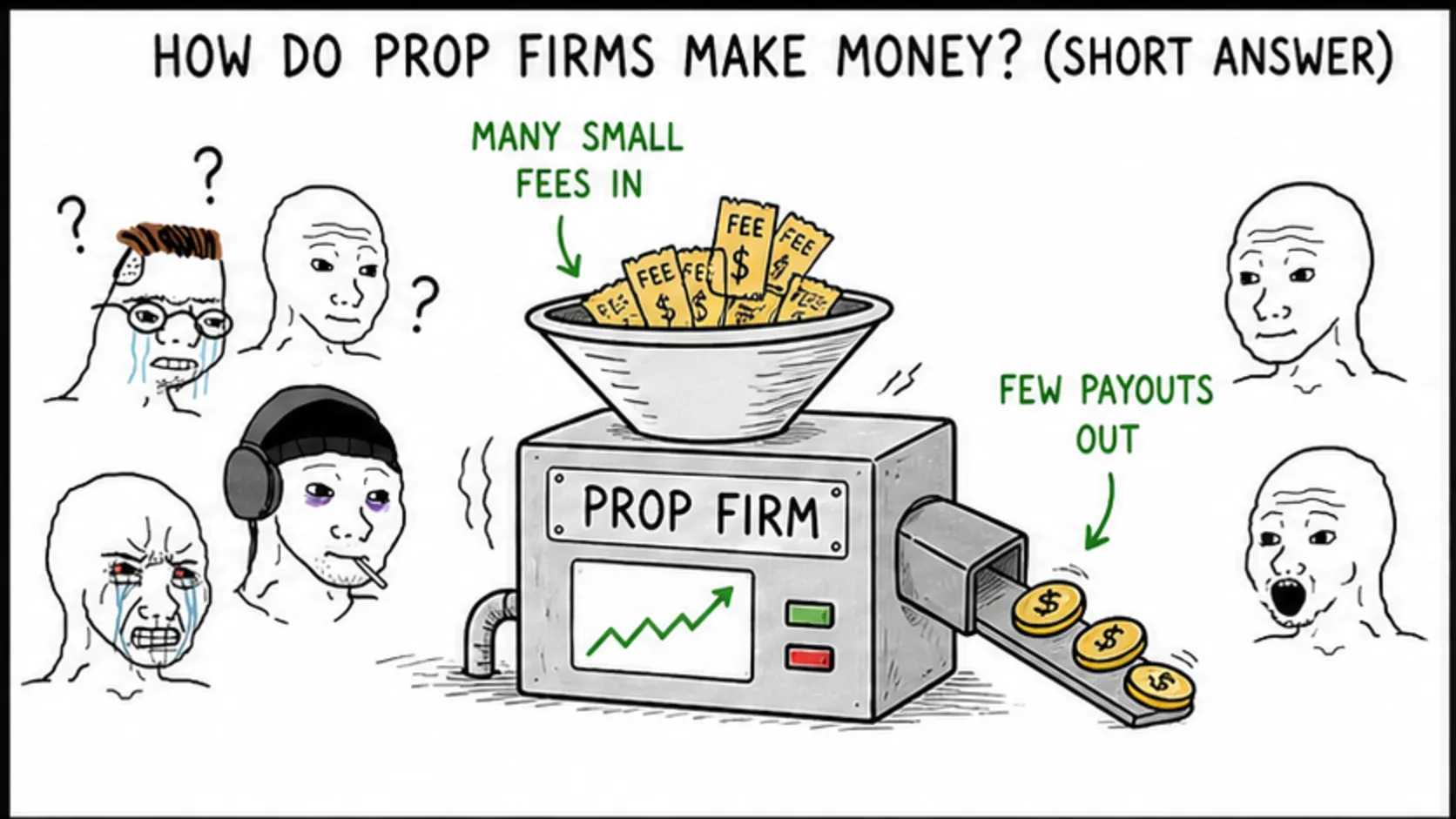
Prop firms have three revenue streams: evaluation fees, profit splits, and add-on services. Evaluation fees dominate everything else.
Think about the numbers. A mid-sized firm processes 3,000 to 5,000 evaluations per month at an average fee of $200. That is $600,000 to $1,000,000 in monthly revenue from evaluations alone.
Since 90-95% of traders fail, the firm collects these fees with no corresponding payout obligation. The 5-10% who pass get funded, and the firm pays them profit splits from their trading gains.
But the profit split revenue is a fraction of the evaluation fee revenue. A firm with 300 funded traders each earning $2,000 per month on an 80/20 split generates $120,000 monthly from profit splits.
That is $120,000 in split revenue versus $600,000 to $1,000,000 in evaluation fees. The math is clear.
Challenge Fees: The Revenue Engine That Runs Everything
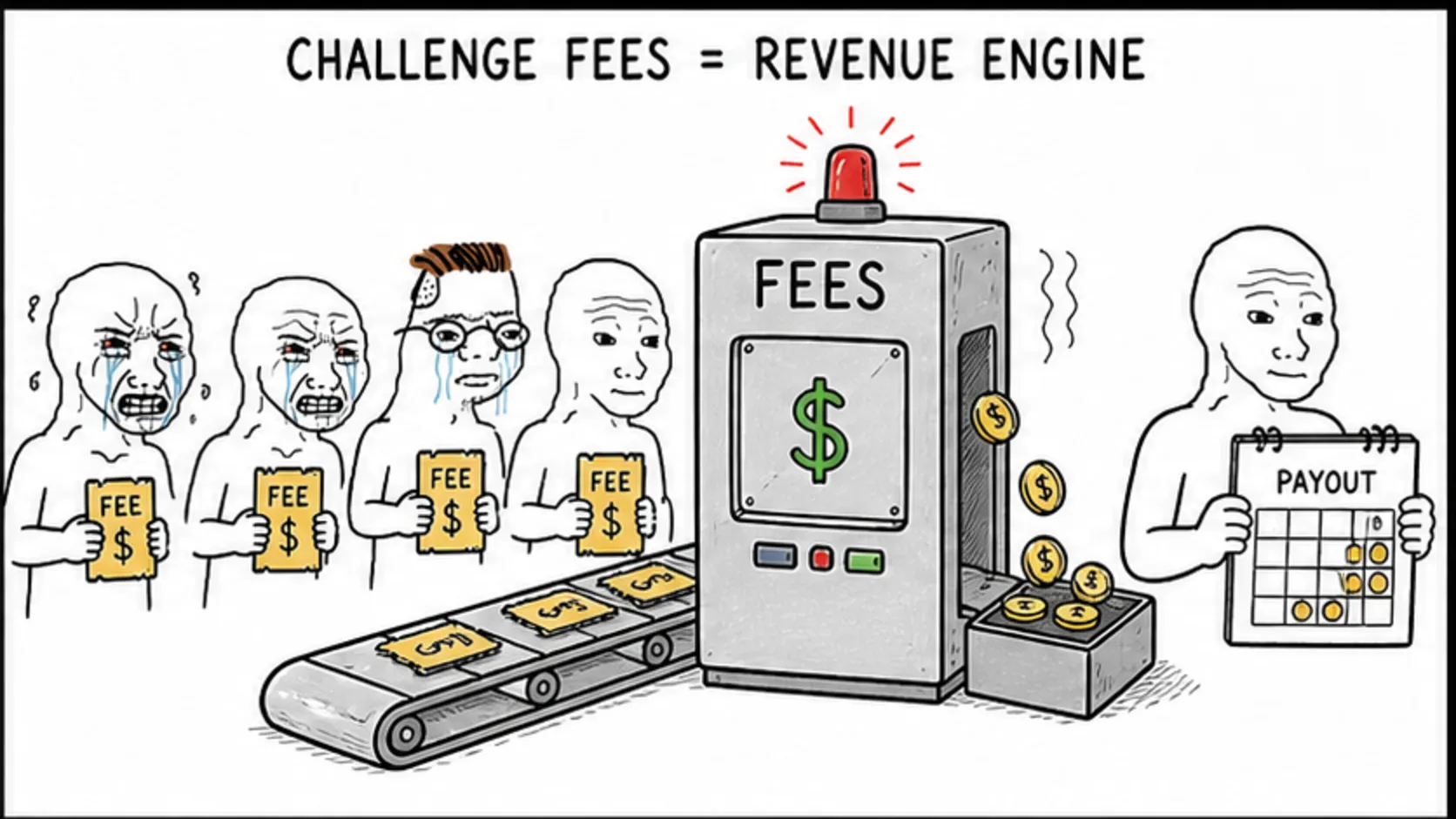
The evaluation fee is the centrepiece of the prop firm business model. Everything else is secondary.
Here is how it works in practice. You pay $200 for a $50,000 account evaluation. The firm gives you a platform login, a profit target of 8%, and a set of risk rules.
Most traders fail. The firm keeps the $200 and moves on. Multiply that by thousands of evaluations per month and you have a business.
The fee structure varies by account size. A $10,000 account might cost $80, a $100,000 account might cost $500, and a $200,000 account can cost $1,000 or more.
The pricing is designed to maximise revenue while remaining accessible enough that new traders keep signing up. If the fees were too high, nobody would try. If they were too low, the revenue would not cover operations.
The three-stage process amplifies this. Some traders pass the evaluation but fail verification, meaning they pay twice without ever reaching funded status.
Repeat buyers are the real goldmine. Traders who fail once and come back for another attempt represent recurring revenue with almost zero additional cost to the firm.
The Profit Split: What Happens When You Actually Win
Profit splits are the revenue stream that prop firms talk about in their marketing. They are also the smallest revenue stream.
When a funded trader makes money, the profits are split between the trader and the firm. The most common split is 80/20 in the trader's favour, though some firms offer up to 90/10.
On a $50,000 funded account, if the trader makes $2,000 in a month, the firm takes $400 at an 80/20 split. That is $400 from one trader for one month.
Compare that to the $200 evaluation fee the firm collected from the 10-20 traders who failed before one passed. The evaluation fees dwarf the profit splits.
But profit splits serve an important purpose beyond revenue. They prove the firm pays out, which drives more evaluation purchases. Every payout screenshot on social media is free marketing for the firm.
The funded traders are the billboard. The failed evaluations are the business.
Do Prop Firms Use Real Money or Demo Accounts?
This question comes up constantly, and the answer matters for understanding how prop firms make money.
Most retail prop firms use simulated accounts. Your trades execute on a demo environment that mirrors live market prices, but no real money changes hands during trading.
When you request a payout, the firm pays you from its own funds. They are not distributing profits from actual market trades because, in most cases, no actual trades were placed in the real market.
This is a key part of the economics. The firm does not need to deploy real capital to operate the evaluation business. They need software, servers, and enough reserves to cover payouts to funded traders.
Some firms do offer live accounts after a proving period. These are less common and tend to be at firms with stricter evaluation processes.
The simulated model is not a scam if the firm pays out consistently. But you should know what you are participating in.
The Hidden Revenue Streams Nobody Talks About
Evaluation fees and profit splits are the obvious revenue sources. But prop firms have several additional income streams that most traders never think about.
Account resets. When you fail an evaluation, some firms offer a reset option that lets you try again at a discount instead of paying full price. A reset typically costs 50-70% of the original fee.
This is incremental revenue from customers who would otherwise churn. The firm already has your money from the first attempt, and now they get more without acquiring a new customer.
Premium features. Faster payouts, higher profit splits, larger account sizes, and priority support all come with premium pricing.
Express evaluations. Some firms let you skip the standard evaluation process entirely for a much higher fee. You pay more to get funded faster.
Educational content and courses. A growing number of firms sell training programmes alongside their evaluations. Some bundle them, others sell them separately.
Affiliate programmes. Many firms pay referral commissions to traders who bring in new evaluation buyers. This creates a self-sustaining acquisition loop where funded traders market the firm for them.
Each of these streams is small individually, but together they add up to meaningful revenue on top of the core evaluation fee business.
Traditional Prop Firms vs Internet Prop Firms
Not all prop firms operate the same business model. The distinction between traditional and internet-based firms is important for understanding the economics.
Traditional prop firms, the ones that existed before 2020, operate as actual trading businesses. They hire traders, deploy real capital, and generate revenue from trading profits.
These firms are the original proprietary trading firms that Investopedia writes about. They trade the firm's balance sheet and keep all the profits internally.
Internet prop firms are a different creature entirely. They are technology companies that sell access to simulated trading environments.
Their revenue comes primarily from selling evaluations, not from trading. The funded traders generate some revenue through profit splits, but the core business is processing evaluation fees at scale.
Understanding this distinction helps you set realistic expectations. You are not joining a trading firm. You are buying a service from a technology company that happens to be in the trading space. Whether these firms have outside investors backing them is a separate question, and the answer might surprise you.
Are Prop Firms Just Pyramid Schemes?
No. But the question is fair, so let us address it directly.
A pyramid scheme generates returns for earlier investors by recruiting new investors, with no underlying product or service. Prop firms provide a genuine service: access to trading capital for people who can prove they manage risk.
The evaluation is a real test of skill and discipline. The rules are published upfront. The firms that have been around for years pay out consistently.
But there are similarities that make people suspicious. The business model depends on a constant flow of new evaluation buyers. The funded traders serve as marketing to attract more buyers.
And the industry is largely unregulated. The European Securities and Markets Authority does not oversee retail prop firms because they do not hold client deposits or provide investment advice.
This means due diligence is entirely your responsibility. Research every firm before you pay. Check their payout history, read community feedback on Reddit and Discord, and avoid firms that promise unrealistic returns. If you are the type who sees a business model and thinks "I could do that", understanding the revenue mechanics is step one.
The legitimate firms are not pyramid schemes. But the space has enough bad actors that the suspicion is understandable.
Do Prop Firms Actually Want You to Fail?
This is the wrong way to think about it. Prop firms do not actively want you to fail. They also do not particularly care whether you pass or not.
The evaluation is a standardised test. It applies the same rules to everyone. The firm profits from the fee regardless of the outcome.
What the firm does want is for the evaluation to be difficult enough that most traders fail. If the pass rate was 50%, the business model would collapse because too many funded traders would create unsustainable payout obligations.
The 5-10% pass rate is the sweet spot. Enough traders pass to provide marketing material and generate some profit split revenue, while the vast majority fund the business through evaluation fees.
The rules are designed to test real skills: risk management, emotional discipline, and consistency. These are not arbitrary obstacles. They are the skills that separate profitable traders from unprofitable ones.
If you have those skills, the evaluation is a solvable puzzle. If you do not, the firm collects your fee and waits for the next candidate.
What Happens When Too Many Traders Get Profitable?
This is the existential question for the prop firm industry. What happens if the pass rate doubles and suddenly there are twice as many funded traders earning payouts?
It would strain the model. Firms manage this risk in several ways.
They adjust the rules. Tighter drawdown limits, stricter consistency requirements, and higher profit targets all serve to keep the pass rate in the target range.
They build reserves from evaluation fee revenue. A well-run firm should have enough in reserves to cover several months of payouts even if new evaluation purchases slow down.
They scale operations. More funded traders means more profit split revenue, which partially offsets the increased payout obligations.
The firms that have survived multiple market cycles have proven they can manage this balance. The ones that fail tend to be the ones that grew too fast, offered unrealistic terms, and ran out of reserves when payouts exceeded revenue.
The collapse of MyForexFunds in 2023 was a cautionary tale. The firm had more payout obligations than it could sustain, and the entire operation fell apart.
Choose firms with proven track records and transparent operations. The ones that have been paying out consistently for years are the safest bet.
The traders who understand the economics of prop firms have a significant advantage. They know what they are participating in, they know the odds, and they approach the evaluation with the right mindset.
Everyone else is just paying for the experience.
The Sustainability Problem: What Happens When Too Many Traders Pass
There is a fundamental tension at the heart of every prop firm's business model. The marketing says "pass our challenge and get funded." The economics say "please do not pass, we need your fee." What happens when too many traders start passing consistently?
The answer is that the math gets uncomfortable fast. Let me walk you through a simplified example. A firm processes 5,000 evaluations per month at $200 each. That is $1 million in monthly revenue. Historically, with a 7% pass rate, 350 traders get funded each month. If each earns an average of $2,000 monthly on an 80/20 split, the firm pays out $560,000 in trader profits and keeps $140,000 from the splits.
Now imagine the pass rate doubles to 14%. Same evaluation volume, same revenue. But now 700 traders get funded. Payouts jump to $1.12 million. The firm is now losing money every month, paying out more than it collects from evaluation fees. The reserve fund starts draining. This is exactly what killed MyForexFunds and several smaller firms in 2023.
Firms manage this tension in a few ways. The most common is gradually tightening the rules. A drawdown limit that was 12% becomes 10%. The profit target creeps up from 8% to 10%. News trading restrictions appear that were not there before. These changes are not always announced loudly. They just show up in the updated terms and conditions that nobody reads.
Some firms take a more aggressive approach. They introduce consistency rules that cap the profit you can make from a single trading day, preventing traders from passing too quickly on volatile sessions. Others extend the minimum trading days requirement, dragging out the evaluation period so fewer traders pass in any given month.
The honest firms build reserves during the good times and adjust proactively. The dishonest ones keep collecting fees until the math collapses. Understanding this tension helps you pick the right firm. If a firm's terms keep getting stricter every few months, it might be struggling with its payout ratio. If a firm has maintained consistent rules for years, the math is probably working.
Reset Revenue: The Hidden Profit Centre
When you fail an evaluation, most firms offer you a choice. Buy a brand new evaluation at full price, or reset your current account at a discount. That reset fee is one of the most profitable revenue streams in the entire industry, and almost nobody talks about it.
A typical reset costs 50 to 70% of the original evaluation fee. On a $200 evaluation, the reset is $100 to $140. The firm already has your money from the first attempt. The reset costs them essentially nothing to process because it is just resetting a software counter. The marginal cost of giving you another simulated account to trade on is effectively zero.
From the firm's perspective, resets are pure margin. No marketing cost to acquire a new customer. No onboarding. No customer support for a new user. Just a button click that generates $100+ from someone who was already going to leave.
From your perspective, resets are a trap if you fail for the wrong reasons. If you blew your account because of revenge trading, poor risk management, or emotional decisions, the reset gives you another chance to make the exact same mistakes. I have seen traders reset the same account four or five times, spending $500+ in reset fees on what should have been a $200 evaluation. At that point, you are not investing in a prop firm challenge. You are funding the firm's profit margin.
The reset is only worth it if you can honestly identify why you failed and have a specific plan to fix it. If you failed because you hit your daily loss limit on day 3, you need a daily loss management strategy, not a reset. If you failed because your strategy had a negative expected value over 30 trades, you need a different strategy, not a reset.
Treat the reset option as a second chance, not a subscription. If you cannot articulate exactly what went wrong and what you will do differently, save your money. The firm will still be there when you are actually ready.
