
Prop trading for beginners is not what you think it is. You're not getting hired by Goldman Sachs. You're not walking onto a trading floor. You're paying a fee to prove you can manage risk, and if you do it well enough, the firm gives you capital to trade and splits the profits with you. That's the entire business model, and once you understand that, everything else about the prop trading industry starts making sense.
Key Takeaways
- Prop trading means trading with a firm's capital after passing an evaluation, not trading your own money in a brokerage account.
- Most retail prop firms make money from evaluation fees, which means the majority of their revenue comes from traders who fail challenges.
- The typical evaluation costs $100-$500, requires hitting a profit target while staying within strict risk rules, and takes 10-30 days to complete.
- About 5-10% of traders pass prop firm evaluations, and most failures come from emotional rule breaches, not bad strategy.
- Prop firms are mostly unregulated because they don't hold client deposits or provide investment advice, so you need to research each firm carefully.
On This Page
- What Is Prop Trading and How Does It Actually Work?
- The Three Ways Prop Firms Make Money
- Prop Firm Challenges and Evaluations
- What You Can Trade With Prop Firms
- Prop Firm Rules That Will End Your Challenge
- Are Prop Firms Legit or a Scam?
- How Much Does Prop Trading Actually Cost?
- The Skills You Actually Need
- Getting Started: Your Path to Funded
- Prop Trading Regulation and Legality
What Is Prop Trading and How Does It Actually Work?
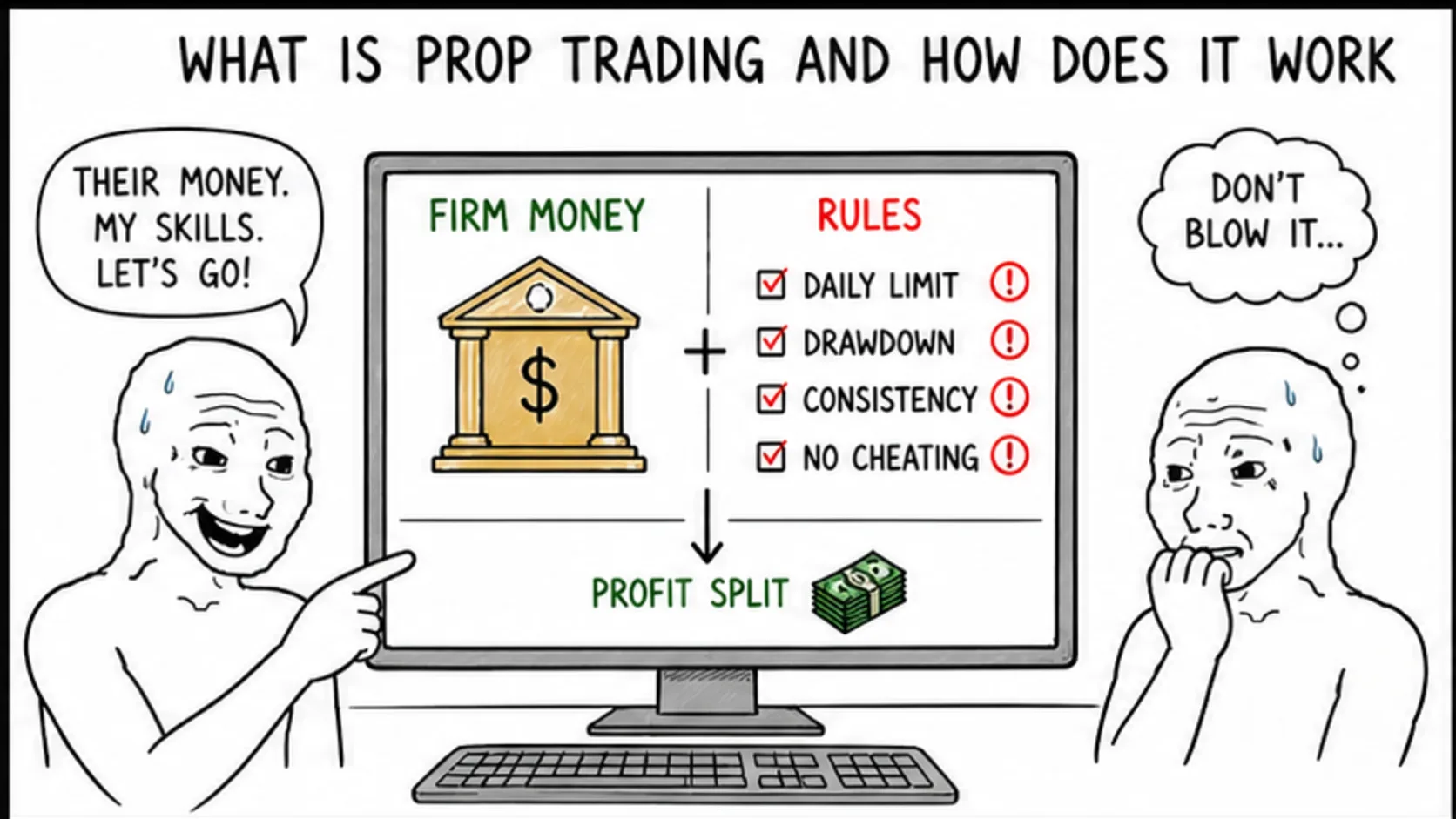
Proprietary trading, usually just called prop trading, is when you trade using a firm's capital instead of your own. The firm gives you access to a simulated or live trading account, you trade under their rules, and you split whatever profits you make. Simple concept. The execution is where it gets messy.
Here's what actually happens. You pay an evaluation fee, say $200 for a $50,000 account. You then trade on that account for a set period, usually 10 to 30 days, trying to hit a profit target while staying inside strict risk parameters. Hit the target without breaking any rules, and you get a funded account. Miss the target or break a rule, and you lose the fee.
This is not the same as traditional proprietary trading desks at investment banks. Those desks trade the firm's actual balance sheet with institutional capital and employ salaried traders. Modern retail prop firms operate on a completely different model. They're selling access to trading capital, not hiring employees.
The global prop trading industry has exploded since 2020. Some estimates put the number of active prop firm traders at over 4 million worldwide, with the market growing at roughly 30% per year. That growth has attracted both legitimate operators and outright scams, which is why understanding this space before you put money down matters.
Think of it this way. A prop firm is essentially a risk filter. They want to find traders who can be consistently profitable without blowing up accounts. The evaluation is their screening process. If you can prove you trade with discipline and manage risk, they'll happily give you capital and take a cut of your profits. If you can't, they keep your fee and move on to the next applicant.
The Three Ways Prop Firms Make Money
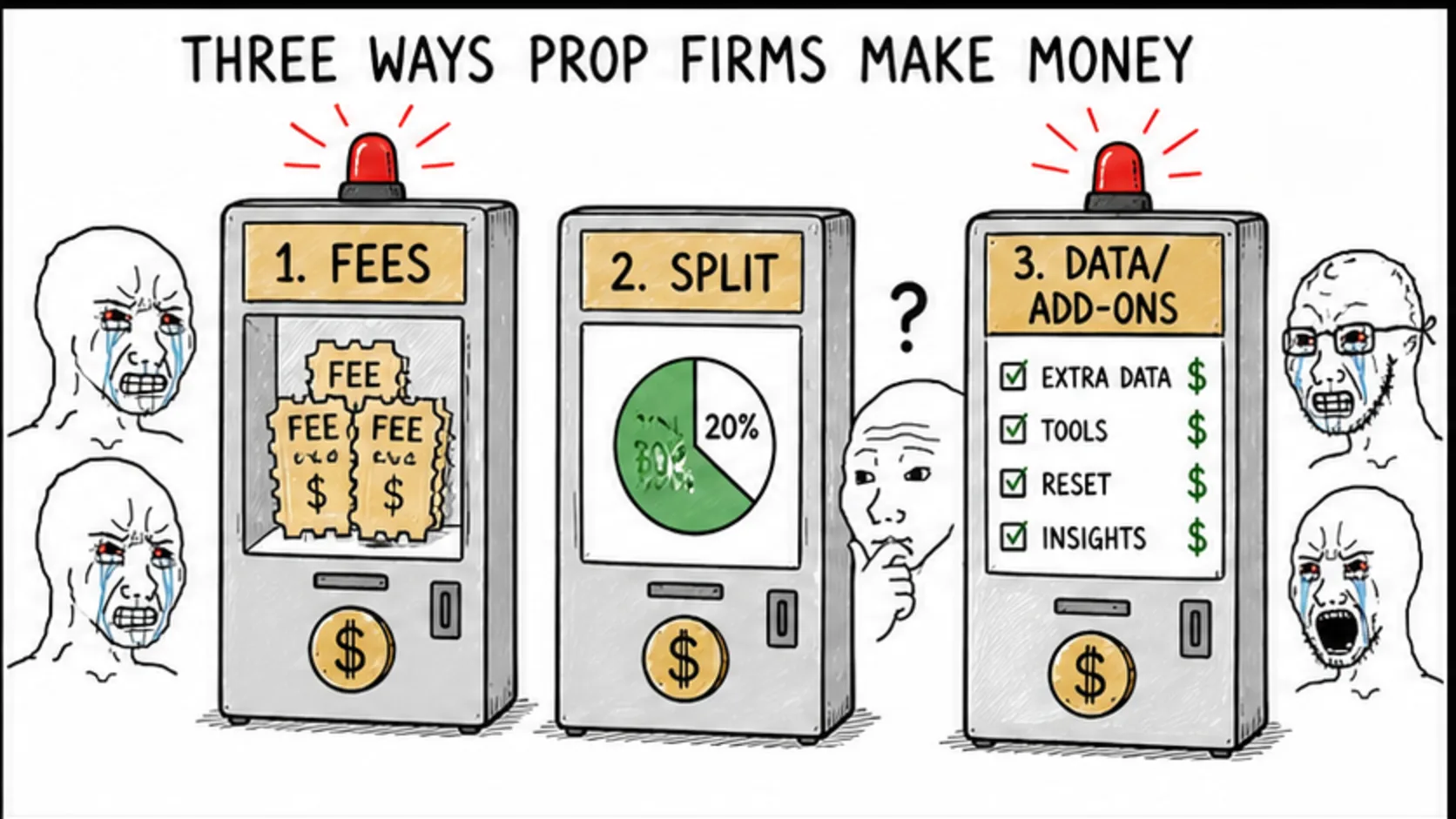
Let's be honest about this because most beginner guides skip it. Prop firms have three revenue streams, and understanding all three tells you everything about how this industry actually works.
Revenue stream one: evaluation fees. This is the big one. Every trader who wants a funded account pays a fee upfront. With pass rates estimated at 5-10%, that means 90-95% of fees come from traders who never get funded. For a firm processing 10,000 evaluations per month at an average fee of $200, that's $2 million in monthly revenue from failed challenges alone.
Revenue stream two: profit splits. Funded traders who generate profits share them with the firm, usually at a 70-90% split in the trader's favour. A firm with 1,000 funded traders averaging $500 monthly profit at an 80/20 split earns $100,000 per month from profit splits. Decent money, but a fraction of the evaluation fee revenue.
Revenue stream three: add-ons and upsells. Account resets, challenge upgrades, faster payouts, and premium features. Some firms charge $50-$100 to reset a failed challenge instead of buying a new one. Others offer premium evaluations with looser rules for higher fees.
Does this mean prop firms want you to fail? Not exactly. They need some traders to pass and get funded, both for marketing purposes and for the profit split revenue. But the economics are clear: the business model works because most traders fail evaluations. The European Securities and Markets Authority has noted the rapid growth of this sector and the risks involved for retail participants.
If you understand nothing else about prop firms, understand this. Your evaluation fee is the product. The funded account is the marketing. The profit split is the cherry on top.
Prop Firm Challenges and Evaluations: How You Get Funded
The evaluation process is the gate between you and a funded account. Every prop firm uses some version of it, and understanding the structure before you start is the difference between a planned attempt and an expensive donation.
Most prop firm challenges follow a similar pattern. You pay a fee, receive login credentials for a trading account, and trade according to the firm's rules. The goal is to hit a profit target, usually 8-10% of the account balance, within a time limit while staying inside risk parameters. Hit the target, pass the evaluation. Break a risk rule, instant fail.
There are two main evaluation structures. The one-step evaluation has a single phase: hit the target with one set of rules. The two-step evaluation splits it into Phase 1 (stricter rules, higher target) and Phase 2 (relaxed rules, lower target). Two-step evaluations are generally cheaper but take longer.
Some firms also offer instant funding, where you skip the evaluation entirely and pay a higher fee for immediate access to a funded account. These sound appealing but come with much stricter drawdown rules, and the higher fee means more money at risk if you breach.
What happens after you pass? You get a funded account, which means you're now trading with the firm's capital under their ongoing rules. You make money, you request a payout, and the firm sends you your profit share. The first payout usually arrives 14-30 days after your first profitable month.
The jump from evaluation to funded trading catches people off guard. During the evaluation, your only job is to hit a target. During funded trading, your job is to be consistently profitable month after month without breaking rules. Different game entirely.
What You Can Trade With Prop Firms
Prop firms don't all offer the same instruments. The two biggest markets are forex and futures, with crypto and stocks growing but still secondary. What you can trade depends on which firm you choose and which account type you purchase.
Forex prop firms are the most common. You trade currency pairs like EUR/USD, GBP/USD, and USD/JPY on platforms like MetaTrader 4, MetaTrader 5, or cTrader. The daily forex market volume is roughly $7.5 trillion according to the Bank for International Settlements Triennial Survey, making it the most liquid market in the world. That liquidity is why prop firms favour it.
Futures prop firms are the second category. You trade contracts on indices like the S&P 500 (ES), Nasdaq (NQ), or commodities like crude oil (CL) and gold (GC). Futures prop firms typically use platforms like NinjaTrader, TradingView, or proprietary platforms. The appeal is lower evaluation costs and faster payouts at some firms.
A growing number of firms now offer crypto, stocks, and even options. These tend to have smaller account sizes and tighter risk rules. Many forex prop firms use CFDs (Contracts for Difference) rather than actual currency delivery, which is worth understanding before you start.
The instrument matters less than you think for beginners. What matters is that you pick a market you understand and stick with it. Jumping between forex, futures, and crypto because one isn't working is a guaranteed way to fail every evaluation you buy.
Prop Firm Rules That Will End Your Challenge
More traders fail prop firm challenges from rule breaches than from bad trading. That sentence is worth reading twice. Your strategy could be genuinely profitable, your entries could be solid, your analysis could be correct, and you could still lose your challenge because you ignored a single rule.
The four rules that end most challenges are the daily loss limit, the maximum drawdown, the trailing drawdown, and the consistency rule. Every prop firm enforces at least two of these, and the stricter firms enforce all four.
The daily loss limit is exactly what it sounds like. A ceiling on how much you can lose in a single day, usually 4-5% of the account balance. Your daily loss limit is sitting there, watching you, waiting for you to make one stupid decision. On a $50,000 account with a 5% daily loss limit, you can lose $2,500 before the firm closes your account. One revenge trade after a stop-out can eat through that in minutes.
The maximum drawdown is the total amount you're allowed to lose from your starting balance or your peak equity, depending on the firm. Typically 10-12% of the account. This is your total leash. Once you hit it, the challenge is over.
The trailing drawdown is the most misunderstood rule in prop trading. It follows your highest equity point, not your starting balance. Every dollar you make, the trailing drawdown creeps up behind you. It's a shadow that never stops moving. You could be profitable and still breach the trailing drawdown if you give back too much of your gains.
The consistency rule says that no single trading day can account for more than a certain percentage of your total profit, usually 30-40%. This prevents traders from getting lucky on one massive trade and passing the challenge without demonstrating actual consistency.
Are Prop Firms Legit or a Scam?
This is the question every beginner asks, and the straight answer is that most established prop firms are legitimate businesses operating in an unregulated space. But "legitimate" and "well-run" are not the same thing, and some firms are better than others at actually paying out traders.
The legit firms share certain characteristics. They've been operating for more than a year. They have documented payout proof from multiple traders. Their rules are clearly published and don't change retroactively. They respond to support requests within a reasonable time. And they don't make outrageous claims about guaranteed funding or impossible profit splits.
The scam firms, or at minimum the questionable ones, have their own tells. They launch with massive marketing campaigns but no track record. They offer unrealistic profit splits above 95%. They change rules after you've already paid for an evaluation. They deny payouts for vague "strategy violations" that weren't mentioned in their terms. And they have no verifiable payout proof.
Reddit is full of traders questioning whether the entire prop firm model is sustainable. The concern is fair. When 90-95% of your revenue comes from failed evaluations, the model looks more like selling lottery tickets than funding traders. But the comparison isn't quite right. The evaluation is testing a real skill, and the firms that have been operating for years have consistently paid out traders who follow the rules.
Red flags to watch for include: no payout proof anywhere online, terms and conditions that give the firm discretion to deny payouts for any reason, a recently registered domain with no company information, and aggressive affiliate marketing that focuses entirely on potential earnings rather than the reality of trading.
The smartest thing you can do before choosing a firm is verify their legitimacy independently. Check their payout proof. Read their terms. Search for complaints on Reddit and Trustpilot. And never buy an evaluation from a firm that's been operating for less than six months.
How Much Does Prop Trading Actually Cost?
Let's talk numbers, because beginner guides love to skip this part. The cost of prop trading depends on the account size and the firm, but here's a realistic breakdown.
Evaluation fees range from roughly $50 to $1,000. A $10,000 account typically costs $80-$150. A $50,000 account costs $200-$400. A $100,000 account costs $400-$600. A $200,000 account can run $700-$1,000. These are one-time fees. You pay them whether you pass or fail, and you don't get them back.
The fee is not a deposit. This is a common misconception. You're not putting $200 into an account that you'll withdraw later. You're paying $200 for the opportunity to prove you can trade. Think of it like a test fee, not a bank deposit.
Beyond the evaluation fee, there are potential additional costs. Account resets cost $50-$100 if you fail and want to try again with the same firm. Some firms charge for faster payouts or premium features. And of course, there's the opportunity cost of the time you spend trading the evaluation instead of doing literally anything else.
Here's the comparison most people don't make. Failing three $200 evaluations costs $600 total. Blowing a $2,000 personal trading account costs $2,000. The prop firm route is significantly cheaper if you're going to make mistakes, which as a beginner, you absolutely will. The question isn't whether prop trading costs money. It's whether it costs less than the alternatives. And if you do start earning payouts, you will owe taxes on every dollar, so factor that into your numbers too.
The Skills You Actually Need to Pass a Prop Firm Challenge
You have three missions in any prop firm evaluation.
Mission one: do not blow the account. This is non-negotiable. Always. Even if you see the cleanest setup of your life that looks like a guaranteed winner. Do not blow the account. Protecting capital is your primary job.
Mission two: hit the profit target. This comes second. If you have to choose between protecting the account and chasing the target, you protect the account. Every single time.
Mission three: do it within the time limit. Last priority. Never rush this one. A slow pass is still a pass. A fast fail is still a fail.
Those three missions tell you everything about what skills actually matter. Risk management is number one by a mile. The traders who pass evaluations consistently are not the ones with the best strategies. They're the ones who never violate their risk parameters.
Psychology is number two. The average funded trader blows their first funded account within six weeks. Not because the market destroyed them. Because they started trading like they owned the place the second they got the green light. Emotional control under pressure is what separates funded traders from challenge buyers.
Strategy is a distant third. You need a strategy that works, obviously. But a mediocre strategy with world-class risk management will pass more evaluations than a brilliant strategy with poor risk management. The 1-2% risk per trade rule exists for a reason. On a $50,000 account, that's $500-$1,000 maximum risk per trade. Most beginners are risking 5-10% per trade because the numbers feel small when they're percentages, not dollars.
The skill nobody talks about is patience. Passing a 10% target on a $50,000 account means making $5,000. That's $250 per day over 20 trading days. $250 per day. Not $5,000 in a single trade. Not a home run. Grinding out small, consistent profits while the account slowly climbs toward the target.
Getting Started: Your Path From Beginner to Funded Trader
If you're a complete beginner, do not buy a prop firm challenge today. Most beginners are not ready for one. I mean it. Go open a free demo account first. Spend at least a month practising. Learn how to place orders, read charts, and manage positions. The evaluation clock starts the moment you pay, and you don't want to be learning platform basics while that timer is running.
Once you're comfortable with the mechanics, pick one market and one strategy. Not three markets and five strategies. One. Forex or futures, pick one. A single strategy you've practised enough to execute without thinking about the mechanics.
Choose your first firm carefully. Read the terms and conditions before you pay anything. Look for firms with clear rules, documented payout history, and reasonable profit targets. Start with a small account, $10,000 or $25,000. The fees are lower, the pressure is less, and the lessons you learn are the same whether you're trading $10K or $100K.
Do not buy multiple challenges at once. This is the single most common beginner mistake. You buy three evaluations thinking you'll pass at least one, then you fail all three because you're spreading your attention across multiple accounts instead of focusing on one. Buy one. Pass it. Then scale up.
Keep a trading journal from day one. Write down every trade, every thought, every emotional reaction. The traders who improve fastest are the ones who study their own behaviour, not the ones who study more strategies. You already know this. You just don't do it. That's the problem.
Use the free calculators available on this site to plan your risk parameters before each trading day. Know your maximum daily loss, your position sizes, and your risk-reward ratios before you open your platform. Trading without a plan is gambling with extra steps.
Prop Trading Regulation: Is It Legal Where You Live?
The regulatory landscape for prop trading is weird, and beginners deserve a straight answer about it. Prop trading is legal in most countries, but the firms themselves are largely unregulated. And understanding why tells you a lot about the risks involved.
Prop firms don't hold client deposits. They don't execute trades on behalf of clients. They don't provide investment advice. They don't custody assets. These are the activities that financial regulators oversee, and prop firms deliberately structure their businesses to avoid all of them.
Forex prop firms are not regulated by the FCA in the UK, the CFTC in the US, or equivalent bodies in most jurisdictions. They register as technology companies, education providers, or trading simulation services. This is why they can offer leveraged trading to retail clients in regions where leveraged retail trading is restricted.
The legal question is different from the regulatory question. In the UK, prop trading is legal for both the firms and the traders. In Australia, the same applies. The US is slightly more complex because of how the CFTC and NFA regulate futures trading, but the major prop firms operating in the US market have structured their offerings to comply with existing rules.
What does unregulated actually mean for you? It means there's no ombudsman to complain to if a firm denies your payout unfairly. There's no compensation scheme if the firm goes bankrupt. There's no licensing requirement that ensures the firm meets minimum standards. You are entirely reliant on the firm's reputation and your own due diligence.
That's not a reason to avoid prop trading. It's a reason to choose your firm carefully, verify their payout track record, and never risk money you can't afford to lose on an evaluation fee.
