
A forex prop firm is a proprietary trading company that gives you access to capital specifically for trading currency pairs. You pay an evaluation fee, prove you can trade forex without blowing up, and the firm hands you a funded account.
Forex prop firms dominate the prop trading landscape. Currency markets offer the liquidity, the volatility, and the 24-hour trading window that makes this model work at scale.
Key Takeaways
- A forex prop firm provides funded accounts specifically for currency trading, with profit splits typically ranging from 70-90%.
- Forex prop firms trade major and minor currency pairs on platforms like MetaTrader 4, MetaTrader 5, and cTrader.
- Leverage ranges from 1:30 to 1:100, with position sizes controlled by the firm's risk rules.
- The evaluation process is the same as other prop firms: hit a profit target without breaking risk rules.
On This Page
- What Is a Forex Prop Firm?
- How Forex Prop Firms Differ From Other Prop Firms
- The Currency Pairs You Can Trade
- Trading Platforms Used by Forex Prop Firms
- How Forex Prop Firm Evaluations Work
- The Rules Specific to Forex Prop Trading
- Leverage and Lot Sizes in Forex Prop Firms
- Are Forex Prop Firms Regulated?
- Choosing the Right Forex Prop Firm
- Getting Started With Your First Forex Evaluation
What Is a Forex Prop Firm?
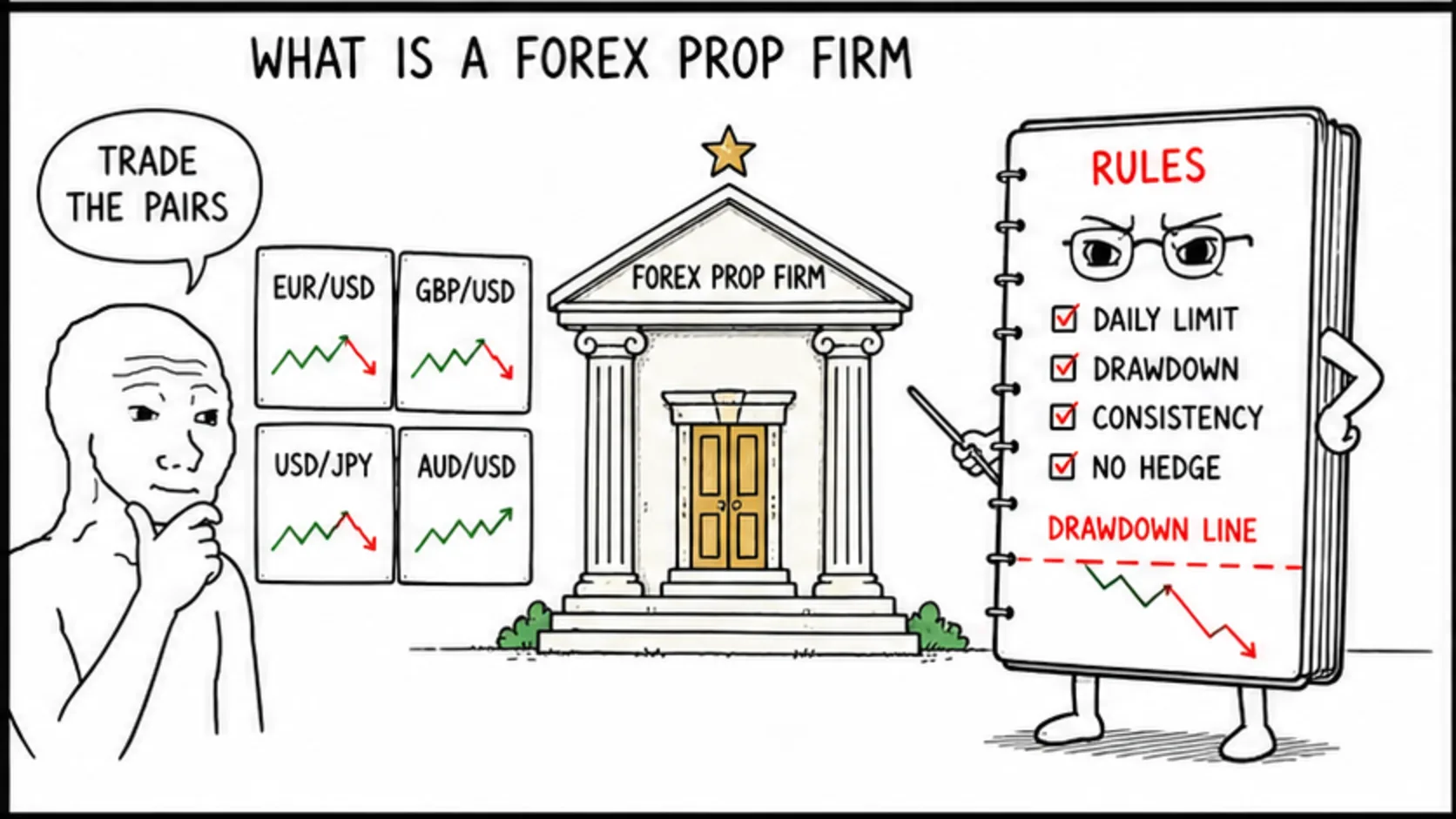
A forex prop firm is exactly what it sounds like. A prop firm that specialises in foreign exchange trading. You trade currency pairs using the firm's capital, follow their risk rules, and split the profits.
The forex market turns over roughly $7.5 trillion daily according to the Bank for International Settlements Triennial Survey. That massive liquidity is why forex prop firms are the most common type in the industry.
The model is identical to other prop firms. You pay an evaluation fee, hit a profit target without breaching risk rules, and get funded. The difference is purely in the instruments you trade.
How Forex Prop Firms Differ From Other Prop Firms
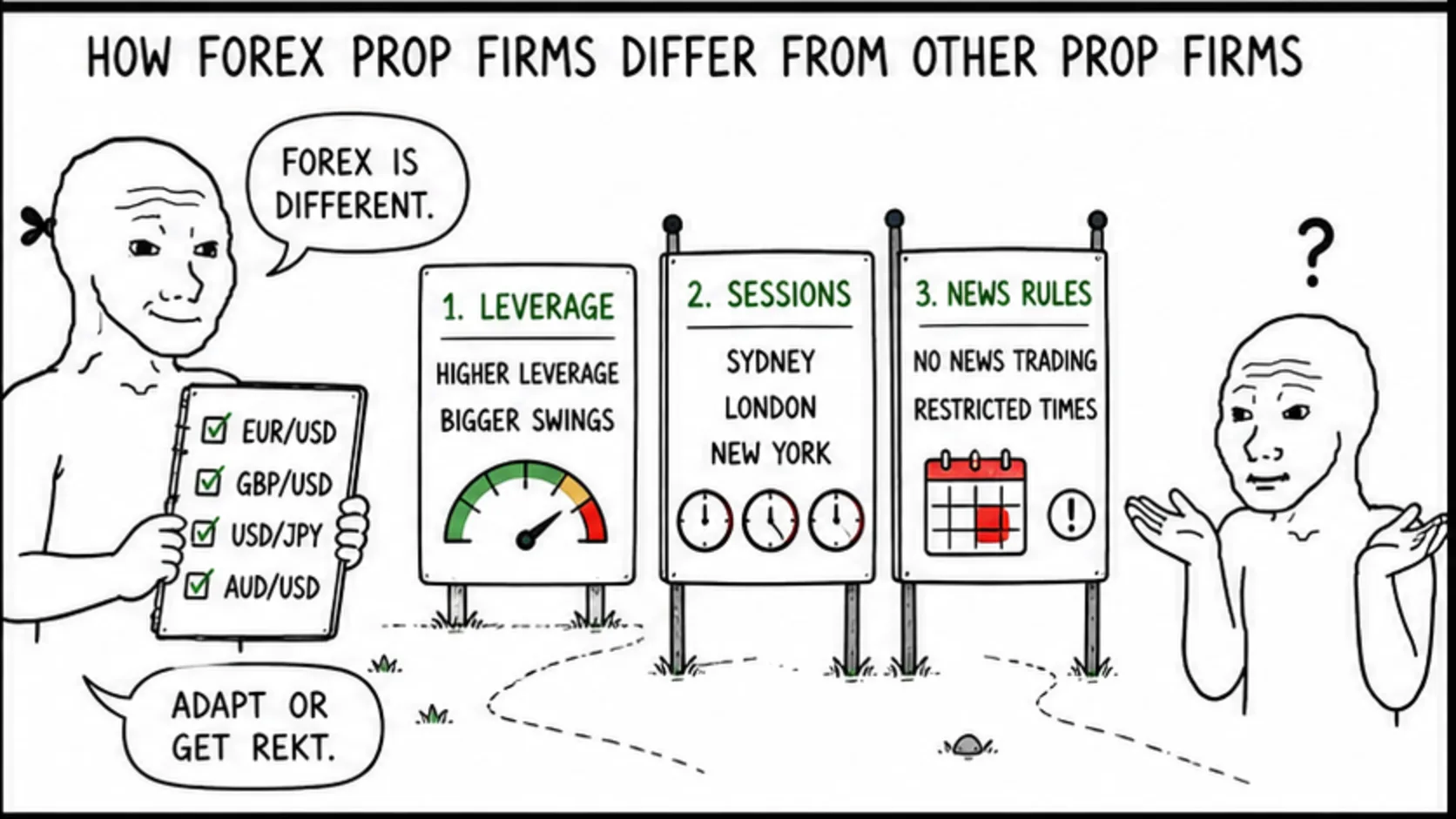
The core prop firm model is the same regardless of what you trade. But forex prop firms have some specific characteristics.
Trading hours. The forex market runs 24 hours a day, five days a week. This gives forex prop traders flexibility that futures and stock traders do not have.
Leverage. Forex prop firms typically offer leverage between 1:30 and 1:100, sometimes higher. Futures prop firms use contract-based position sizing instead.
Platforms. Forex firms use MetaTrader 4, MetaTrader 5, or cTrader. Futures firms use NinjaTrader, TradingView, or proprietary platforms.
Account sizes. Forex prop firms tend to offer larger account sizes, from $5,000 to $200,000. Futures firms often have smaller maximums.
Spreads and commissions. Forex traders deal with variable spreads that widen during news events. Futures traders pay fixed commissions per contract.
The Currency Pairs You Can Trade
Not every currency pair is available at every forex prop firm. Here is how the landscape breaks down.
Major pairs are available everywhere. EUR/USD, GBP/USD, USD/JPY, and USD/CHF are the bread and butter of forex prop trading. They offer tight spreads and deep liquidity.
EUR/USD accounts for approximately 27% of daily forex volume. It is the most traded pair in the world and the default choice for most prop traders.
Minor pairs like EUR/GBP, AUD/NZD, and GBP/JPY are available at most firms. They have wider spreads but still offer decent liquidity.
Exotic pairs like USD/TRY, EUR/ZAR, and USD/MXN are restricted at many firms. The spreads are too wide and the liquidity too thin for reliable prop trading.
Some firms also allow trading gold (XAU/USD), silver, and a few indices alongside forex pairs. Check the firm's instrument list before you sign up.
Trading Platforms Used by Forex Prop Firms
The platform you trade on is determined by the prop firm. You do not get to choose.
MetaTrader 4 is still the most widely used platform in the forex prop firm space. It has been around since 2005 and is familiar to most forex traders.
MetaTrader 5 is the newer version with additional features like more order types and a built-in economic calendar. Some firms have migrated to MT5, others still use MT4.
cTrader is used by a smaller number of firms. It offers a cleaner interface and faster execution, but has a smaller user base than MetaTrader.
TradingView integration is becoming more common. Some firms let you analyse on TradingView while executing on MetaTrader, or offer direct TradingView execution.
The platform matters less than you think. If you have a solid strategy, you can execute it on any of these platforms. Do not let platform preference drive your firm choice.
How Forex Prop Firm Evaluations Work
The evaluation process for forex prop firms follows the same structure as other prop firms, but with forex-specific parameters.
You choose an account size, pay the fee, and receive your platform credentials. The firm sets a profit target, usually 8-10%, and risk rules that apply specifically to forex trading.
The challenge mechanics are the same. Hit the target without breaking any rules and you advance. Break a rule and the evaluation ends.
Forex-specific considerations include lot size limits that prevent oversized positions, spread restrictions during news events when spreads widen dramatically, and swap considerations for positions held overnight.
The evaluation tests whether you can manage forex-specific risks like sudden spread widening during news, gap risk over weekends, and the psychological pressure of 24-hour markets.
The Rules Specific to Forex Prop Trading
Most rules are the same across all prop firm types. But forex prop firms have some additional restrictions you need to know about.
News trading restrictions. Some firms restrict trading around major economic events like NFP, FOMC, or ECB rate decisions. The spread during news time is not your friend. It has never been your friend.
Weekend holding rules. Many firms require you to close all positions before the Friday market close. Holding over the weekend introduces gap risk that the firm does not want.
Lot size limits. The firm may cap your maximum lot size per trade to prevent oversized positions that could cause rapid drawdowns.
The daily loss limit applies to your total equity including floating profit and loss. A position that moves against you during the day counts toward your daily loss even if you have not closed it yet.
Swap-free accounts. Some firms offer Islamic accounts that do not charge overnight swaps. These are useful for traders who hold positions for multiple days.
Leverage and Lot Sizes in Forex Prop Firms
Leverage in forex prop firms is a double-edged sword. Understanding how it works is essential before you start trading.
Most firms offer leverage between 1:30 and 1:100. With 1:100 leverage on a $50,000 account, you can control positions worth up to $5,000,000.
That sounds enormous, and it is. But the firm's risk rules constrain how much of that leverage you can actually use.
Your daily loss limit and maximum drawdown effectively cap your position sizes far below the maximum leverage. On a $50,000 account with a 5% daily loss limit, you can lose a maximum of $2,500 per day.
At 1:100 leverage, a single standard lot on EUR/USD is worth approximately $10 per pip. A 250-pip adverse move would hit your daily loss limit. The risk rules are what keep you safe, not the leverage cap.
Position sizing should be based on your risk parameters, not the maximum leverage available.
Are Forex Prop Firms Regulated?
The short answer is no, not in the way you might expect.
Retail forex prop firms are not regulated by financial authorities like the Financial Conduct Authority or the Commodity Futures Trading Commission because they do not hold client deposits or provide investment advice.
This means consumer protections are limited. If a prop firm stops paying out or disappears entirely, there is no regulatory body to file a complaint with.
However, the established firms have built their reputations on consistent payouts. Firms that have been operating for multiple years with verifiable payout records are generally trustworthy.
Do your own research before paying any firm. Check Reddit threads, Discord communities, and independent review sites for recent payout experiences.
Choosing the Right Forex Prop Firm
Not all forex prop firms are created equal. Here are the factors that actually matter.
Payout reliability is number one. The only thing that matters is whether the firm actually pays. Check recent payout proof, community feedback, and how long the firm has been operating. Beyond payouts, learning how to choose a prop firm without affiliate bias means looking past the rankings and evaluating what actually fits your trading style.
Rule structure matters because it determines how you trade. Some firms have strict trailing drawdowns, others use static drawdowns. Some require minimum trading days, others do not.
Platform choice affects your workflow. If you have been trading on MT4 for years, switching to cTrader for a prop firm adds unnecessary friction.
Account sizes and fees should match your experience level. Start with a smaller challenge account and scale up after proving you can pass.
Getting Started With Your First Forex Evaluation
If you are ready to try a forex prop firm evaluation, here is the practical path forward.
First, master one or two currency pairs. Do not try to trade everything. EUR/USD is the obvious starting point because of its tight spreads and deep liquidity.
Second, practise your strategy on demo for at least four weeks. Track every trade. If you are not profitable on demo, you will not be profitable on an evaluation.
Third, choose a firm with rules that match your trading style. If you hold positions overnight, make sure the firm allows it. If you trade news, check their news trading policy.
Fourth, read every rule before you pay. Understand the daily loss limit, maximum drawdown, trailing drawdown, consistency rule, and any forex-specific restrictions.
Fifth, execute. Buy one evaluation, follow your plan, and respect the rules. The traders who pass are the ones who treat it like a risk management test, not a trading competition.
