
Daily loss limits are firm-level rules, but the risk principle is regulatory common sense. The CFTC forex advisory warns how quickly leveraged losses can escalate.
The daily loss limit is the rule that ends more prop firm challenges than any other. Not the max drawdown. Not the consistency rule. Not news trading violations. The daily loss limit.
This is the rule sitting there, watching you, waiting for you to make one stupid decision after two consecutive stop-outs. And you will. Almost everyone does at least once before they learn.
Here is everything you need to know about the daily loss limit in prop trading, including how it is calculated, where traders go wrong, and how to set your own personal limit that keeps you safe.
Key Takeaways
- The daily loss limit caps how much you can lose in one trading day, typically 4-5% of account balance.
- It is the most commonly breached prop firm rule, usually after emotional revenge trading. If you believe a breach was triggered unfairly, here is how to dispute a rule violation.
- Daily loss limits can be balance-based or equity-based, and the difference matters. Whether the firm measures drawdown at EOD or intraday also affects how the daily limit is enforced.
- Your personal daily loss limit should be 60-70% of the firm's maximum to create a safety buffer.
- Swaps, commissions, and slippage all count toward the daily loss limit at most firms.
On This Page
What Is a Daily Loss Limit in Prop Trading?
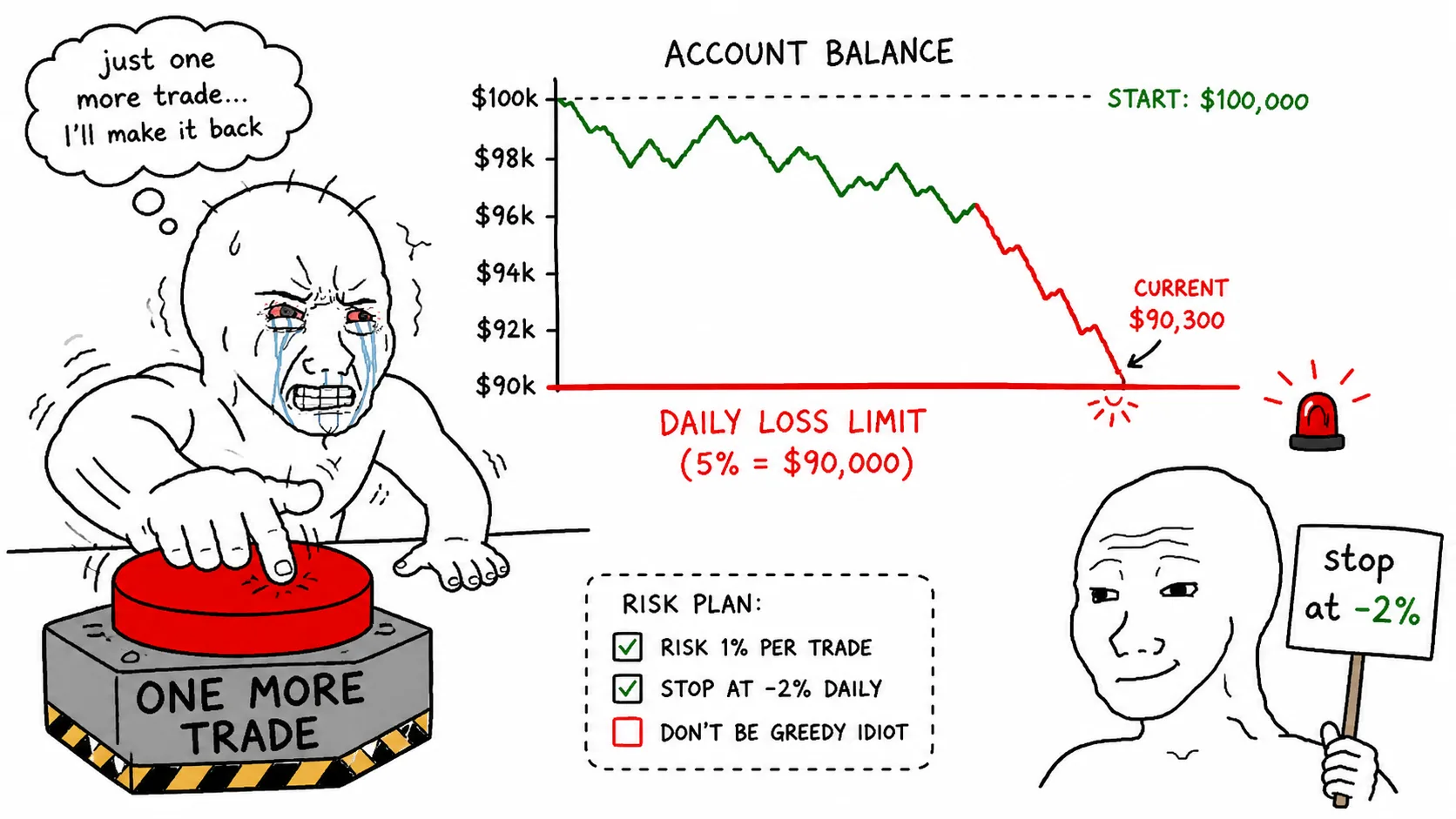
A daily loss limit is exactly what it sounds like. A hard ceiling on how much you can lose in a single trading day. It is the single most important rule on any prop firm account, and the one most traders ignore until it costs them.
On a $50,000 account with a 5% daily loss limit, you can lose up to $2,500 before the firm steps in and closes everything. Go $2,501 in the red for the day, and your challenge or funded account is done.
In practice, I treat the firm's limit as the emergency brake, not the working brake. If the dashboard says 5%, my personal stop is lower, because the final half-percent is where spread, slippage, and bad decisions tend to meet.
Most firms set the daily loss limit between 4% and 5%. Some go as low as 3%, a few go up to 6%. The exact percentage depends on the firm, the account size, and the evaluation tier you choose.
90% of traders fail prop challenges. That means 9 out of 10 of you will donate money to a prop firm and get nothing back. And the daily loss limit is the toll booth most of you pass through on the way out. Not because the rule is unfair, but because losing is easier than stopping.
How the Daily Loss Limit Is Calculated
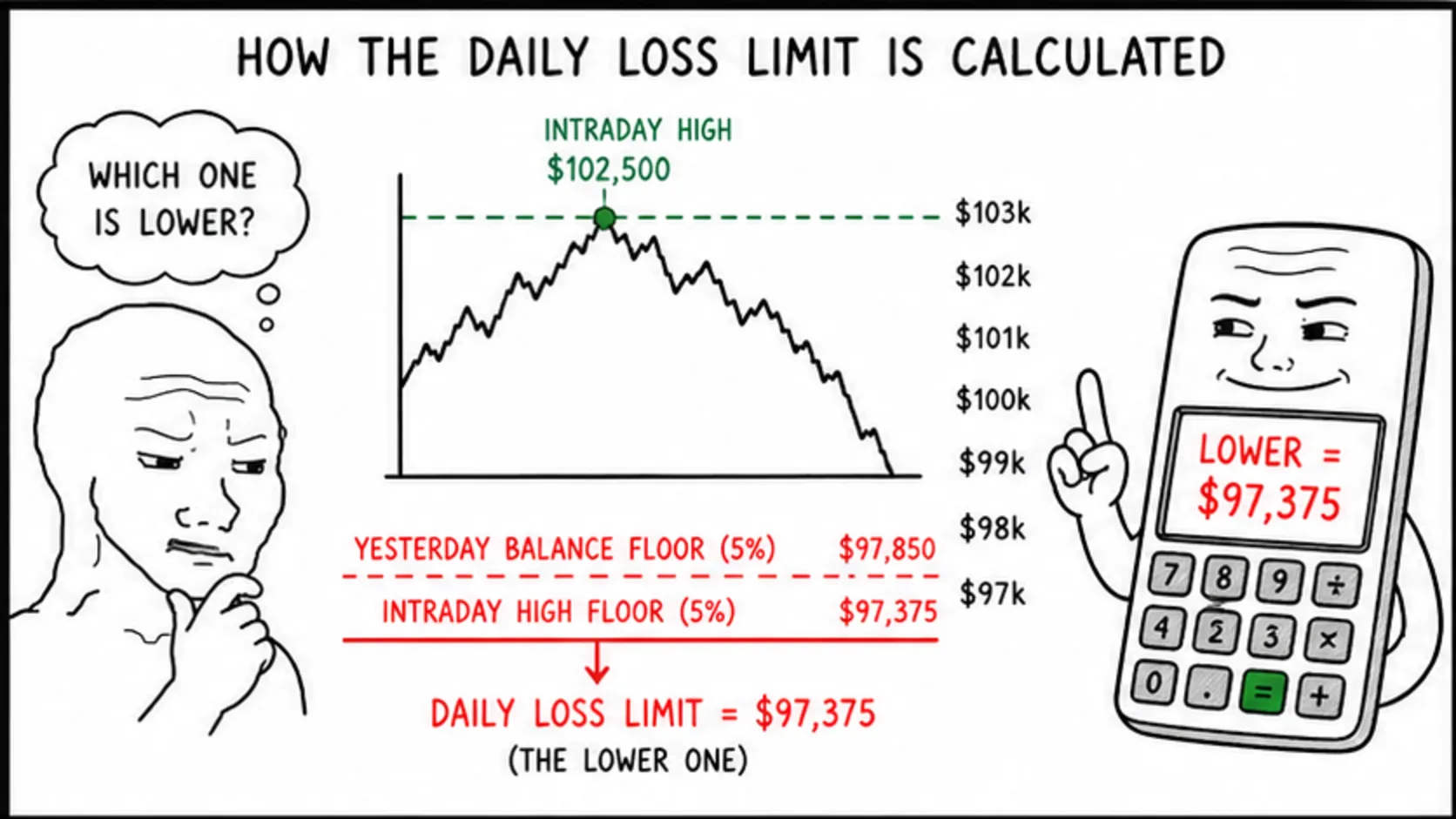
The daily loss limit resets at midnight server time. Not your local time. Server time. Which varies by firm. Some use New York time, others use London or UTC. Know which one your firm uses before your first trade.
Let us say you have a $100,000 account with a 5% daily loss limit. Your daily loss ceiling is $5,000. If your closed and floating losses for the day reach $5,000 from the day's starting point, the firm closes your positions and locks you out.
Critical point: this includes unrealised losses. If you have open positions that are losing $4,500 and you have already closed $500 in losses today, your total daily loss is $5,000. Even though the $4,500 has not been realised yet, it counts.
This catches traders off guard all the time. They think floating losses do not count. They do. The firm sees your equity, not just your closed PnL.
Balance-Based vs Equity-Based Calculation
Here is where it gets nuanced. Firms calculate the daily loss limit differently, and the method they use changes your actual risk.
Balance-based calculation uses your starting balance at the beginning of the day. On a $100,000 account with 5% daily loss, your floor is always $95,000 for that day regardless of what happened yesterday.
Equity-based calculation uses your current equity. If you made $2,000 yesterday and your balance is now $102,000, your daily loss floor might be based on the previous day's closing equity. This is more restrictive because the reference point keeps shifting.
Why does this matter? Because on equity-based accounts, your daily loss limit can actually shrink after losing days. The balance-based method gives you the same runway every day. Know which one your firm uses.
The Reddit thread comparing 5% daily loss limits across firms is full of people who did not realise their firm used equity-based calculation until they breached it. Do not be that person. Read the FAQ or ask support.
Why Traders Keep Breaching the Daily Loss Limit
The daily loss limit is not breached by accident. It is breached on purpose by traders who know they are close to the edge but convince themselves one more trade will fix everything.
Here is the standard pattern. You lose on your first trade. Annoying but fine. You lose on your second trade. Starting to feel it. Third trade, another loss. Now you are at 3% of your daily limit and you are angry.
Your brain says: size up, make it back, you know the setup now. Your brain is lying. You are emotional, oversized, and about to blow through the remaining 2% in one reckless trade.
This is a certified account-nuke moment. And it happens thousands of times a day across every prop firm on the internet.
Some traders even deliberately push past the limit because they think the firm will give them a second chance. Prop firms do not give second chances. The breach is automated. The account is closed. The fee is gone.
What Should Your Daily Loss Limit Be?
Your personal daily loss limit should be lower than the firm's maximum. Significantly lower.
The standard recommendation is 60-70% of the firm's limit. If the firm allows 5% daily loss, your personal stop-trading point is 3%. The remaining 2% is your emergency buffer for slippage, spread widening, and the occasional bad fill.
That buffer is not trading budget. It is insurance. Use it only when market conditions cause losses beyond your control, not when you decide to take one more trade after hitting your personal limit.
For traders using a risk calculator, this means setting your daily stop at 3% and then walking away from the screen. Physically. Close the laptop. Go outside. The market will be there tomorrow.
If you are scalping or trading futures with tight stops, you might want to go even lower. 50% of the firm's limit gives you maximum protection but requires more patience to hit your profit targets.
Strategies to Manage Your Daily Loss Limit
You already know this. You just do not do it. That is the problem.
Strategy one: track your daily loss in real time. Before every trade, know exactly how much room you have left. Not roughly. Exactly. Down to the dollar.
Strategy two: set a hard stop after two consecutive losses. Not after hitting your daily limit. After two losses. Most traders who breach the daily limit do it on trades three through five, not trades one and two.
Strategy three: use an alarm. Set a timer for your trading session. When it goes off, close everything and evaluate. Do not just keep trading because you have time left.
Strategy four: keep a journal. Write down your emotional state after each trade. If you write frustrated, annoyed, or desperate after a losing trade, stop immediately. Those words are predictors of a daily loss breach.
Strategy five: never trade the last hour of your session if you are already down for the day. The last hour is where bad decisions concentrate. Everything feels urgent because the day is ending, but the urgency is fake. The market does not care about your daily timeline.
Hidden Costs That Count Against Your Limit
Swaps, commissions, and spread costs all count toward your daily loss limit at most firms. This means your effective trading buffer is smaller than the headline number.
On a $50,000 account with a 5% daily loss limit, you have $2,500 of room. But if your average round-trip commission is $7 per lot and you trade 10 lots, that is $70 per trade in commissions alone. Ten trades a day and you have burned $700 in costs before any actual trading losses.
Slippage during volatile periods adds even more. Your stop loss gets filled $50 worse than expected, and that $50 comes out of your daily loss budget. These small leaks add up fast.
The fix is to factor costs into your position sizing. If you risk $200 per trade, your real risk is $200 plus commission plus potential slippage. Size your positions based on total cost, not just the distance to your stop loss.
Being honest about costs is not exciting. But it is the difference between traders who last and traders who get margin-called on day three.
