
Consistency rules exist because firms want controlled risk, not one lucky oversized trade. The ESMA investor corner is a useful independent reminder of why retail risk controls matter.
The consistency rule in prop firms is the one that catches people off guard. You hit your profit target, you celebrate, and then you find out your challenge failed because one good day did all the heavy lifting. That is the consistency rule doing its thing.
Most traders focus on drawdown limits and daily loss caps. Fair enough, those are the rules that blow accounts. But the consistency rule is the silent killer. It does not lose you money. It loses you the challenge after you already made the money.
Here is exactly how the consistency rule works, what different thresholds mean, and how to structure your trading so you never fail it.
Key Takeaways
- The consistency rule limits how much of your total profit can come from a single trading day, typically 25-35%.
- Common thresholds include 15%, 20%, 25%, 30%, and 35%, each with different implications for your trading style.
- The rule exists to filter out lucky one-day wins and reward traders who produce steady, repeatable results.
- You can beat the consistency rule by capping daily profits, using fixed lot sizes, and spreading gains across minimum trading days.
- Some prop firms have no consistency rule, but they often compensate with stricter drawdown or time limits.
On This Page
What Is the Consistency Rule in Prop Firms?
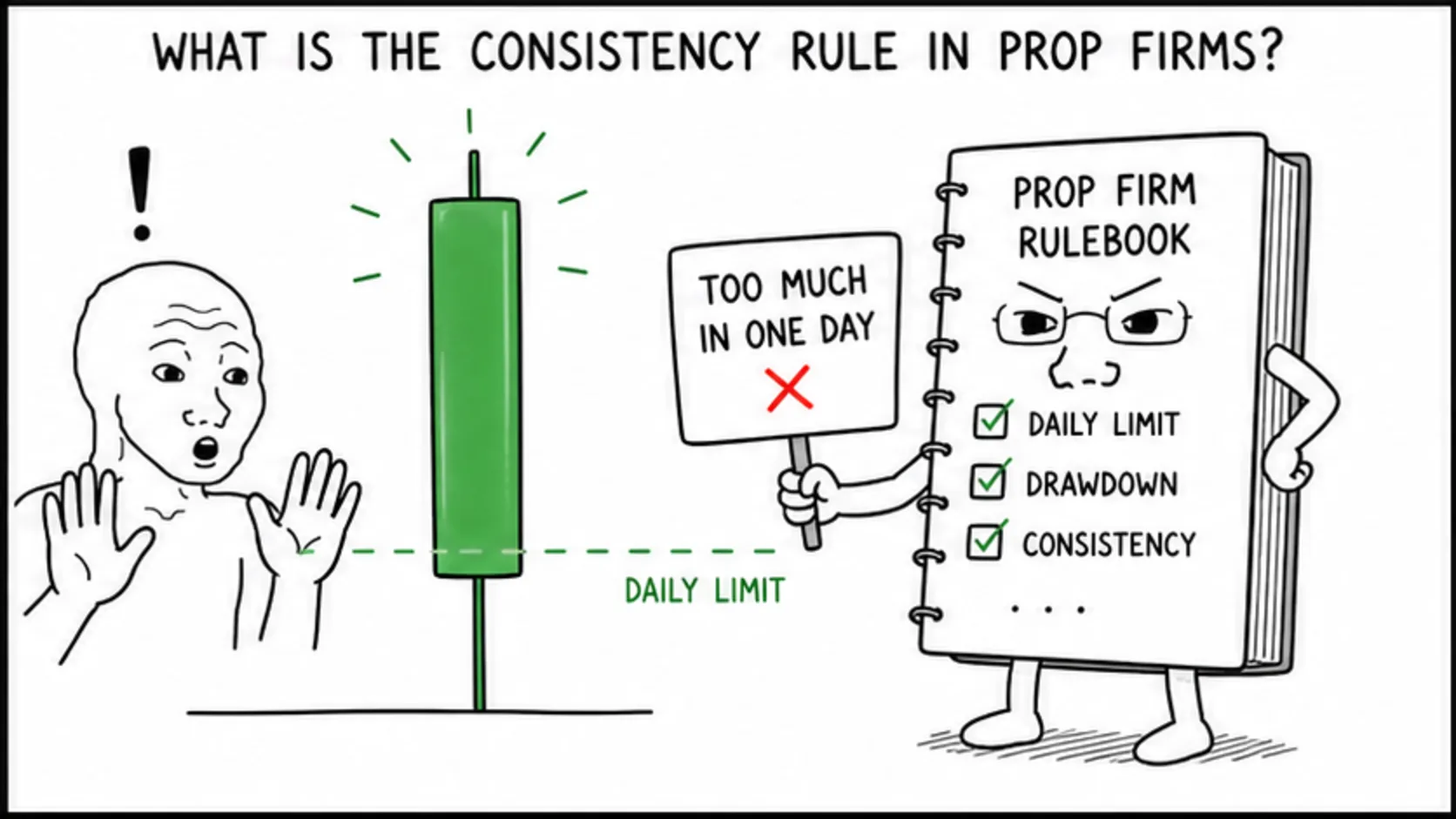
The consistency rule is a restriction that limits how much of your total profit can come from any single trading day. If your best day accounts for too much of your total gains, you fail the rule even if you hit the profit target.
Think of it like this. The firm wants to fund traders who can produce reliable daily results, not someone who got lucky on one trade and then coasted. The consistency rule is their filter.
The rule is usually expressed as a percentage. A 30% consistency rule means your best trading day cannot represent more than 30% of your total net profit. Go above that, and your challenge does not pass.
Some traders think this is unfair. You made the money, why does it matter how you made it? The firm's perspective is different. They are about to hand you real capital. They want proof that your edge is repeatable, not that you caught one good move and hung on for dear life.
Why Prop Firms Use the Consistency Rule
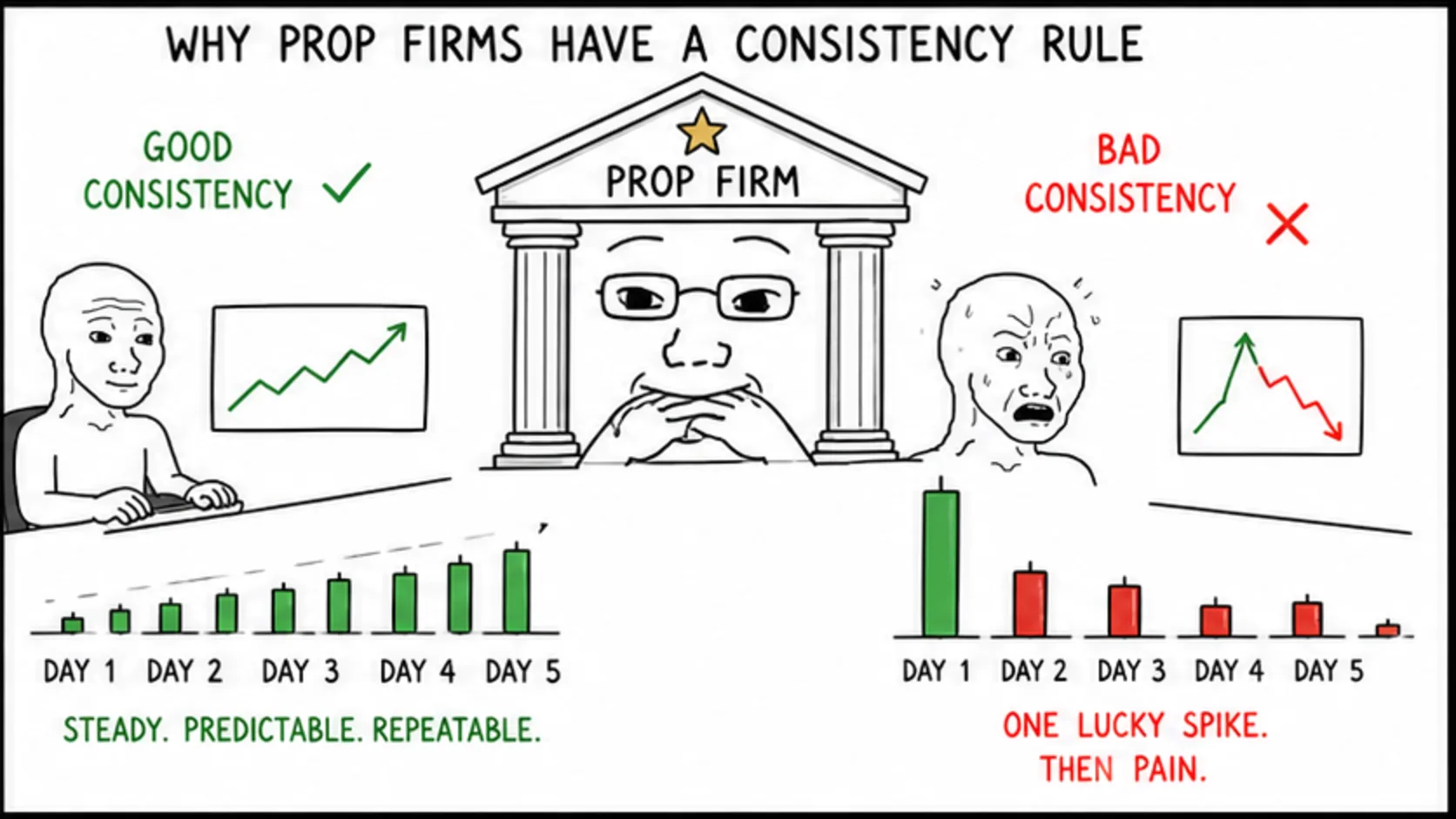
Prop firms are not charities. They are businesses that make money when traders pass evaluations and lose money when funded traders blow up. The consistency rule helps them answer one question before giving you capital: can this person produce results more than once?
A trader who makes $4,000 in one day and loses $1,000 over the next nine days looks profitable on paper. But their edge is fragile. One bad week and the firm is on the hook for losses.
A trader who makes $400 a day for ten days straight has a process. That is the trader the firm wants to fund. The consistency rule is designed to find that second person and filter out the first.
The rule also protects traders from themselves. You might think hitting a massive winning trade on day two of your challenge is a dream start. Little do they know, it can actually make passing harder because every remaining day needs to contribute enough to dilute that one big win below the consistency threshold.
Consistency Rule Thresholds Explained: 15% to 35%
Not all consistency rules are created equal. The percentage threshold changes everything about how you need to trade. Here is a breakdown of the most common ones.
The 15% Consistency Rule
This is brutal. Your best day can only be 15% of total profit. On a $3,000 profit target, your biggest day is capped at $450. This is rare and usually found on funded accounts where the firm wants iron-clad proof of consistency.
If you are a swing trader who takes fewer but larger trades, the 15% rule is basically designed to make your life miserable. You need to either take smaller positions or find a way to spread your gains across more days.
The 20% Consistency Rule
What is a 20% consistency rule? It means no single day can account for more than 20% of your total profits. Still strict, but more manageable than 15%. On $5,000 total profit, your best day is capped at $1,000.
This forces you to trade almost every day with similar results. One big win and you need four more equally good days to dilute it. Most day traders can work with this if they keep their lot sizes consistent.
The 25% Consistency Rule
The 25% consistency rule for prop firms is a middle ground. Your best day can be up to a quarter of your total profit. On $4,000 total, that is $1,000 max for your best day.
This is where things start to feel reasonable for most trading styles. You can have a slightly better day here and there without panicking, but you still need to show up consistently.
The 30% Consistency Rule
The most common threshold. Your best day can be up to 30% of total profit. Reddit is full of people complaining about this one, calling it unfair or unnecessary. It is neither. It is the standard.
On a $5,000 profit target, your best day can be $1,500. That is a good day by any measure. If you cannot pass with a 30% threshold, the problem is not the rule. The problem is that one trade is doing all the work.
The 35% Consistency Rule
The 35% consistency rule is more lenient. Your best day can be up to 35% of total profit. This gives swing traders and position traders more breathing room since their profits naturally cluster around fewer days.
If you are the type of trader who takes 2-3 trades per week instead of 5-10 per day, a 35% threshold is your friend. You still need consistency, but the firm acknowledges that your style produces lumpier results.
How the Consistency Rule Is Calculated
The calculation is straightforward once you know the formula.
Step one: add up all your daily profits and losses to get your total net profit.
Step two: find your best single day in terms of profit.
Step three: divide your best day by your total net profit and multiply by 100.
If the result is above the consistency threshold, you fail. If it is below, you pass.
Here is the critical detail most people miss. Losing days do not dilute your best day. If you make $3,000 on Monday, lose $500 on Tuesday, and make $500 on Wednesday, your total profit is $3,000. Your best day is $3,000. That is 100% of your total profit from one day. The losing days do not help you.
Only profitable days count toward diluting your best day. You need more good days, not fewer bad days, to pass the consistency rule.
Worked Example: $100,000 Account With 30% Rule
Let us walk through a real scenario so you can see exactly how this plays out.
You have a $100,000 account with a 10% profit target ($10,000) and a 30% consistency rule.
Your trading results over 15 days look like this. Day 1: +$800. Day 2: +$600. Day 3: +$1,200. Day 4: -$300. Day 5: +$900. Day 6: +$500. Day 7: +$3,500. Day 8: +$700. Day 9: +$1,100. Day 10: +$1,000. Day 11: +$400. Day 12: +$650. Day 13: +$850. Day 14: +$750. Day 15: +$1,350.
Total profit: $12,500. Best day: $3,500 (Day 7). Consistency check: $3,500 divided by $12,500 equals 28%. Under 30%. You pass.
But what if Day 7 was $4,500 instead of $3,500? Then your total would be $13,500 and your best day would be $4,500, which is 33.3%. Over 30%. You fail the consistency rule despite making more money in total.
This is why a huge single day can actually be dangerous. It sounds absurd, but there are traders on Reddit who deliberately lose small amounts on purpose after a big winning day to avoid failing consistency. Do not do that. Plan your trading so it never comes to that.
How to Beat the Consistency Rule
You have five missions when it comes to the consistency rule. Pay attention because this part actually matters.
Mission one: use fixed lot sizes. Every trade, same size. No scaling up because you feel confident. No doubling down because the setup looks perfect. Fixed lot sizes produce fixed-range results, and fixed-range results pass consistency checks.
Mission two: set a daily profit cap. If your firm has a 30% rule and your total target is $5,000, your max daily profit should be around $1,000. When you hit that cap, close the platform. Walk away. The extra $500 you might make is not worth failing the challenge.
Mission three: spread your trading across minimum days. Most firms require a minimum number of trading days anyway. Use all of them. Do not try to finish in three days because you will almost certainly fail the consistency rule.
Mission four: avoid news events during evaluations. News trades produce outsized moves. One NFP trade can generate more profit than ten normal days combined. That one trade will wreck your consistency ratio.
Mission five: bank profits early and slow down. If you are ahead of pace, reduce your position sizes for the remaining days. You do not need to keep hitting home runs. Singles and doubles win this game.
Mistakes That Trigger Consistency Violations
You have done this. Do not lie. You have done exactly this.
Mistake one: sizing up mid-evaluation. You have been trading 0.5 lots for ten days, things are going well, so you bump it to 2 lots on day eleven. That one trade produces four times your normal daily profit. Boom, consistency violation.
Mistake two: revenge trading into a massive win. You lose on three trades, get angry, size up to make it back, and the trade works. Congratulations, you just made $2,000 on a revenge trade and your consistency ratio is now wrecked. The universe has a sick sense of humour.
Mistake three: holding trades overnight into a gap. You hold a position over the weekend and Monday opens with a massive gap in your favour. Your single trade just produced more profit than the last ten days combined. The consistency rule does not care that it was a smart hold. It only sees the numbers.
Mistake four: ignoring the rule until payout. Some traders do not even check their consistency ratio until they hit the profit target. By then it is too late to fix it. Track your consistency daily, not just at the end.
Prop Firms Without a Consistency Rule
Some firms have no consistency rule at all. If this sounds like paradise, slow down. Firms without consistency rules often compensate with stricter drawdown limits, shorter time limits, or other restrictions.
Apex Trader Funding is one of the bigger names with no consistency rule. Topstep also does not enforce a consistency rule on their Trading Combine. Several futures-focused firms skip it entirely.
The trade-off is usually a tighter trailing drawdown or a requirement to hit profit targets in fewer days. The firm is still protecting itself. It just uses different tools.
Before choosing a firm specifically because it has no consistency rule, look at the full picture. A 30% consistency rule with a 12% max drawdown might be easier to navigate than no consistency rule with a 6% trailing drawdown that never stops chasing you.
If you are swing trading or holding positions for multiple days, a firm without a consistency rule or one with a 35%+ threshold is worth seeking out. If you are day trading with multiple entries per session, the standard 30% rule will rarely be a problem.
The people getting funded are not dodging the consistency rule. They are building a trading approach that naturally produces consistent daily results. Now you know it too. Go build one.
