
Challenge rules are private contract terms, not universal regulation. The FCA scam protection guidance is a useful reference when a firm buries key restrictions in its terms.
Prop firm challenge rules are the invisible walls around every evaluation. You cannot see them while you are trading, but the moment you touch one, your challenge is over. No warning, no second chance, no refund.
Most traders fail challenges not because they cannot trade, but because they do not fully understand the rules before they start. They read the headline numbers, skip the fine print, and then get surprised when their account disappears on day four.
Here is every rule you will encounter across most prop firm challenges, how each one works, and the specific mistakes that trigger violations.
Key Takeaways
- Prop firm challenge rules typically include daily loss limits, maximum drawdown, profit targets, consistency rules, and trading time restrictions.
- The daily loss limit is the most commonly breached rule, usually after emotional trading decisions.
- Rules vary significantly between firms. Never assume one firm's rules apply to another.
- The hardest rule to follow is not the strictest one. It is the one you break when you are emotional.
- Reading the full terms and conditions before purchasing any challenge is non-negotiable.
On This Page
What Are Typical Prop Firm Rules?
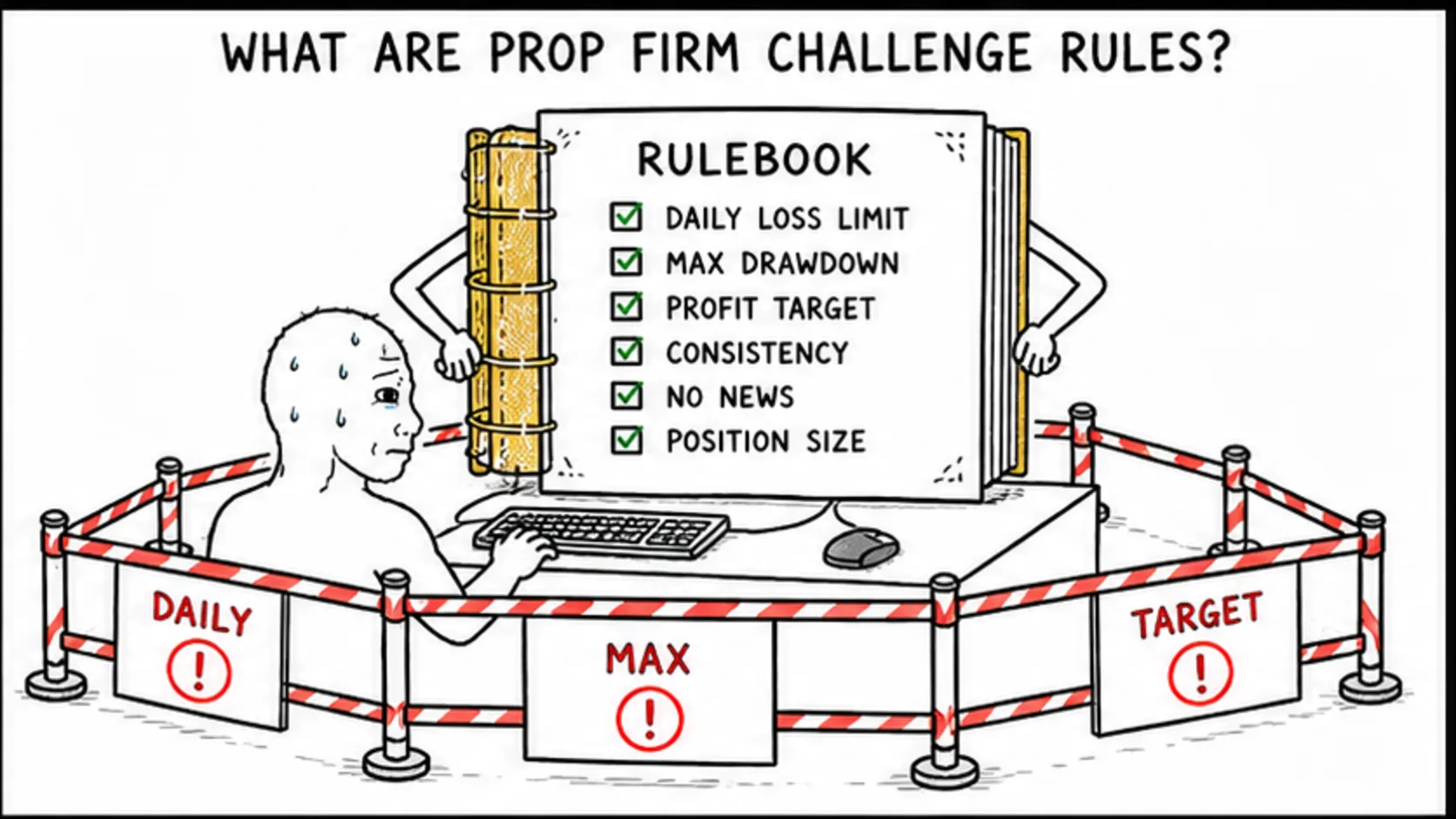
Most prop firm challenges share a core set of rules, even though the exact numbers differ. Here are the six you will find almost everywhere.
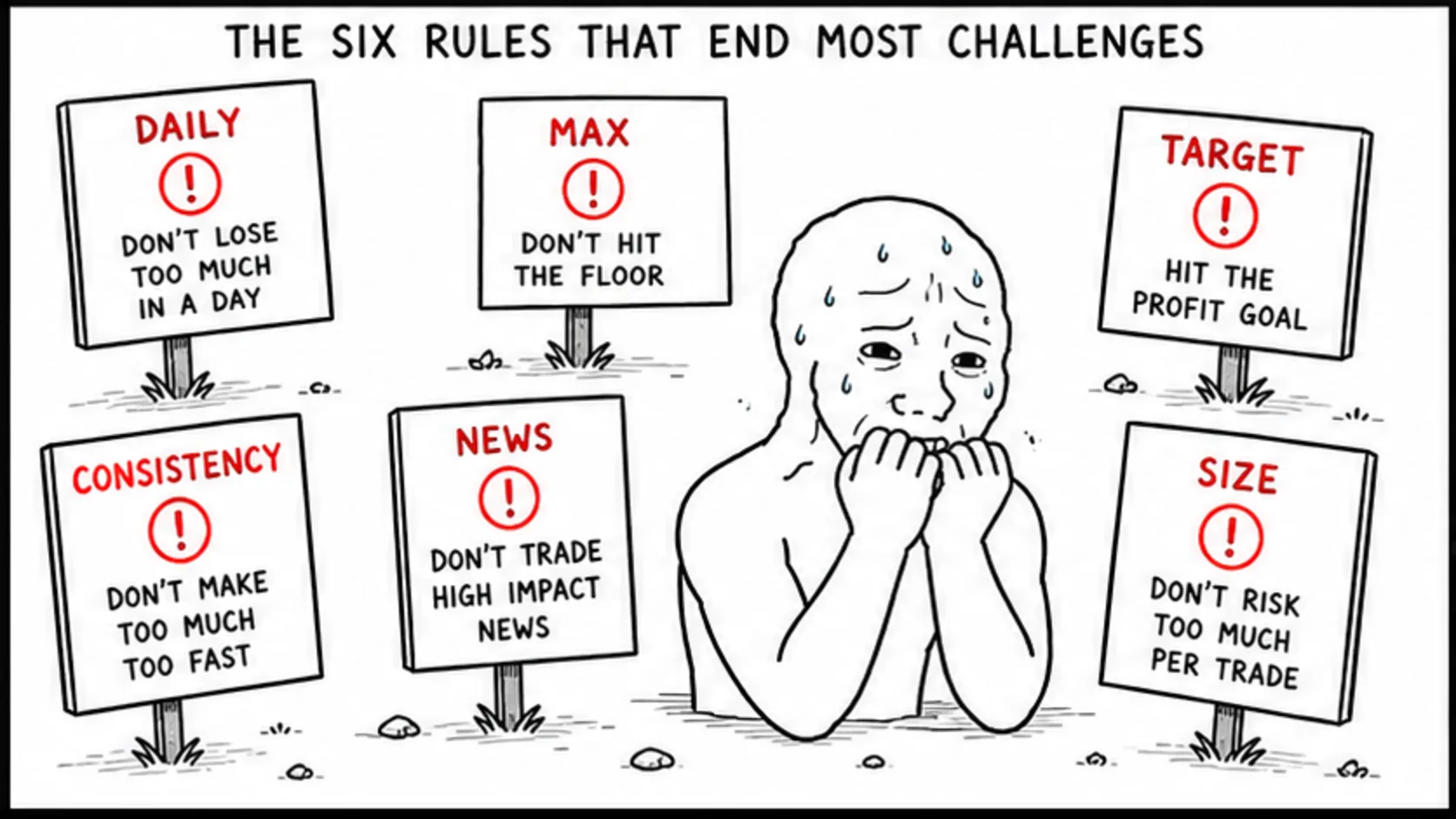
One: the daily loss limit. Usually 4-5% of your account balance. The most commonly breached rule in all of prop trading.
Two: the maximum drawdown. Typically 10-12% of your starting balance or trailing equity. Your total leash for the entire challenge.
Three: the profit target. Usually 8-10% for a one-step challenge, split into two phases for two-step challenges. The number you need to hit to pass.
Four: the consistency rule. Normally 30% of total profit from your best day. Prevents you from passing with one lucky trade.
Five: minimum trading days. Usually 5-10 days. Stops you from passing in two days with a single trade.
Six: trading restrictions. News trading windows, weekend holding rules, and prohibited strategies like hedging or copy trading.
These six rules form the framework of almost every prop firm evaluation. Miss any one of them and the challenge is over. Not sometimes. Always.
The Daily Loss Limit
The daily loss limit caps how much you can lose in a single day. On a $50,000 account with 5% daily loss, your ceiling is $2,500. Hit that number and the firm closes your account for the day or terminates the challenge.
This rule resets every day at midnight server time. New day, new limit. But here is the catch. If your daily loss breach also pushes your account below the maximum drawdown floor, the challenge is permanently closed.
The daily loss limit and the max drawdown work together. Think of the daily limit as a speed bump and the max drawdown as a brick wall. Hit the speed bump too fast and you go through the wall.
Your personal daily loss limit should be about 60-70% of the firm's maximum. If they give you 5%, stop trading at 3%. The extra room is your buffer, not your playground.
Maximum Drawdown
The maximum drawdown is your total leash for the entire evaluation. Typically 10-12% of the account balance, though some firms go as low as 8% or as high as 15%.
On a $100,000 account with 10% max drawdown, your equity cannot drop below $90,000 at any point. Not just at close. At any point. Including while you have open positions with floating losses.
This is where traders get confused. They think unrealised losses do not count. They do. The firm monitors your equity in real time. If your floating drawdown touches the max drawdown line, the account is closed automatically.
The max drawdown can be static or trailing. Static stays fixed at your starting balance. Trailing follows your highest equity point, which means your floor keeps rising as you make profits. Trailing drawdown is more restrictive and more common at major firms.
Profit Targets
The profit target is straightforward. Make this much money and you pass. For one-step challenges, it is usually 8-10% of the account balance. Two-step challenges split it into 10% for Phase 1 and 5% for Phase 2.
On a $50,000 account with a 10% target, you need $5,000 in closed profit. Open profits do not count. Only realised gains from closed trades move you toward the target.
Here is where the profit target becomes a psychological weapon. Every trader knows exactly where they stand relative to the target at all times. Being at 9.8% with two days left creates a very specific type of pressure that leads to very stupid trading decisions.
Fast forward past the emotional part. You hit the target, you celebrate, and then you check whether you passed the consistency rule. Because the profit target alone is not enough.
The Consistency Rule
The consistency rule says no single trading day can account for more than a certain percentage of your total profit. Usually 30%.
Make $5,000 total with $2,000 coming from one day. That is 40% from your best day. You fail the consistency rule. You do not pass the challenge. The firm keeps your fee.
This rule exists to filter out lucky trades. The firm wants to fund traders who produce repeatable daily results, not someone who hit one big winner and then coasted.
The fix is simple in theory. Use consistent lot sizes. Set a daily profit cap. Spread your trading across all minimum days. In practice, traders keep failing this rule because they size up when they feel confident. Do not size up. Ever. During a challenge, consistency is more important than profit.
Trading Restrictions: News, Weekends, and Prohibited Strategies
Most firms restrict trading during major economic news events. Typically no new positions 30 minutes before and 30 minutes after high-impact announcements.
The spread during news time is not your friend. It has never been your friend. It does not care about you or your challenge. Trading during a restricted news window will trigger an automatic flag and terminate the challenge.
Weekend holding restrictions are also common. Some firms require all positions closed before Friday's market close. Forget to close, and the violation can end your challenge.
Prohibited strategies include copy trading between accounts, hedging on the same instrument, martingale approaches, and grid trading. Some firms do allow copy trading under specific conditions. Some firms allow expert advisors, others ban them entirely. Check before you start.
If you are unsure whether your strategy violates a firm's rules, email their support team before you start. A two-minute email can save you hundreds of dollars in wasted evaluation fees.
What Is the 3-5-7 Rule in Trading?
You might have seen this mentioned in forums or trading groups. The 3-5-7 rule is not a prop firm rule. It is a general risk management guideline that some traders follow.
The idea is to risk no more than 1-3% of your account per trade, keep total open risk at 5% or less across all positions, and ensure no single sector or currency pair exposure exceeds 7% of your account.
This is solid risk management advice, but no prop firm enforces the 3-5-7 rule specifically. They have their own rules that cover similar ground in different ways. The daily loss limit caps your total daily risk, the max drawdown caps your total account risk, and position limits cap your per-trade exposure.
Following the 3-5-7 framework will generally keep you within most prop firm rules, but do not confuse it with the actual rules of your challenge. Read your firm's terms, not a Reddit thread.
The Hardest Rule to Follow
Ask any funded trader which rule is hardest to follow, and the answer is always the same. The daily loss limit. Not because it is the strictest rule, but because it is the one you break with your emotions, not your strategy.
The max drawdown creeps up on you over days. The consistency rule can be managed with planning. But the daily loss limit gets breached in a single moment of weakness. Two losses, rising frustration, one oversized trade to make it back.
Challenge rules exist because most traders cannot self-regulate. The daily loss limit stops you from revenge trading. The max drawdown stops you from riding a bad position into oblivion. The minimum trading days stop you from gambling your way to the target in a week. The rules are not obstacles. They are the structure most traders need but refuse to build for themselves.
The traders who consistently pass challenges are not more talented than you. They have systems that prevent emotional decisions. Daily loss tracking, hard stop rules after consecutive losses, and the discipline to close the platform when things go wrong.
Your Pre-Challenge Rule Checklist
Before paying for any evaluation, answer these questions. If you cannot answer all of them, do not start the challenge.
What is the daily loss limit percentage and how is it calculated? What is the maximum drawdown and is it static or trailing? What is the profit target for each phase? How many minimum trading days are required? What is the consistency rule threshold? Are there news trading restrictions and what events are covered?
Can you hold positions overnight? Can you hold over the weekend? Are expert advisors allowed? Are there maximum lot size limits? What timezone does the firm use for daily resets?
Write the answers down. Keep them next to your screen while you trade. Refer to them before every session. This sounds tedious. It is also the difference between passing and donating.
The people getting funded are not smarter than you. They just did this before they started. Now you can too.
