
Prop firm rules are the invisible walls around every funded account and evaluation challenge. They dictate how much you can lose, when you can trade, what you can hold overnight, and how consistent your profits need to be.
More traders fail from rule breaches than from bad trading. Your strategy could be genuinely profitable, your entries solid, and your analysis correct, and you could still lose your account because you ignored a single restriction.
Here is a complete breakdown of every major prop firm rule, how each one works, and how to avoid being the trader who learns about them the expensive way.
Key Takeaways
- Prop firm rules include daily loss limits, max drawdown, trailing drawdown, consistency rules, and trading restrictions that vary by firm.
- The daily loss limit is the most commonly breached rule, typically set at 4-5% of the account balance.
- Trailing drawdown follows your highest equity point, meaning you can be in profit and still breach it.
- Most rule breaches come from emotional decisions like revenge trading, not from lack of understanding.
- Reading the full terms and conditions before starting any evaluation is non-negotiable.
On This Page
The Daily Loss Limit: The Rule That Ends Most Challenges
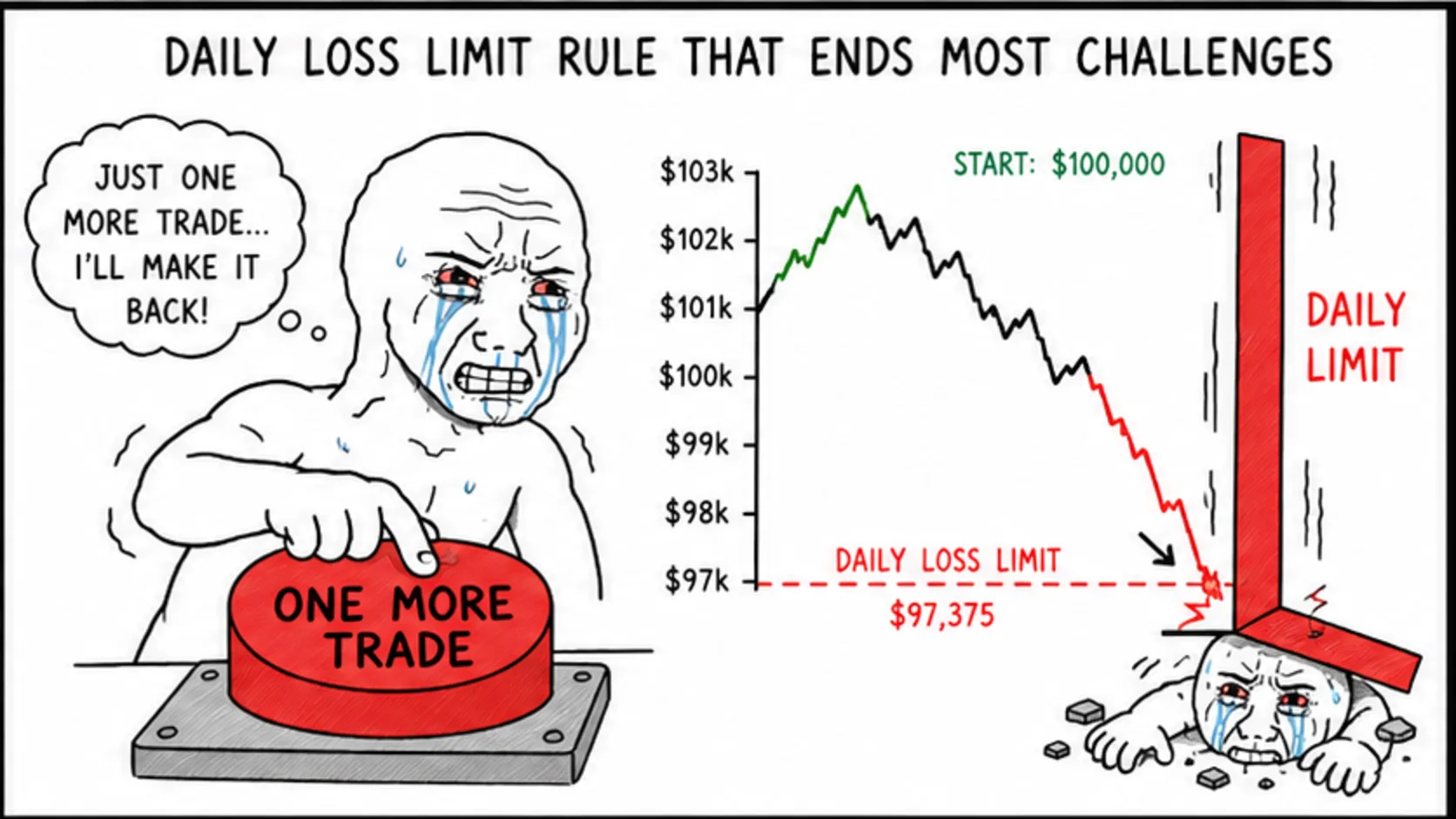
The daily loss limit is exactly what it sounds like. A ceiling on how much you can lose in a single trading day, usually set at 4-5% of the account balance.
On a $50,000 account with a 5% daily loss limit, you can lose up to $2,500 before the firm closes your account for the day or terminates the challenge entirely.
Your daily loss limit is sitting there, watching you, waiting for you to make one stupid decision. And that decision usually comes after two consecutive stop-outs when you decide to "make it back" with a larger position.
The daily loss limit resets at midnight server time, which varies by firm. Some firms use New York time, others use London or UTC. Know which timezone your firm uses before you start trading.
Most traders who breach the daily loss limit do it on purpose, not by accident. They know they are close to the limit but enter one more trade anyway because they believe it will work. It usually does not.
The solution is simple. Set a personal daily loss limit at 60-70% of the firm's limit. If your firm allows 5%, stop trading for the day at 3%. The extra 2% is your emergency buffer, not your trading budget.
Maximum Drawdown Explained
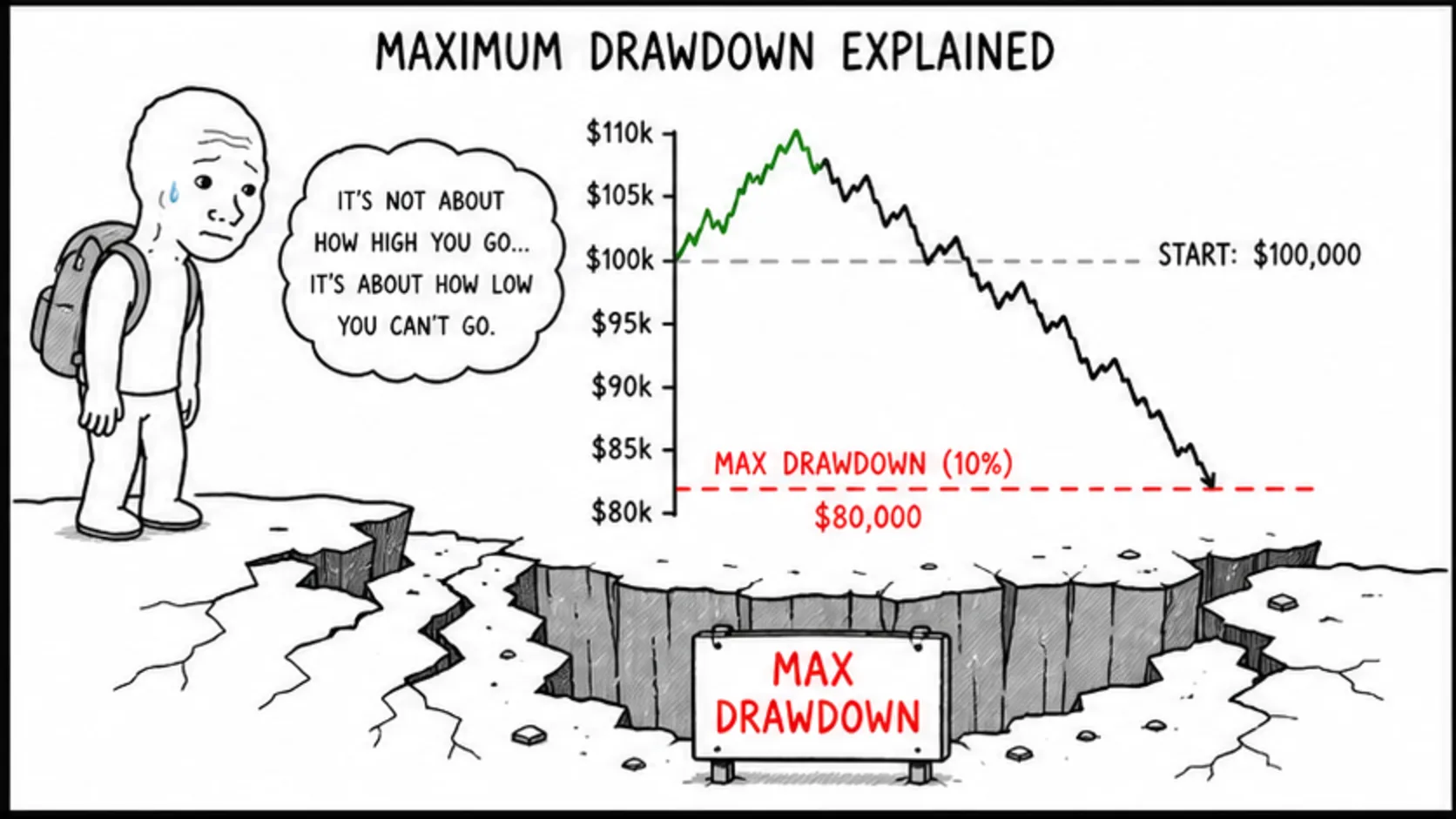
The maximum drawdown is your total leash. It is the maximum amount your account equity can fall from its reference point, typically 10-12% of the account balance.
On a $50,000 account with a 10% max drawdown, your equity cannot drop below $45,000 at any point. Breach that level and the challenge or funded account is closed.
Critical point: the max drawdown includes unrealised losses. If you have open positions that are $4,000 in negative floating PnL, that counts against your drawdown even though you have not closed the trades yet.
This catches traders off guard because they think "I have not lost that money yet." The firm disagrees. Your floating drawdown is real from the moment the position goes negative.
Max drawdown is measured differently by different firms. Some measure from the starting balance only. Others measure from the highest equity point, which is effectively a trailing drawdown.
Understanding exactly how your firm measures drawdown before you start trading is one of the most important things you can do. Read the terms, or ask support directly.
Trailing vs Static Drawdown
The trailing drawdown is the most misunderstood rule in prop trading. It follows your highest equity point, not your starting balance.
Here is how it works. You start with $50,000 and a 10% trailing drawdown. Your initial floor is $45,000. You make $5,000, so your account is now $55,000 and your floor moves up to $49,500.
You are still in profit, but if you give back more than $5,500 from your peak, you breach the trailing drawdown. Every dollar you make, the trailing drawdown creeps up behind you.
A static drawdown stays fixed at the starting balance. On a $50,000 account with 10% static drawdown, your floor is always $45,000 regardless of how much profit you make.
Static drawdown is more forgiving because your floor never moves. Trailing drawdown is more restrictive because it locks in your gains by raising the floor behind you.
The trailing drawdown is a dog that follows you around. You can run but you cannot shake it. Every profit you make, it catches up. It only bites when you start giving money back.
Most major firms use trailing drawdown. A few still offer static. Knowing which one your firm uses changes your entire trading approach during a challenge.
Consider this example to see why trailing drawdown is more dangerous. You start at $50,000, trade your way up to $60,000, and then give back $6,000. With static drawdown, your floor was always $45,000, so you are still safe at $54,000. With trailing drawdown, your floor moved to $54,000 when you hit $60,000, and giving back $6,000 puts you exactly at the floor. One more losing trade and you are out.
The European Securities and Markets Authority has noted that many retail traders do not fully understand the drawdown mechanics of prop firm accounts before purchasing evaluations. This lack of understanding contributes significantly to the high failure rates across the industry.
The Consistency Rule
The consistency rule says that no single trading day can account for more than a certain percentage of your total profit, usually 30-40%.
This rule exists to prevent traders from passing with one lucky trade. The firm wants to see consistent daily profits, not a single home run surrounded by losses.
If you make $5,000 total profit and $3,000 of it came from one day, you fail the consistency rule on most platforms. Your best day cannot dominate your results.
The fix is straightforward. Trade every day with consistent position sizes and consistent risk. Avoid sizing up dramatically on days when you feel confident.
Some firms enforce the consistency rule during the evaluation only. Others enforce it on funded accounts as well. Check your firm's terms to understand when it applies.
Profit Targets
The profit target is the amount you need to earn to pass the evaluation, typically 8-10% of the account balance for one-step challenges.
On a $50,000 account with a 10% target, you need $5,000 in closed profit. Open profits do not count. Only realised gains from closed trades move you toward the target.
Two-step challenges usually have different targets for each phase. Phase 1 might require 10% while Phase 2 only needs 5%. The reduced Phase 2 target rewards consistency.
The profit target is the simplest rule to understand but the hardest to achieve under pressure. Every trader knows exactly where they stand relative to the target at all times, which creates its own psychological burden.
News Trading Restrictions
Many prop firms restrict trading during major economic news events. This typically means no new positions 30 minutes before and 30 minutes after high-impact announcements.
The spread during news time is not your friend. It has never been your friend. It does not care about you or your challenge.
High-impact news events include Non-Farm Payrolls, Consumer Price Index, Federal Reserve interest rate decisions, and GDP releases. The exact list varies by firm.
If you already have a position open when news hits, some firms allow you to hold it while others require you to close before the announcement. Read your firm's specific rules.
Accidentally placing a trade during a restricted window will trigger an automatic flag on most platforms. The challenge will be terminated with no appeal.
Overnight and Weekend Holding Rules
Some firms restrict holding positions overnight or over the weekend. These rules protect the firm from gap risk, where markets open significantly different from their Friday close.
Weekend holding restrictions are more common than overnight restrictions. If your firm prohibits weekend positions and you forget to close before Friday's market close, the violation can end your challenge.
Overnight rules are less common but still exist at some firms. They typically require closing all positions before a certain time each day, often aligned with the New York close.
Set calendar reminders for yourself if your firm has weekend or overnight restrictions. One forgotten open position on a Friday evening can cost you an entire challenge.
Prohibited Strategies: Copy Trading, EAs, and Hedging
Most firms prohibit copy trading between accounts. You cannot mirror trades from one account to another, whether they are both with the same firm or different firms. Firms also track your IP address to detect account sharing and multiple-account trading.
Expert advisors (EAs) and automated trading bots are prohibited by some firms and allowed by others. If you use EAs, verify they are permitted before purchasing an evaluation.
Hedging, where you hold opposing positions on the same instrument, is prohibited by most prop firms. It is seen as a way to circumvent risk rules rather than a legitimate strategy.
Some firms also prohibit martingale strategies, grid trading, and other high-risk approaches. The common thread is that firms want to see genuine trading skill, not systematic risk-taking disguised as a strategy.
If you are unsure whether your strategy violates a firm's rules, ask their support team before you start trading. A two-minute email can save you hundreds of dollars in wasted evaluation fees.
Lot Size and Position Limits
Some firms impose maximum lot sizes per trade or per instrument. These limits prevent traders from taking oversized positions that could blow through drawdown limits in a single trade.
On a $50,000 account, a firm might cap you at 5 standard lots per position. This prevents you from opening a 50-lot trade that could lose $5,000 in minutes during a volatile market move.
Lot size limits are less about restricting your strategy and more about protecting the firm's capital. They exist because enough traders have blown accounts with oversized positions to make the rule necessary.
Even without explicit lot size limits, proper position sizing is fundamental to passing any challenge. Risking 1-2% per trade naturally keeps your lot sizes within reasonable bounds.
How to Avoid Breaking Rules
Most rule breaches are preventable with a few simple habits. Here is what consistently funded traders do differently.
Track your drawdown in real time. Use a drawdown calculator and check it before every trade. Know exactly how much room you have before hitting any limit.
Set personal limits at 60-70% of the firm's limits. If the daily loss cap is 5%, stop trading at 3%. This buffer protects you from the compounding effect of bad decisions.
Never trade immediately after a loss. Take a break, walk away, and come back with a clear head. Revenge trading is the number one cause of rule breaches across all prop firms.
Read the full terms and conditions before paying for any evaluation. Use a checklist to verify you understand every rule before you start.
The traders who never breach rules are not more disciplined by nature. They have systems in place that make breaching rules difficult. Build those systems before you start your next challenge.
Start by creating a daily trading checklist that includes checking your current drawdown, remaining daily loss room, and whether any high-impact news events are scheduled. This takes two minutes and prevents 90% of accidental rule breaches.
Use a physical timer or phone alarm for trading session boundaries. If your firm prohibits trading during certain hours, set an alarm to remind you to close positions before the restriction window begins.
Keep a trading journal that tracks not just your trades but your emotional state. Note when you feel frustrated, overconfident, or anxious. These emotional states are predictors of rule breaches, and recognising them early gives you time to step away before making a costly decision.
