
Trailing drawdown is not a regulator-mandated standard; it is a firm risk policy. The ESMA investor corner is a useful baseline for understanding why retail trading risk needs clear limits.
Trailing drawdown is the most misunderstood rule in prop firm trading. Traders think they understand it, start their challenge, and then watch their account get terminated while they are still in profit. That is the trailing drawdown doing exactly what it was designed to do.
The trailing drawdown is literally following you around. You cannot shake it. Every profit you make, it catches up. It is a dog that bites you when you are winning.
Here is exactly how trailing drawdown works, why firms use it instead of static drawdown, and how to trade around it without getting caught.
Key Takeaways
- Trailing drawdown follows your highest equity point, raising the floor as you make profits.
- You can be in profit and still breach a trailing drawdown if your account drops below the trailing floor.
- Static drawdown stays fixed at your starting balance and is more forgiving for most traders.
- Most major prop firms use trailing drawdown because it protects their capital from profitable traders who then give back gains.
- Managing trailing drawdown requires locking in profits early and avoiding large equity swings.
On This Page
What Is Trailing Drawdown in Prop Firms?
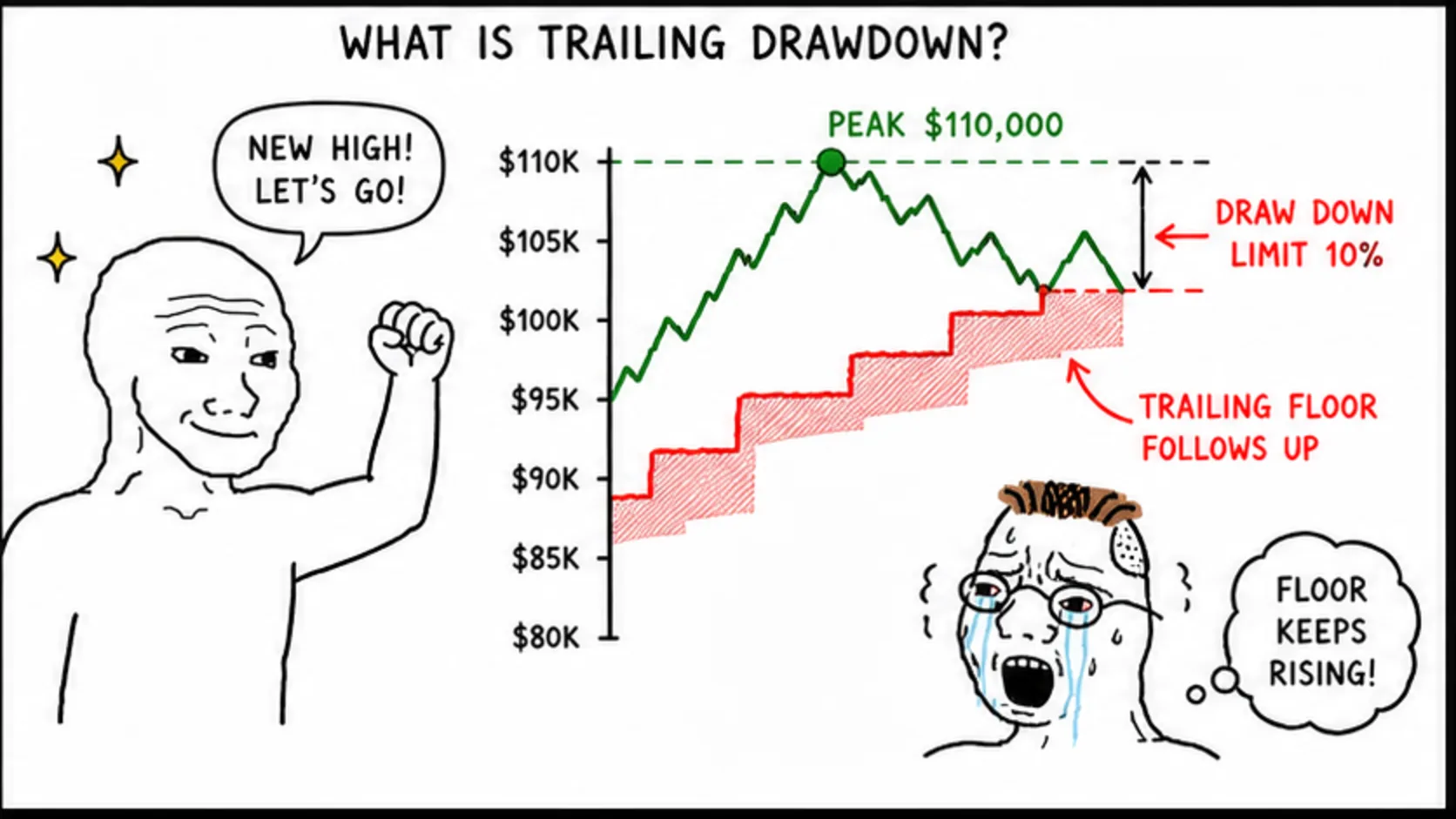
Trailing drawdown is a risk management rule that sets a floor beneath your highest account equity. The floor moves up every time your equity reaches a new high. It never moves down.
On a $50,000 account with a 10% trailing drawdown, your initial floor is $45,000. Make $5,000 and your equity is now $55,000. The floor trails up to $49,500. You are still in profit, but your safety margin has changed.
This is the rule that makes traders feel punished for winning. I have learned to treat new equity highs as a reason to reduce risk temporarily, not as permission to press harder, because the safety margin has just moved with you.
Unlike static drawdown, which stays fixed at the starting balance, trailing drawdown locks in your gains by raising the threshold. Every dollar you make, the trailing drawdown creeps up behind you.
The key word is trailing. It follows. It tracks your highest point and ensures you can never give back more than the trailing percentage from that peak.
How Trailing Drawdown Actually Works
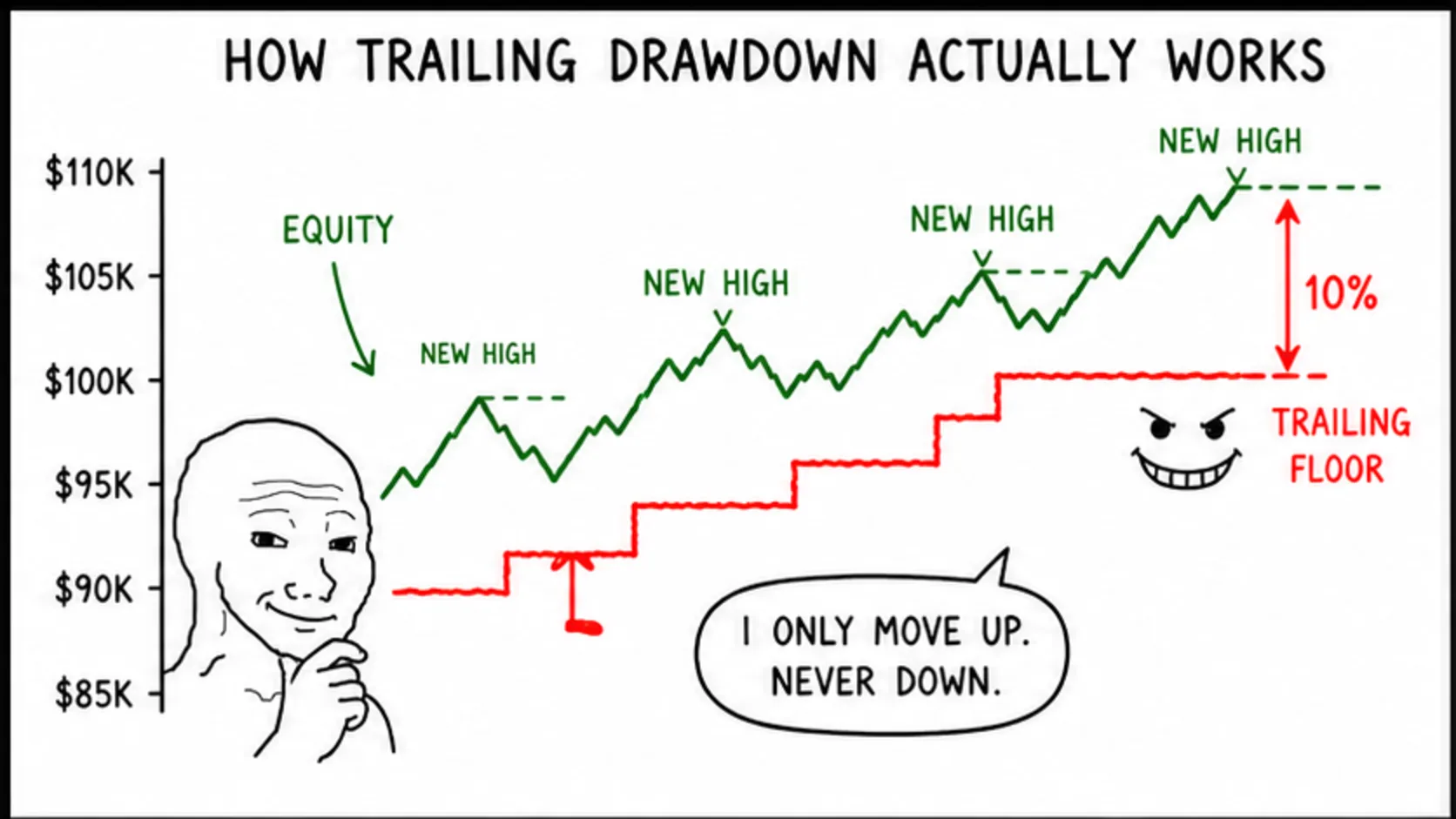
Let us walk through this step by step because the details matter.
You start with $50,000 and a 10% trailing drawdown. Floor: $45,000.
Day one, you make $2,000. Equity: $52,000. Floor moves to $46,800.
Day two, you lose $1,000. Equity: $51,000. Floor stays at $46,800 because your equity did not reach a new high.
Day three, you make $3,000. Equity: $54,000. Floor moves to $48,600.
Day four, you lose $2,500. Equity: $51,500. Floor stays at $48,600. You are $2,900 above the floor. Safe, but closer than you think.
Day five, you make $4,000. Equity: $55,500. Floor moves to $49,950.
Day six, you lose $4,000. Equity: $51,500. Floor is $49,950. You are now only $1,550 above the floor. You are still $1,500 in profit from your starting balance, but one more losing day and you breach.
Notice what happened. You made $6,000 total but the trailing drawdown turned a $6,000 profit cushion into a $1,550 safety margin. Every time you hit a new equity high, the floor chased you up.
This is why traders on Reddit constantly ask about workarounds for trailing drawdown. There are no workarounds. The only solution is understanding the math and trading within it.
Static vs Trailing Drawdown
Which is better, static or trailing drawdown? For most traders, static is more forgiving.
Static drawdown stays fixed at your starting balance. On a $50,000 account with 10% static drawdown, your floor is always $45,000 regardless of how much profit you make. You could grow the account to $70,000 and your floor is still $45,000.
Trailing drawdown follows your highest equity. Same $50,000 account, same 10%, but your floor moves to $63,000 when your equity hits $70,000. You can only give back $7,000 from your peak.
Here is a direct comparison to make this clear. Start at $50,000 with 10% drawdown. Both accounts grow to $60,000.
Static account: floor is still $45,000. You can lose $15,000 before breaching. Trailing account: floor is $54,000. You can only lose $6,000 before breaching.
Same starting balance, same percentage, same current equity. Completely different safety margins. That is the trailing drawdown effect.
Some firms offer both options. If you have the choice and you are not a highly consistent trader, take the static option. It gives you more room to recover from losing streaks. Drawdown timing also matters: firms measure drawdown differently depending on whether it is EOD or intraday.
Why Prop Firms Use Trailing Drawdown
Prop firms use trailing drawdown because it protects them from a specific type of trader. The one who makes money, then gives it all back, then makes it again, then gives it back again.
From the firm's perspective, this is dangerous. A trader whose equity swings wildly between profit and loss is more likely to eventually blow the account entirely. The trailing drawdown prevents large equity swings by locking in gains.
Think of it from the firm's side. They give you $100,000 to trade. You make $20,000. The firm is happy. Then you lose $15,000. The firm is nervous. Then you make $10,000. Then you lose $12,000. The firm has whiplash.
Trailing drawdown cuts this cycle short. Once you make $20,000, the floor rises to protect those gains. You cannot ride the rollercoaster indefinitely. The firm either gets a consistently profitable trader or they cut their losses early.
This is not a conspiracy against traders. It is risk management. The firm is protecting its capital the same way you should be protecting your challenge fee.
What Is a 5% Trailing Drawdown?
A 5% trailing drawdown is tight. It means your equity cannot drop 5% below your highest point. On a $100,000 account, if your peak is $105,000, your floor is $99,750. You can only give back $5,250 from that peak.
This is common at futures prop firms where the profit targets are lower and the challenges are designed to be quicker. The tight trailing drawdown compensates for the easier targets.
If you are trading with a 5% trailing drawdown, your margin for error is slim. One bad day can put you at the floor. Two bad days and you are out.
The strategy with a 5% trailing drawdown is to make small, consistent gains and avoid large drawdowns entirely. You cannot afford big losing streaks. Risk 0.5-1% per trade maximum and build slowly.
Can You Be Profitable and Still Breach It?
Yes. This is the part that infuriates new traders.
You could be $3,000 above your starting balance and still breach the trailing drawdown. How? Because the floor moved up while you were making money.
Start at $50,000. Make your way up to $58,000. Floor is now $52,200 with a 10% trailing drawdown. Then you have a bad couple of days and drop to $52,000. You are still $2,000 in profit from where you started, but you just breached the $52,200 floor.
Anyone watching thinks your challenge is fine. You are in profit. But little do they know, you just got terminated because the trailing drawdown was chasing you the whole time.
This is why trailing drawdown is the rule that causes the most confusion and frustration. Traders feel like they were punished for being profitable. They were not. They were punished for giving back too much of their profit.
How to Manage Trailing Drawdown
You have four rules for surviving trailing drawdown. Follow them or do not, and keep donating to prop firms. Your choice.
Rule one: lock in profits early. When you are up significantly for the day, close your best positions. Do not let winners turn into losers. The trailing drawdown punishes giving back gains more than it punishes taking small losses.
Rule two: avoid large equity swings. Your account should climb steadily, not rocket up and crash down. A smooth equity curve is your best friend with trailing drawdown. Volatile equity curves get you killed.
Rule three: reduce position sizes after big wins. If you just had a $3,000 day, do not trade the same size tomorrow. Scale back to 70% of your normal size for the next session. Let the trailing floor settle before pushing again.
Rule four: track your trailing floor in real time. Know your highest equity point at all times. Calculate the floor manually if your platform does not show it. This is not optional. If you do not know where the floor is, you cannot avoid it.
The trailing drawdown is designed to find traders who build steadily and filter out those who swing wildly. Be the steady trader. Your funded account depends on it.
