
Prop challenges sit outside normal broker account structures, so it helps to understand the regulatory baseline. The CFTC forex advisory explains common risks around retail trading promotions.
how do prop firm challenges work the basics: what a challenge actually is. This is the core topic and we are going to break it down properly.
Most traders search for a magic strategy that guarantees a pass. It does not exist. What does exist is a systematic approach to challenges that dramatically improves your odds when you follow it.
Key Takeaways
- Prop firm challenges operate in phases: evaluation, verification, and funded trading. Each phase has its own rules and targets.
- Everything is enforced by software. There is no human reviewing your trades or making judgment calls on rule breaches.
- The evaluation is a simulated environment that mirrors live market conditions. No real money is traded during the evaluation.
- Payouts happen every 14-30 days after the firm verifies your compliance with all rules for the period.
On This Page
The Basics: What a Challenge Actually Is
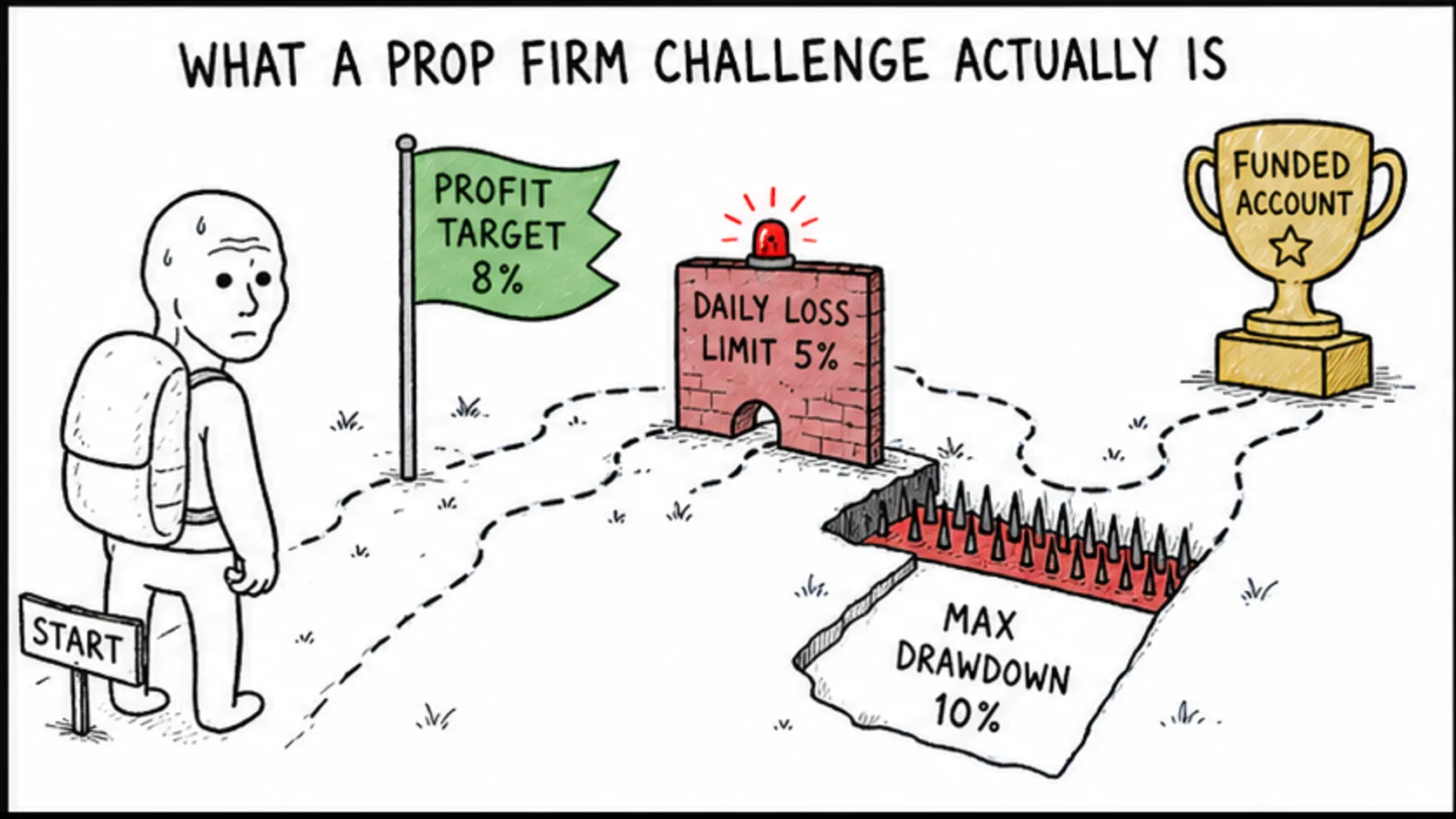
A prop firm challenge is an evaluation you pay for to prove you can trade profitably without blowing up an account. Think of it as an audition.
You pay a fee (typically $50 to $500 depending on account size), get access to a simulated trading account, and try to hit a profit target without breaking any risk rules. Pass, and you get a funded trading account with real profit splits. Fail, and you lose the fee. If the price tag stings, there are cheaper challenges out there that still get the job done.
Most challenges have two phases. Phase one is the main evaluation with a higher profit target. Phase two is verification with a lower target to confirm your results were not a fluke. Pass both and you are funded.
Phase One: The Evaluation
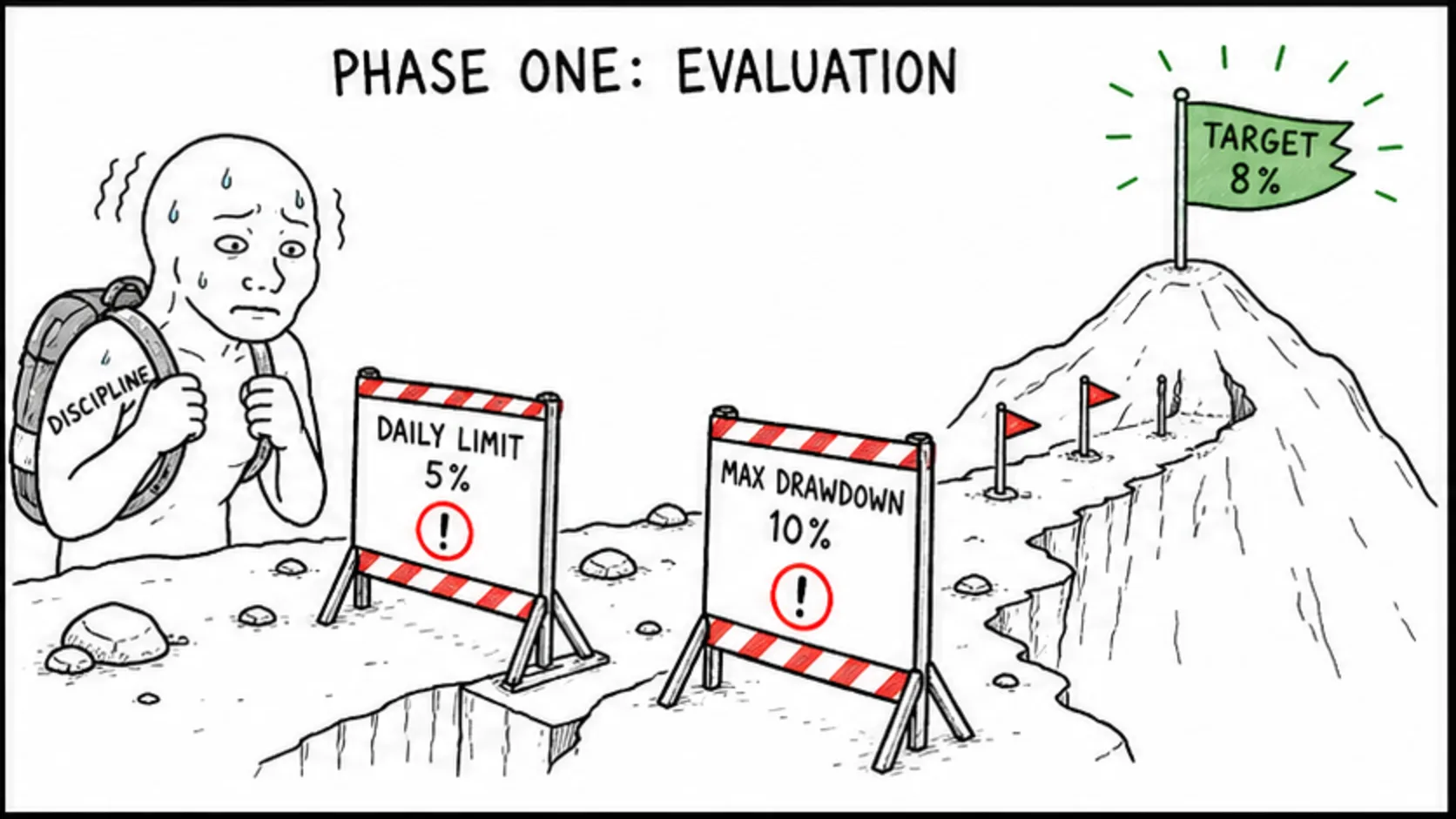
This is where most traders fail, and it is not because the trading is hard. It is because the rules are strict and the pressure is real.
Typical evaluation parameters: 8-10% profit target, 5-10% max drawdown, 3-5% daily loss limit, and a time limit of 30 calendar days (with 5-10 minimum trading days). These numbers vary by firm, but the structure is consistent across the industry.
On a $100,000 account with an 8% target, you need to make $8,000 in profit without your equity dropping below $90,000 (assuming 10% max drawdown) or losing more than $5,000 in a single day (assuming 5% daily loss limit).
That sounds manageable until you are on day 18, sitting at $6,200 profit, and the market goes quiet for a week. The clock is ticking. The pressure builds. This is where discipline matters more than strategy.
Phase Two: The Verification
The verification phase is easier on paper. Lower profit target (usually 5%), same risk rules, and a similar time limit. The firm wants to see that your evaluation results were repeatable.
Some firms skip verification entirely and go straight to funded. Others make you do two phases. A few even have a third phase. Read the firm's structure before you buy.
The biggest mistake traders make in verification is treating it like a victory lap. It is not. Same rules apply. Same discipline required. Traders who relax in phase two sometimes fail because they start sizing up or taking lower-quality setups.
The Funded Account Phase
Once you pass both phases, you get a funded account. This is where you trade firm capital and split profits. Typical splits range from 70-90% in your favour.
The rules are usually the same as the challenge, sometimes slightly relaxed. Some firms increase your account size over time if you perform consistently. Others offer add-on accounts or scaling plans.
Payouts happen every 14-30 days depending on the firm. You request a withdrawal, the firm processes it, and the money lands in your account. Some firms pay within 24 hours. Others take up to a week.
Here is the part Reddit does not like to talk about. A $50,000 funded account with an 80% split, making 5% per month, pays you $2,000 per month. That is solid. But it is not the $10,000 per month some people on social media are promising you. Set realistic expectations or you will overtrade trying to hit imaginary targets.
How Rule Enforcement Works
Rule enforcement is automated. There is no human reviewing your trades in real time. Software monitors your equity, drawdown, and daily P&L continuously.
If you breach any rule, your account is closed instantly. No warning. No appeals. The system detects the breach and terminates your access.
This means floating losses count. If you have an open position that pushes your equity past the max drawdown line for even one second, you are done. It does not matter if the trade eventually comes back into profit. The breach happened.
This catches beginners off guard constantly. They think unrealised losses do not count. They do. The firm monitors equity, not just balance.
The Platform Mechanics
Most prop firms use MetaTrader 4, MetaTrader 5, or cTrader as their trading platforms. Some have moved to DXtrade or Match-Trader.
You get login credentials after purchasing the challenge. The platform looks and feels like a regular trading account, because it is one. The difference is the firm's risk rules are layered on top.
Your trades are executed on a simulated environment, not a live market. This is a point of controversy in the industry, but it is how most retail prop firms operate. Your trades mirror live market prices, and the firm pays you from their own funds based on your simulated performance.
The Payout Process
Payouts work like this. You request a withdrawal through the firm's dashboard. The firm reviews your trading activity to confirm no rule violations. If everything checks out, they send you the money.
Most firms pay via crypto, bank transfer, or Deel. Processing times range from 24 hours to 7 business days. Firms with longer processing times are not necessarily scamming you, but if a firm takes more than two weeks, start asking questions.
You keep your profit split minus any fees. Some firms refund your evaluation fee with the first payout. Others do not. Read the terms before you sign up so you know exactly what to expect.
Most of the firm's revenue comes from evaluation fees, not from trading losses. They need far more people to fail evaluations than to pass and request payouts. The business model works because the failure rate is high. Whether that is a problem for you depends on whether you plan to be in the failing majority or the passing minority.
