
A funded trading account is not the same as a protected client brokerage account. The FCA guidance on avoiding scams is useful when comparing firms and payout claims.
A funded trading account is an account loaded with a prop firm's capital that you trade after passing their evaluation. You keep a cut of the profits. The firm keeps the rest. You risk none of your own money beyond the evaluation fee. That is the short version.
The longer version involves understanding what "funded" actually means, what you give up in exchange for access to capital, and whether this setup makes sense for your specific situation. Because it is not for everyone, despite what the affiliate marketers tell you.
Key Takeaways
- A funded trading account is a prop firm's capital that you trade after proving yourself through an evaluation.
- Evaluation fees range from $50 to $600. A $100,000 account evaluation typically costs $400-$600.
- Profit splits range from 70% to 90% in your favour, paid out every 14-30 days.
- Funded accounts come with strict risk rules. Break them and you lose access immediately.
On This Page
What Is a Funded Trading Account?
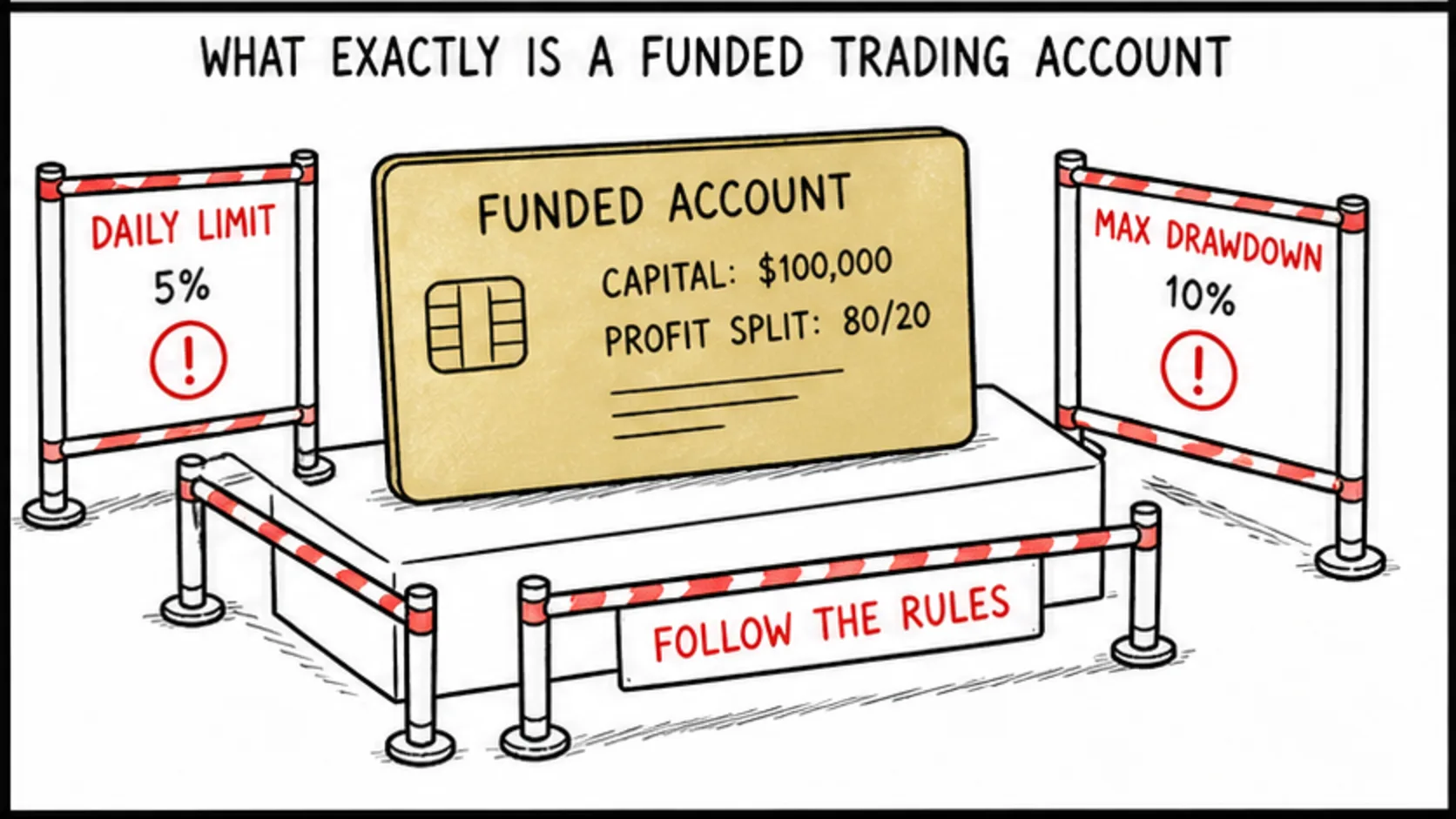
A funded trading account is capital provided by a proprietary trading firm that you, the trader, manage in exchange for a share of the profits. The firm owns the money. You direct the trades. The profits get split.
This is not a loan. You do not owe the firm anything if you lose money while following their rules. This is not a job. You are not an employee with a salary and benefits. This is an arrangement where you prove you can trade responsibly, and the firm rewards you with access to their capital.
The prop firm exists to identify traders who can generate returns without taking reckless risks. The funded account is the instrument through which those traders operate.
You get the account only after passing an evaluation. The evaluation is a filtering mechanism. It is designed to let through traders who manage risk and reject traders who do not. Simple concept, brutal execution.
What "Funded" Actually Means
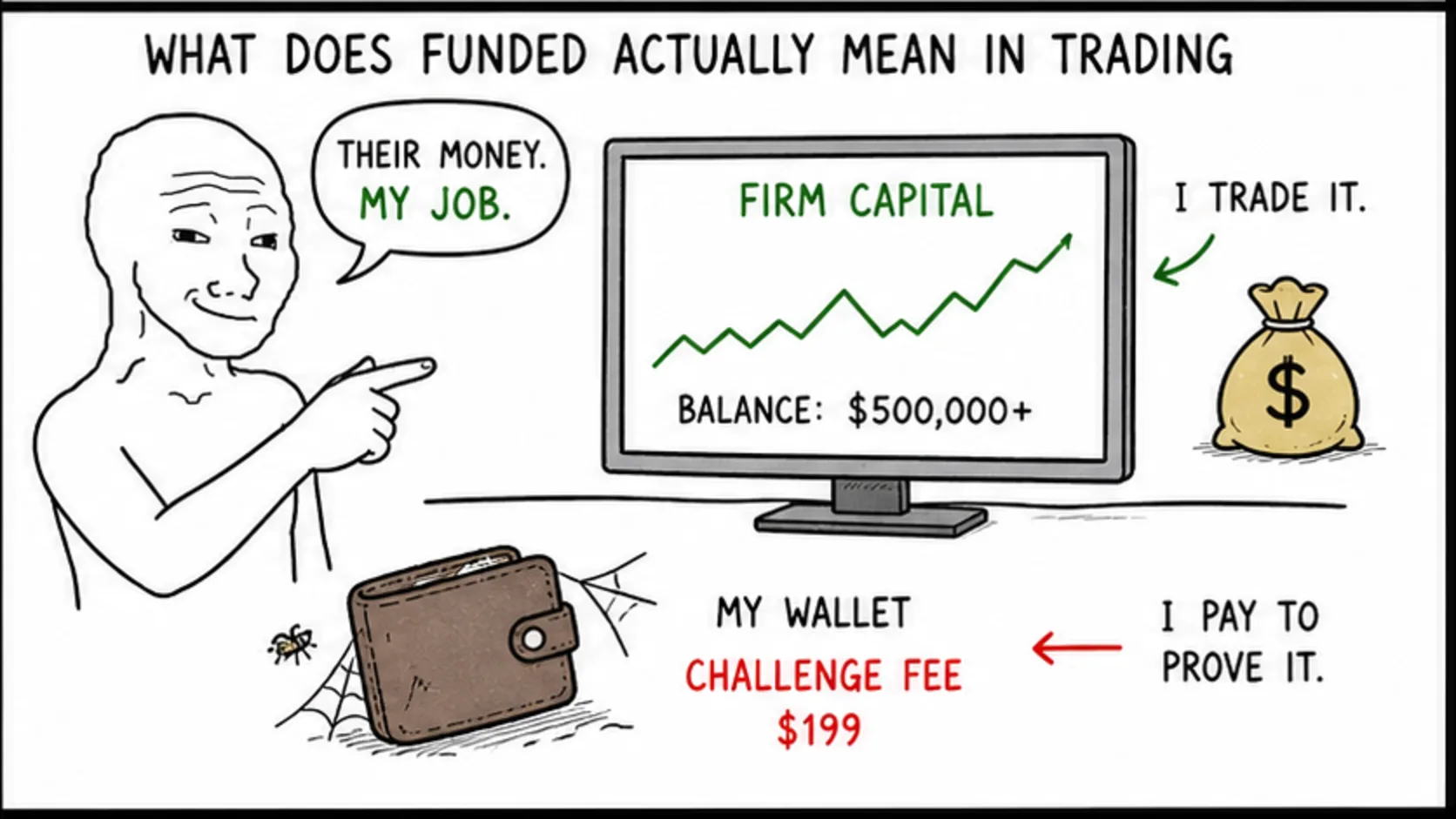
The word "funded" creates confusion because it sounds like someone handed you a bag of cash. Let me clarify what is actually happening.
When you get funded, the firm gives you access to a trading account with a specific balance. This could be $25,000, $50,000, $100,000, or more depending on what you applied for and passed.
Some firms give you a live account with real money in the market. Others give you a simulated account that mirrors live market conditions but where the firm's actual capital is not directly at risk. Either way, the trading experience is identical. You place orders, they fill at market prices, and your P&L moves in real time.
The "funded" part means you are trading with the firm's backing. Your profit split is real money paid to you on a schedule. Your losses, within the rules, are absorbed by the firm. Step outside the rules, and the arrangement ends.
How You Get a Funded Account
The path to a funded account follows a clear sequence. You can read the full step-by-step guide here, but here is the summary.
First, you choose a prop firm and buy an evaluation. The evaluation fee is your only cost. Then you trade the evaluation account, hitting a profit target while following all risk rules. Pass the evaluation, possibly complete a verification phase, and you receive your funded account.
The entire process can take anywhere from two weeks to several months depending on your trading style, the firm's rules, and how quickly you hit the target.
There are no interviews, no CV submissions, no background checks. The evaluation is the interview. Your trading results are your resume.
The Rules That Come With It
Funded accounts are not free money with no strings attached. The strings are called rules, and they exist to protect the firm's capital from traders who cannot control themselves.
Daily loss limit. The maximum you can lose in a single trading day. Usually 3-5% of the account balance. Hit this limit and your trading stops for the day automatically.
Maximum drawdown. The maximum your account can drop from its peak or starting balance. Typically 6-10%. Breach this and the account closes permanently.
Consistency rule. Some firms require that no single trading day accounts for too large a portion of your total profits. This prevents one lucky trade from passing an otherwise inconsistent trader.
Minimum trading days. Some firms require you to trade a minimum number of days before requesting a payout. This stops traders from making one big trade and immediately withdrawing.
Understanding every rule before you start trading is not optional. It is the difference between keeping your account and losing it over something you did not know about.
What Funded Accounts Cost
The cost of getting a funded account is the evaluation fee. Here is what you can expect to pay based on account size.
- $10,000 account: $50 to $100
- $25,000 account: $100 to $200
- $50,000 account: $200 to $350
- $100,000 account: $400 to $600
These fees are one-time payments for the evaluation. There are no monthly subscriptions or ongoing fees on most funded accounts. You pay once, pass the evaluation, and trade.
If you fail, you pay again. Some firms offer resets at a discount. Either way, the fee structure is transparent. You know exactly what you are paying before you start.
Is a Funded Trading Account Worth It?
This is the question Reddit threads are made of, and the answer depends entirely on who is asking.
If you have been trading profitably on demo for months, you understand risk management, and you have a strategy with a real edge, then yes. A funded account gives you access to capital you could never afford to deposit yourself, with limited downside risk.
If you have been trading for three weeks, watched some YouTube videos, and think you are ready because you made $200 on a demo account last Tuesday, then no. You are about to donate money to a prop firm. Wait. Learn. Prove yourself on demo first.
The funded account is a tool. Like any tool, it is only as good as the person using it. A hammer is great if you know where to swing it. It is terrible if you do not.
Funded Account vs Trading Your Own Money
The comparison is straightforward. With your own money, you have complete freedom and complete risk. With a funded account, you have strict rules and limited personal financial risk.
A trader with $5,000 making 5% a month earns $250. The same trader on a $100,000 funded account at 80% profit split earns $4,000. The skill level is identical. The access to capital makes the difference.
But your own account has no daily loss limit, no drawdown ceiling, no consistency rule, and nobody telling you to stop trading. For some people, that freedom is worth more than the extra capital.
The right choice depends on your capital, your discipline, and your goals. Neither option is inherently better. They serve different purposes for different types of traders.
A funded trading account is not a magic solution. It is leverage on your skill. If your skill is real, the leverage works in your favour. If it is not, the leverage works against you.
