
Before paying for any evaluation, check the firm and its claims. The FCA warning list and public regulator registers are useful starting points.
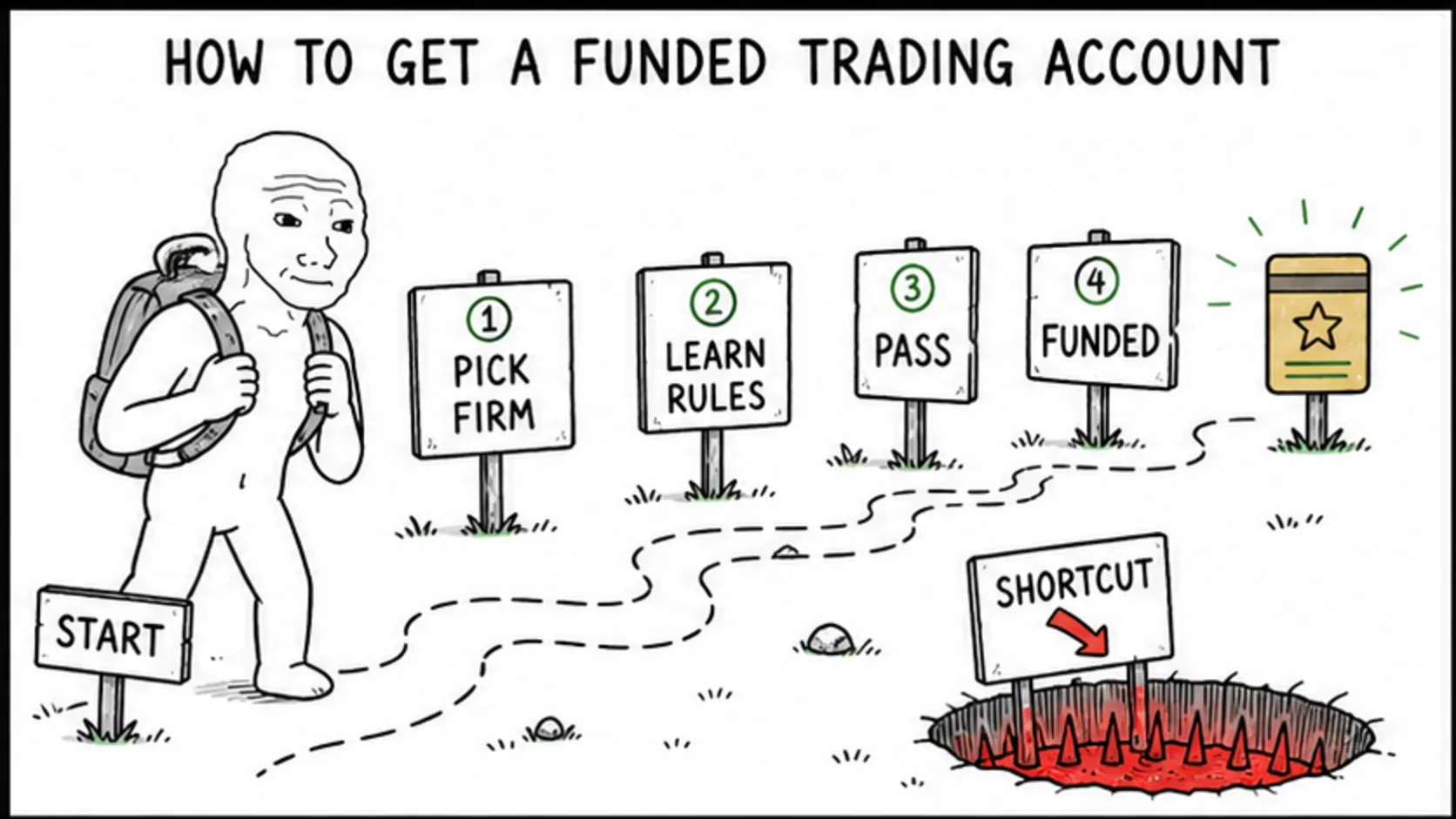
Getting a funded trading account is not complicated. You pick a firm, pay the fee, pass the evaluation, and get funded. That is the three-sentence version. The real version involves research, preparation, discipline, and a very specific set of decisions that determine whether you pass or donate your money to a prop firm's revenue line.
I have been through this process. I have passed evaluations and I have failed them. The steps below are not theory. They are the actual playbook.
Key Takeaways
- Getting funded requires choosing the right firm, preparing on demo first, and passing an evaluation with strict risk rules.
- There are no formal qualifications. Anyone can buy an evaluation. But passing one requires real trading discipline.
- Evaluation fees range from $50 to $600. A $100,000 account evaluation typically costs $400-$600.
- The most common reason traders fail is not lack of skill. It is breaking risk rules under pressure.
On This Page
Before You Start: Demo First, Always
Before you spend a single dollar on an evaluation, you need to prove to yourself that you can trade profitably on a demo account. Not for a week. Not for two weeks. For at least two to three months of consistent results.
If you cannot make money on demo where there is zero emotional pressure, you will not make money on a funded evaluation where every trade feels like it matters. That is not opinion. That is how human psychology works.
Track your win rate, your average win, your average loss, and your risk per trade. Know your numbers cold before you pay for anything.
Step One: Choose the Right Prop Firm
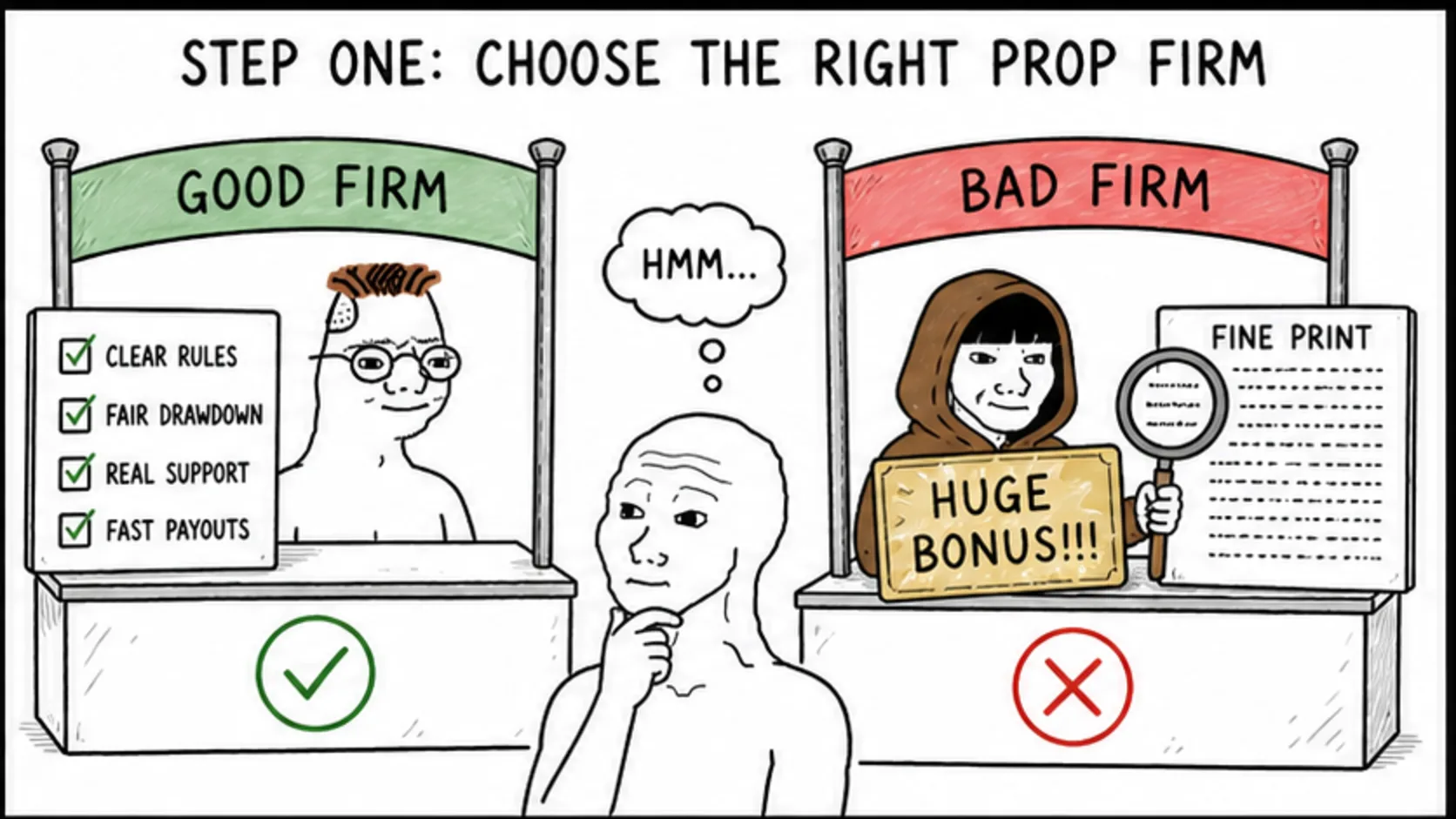
Not all prop firms are the same. Our tested ranking of prop firms separates the legitimate operators from the fee collectors. Some have reasonable rules. Some exist to collect fees from failed traders. You need to know the difference before you hand over money.
Look at four things: payout history, rule structure, profit split, and how long the firm has been operating. A firm that has been paying traders for three years is different from a firm that launched last month with a slick website.
Check the daily loss limit and maximum drawdown rules. Some firms give you 5% daily loss on a $100,000 account. Others give you 3%. That difference of $2,000 in daily room can be the difference between surviving a bad day and getting your account closed.
Compare profit splits. The industry standard is 80/20 in your favour. Some firms go up to 90/10. If a firm offers 50/50, ask yourself why they need to take half your profits when every other firm takes 20%.
Step Two: Buy the Evaluation
Once you have chosen a firm, you buy an evaluation for the account size you want. Account sizes typically range from $10,000 to $200,000.
Do not go for the biggest account. A $200,000 account sounds impressive but comes with tighter proportional risk limits and more pressure. If you are just starting out, a $25,000 or $50,000 account is more manageable.
The evaluation fee is your only financial risk. You pay once. If you pass, you trade the firm's money. If you fail, the fee is gone. No refunds.
Most firms run promotions that discount fees by 20-50%. Wait for one if you are not in a rush. There is no point paying full price when the same evaluation goes on sale every few weeks.
Step Three: Read Every Single Rule
This is where I watch people skip ahead and then wonder why they failed. Read. Every. Rule.
Know your profit target. Know your daily loss limit. Know your maximum drawdown. Know whether the drawdown is static or trailing. The trailing drawdown is a sneaky rule that trips up experienced traders.
Know if there is a consistency rule. Know if there is a minimum trading days requirement. Know whether you can hold trades over the weekend. Know if there are restricted trading hours around news events.
If you cannot explain every rule to a friend without looking at the website, you are not ready to start trading.
Step Four: Trade the Evaluation
Now you trade. Not aggressively, not timidly, just execute your plan within the rules.
Risk 0.5% to 1% per trade. On a $100,000 account, that is $500 to $1,000 per position. This sizing lets you survive a string of losing trades without threatening your drawdown limit.
Only take your best setups. If you are used to taking ten trades a day, cut it to three. Quality over quantity, especially in an evaluation where every loss chip away at your drawdown room.
Stop trading after two consecutive losses. Take a break. Revenge trading in an evaluation is the fastest way to donate your fee and start over.
Do not rush. If the evaluation has no time limit, use that to your advantage. Slow and consistent beats fast and reckless every single time.
Step Five: Pass and Get Funded
Hit the profit target without breaking any rules and you advance. Some firms require a verification phase, a shorter, easier second evaluation to confirm your results were not a fluke.
Once you pass everything, you receive your funded account. The firm sends you login credentials for a live account with their capital. You start trading under the firm's ongoing rules, which are usually slightly more relaxed than the evaluation rules.
You earn a profit split on everything you make above the starting balance. Payouts happen on a schedule, typically every 14 to 30 days depending on the firm.
Congratulations, you are now a funded trader. The hard part is not over. Staying funded is harder than getting funded, because the temptation to size up and trade like you own the place is very real.
What It Actually Costs
Here is a breakdown of typical evaluation costs by account size.
- $10,000 account: roughly $50 to $100 evaluation fee
- $25,000 account: roughly $100 to $200 evaluation fee
- $50,000 account: roughly $200 to $350 evaluation fee
- $100,000 account: roughly $400 to $600 evaluation fee
- $200,000 account: roughly $700 to $1,200 evaluation fee
These are one-time fees. If you fail, you pay again for a new evaluation. Some firms offer reset options at a discounted rate, usually 50-70% of the original fee.
The cheapest funded account is not always the best choice. A $50 evaluation with terrible rules is $50 wasted. A $400 evaluation with fair rules and a real payout track record is money well spent.
Where Most People Screw Up
Buying an evaluation without demo experience. If you have not traded profitably on demo for at least two months, you are not ready. The evaluation is not the place to learn how to trade. It is the place to prove you already can.
Choosing the biggest account size. More money means more pressure and tighter proportional limits. Start small, pass an evaluation, build confidence, then scale up.
Not reading the rules. I cannot say this enough. Traders fail evaluations because they did not know about a rule. That is the dumbest possible way to lose your fee.
Changing strategy mid-evaluation. Day five of a challenge is not the time to switch from trend following to scalping. If your strategy is not working, stop and review. Do not reinvent your entire approach while the clock is running.
Rushing the target. You do not get bonus points for finishing fast. Slow, consistent trading beats aggressive, risky trading in evaluations every single time.
The people getting funded are not smarter than you. They just did the preparation, followed the rules, and did not self-destruct. Now you know the playbook. Go use it.
