
Being a funded trader does not remove market risk. The CFTC forex advisory is a reminder that trading skill and risk controls matter more than account labels.
A funded trader is someone who trades a prop firm's capital after proving they can manage risk. That is the definition. The reality is messier, more interesting, and involves a lot more people failing than the marketing materials suggest.
Most people hear "funded trader" and picture someone at a desk in Canary Wharf with two monitors and a six-figure salary. That version exists, but it is not what this article is about. The funded trader you are looking into is a retail trader who passed an online evaluation and now trades someone else's money for a cut of the profits.
Key Takeaways
- A funded trader trades a prop firm's capital, keeps a profit split of 70-90%, and risks none of their own money beyond the evaluation fee.
- The evaluation pass rate is roughly 5-10%. Most traders fail because they break risk rules, not because they cannot read a chart.
- Funded trading is not a salary. Your income depends entirely on what you produce. Some months you make money, some months you do not.
- The evaluation fee is your only financial risk. Once funded, you trade the firm's capital, not yours.
On This Page
What Is a Funded Trader?
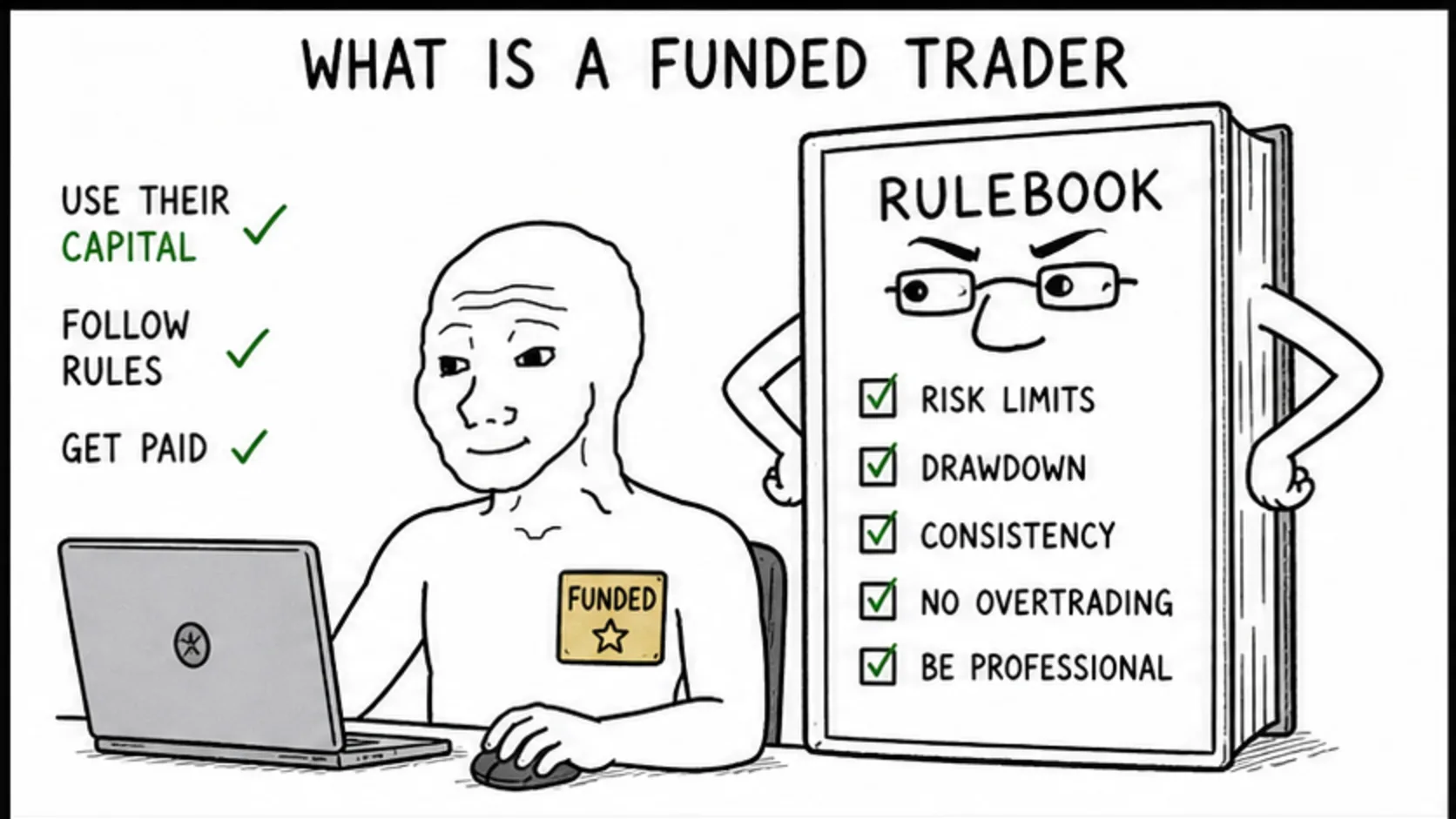
A funded trader is a person who has passed a proprietary trading firm's evaluation and now trades the firm's money on a live or simulated account. The trader keeps a percentage of the profits. The firm keeps the rest. The trader risks none of their own capital beyond the initial evaluation fee.
Think of it like this. You rent access to someone else's trading account. The rent is the evaluation fee. The landlord takes a cut of whatever you earn. If you lose money, the landlord absorbs the loss as long as you followed the house rules.
Those house rules are where things get serious. Every prop firm has strict risk parameters, daily loss limits, maximum drawdown rules, and consistency requirements. Break any of them and you lose the account.
The prop firm is not a charity. Their business model works because most people fail the evaluation. The funded traders are proof the system is real. The failed evaluations are how the firm stays profitable.
How Funded Trading Works
The path from random person to funded trader follows a specific process. It starts with choosing a firm and buying an evaluation. That evaluation typically costs between $50 for a small account and $500 for a larger one.
Once you pay, the firm gives you access to a trading platform with a simulated account. You have a profit target to hit, usually 8-10% of the account balance, and a set of risk rules you cannot violate.
Hit the target without breaking the rules, and you get funded. The firm gives you a live account to trade with their capital. Everything you earn above the starting balance gets split between you and the firm.
The typical profit split ranges from 70% to 90% in the trader's favour. Some firms offer 80/20 as standard. A few go up to 90/10. The firm takes their cut and pays you the rest on a regular schedule, usually every 14 to 30 days.
If you blow through the risk rules, the account gets closed. No refund on the evaluation fee. No second chances. You can buy another evaluation and try again, but that failure is permanent on your record and your wallet.
What Funded Traders Actually Make
How much do funded traders make? It depends on account size, profit split, and how consistently the trader produces returns. That is not a cop-out — it is the reality.
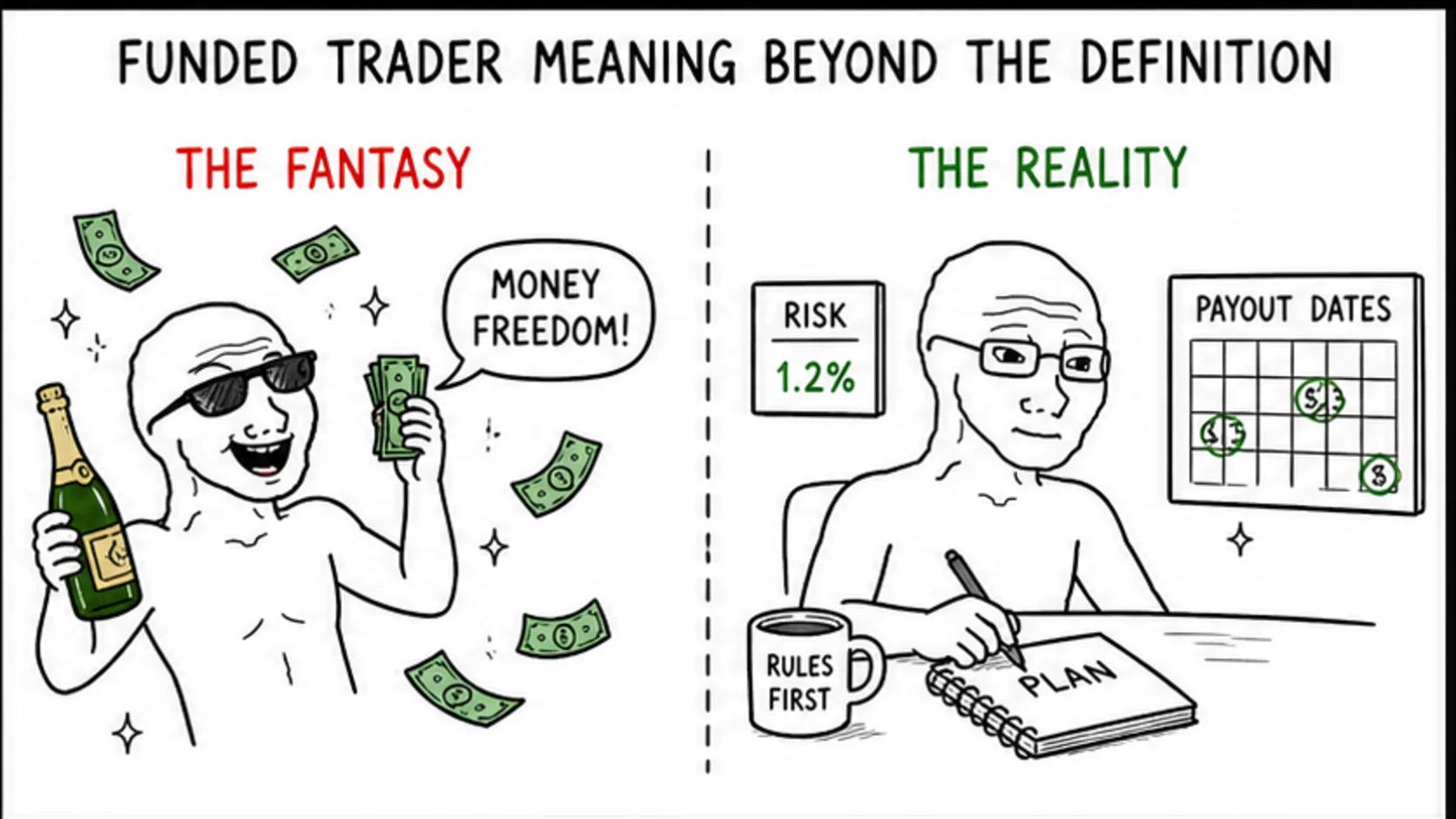
Let us run some real numbers. On a $100,000 funded account with an 80% profit split, a trader making 3% per month generates $3,000. That is $36,000 per year. Not bad, but not the yacht money people imagine.
A trader making 5% per month on the same account walks away with $5,000 monthly, or $60,000 annually. Consistent 5% monthly returns are extremely difficult to achieve. Anyone telling you otherwise is selling something.
Some months you will make more. Some months you will make less or nothing at all. The funded trader income is variable, unpredictable, and depends entirely on your performance. There is no base salary, no safety net, and nobody handing you a paycheck for showing up.
Most funded traders make between $500 and $3,000 per month on average. A small percentage make significantly more. A large percentage lose their funded account before their first payout.
Is It Hard to Become a Funded Trader?
Yes. The pass rate for most evaluations sits between 5% and 10%. That means for every 100 people who buy an evaluation, between 5 and 10 actually get funded.
But here is what that statistic does not tell you. Most of those failures are not because people cannot trade. The failures happen because traders crack under the pressure of the rules.
They trade well for 18 days, then revenge trade on day 19 and blow past the daily loss limit. They get close to the profit target, size up to finish faster, and hit maximum drawdown. They change strategies three times in one week because the first one was not exciting enough.
The evaluation is designed to test your risk management, not your chart-reading ability. If you can keep your losses small, trade consistent position sizes, and survive long enough for your edge to play out, you can pass.
That is a big "if" and the statistics prove it. But the difficulty is behavioural, not technical. You are fighting yourself, not the market.
Your Three Missions as a Funded Trader
Once you are funded, the game changes. You are no longer trying to hit a target. You are trying to survive and produce consistently. Here are your three missions.
Mission one: protect the account. Non-negotiable. Always. Every day. No exceptions. The funded account is your income source. Lose it and you are back to paying evaluation fees.
Mission two: produce consistent returns. Not massive returns. Consistent returns. Making 2-3% every month for a year is infinitely more valuable than making 15% one month and losing 20% the next.
Mission three: grow your track record. The longer you stay funded and the more consistent your payouts, the more value you have. Some firms offer scaling plans that increase your account size based on performance. A proven track record is worth more than any single trade.
Funded Trader vs Regular Trader
If you are wondering why anyone would bother with prop firms instead of just trading their own money, here is the comparison that matters.
A regular trader with a $5,000 account making 5% per month earns $250. A funded trader on a $100,000 account making 5% with an 80% split earns $4,000. Same skill level, vastly different outcome.
The prop firm gives you leverage on your skill without leverage on your bank account. You access capital you could never afford to deposit yourself, and you only risk the evaluation fee.
The trade-off is the rules. Funded traders have daily loss limits, maximum drawdowns, and sometimes consistency rules that cap how much you can make in a single day relative to your total performance. The consistency rule exists to prevent traders from getting lucky on one trade and passing.
Regular traders answer to nobody. Funded traders answer to the firm's risk parameters. Which one is better depends on your capital, your skill, and your discipline.
Common Myths About Funded Trading
"Funded traders are employees." No. You are an independent contractor. There is no salary, no benefits, no pension. You earn what you produce.
"Once funded, the money is guaranteed." Absolutely not. You can lose the account at any time if you breach the rules. Many funded traders blow their first account within weeks because they start trading like the rules do not apply anymore.
"You need to be a pro to get funded." You need to be disciplined, not professional. Plenty of traders with fancy credentials fail evaluations. Plenty of self-taught traders with boring strategies pass them.
"Funded trading is a scam because most people fail." Most people fail at everything difficult. Most businesses fail. Most diets fail. Most gym memberships go unused. The failure rate does not make something a scam. The firms that have been operating for years and paying out consistently are legitimate.
Funded trading works — for the right person with the right approach. Whether it works for you depends on whether you are willing to do the boring, disciplined work that the 90% are not willing to do.
