
How do prop firms work? You pay a fee, prove you can trade without blowing up, and the firm gives you capital to trade with a profit split. That is the elevator pitch.
The actual process is more nuanced. There are stages, rules, technology, and a business model that you need to understand before handing over your money. Most people skip this part and then wonder why their evaluation got terminated on day three.
Key Takeaways
- Prop firms operate a three-stage process: evaluation, verification, and funded trading. You must pass each stage before advancing.
- The evaluation tests risk management, not trading skill. Most failures come from rule breaches, not from failing to hit the profit target.
- Most retail prop firms use simulated accounts, not live capital. Your trades mirror real markets but the firm pays profits from its own funds.
- The business model depends on evaluation fees from the 90-95% who fail, making funded traders the marketing, not the revenue.
On This Page
- How Do Prop Firms Work?
- The Three-Stage Prop Firm Process
- Stage One: The Evaluation
- Stage Two: Verification
- Stage Three: Funded Trading
- How Prop Firms Set Their Rules
- The Technology Behind Prop Firm Trading
- How Payouts Actually Work
- What Happens When You Break a Rule
- The Business Model: Why Prop Firms Exist
How Do Prop Firms Work?
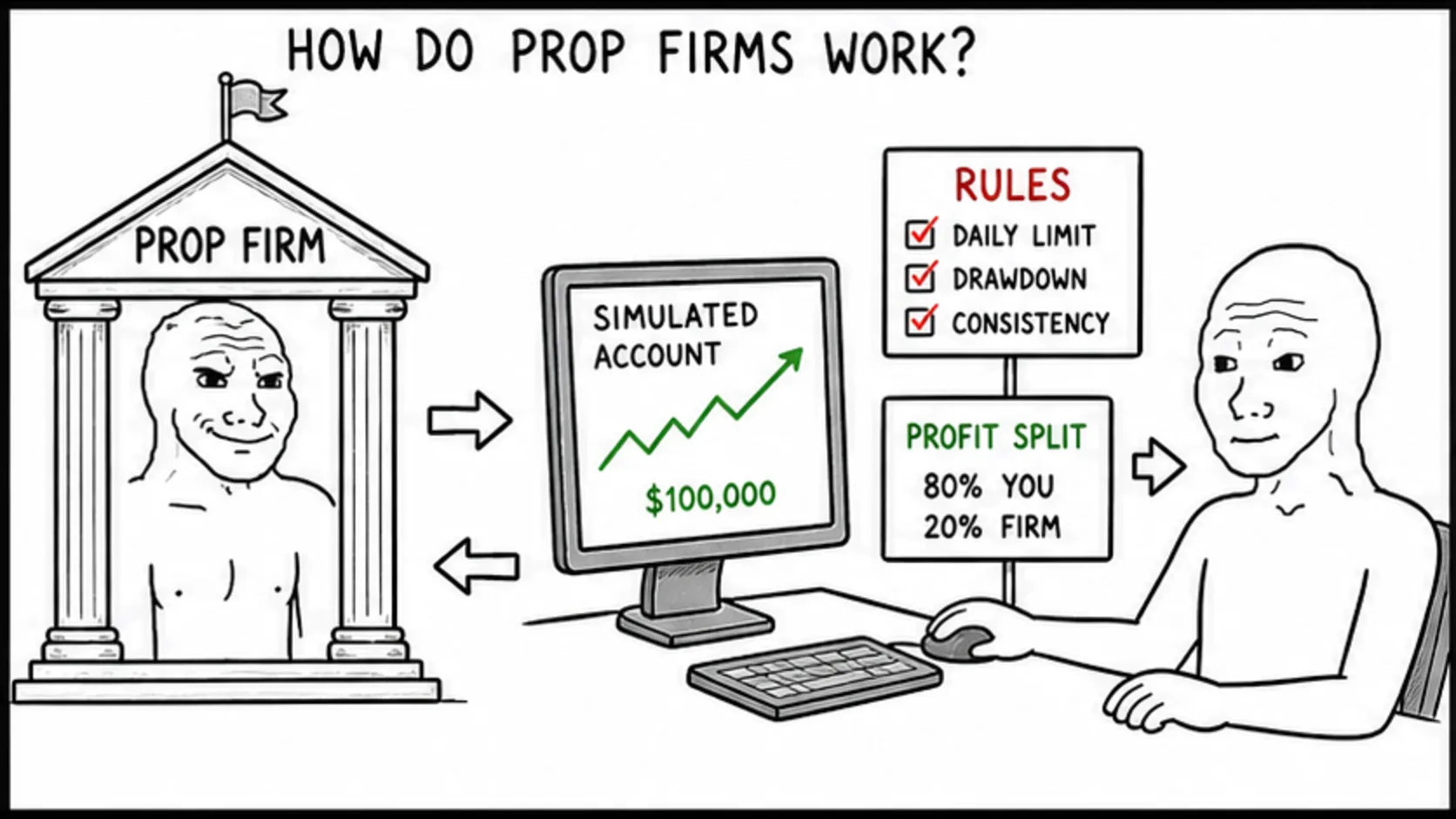
A prop firm, in the retail trading context, is a company that provides traders with access to capital in exchange for a share of the profits. The trader pays nothing beyond the evaluation fee.
No deposits, no margin requirements, no personal liability for losses. The firm absorbs trading losses within the agreed risk parameters.
Prop trading works by outsourcing the trading to independent contractors who have proved they can manage risk. The firm provides the platform, the capital, and the rules. The trader provides the skill and discipline.
The entire operation runs on software. When you buy an evaluation, you get credentials to a trading platform, usually MetaTrader 4, MetaTrader 5, cTrader, or TradingView.
Your trades execute on a simulated environment that mirrors live market prices. The firm monitors every position, every drawdown level, and every rule in real time. If you breach a rule, the system terminates your account automatically.
There is no human sitting there watching your trades. The technology handles everything, from order execution to rule enforcement to payout calculations.
The Three-Stage Prop Firm Process
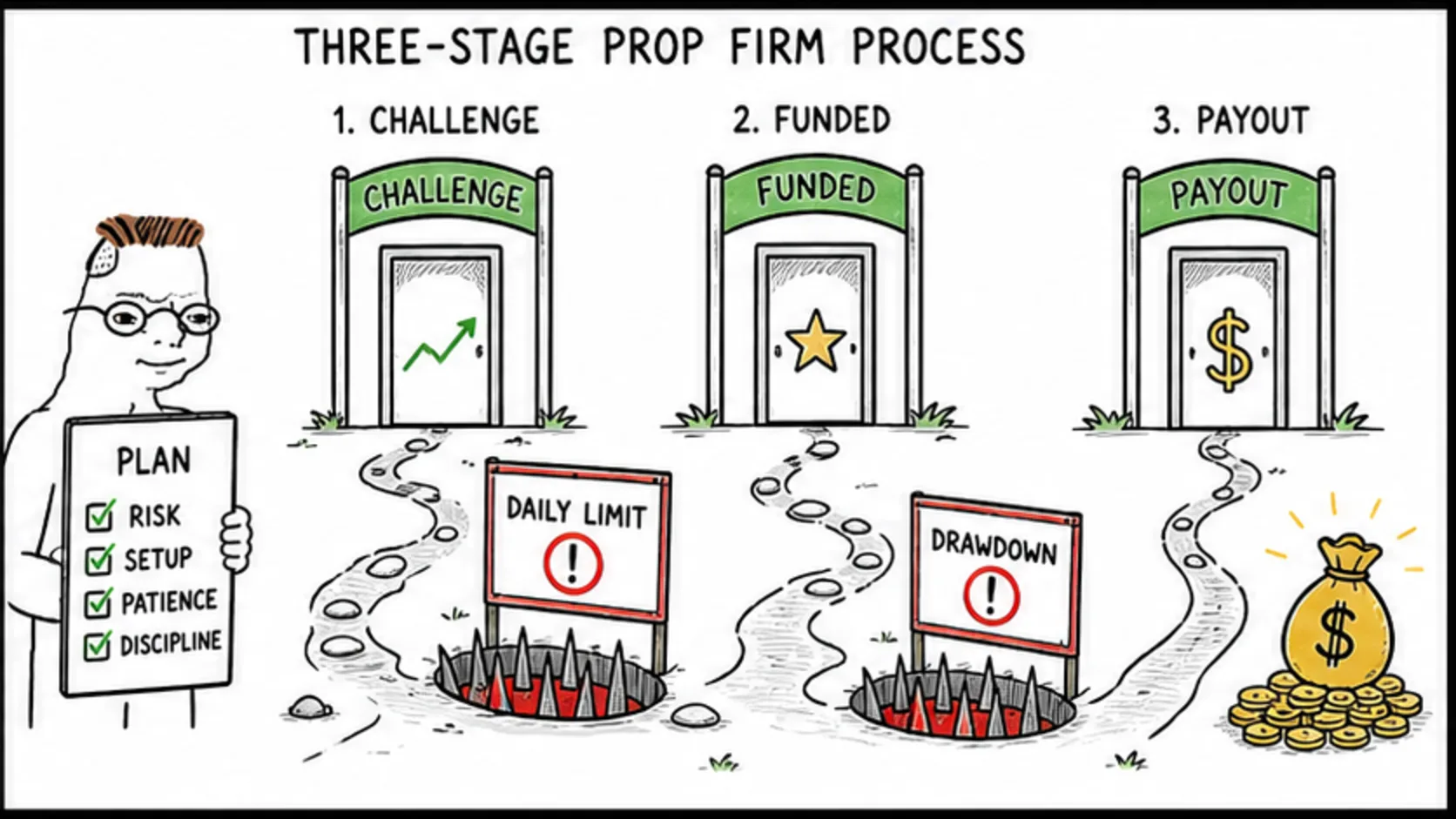
Most prop firms use a three-stage pipeline to move traders from evaluation to funded trading. Some firms combine stages, some skip verification, but the general structure is consistent across the industry.
Stage one: evaluation. You pay a fee and trade to hit a profit target while following risk rules.
Stage two: verification. You repeat the process, usually with a smaller target, to prove the first run was not luck.
Stage three: funded trading. You trade firm capital with ongoing rules and receive profit splits on a regular payout schedule.
Not every firm uses all three stages. Some go straight from evaluation to funded. Others add extra steps. But the three-stage model is the industry standard because it filters out traders who got lucky on their first attempt.
Stage One: The Evaluation (Buying Your Shot)
The evaluation is where most traders fail. Understanding exactly how it works is the difference between passing and donating your fee to the firm's revenue line.
You choose an account size, typically ranging from $5,000 to $200,000. The fee scales with the account size: a $10,000 account might cost $80, while a $100,000 account costs around $500.
Once you pay, you receive your platform credentials and the clock starts. The firm gives you a profit target, usually 8-10% of the account value, and a set of rules you must follow.
The core rules are consistent across most firms. A daily loss limit that caps how much you can lose in a single day, typically 4-5% of the account.
A maximum drawdown that caps your total losses from the starting balance, usually 8-12%. Some firms use a trailing drawdown that follows your highest balance upward.
Minimum trading days, usually 4-10 days, to prevent traders from gambling their way through in a single session. A consistency rule at some firms that limits how much of your profit can come from a single trade.
Hit the target without breaking any rules and you advance. Break a rule and the evaluation ends immediately. No appeals, no exceptions.
Stage Two: The Verification (Proving It Was Not Luck)
The verification stage exists because one good run does not make you a consistently profitable trader. The firm wants to see you do it again.
Verification usually has a smaller profit target, around 5% instead of 8-10%, and the same risk rules as the evaluation. You trade on the same platform with the same account size.
The logic is simple. If you genuinely have an edge and solid risk management, passing a second time should not be a problem.
If your first pass was a lucky streak, verification will expose that. The firm would rather find out during verification than after handing you a funded account.
Not all firms require verification. Some go straight from evaluation to funded trading. Others have eliminated it to speed up their onboarding process.
The firms that keep verification tend to be the ones with stricter standards across the board. It is an extra filter, and it works.
Stage Three: Funded Trading (The Real Game)
This is where prop firms actually start paying you. You are now trading with firm capital, subject to ongoing rules, and earning profit splits on your gains.
The rules during funded trading are usually similar to the evaluation rules, sometimes slightly relaxed. Your daily loss limit and maximum drawdown still apply, but the profit target is gone.
Instead of chasing a specific percentage, you simply trade profitably and collect your split at the end of each payout period.
Profit splits typically range from 70% to 90% in your favour, paid every 14 to 30 days depending on the firm. Some firms offer instant funding options that let you skip stages for a higher fee.
Getting funded is the goal, but staying funded is the challenge. The average funded trader does not last more than a few months before breaching a rule.
The firms that have been around longest, think FTMO (Read the PassPropTradingFirms FTMO writeup), MyForexFunds before it imploded, and a handful of others, have proven track records of paying out consistently.
But the funded phase comes with its own psychological pressure. You are now trading real money that is not yours, with rules that will terminate your access if you slip up. That pressure is different from the evaluation, and it catches people off guard.
How Prop Firms Set Their Rules
The rules are not arbitrary. Every rule a prop firm sets exists to protect their capital from traders who cannot manage risk. Understanding why each rule exists helps you follow them.
The daily loss limit prevents catastrophic single-day blowups. Without it, a trader having a bad day could lose 20% of the account in one session. The daily loss limit says: stop trading when you are down 4-5%, no exceptions.
The maximum drawdown protects the firm's total exposure. It sets a floor on how far the account can fall from its starting balance or its peak. Hit that floor and the account closes permanently.
The trailing drawdown is the sneaky one. It follows your highest balance upward, meaning your risk buffer shrinks as you make money. The trailing drawdown is literally following you around, catching up to every profit you make.
Minimum trading days prevent the lottery-ticket approach. Without them, a trader could buy an evaluation, go all-in on one trade, and either pass instantly or blow up. The minimum days requirement forces consistency.
The consistency rule limits how much of your total profit can come from a single trade. If one trade accounts for more than 30-40% of your gains, some firms will not let you pass. They want to see distributed profits, not one lucky hit.
The Technology Behind Prop Firm Trading
Prop firms are technology companies first and trading companies second. The entire operation runs on software that handles everything from account provisioning to rule enforcement.
When you buy an evaluation, a back-end system creates your account, sets your parameters, and sends you credentials. Your trading platform connects to price feeds that mirror live market conditions.
Every trade you place is monitored in real time. The system tracks your current drawdown, your daily profit and loss, and your position sizes. If any metric breaches a rule threshold, the system closes your positions and locks your account.
There is no phone call. No email. The software does it all automatically, usually within milliseconds of the breach. TradingView, MetaTrader, and cTrader are the most common platforms, but some firms build their own.
The payout system is also automated. You request a withdrawal, the system verifies your compliance with all rules, calculates the profit split, and initiates the transfer.
How Payouts Actually Work
Payouts are the reason anyone signs up for this. Here is how they actually function.
You trade profitably on your funded account. The firm tracks your gains. At the end of each payout period, typically every 14 or 30 days, you submit a withdrawal request.
The firm reviews your trading history for the period. If everything checks out, no rule breaches, no suspicious activity, they calculate your share of the profits and send it to you.
Payment methods vary by firm but commonly include bank transfer, crypto, Deel, or other platforms. Processing times range from same-day to two weeks depending on the firm.
The profit split is the key number. An 80/20 split means you keep 80% of what you earn. On a $50,000 account where you make $2,000 in a month, you receive $1,600.
Do that consistently across multiple accounts and you are looking at $3,000 to $6,000 per month. Scale further and the numbers grow. But consistency is the hardest part.
What Happens When You Break a Rule
Rule breaches are the number one reason traders lose their accounts. Here is exactly what happens when you violate one of the firm's risk parameters.
The system detects the breach instantly. Your positions are automatically closed at the current market price. Your account is locked.
You receive a notification, usually an email, explaining which rule was breached and when. The evaluation or funded account is terminated.
There are no appeals. The rules are published before you start, and the system enforces them without bias. Arguing with support will not change the outcome.
The most common breaches are exceeding the daily loss limit, hitting the maximum drawdown, and violating the consistency rule. All three are preventable with proper risk management.
If you breach during an evaluation, you lose the evaluation fee. If you breach during funded trading, you lose the funded account. Some firms offer a reset option that lets you retry for a fee without starting completely from scratch.
The firms that have been around longest have the most reliable enforcement. You want a firm where the rules are clear and the system is consistent, not one where enforcement feels arbitrary.
The Business Model: Why Prop Firms Exist
Understanding the business model tells you everything you need to know about how prop firms work and where you fit in.
Prop firms make money from evaluation fees. That is the primary revenue stream. With 90-95% of traders failing evaluations, a firm processing 5,000 evaluations per month at an average fee of $200 generates $1 million in monthly revenue from failures alone.
Profit splits from funded traders are secondary. A firm with 500 active funded traders earning an average of $2,000 per month at an 80/20 split generates $200,000 monthly from profit splits. Nice, but dwarfed by evaluation fees.
Additional revenue comes from add-on services: account resets, premium features, faster payouts, and educational content. These are upsells targeted at traders who have already paid for evaluations.
The model works because the evaluation is genuinely difficult. The rules are strict enough that most traders cannot follow them consistently. That is by design, not by accident.
Does that make it predatory? Not necessarily. The rules test real skills, risk management, discipline, and emotional control. The firms that pay out consistently are providing a legitimate service.
But you should walk in knowing that you are the product. The evaluation fee is the firm's revenue. Your job is to be in the 5-10% who make it through.
The traders who understand this dynamic, who treat the evaluation as a test rather than a gamble, are the ones who pass. Everyone else is funding the business.
