
What is prop trading, really? It is when you trade someone else's money, keep a cut of the profits, and lose nothing but your evaluation fee if it all goes sideways. That is the clean version.
The real version involves strict rules, psychological pressure most people are not ready for, and an industry that makes most of its money from the 90% of traders who fail the evaluation. That failure rate is a discipline problem, not a strategy problem. But for the people who figure it out, retail prop trading is one of the cheapest ways to access serious trading capital without needing a six-figure bank account.
Key Takeaways
- Prop trading means trading a firm's capital after passing an evaluation, not trading your own money in a personal brokerage account.
- Retail prop trading is completely different from institutional prop trading. You are not getting hired. You are paying for access to capital.
- The evaluation tests your risk management and discipline more than your strategy. Most failures come from rule breaches, not bad analysis.
- Profit splits range from 70% to 90%, paid out every 14-30 days, but only after you pass the evaluation and start trading a funded account.
On This Page
- What Is Prop Trading?
- Prop Trading Meaning: The Simple Definition
- Institutional vs Retail Prop Trading
- How Retail Prop Trading Actually Works
- What Makes Prop Trading Different From Regular Trading
- The Skills That Actually Matter in Prop Trading
- What You Can Trade as a Prop Trader
- The Economics of Prop Trading
- Is Prop Trading Right for You?
- Getting Started: From Zero to First Evaluation
What Is Prop Trading?
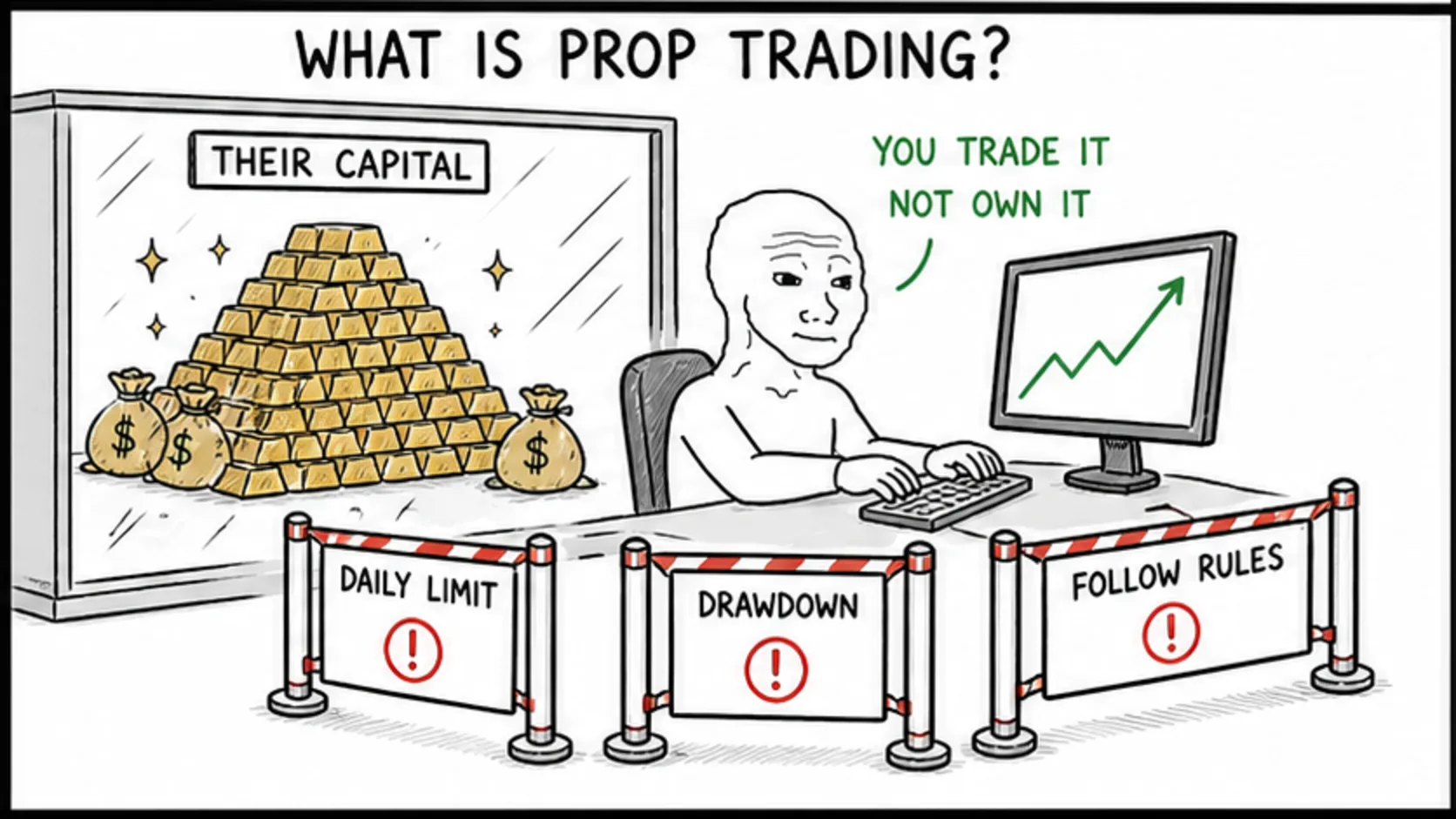
Proprietary trading, prop trading, whatever you want to call it, means trading with capital that belongs to a firm, not to you. The firm puts up the money, you put up the skill, and you split whatever you make.
You do not deposit funds, open a brokerage account, or wire your savings to some trading platform. You pay an evaluation fee, prove you can trade without blowing things up, and the firm hands you an account to manage.
The profits get split, usually 80/20 in your favour. The losses, assuming you follow the rules, are absorbed by the firm. That sounds too good to be true, and you are right to be suspicious.
The catch is that most people do not pass the evaluation. The firm designs the challenge to filter out traders who cannot manage risk. The evaluation process is the entire gatekeeping mechanism, and it is very good at what it does.
Prop trading has existed for decades at investment banks and hedge funds. Investopedia defines proprietary trading as a firm trading its own capital for direct gain rather than earning commission from client trades. That is the original meaning.
The version you are looking at as a retail trader is something different, and understanding that difference is where most beginners get confused.
Prop Trading Meaning: The Simple Definition
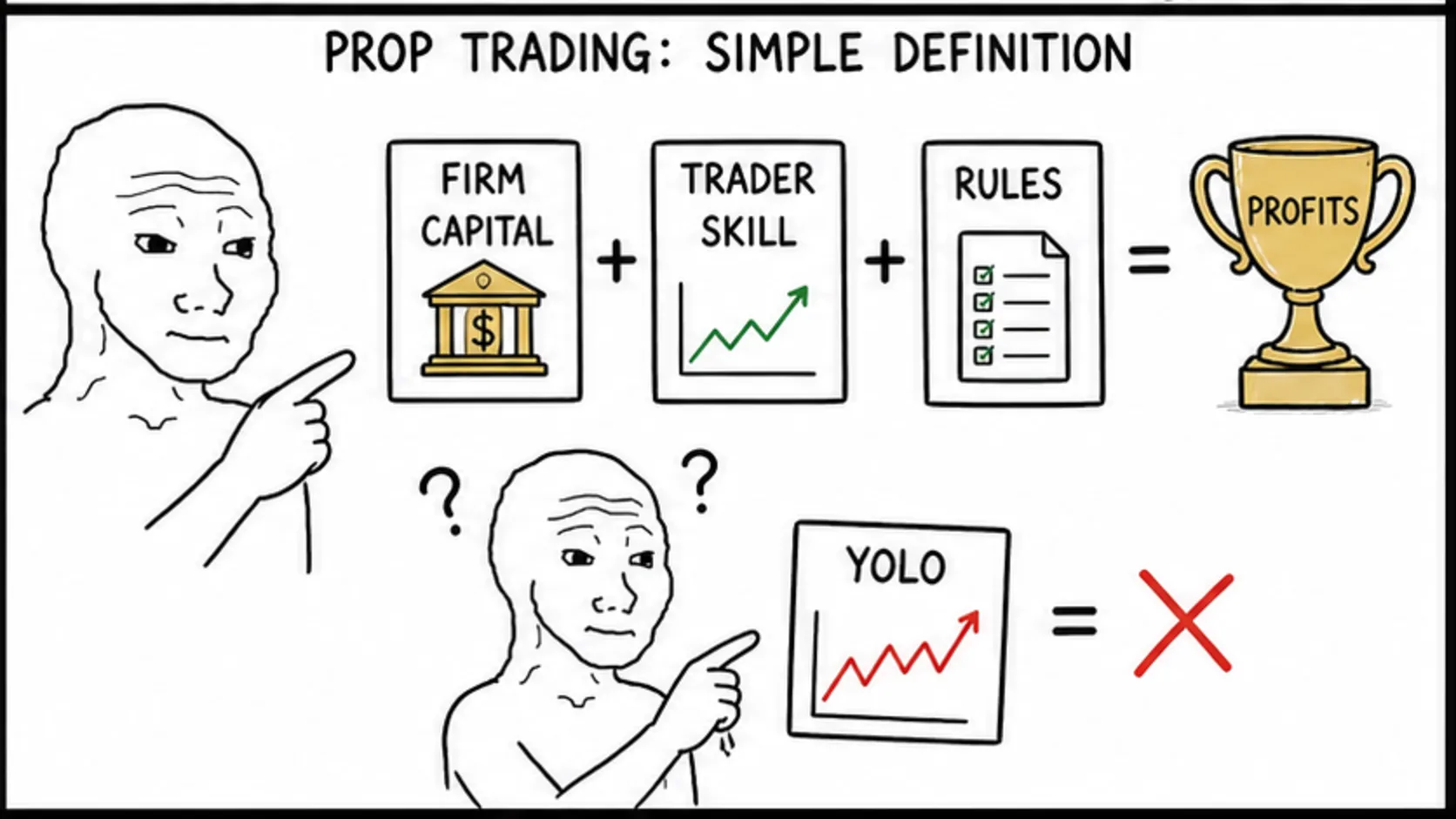
Here is the simplest way to think about the prop trading meaning. You are renting access to trading capital.
The evaluation fee is your rent payment, the profit split is how the landlord gets paid back. If you are profitable, everyone wins. If you are not, the firm keeps your fee and moves on to the next tenant.
The model works because most traders fail. That sounds harsh, but the numbers do not lie. Industry estimates put the evaluation pass rate somewhere between 5% and 10%.
For every 100 people who pay for an evaluation, between 5 and 10 actually get funded. Firms make the majority of their revenue from failed evaluations, not from profit splits.
The funded traders are the marketing, the failed evaluations are the business. A firm processing thousands of evaluations per month at $150 to $400 each generates serious money regardless of whether anyone passes.
Does that mean it is a scam? No. The evaluation is testing a real skill and the rules are published upfront. The firms that have been around for years pay out consistently.
But you need to walk in knowing that the odds are against you, and the firm is fine with that. Think of it like a driving test. Most people fail the first time, the testing centre does not care either way.
They collect the fee, administer the test, and if you pass, great. The prop firm evaluation is the same thing with higher stakes and more emotions involved.
Institutional vs Retail Prop Trading
This is where most beginners get things twisted, so pay attention. There are two completely different types of prop trading, and confusing them will give you the wrong idea about what you are signing up for.
Institutional prop trading happens inside investment banks, hedge funds, and proprietary trading firms in financial centres like London, New York, and Chicago.
These firms hire traders as employees, pay them salaries and bonuses, and give them access to the firm's actual balance sheet. This is the world of SEC-registered entities, compliance departments, and seven-figure bonuses for top performers.
You are not getting into that world by paying $200 for an online evaluation. That is not how this works.
Retail prop trading is the version that has exploded since 2020. Retail prop firms are technology companies that sell access to simulated trading accounts.
You pay a fee, trade on a demo that mirrors live market conditions, and if you meet the profit target without breaking risk rules, you get a funded account with a profit split.
The key difference is straightforward. Institutional traders are employees with salaries. Retail prop traders are independent contractors who pay for the opportunity to prove themselves.
One is a job application, the other is a service you purchase. Both are technically "prop trading" and both involve trading firm capital. But the experience, the risk, the rewards, and the entry requirements are completely different.
Can Banks Still Do Prop Trading?
Here is a fun fact that separates the people who actually understand prop trading from the people who just skimmed an Investopedia article.
After the 2008 financial crisis, the US government introduced something called the Volcker Rule, part of the Dodd-Frank Act. This rule banned banks from using their own deposits for proprietary trading.
The logic was simple. Banks had been gambling with customer money, losing it, and then needing taxpayer bailouts. The Volcker Rule said: you can trade to facilitate client orders (market making), but you cannot trade for your own speculative profit.
So can banks do prop trading? Technically no, with a massive asterisk. Banks still have proprietary trading desks. They just label them "market making" or "hedging" or "client facilitation." The line between legitimate market making and proprietary speculation is thin, and banks have lawyers who are very good at arguing which side of that line any given trade falls on.
This matters to you because when you hear "prop trading" in the news, people are usually talking about institutional desks at major banks, not the retail evaluation model you are actually signing up for. Two different worlds. One is regulated by the CFTC and the SEC. The other is a technology company that sells you access to a demo account.
How Retail Prop Trading Actually Works
Let us walk through the actual process step by step. Understanding the mechanics is what separates people who pass from people who keep buying evaluations and wondering why nothing works.
Step one: you choose a firm and buy an evaluation. The evaluation, usually called a challenge, costs anywhere from $50 for a small account to $1,000 for a large one. You pick your account size, pay the fee, and receive login credentials for a trading platform.
Bam. You are in.
Step two: you trade. The firm gives you a profit target, typically 8-10% of the account value, and a set of risk rules you must follow. Hit the target without breaking any rules and you advance.
Break a rule and the evaluation ends immediately. No appeals, no second chances.
Step three: if you pass, you get a funded account. You are now trading with the firm's capital under their ongoing rules. Every dollar you make above your starting balance is split between you and the firm, usually 80/20 in your favour.
Step four: you request payouts. Most firms pay every 14 to 30 days after verifying you have not broken any rules. The funded account phase is where the actual money gets made, not during the evaluation.
That is the clean version. The messy part is that most traders never make it past step two. They blow the account through bad risk management, breach a rule they did not fully understand, or revenge-trade their way into a daily loss limit violation after a losing streak.
The evaluation is not testing whether you can pick winning trades. It is testing whether you can follow instructions under pressure.
What Makes Prop Trading Different From Regular Trading
If you have been trading your own money in a personal brokerage account, prop trading will feel like a parallel universe. The mechanics are the same but everything around them is different.
With regular trading, you decide your own rules. You pick your position size, your stop loss, your daily loss limit, or you do not, because nobody is enforcing anything.
Your money, your choices. Keep 100% of profits, eat 100% of losses. Freedom and risk in equal measure.
With prop trading, the firm decides the rules. Your position size has a ceiling, your daily loss has a hard limit, and your total drawdown is capped. The rules exist to protect the firm's capital, and they are enforced automatically.
Break one and your account gets closed. No phone call, no warning, no negotiation.
The capital difference is the obvious one. Most people do not have $100,000 sitting in a brokerage account, but they can pay $400 for an evaluation that gives them access to one. That leverage is the entire appeal.
The psychological difference is the one nobody warns you about. Trading your own money hurts when you lose, but you can always deposit more. Trading a funded account comes with rules that will terminate your access if you lose too much in a single day.
Your daily loss limit is sitting there, watching you, waiting for you to make one stupid decision. That pressure changes how people trade, and it changes them fast.
Then there is the payout structure. In regular trading, profits sit in your account immediately. In prop trading, you wait for the payout cycle, usually two to four weeks, and the firm takes their cut before sending the rest.
Slower, but you are trading with capital you did not have to save for years to access.
The Skills That Actually Matter in Prop Trading
You have three missions in any prop firm evaluation.
Mission one: do not blow the account. Non-negotiable, always, even if you see the cleanest setup of your life.
Mission two: hit the profit target. Secondary to mission one, if you have to choose, you protect the account every single time.
Mission three: do it within the time limit. Last priority, never rush this one.
A slow pass is still a pass. A fast fail is still a fail.
Those three missions tell you exactly which skills matter. Risk management is at the top, and it is not close. The traders who consistently pass evaluations are not the ones with the most sophisticated strategies.
They are the ones who never violate their risk parameters. They size positions correctly, use stop losses, do not revenge trade, and do not size up after a win streak because they are "feeling it."
Emotional discipline is number two. The average funded trader blows their first funded account within six weeks. Not because the market destroyed them, but because they started trading like they owned the place the second they got the green light.
If you cannot handle losing streaks without changing your behaviour, you will not last long. A mediocre strategy with world-class risk management will pass more evaluations than a brilliant strategy with poor discipline.
The skill nobody talks about is patience. Hitting an 8% target on a $50,000 account means making $4,000, which is $200 per day over 20 trading days. Not $4,000 in one trade. Grinding out small, consistent profits while the account slowly climbs.
If that sounds boring, good. Boring is profitable. Exciting is what blows accounts.
What You Can Trade as a Prop Trader
Prop firms do not all offer the same instruments. What you can trade depends entirely on which firm you choose and which account type you buy.
The two biggest markets are forex and futures, with crypto and stocks growing but still secondary options. Forex prop firms are the most common. You trade currency pairs like EUR/USD, GBP/USD, and USD/JPY on platforms like MetaTrader 4, MetaTrader 5, or cTrader.
The daily foreign exchange turnover sits at roughly $7.5 trillion according to the Bank for International Settlements Triennial Survey. That liquidity is why prop firms favour forex.
Futures prop firms are the second big category. You trade contracts on indices like the S&P 500 and Nasdaq, commodities like crude oil and gold, or interest rate products.
Futures firms tend to use platforms like NinjaTrader, TradingView, or proprietary solutions. The appeal is lower evaluation costs and, at some firms, faster payouts.
A growing number of firms now offer crypto, individual stocks, and even options. These come with smaller account sizes and tighter risk rules. They are fine if you already know what you are doing, but they are not where a beginner should start.
Here is what matters. Pick one market and stick with it. The number of traders who fail because they jumped between forex, futures, and crypto trying to find something that "works" is staggering.
The market was not the problem. The lack of focus was.
The Economics of Prop Trading
Let us be honest about the money. Beginner guides love to skip the economics and jump straight to "you can make six figures." You probably will not. Most people do not.
The firm makes money three ways: evaluation fees from the 90-95% of traders who fail, profit splits from the 5-10% who pass, and add-ons like account resets and premium features.
The evaluation fee revenue dwarfs everything else. A firm processing 5,000 evaluations per month at an average of $200 each generates $1 million monthly from failures alone.
The funded trader makes money through profit splits. On an 80/20 split with a $50,000 account, if you make $2,000 in a month, you keep $1,600 and the firm takes $400.
Do that consistently and you are earning $1,500 to $3,000 per month from a single funded account. Scale up to multiple accounts and the numbers get more interesting.
But here is the part the marketing does not mention. Most funded traders do not stay funded for long. Losing your funded account because you breached a rule after a bad week is extremely common.
Consistency is the entire game. One good month means nothing. Six good months means you have figured something out.
The evaluation buyer, which is most people reading this, is spending $100 to $500 per attempt with a 5-10% chance of passing.
If you fail three times, you have spent $300 to $1,500 with nothing to show for it. That is not a scam, that is the cost of learning. But walk in knowing the math.
The comparison worth making is this. Blowing a $2,000 personal account costs you $2,000. Failing three $200 evaluations costs $600.
Prop trading is significantly cheaper than personal trading for people who are going to make mistakes, which, if you are a beginner, you absolutely are.
Is Prop Trading Right for You?
This is the question that matters. The answer depends entirely on what kind of trader you are and what stage you are at.
If you have never placed a trade in your life, prop trading is not your starting point. Go open a free demo account and spend a month learning how markets work.
The evaluation clock starts the moment you pay. You do not want to be learning platform mechanics while that timer is running and your money is on the line.
If you have been trading your own money for a while and you are profitable but undercapitalised, prop trading is exactly what you need.
You already know how to trade and you already understand risk management. What you lack is scale, and a funded account gives you that without requiring five years of saving.
If you have been trading your own money and you are consistently losing, prop trading will not fix that. The evaluation will expose the same problems, except now you are paying fees for the privilege.
Fix your trading first, then consider prop firms.
If you are looking for a get-rich-quick scheme, you are in the wrong place entirely. Prop trading rewards consistency, discipline, and patience.
Three things that are boring, difficult, and completely incompatible with the "I need to make $5,000 by Friday" mindset. Be honest with yourself about where you are.
The traders who do best with prop firms already have a strategy, already understand risk, and just need access to bigger capital. If that is you, the evaluation is a solvable puzzle. If it is not you yet, that is fine. Figure out whether you are actually ready first. The prop firms will still be here.
Getting Started: From Zero to First Evaluation
If you have read this far and you are ready to do something about it, here is the path from complete beginner to your first evaluation attempt. No fluff, just steps.
First, spend at least four weeks on a free demo account. Pick forex or futures, not both. Pick one strategy, not five.
Learn how to execute trades, manage positions, and read price action without risking a single dollar. The demo phase is where you figure out whether you can stomach the emotional side of trading.
Most people discover they cannot. Better to learn that for free.
Second, track everything. Every trade, every entry reason, every exit, every emotion you felt during the trade. The traders who improve fastest are the ones who study their own behaviour, not the ones who study more indicators.
You already know this. You just do not do it. That is the problem.
Third, choose a firm that matches your experience level. Start with a small challenge account, $10,000 or $25,000. The fee is lower, the pressure is manageable, and the lessons are identical regardless of account size.
Read the firm's rules before you pay, every single one. If you cannot explain the daily loss limit, the maximum drawdown, and the trailing drawdown to a friend, you are not ready to start.
Fourth, execute. Do not overthink it, do not wait for "perfect" market conditions. Do not buy three evaluations at once and spread your attention across all of them.
Buy one, focus entirely on it, follow your plan, respect the rules. If you fail, review what went wrong, fix it, and try again.
The traders who get funded are not smarter than you, they are not luckier. They just did the boring work of building discipline, tracking their results, and treating the evaluation like a test of risk management rather than a chance to show off.
