
How to open a prop firm? You need a trading platform, a broker partner, a legal entity, capital reserves, challenge rules, a website, payment processing, customer support, and enough runway to survive the first six months before your fee revenue covers your payout obligations. That is the reality. The short version sounds simple. The execution is where most people fall apart. Over 80 firms launched and collapsed between 2023 and 2025 because they got the easy parts right and the hard parts wrong.
Key Takeaways
- Opening a prop firm requires trading platform infrastructure, a broker partnership, legal entity setup, and enough capital to cover payouts before challenge revenue stabilises.
- White-label solutions let you launch quickly for $10,000 to $30,000, but a fully custom, compliant setup costs $50,000 to $200,000 or more.
- Your business model determines everything. Challenge pricing, payout frequency, and rule strictness must balance trader appeal with financial sustainability.
- Over 80 prop firms collapsed in 2024 because they underpriced challenges, lacked capital reserves, and depended entirely on new fee income.
- Regulatory compliance is no longer optional. The CFTC, FCA, and ASIC are actively scrutinising new prop firms, especially those offering CFDs without authorisation.
On This Page
- The Business Model: How Prop Firms Actually Make Money
- What You Need Before You Start
- Trading Platform and Broker Infrastructure
- Legal Structure and Regulatory Compliance
- Designing Your Challenge Rules and Payout Structure
- How Much It Costs to Open a Prop Firm
- Why Most New Prop Firms Fail
- Frequently Asked Questions
The Business Model: How Prop Firms Actually Make Money
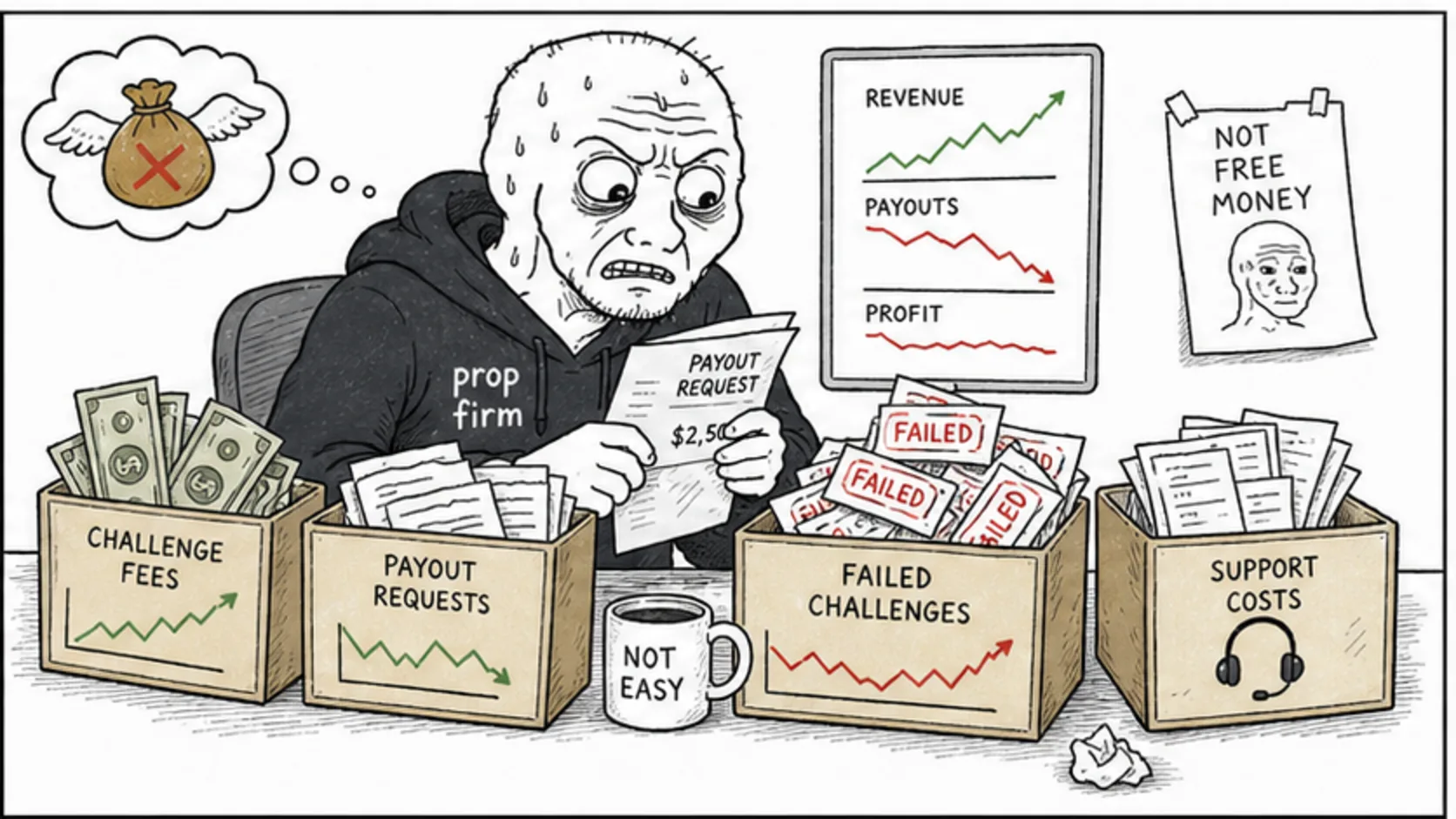
Before you figure out how to open a prop firm, you need to understand the economics. Because if you get the business model wrong, nothing else matters.
Prop firms make money from two sources: challenge fees and profit splits. When a trader buys an evaluation, the firm keeps that fee whether the trader passes or fails. When a trader passes and gets funded, the firm takes a percentage of their trading profits, typically 10% to 30%.
Here is the part most new firm owners do not want to hear. The challenge fee revenue is the engine. The profit splits are a bonus. According to industry data, roughly 7% of traders who buy a challenge ever receive a payout. That means 93% of your revenue comes from people who fail and walk away with nothing. Your pricing and your payout structure need to account for this reality.
If you charge $99 for a $100,000 challenge and 1,000 traders sign up in month one, you collect $99,000. If 10% pass, you now have 100 funded traders. If even 20 of them make consistent profits and request payouts, you are paying out from a pool of $99,000 minus your operational costs. The maths works only if enough people keep failing. This is exactly why over 80 firms collapsed when growth slowed down.
What You Need Before You Start
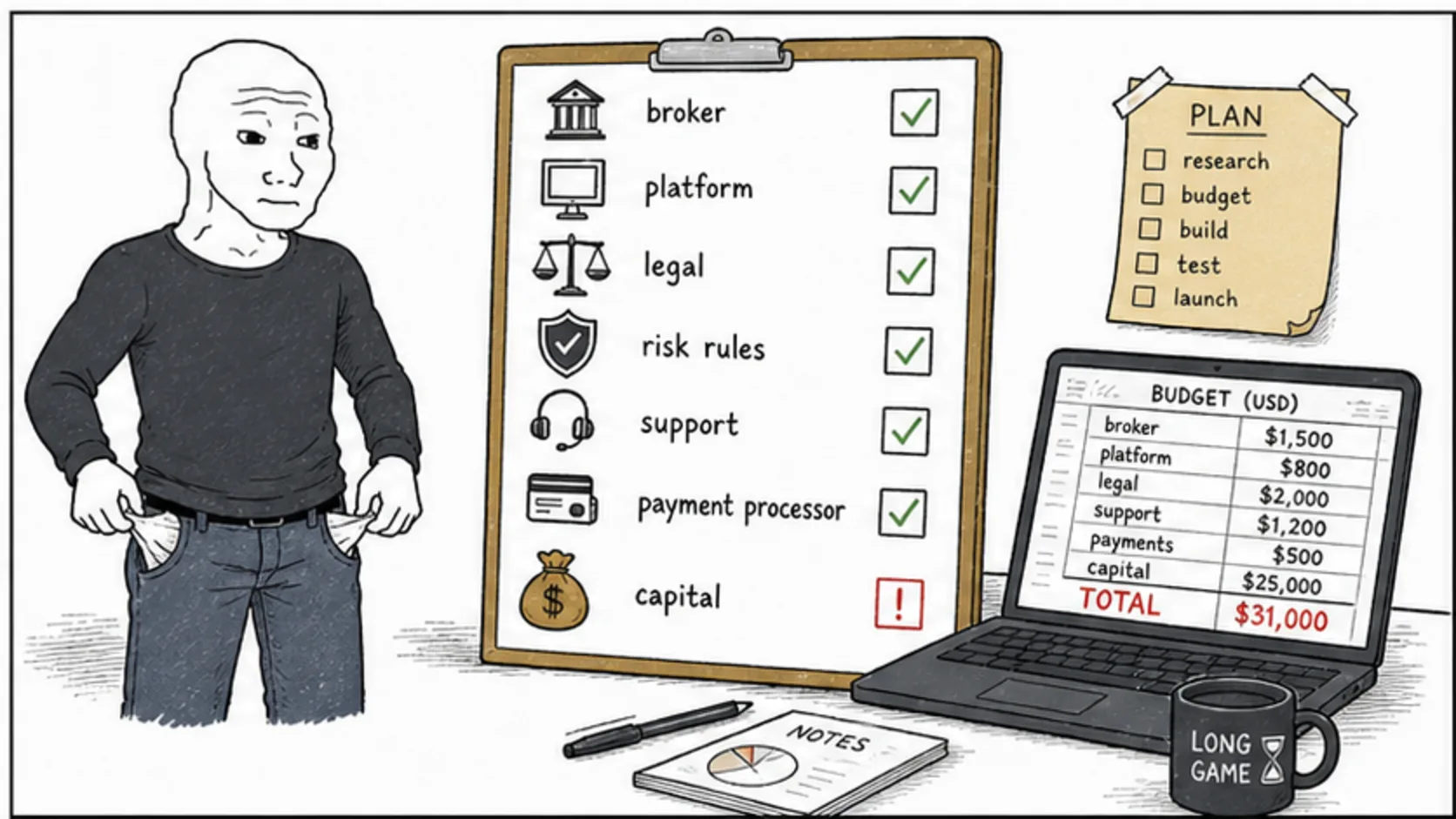
You have three missions before you even think about launching.
Mission one: decide your market. Forex, futures, crypto, or a combination. Each requires different platform infrastructure, different broker relationships, and different regulatory considerations. Forex prop firms dominate the space, but futures prop firms have been growing rapidly with platforms like TopstepX and Project X gaining traction.
Mission two: decide your model. One-step challenge, two-step challenge, instant funding, or direct funding. Each model has different risk profiles and attracts different types of traders. One-step challenges are easier to market but riskier for you because more traders pass. Two-step challenges filter more aggressively but generate more fee income from repeat attempts.
Mission three: secure your capital. Not your challenge fees. Actual capital that sits in reserve and covers your operating costs and payout obligations for at least six months. The firms that collapsed in 2024 had zero reserves. They paid out from incoming fees, and the moment fee growth slowed, they could not meet their obligations. Do not be those firms.
Trading Platform and Broker Infrastructure
This is where it gets technical, and where a lot of new firms cut corners that kill them later.
You need a trading platform. MetaTrader 4 and MetaTrader 5 are the industry standard for forex prop firms. cTrader is popular for firms that want a cleaner interface and better API access. For futures, platforms like TopstepX, Project X, Rithmic, and NinjaTrader dominate. The platform choice affects whether you are offering CFDs or actual futures contracts.
You need a broker partner. Not a white-label you found on a forum. A regulated broker that provides the liquidity, the trading server, and the execution environment for your simulated or live accounts. The broker partnership is the single most important relationship your firm has. If your broker has latency issues, execution problems, or goes under, your entire operation goes with it.
And here is the thing that caught out dozens of firms in 2024. If you are using MetaTrader, you need a properly licensed server. MetaQuotes started cracking down on firms running unlicensed MT4 and MT5 installations. Firms that were sharing server licences or operating grey-market setups lost access overnight. When your platform stops working, your business stops working. Since most retail prop firms run on simulated environments, the platform is literally your entire product.
White-label solutions exist that bundle the platform, broker relationship, and back-office technology into one package. Companies like B2Broker, PropAccount, and TradeLocker offer turnkey prop firm setups. These reduce your launch time from months to weeks, but you are building on someone else's infrastructure. If they have problems, you have problems.
Legal Structure and Regulatory Compliance
Here is where it gets serious. The legal side of opening a prop firm has changed dramatically since 2023, and if you ignore it, regulators will eventually come for you.
The prop firm model exists in a regulatory grey zone. You are not a broker. You are not managing client funds. You are selling access to a trading evaluation, and if traders pass, you give them access to a funded or simulated account. In many jurisdictions, this does not require a financial services licence. But that grey zone is shrinking fast.
The Commodity Futures Trading Commission has been warning about prop firms that operate like unregistered brokers. The Financial Conduct Authority has started action against firms offering CFDs to UK residents without authorisation. Regulators are paying attention now in ways they were not two years ago.
You need a proper legal entity. Most prop firms register in jurisdictions with favourable regulatory environments: Saint Vincent and the Grenadines, Seychelles, the Bahamas, or Dubai. Each has different requirements, costs, and tax implications. Dubai has become a major hub for prop firms, with the Dubai Multi Commodities Centre offering specific licences for trading-related businesses.
You need terms and conditions that actually protect both you and your traders. The terms need to cover challenge rules, payout conditions, account termination, rule changes, dispute resolution, and liability. This is not the place to copy and paste from another firm's website. Get proper legal advice.
You need KYC and AML procedures. Even if you are not regulated as a financial institution, you are handling money from customers. Know-your-customer and anti-money-laundering checks are standard practice and increasingly expected by payment processors and banking partners.
Designing Your Challenge Rules and Payout Structure
Your rules are your product. Get them right and you have a sustainable business. Get them wrong and you are one bad month away from collapse.
Here is the balancing act. Your rules need to be strict enough that most traders fail, because that is how the business model works. But they need to be fair enough that traders feel they had a legitimate shot, because that is how you get repeat business and positive reviews.
The core rules every prop firm needs to define:
- Profit target. Typically 8% to 10% for phase one, 5% for phase two on two-step challenges. Set it too high and nobody passes. Set it too low and too many people pass.
- Maximum drawdown. Usually 10% to 12% of the starting balance. Trailing or static determines how aggressive your risk management needs to be.
- Daily loss limit. Typically 4% to 5% of the starting balance. This is the rule that catches out most traders.
- Minimum trading days. Usually 5 to 10 days. This prevents traders from passing in a single lucky session.
- Consistency rule. Limits how much of your total profit can come from a single trade or a single day. Without this, one lucky trade passes the challenge, and you have funded a trader with no real edge.
Your payout structure is equally critical. How often do funded traders get paid? What is the profit split? Is there a scaling plan? How long is the initial payout hold before the first withdrawal? Every choice here affects your cash flow. Monthly payouts with a 14-day hold give you breathing room. Bi-weekly payouts with no hold give traders faster access but strain your reserves.
The firms that survived the 2024 cull had conservative payout structures. The ones that collapsed were offering weekly payouts, 90% profit splits, and no holding periods. Generous terms attract traders. Unsustainable terms kill firms.
How Much It Costs to Open a Prop Firm
Here are the actual numbers, not the marketing version.
White-label setup: $10,000 to $30,000. This gets you a turnkey platform with broker integration, a basic website, payment processing, and back-office tools. You can launch in 2 to 4 weeks. The downside is you are dependent on the white-label provider for everything, and your margins are thinner because they take a cut.
Custom build: $50,000 to $200,000. This covers proper legal setup, licensed trading platforms, custom website development, marketing, initial capital reserves, and staff. The costs scale with how much of the infrastructure you build yourself versus licensing from providers.
The ongoing costs are what surprise most new firm owners. Server hosting, platform licensing, broker fees, payment processing, customer support, marketing, compliance, and legal retainer. Expect $5,000 to $20,000 per month in operational costs before you pay a single funded trader.
And then there is the capital reserve question. How much money do you need sitting in reserve to cover payouts? That depends on how many funded traders you have and how much they are earning. A rough guideline: have at least three months of projected payout obligations in reserve at all times. If you expect to pay out $50,000 per month at capacity, you need $150,000 in reserves before you launch.
Why Most New Prop Firms Fail
Pay attention because this part actually matters if you are serious about opening a prop firm.
The number one reason new firms fail is pricing. They charge too little for challenges and promise too much in payouts. A $100,000 challenge for $99 with an 80% profit split and bi-weekly payouts is a recipe for disaster. The firms that are worth something charge accordingly. FTMO charges more than most competitors because their infrastructure, compliance, and payout reliability cost money.
The number two reason is inadequate capital. Most new firm owners budget for setup costs but forget about the payout reserve. When the first batch of funded traders starts requesting withdrawals, and the challenge fee revenue has not ramped up enough to cover it, the firm either delays payouts or runs out of money. Neither outcome ends well.
The number three reason is regulatory problems. Launching without proper legal advice, operating in jurisdictions that do not support your model, or offering products that require licences you do not have. Regulators move slowly, but when they move, they move decisively. The legal landscape for prop firms is shifting rapidly, and what worked in 2023 might not work in 2026.
And then there is the competitive reality. The top 10 prop firms control the vast majority of the market. Breaking into that space requires either a genuinely unique model, exceptional marketing, or a niche that the big firms are not serving. A generic MT4 prop firm with mid-range pricing and nothing distinctive is going to struggle against FTMO, FundedNext, and the rest.
So is owning a prop firm profitable? It can be. The established firms make serious money. But getting from launch to established is the hard part, and most firms do not survive the journey. If you are going to do this, do it properly. Capitalise adequately. Price sustainably. Comply with regulations. And build something that can actually last.
