
Are prop firms worth it? Yes, if you have a strategy that works, the discipline to follow rules, and the emotional control to not self-destruct during a challenge. No, if you are still figuring out how to trade, hoping to pass on luck, or treating it like a lottery ticket. There is a clear checklist for knowing when you are actually ready. The difference between those two outcomes is the difference between treating prop firms as a business tool and treating them as a shortcut to free money. One pays off. The other is just an expensive donation.
Key Takeaways
- Prop firms are worth it for traders with proven strategies who need capital, not for beginners still learning to trade.
- Your maximum financial risk is the evaluation fee, typically $50 to $600. Your potential upside is a funded account.
- Roughly 5% to 10% of traders pass challenges. Of those, a smaller percentage maintain funded accounts long enough to get consistent payouts.
- The main disadvantages are non-refundable fees, strict rules, simulated accounts, and profit splits.
- If you have your own capital to trade with, you may not need a prop firm at all.
On This Page
The Case For Prop Firms
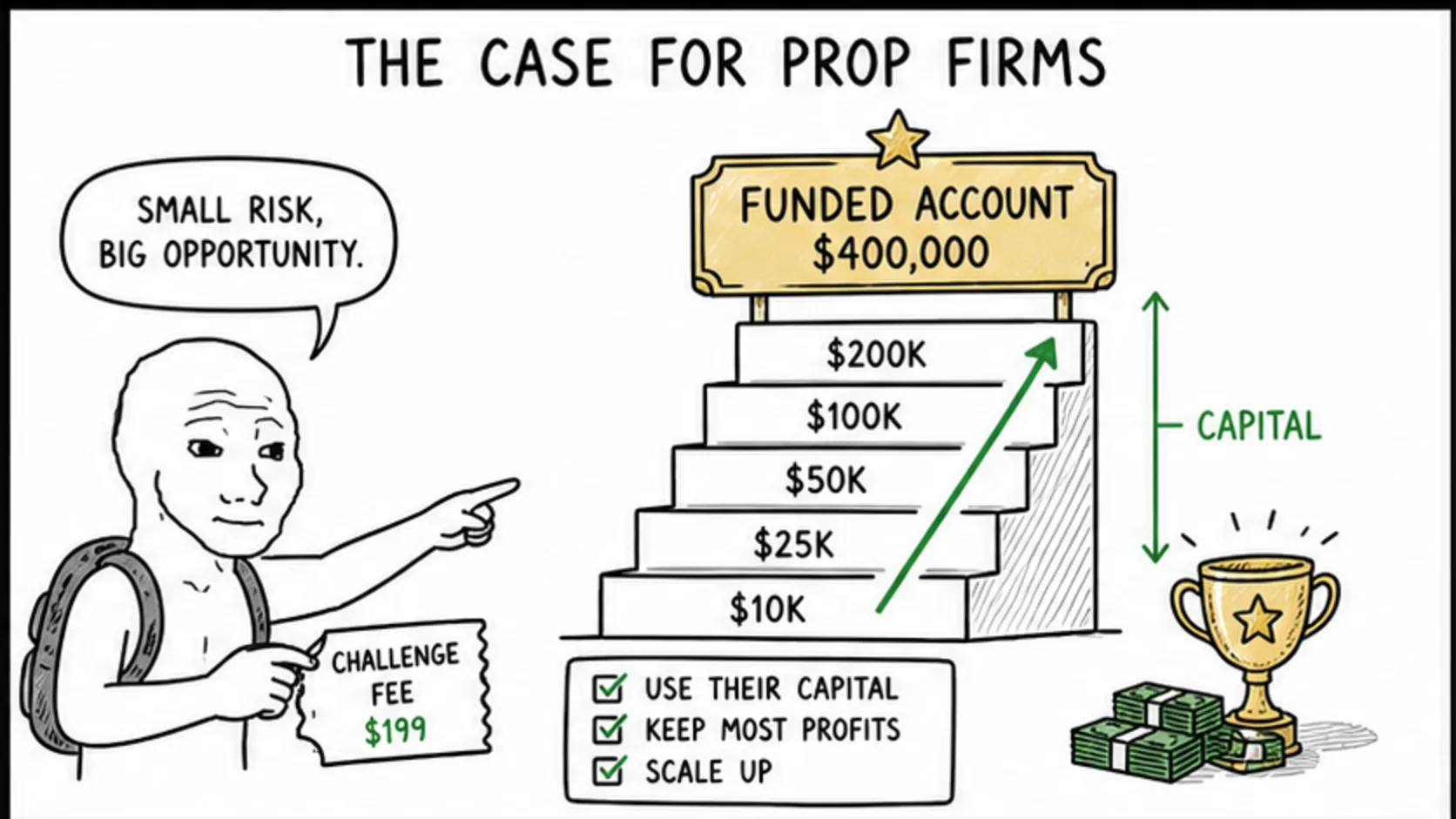
Let me start with the good stuff, because there is genuinely a lot of it.
Access to capital you do not have. This is the entire value proposition. You pay $500 for a chance to trade a $100,000 account. If you had $100,000 of your own, you would not need a prop firm. Most traders do not have $100,000 lying around. Prop firms solve that problem.
Capped downside. Your maximum loss is the evaluation fee. That is it. On a $100,000 personal account, your maximum loss is $100,000. On a prop firm, your maximum loss is whatever you paid for the challenge. The asymmetric risk profile is one of the strongest arguments in favour of prop firms.
Forced discipline. The rules make you a better trader. Daily loss limits, maximum drawdown, profit targets. These constraints force you to manage risk, whether you want to or not. Many traders learn more about risk management in one prop firm challenge than in a year of trading their own account with no rules.
No personal liability for losses. You cannot go into debt to a prop firm. The firm absorbs your trading losses. You lose the fee, not your life savings.
Scalable income. Pass one challenge, get funded, earn payouts. Pass another, get a second account, earn more. Some firms offer scaling plans that increase your account size as you prove consistency. The ceiling is higher than what most retail traders could achieve on their own capital.
The Case Against Prop Firms
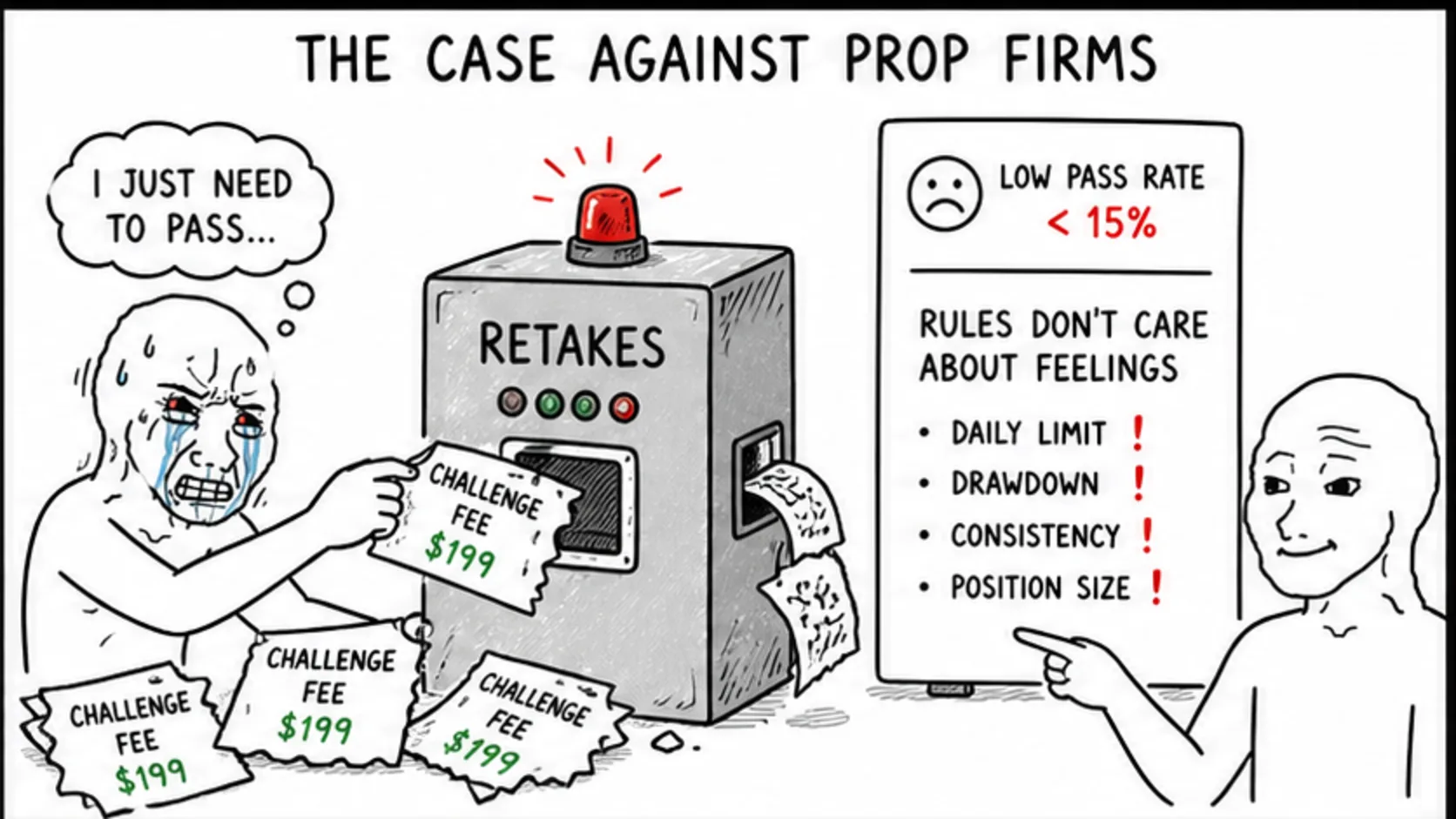
Now the bad stuff. And there is plenty.
Most traders fail. The pass rate for prop firm challenges is roughly 5% to 10%. That means 90% to 95% of people who buy a challenge lose their money and get nothing back. The European Securities and Markets Authority reports that 85% of retail traders lose money on their own accounts. Prop firms add rules on top of that. The pass rate is not encouraging.
Non-refundable fees. The evaluation fee is gone whether you pass or fail. Some firms refund it after your first payout, but that requires actually passing and getting funded first.
Strict rules that can feel arbitrary. Trailing drawdown rules, consistency requirements, minimum trading days, news trading restrictions. These rules exist to protect the firm, not to help you. They can catch out good traders who have one bad day.
Simulated accounts. Most retail prop firms use simulated trading. You are not trading real money. The firm is not risking real capital. This bothers some people. It does not bother others. But you should know before you sign up.
Profit splits are not 100%. You keep 70% to 90% of your profits. That is still better than 0% of $100,000 you do not have, but it means the firm takes a cut of your work.
Payouts can be denied. Firms can deny payouts for rule violations, even minor ones. If you break a rule you did not fully understand, you may lose everything you earned.
The Math: Does It Actually Pay Off?
Let me run the numbers so you can decide for yourself.
Scenario one: you buy a $100,000 challenge for $500. You have a strategy that works, you have tested it, and you pass on your first attempt. You now have a funded account with an 80% profit split.
You make 5% per month on the $100,000 account. That is $5,000 per month. Your share is $4,000. In two months, you have recouped your $500 fee and made $7,500 in profit. Are funded accounts worth it in this scenario? Obviously yes.
Scenario two: you buy the same $100,000 challenge for $500. You fail on your first attempt because you overtrade in week two. You buy another challenge for $500. You fail again because you revenge trade after a loss. You have now spent $1,000 with nothing to show for it.
Scenario three: you buy the challenge, pass, get funded, and then breach your daily loss limit on your third day as a funded trader. Account closed. $500 gone, plus any unrealised profits.
The math depends entirely on whether you pass. And whether you pass depends on whether you have the skill and discipline to trade within the rules for 20 to 30 consecutive days without a catastrophic error.
According to data from the Commodity Futures Trading Commission, most retail traders lose money consistently. Prop firms do not change that statistic. They just cap the loss at the evaluation fee.
Who Prop Firms Are Worth It For
Prop firms are worth it for a specific type of trader. Here is the profile.
You have been trading for at least six months on a demo or small live account. You have a strategy with a positive expectancy, meaning it makes money over a large sample of trades. You understand risk management, position sizing, and emotional control.
You do not have $100,000 of your own capital. Or you do, but you do not want to risk it all on one trading account. You want access to more capital without risking more of your own money.
You can follow rules without arguing with them. Prop firm challenges are not creative endeavours. They are rule-following exercises. If you cannot follow rules for 30 days, prop firms will take your money repeatedly.
You treat the evaluation fee as a business cost, not a gamble. If losing $500 would cause financial stress, you are not ready for a prop firm challenge.
Who Should Not Buy a Challenge
You should not buy a prop firm challenge if any of the following apply.
You are still learning to trade. If you cannot consistently make money on a demo account, you will not make money on a prop firm challenge. The rules make it harder, not easier. Master the basics first.
You have no trading strategy. "I will figure it out during the challenge" is not a strategy. It is a donation. Prepare before you buy. Have a plan. Test it. Then buy the challenge.
You cannot afford to lose the fee. If $500 is grocery money or rent money, do not spend it on a challenge. The most likely outcome is that you lose it. Plan for that.
You are emotionally reactive. If a losing trade makes you want to take a bigger trade to win it back, you will fail. Trading psychology for prop firm challenges is not optional. It is the main event.
You are looking for guaranteed income. Prop firms do not guarantee anything. You can pass the challenge, get funded, and still earn zero if your strategy stops working or you break a rule.
Prop Firm vs Trading Your Own Money
This is the question underneath the question. Are prop firms worth it compared to just trading your own account?
| Factor | Prop Firm | Your Own Account |
|---|---|---|
| Capital required | $50 to $600 (fee only) | Full account balance |
| Maximum loss | The evaluation fee | Your entire balance |
| Profit share | 70% to 90% | 100% |
| Rules | Strict daily loss, drawdown, time limits | None (self-imposed only) |
| Account size | $5,000 to $1,000,000+ | Whatever you deposit |
| Withdrawal freedom | Payout schedule applies | Withdraw anytime |
| Risk of ruin | Very low (capped at fee) | Full balance at risk |
If you have $100,000 of your own and the discipline to manage it properly, you do not need a prop firm. You keep 100% of your profits, you answer to nobody, and you withdraw whenever you want.
If you have $500, prop firms offer something you cannot get anywhere else. Access to capital 200 times your investment with capped downside. That is a legitimate opportunity. Just go in with your eyes open.
How to Decide for Yourself
You have three missions before buying a challenge.
Mission one: prove your strategy works on demo. Not for a week. Not for two weeks. For at least two months of consistent results. If you cannot do it on demo, you cannot do it on a challenge. This is non-negotiable.
Mission two: calculate your expected performance against the firm's rules. Look at the maximum drawdown, the daily loss limit, the profit target, and the time limit. Can your strategy hit the target within the rules? Run the numbers. Do not guess.
Mission three: budget for two attempts. Assume the first one is a learning experience. If you pass on the first try, great. But plan for the realistic scenario where you learn the rules the hard way and need a second shot.
Are prop firms worth it? For traders who do the work, yes. For everyone else, they are an expensive education in what happens when you skip the preparation. Choose the right firm, follow the rules, and treat it like a business. That is the entire formula.
