
Do prop trading firms keep your loss? No. The firm absorbs every dollar you lose on a funded account. You are not personally liable, you cannot go into debt, and nobody is coming after your bank balance because you blew a $50,000 challenge in four days. The only real money you ever lose is the evaluation fee you paid upfront. Everything after that is the firm's problem.
Key Takeaways
- Prop firms absorb all trading losses on funded accounts. You are not personally liable.
- Your maximum financial risk is the evaluation fee, typically $50 to $500.
- Daily loss limits and drawdown rules prevent losses from exceeding the account balance.
- Most retail prop firms use simulated accounts, so losses never touch real capital anyway.
- The firm keeps your evaluation fee whether you pass or fail. That is their revenue.
On This Page
The Direct Answer
Do prop trading firms keep your loss? They do not keep it, they absorb it. There is a difference. "Keeping" implies the firm is somehow extracting money from you. They are not. They are simply letting your account balance go to zero and closing the account.
The firm gave you access to a trading account. You lost money on it. The account balance dropped. The firm's rules, your daily loss limit and maximum drawdown, prevented the loss from getting out of hand. When you hit the limit, the account was automatically closed.
At no point in this process did you owe the firm money. At no point did the firm ask you to cover the difference. The loss exists on paper, and on most retail prop firm accounts, even the paper is simulated.
What Actually Happens When You Lose Money on a Prop Firm Account
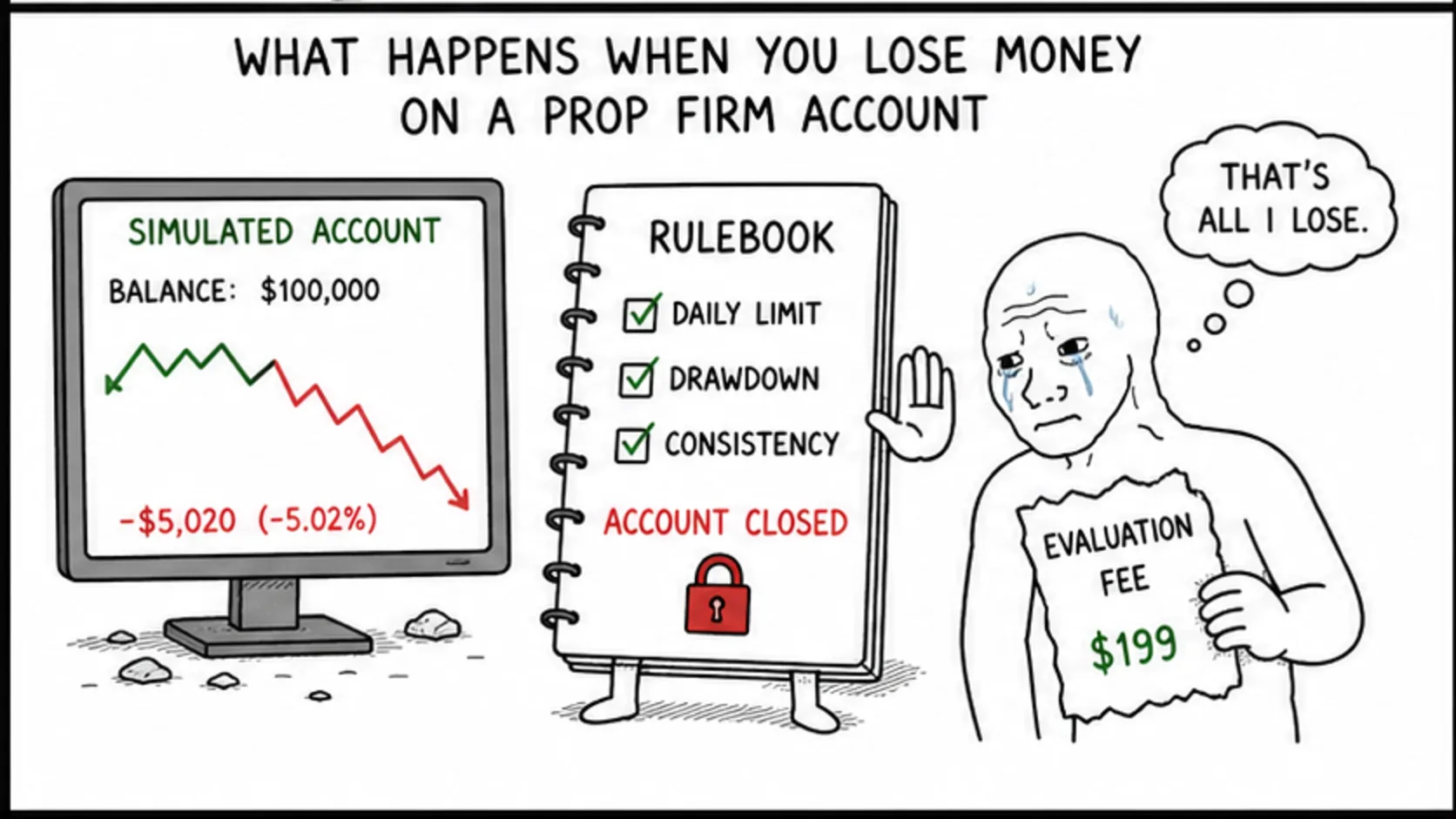
Let me walk you through the exact sequence, because the mechanics matter.
You are on day 12 of your funded account. You take a trade that goes wrong. Then another. Then you revenge trade a third position because you are human and humans do dumb things when they are losing. Your account balance drops from $102,000 to $95,000.
If your maximum drawdown is 10% on a $100,000 account, you are allowed to drop to $90,000 before the account is breached. You are at $95,000. You are still in the game, but your drawdown is creeping up.
Let us say you keep trading badly and hit $89,500. The system automatically closes all your open positions. Your account is flagged as breached. You receive an email saying your funded status has been revoked.
That is it. No invoice. No collections agency. No impact on your credit score. The prop firm losses are absorbed entirely. The firm takes the $10,500 loss on its simulated server and moves on.
Why the Firm Does Not Need to Collect Your Losses
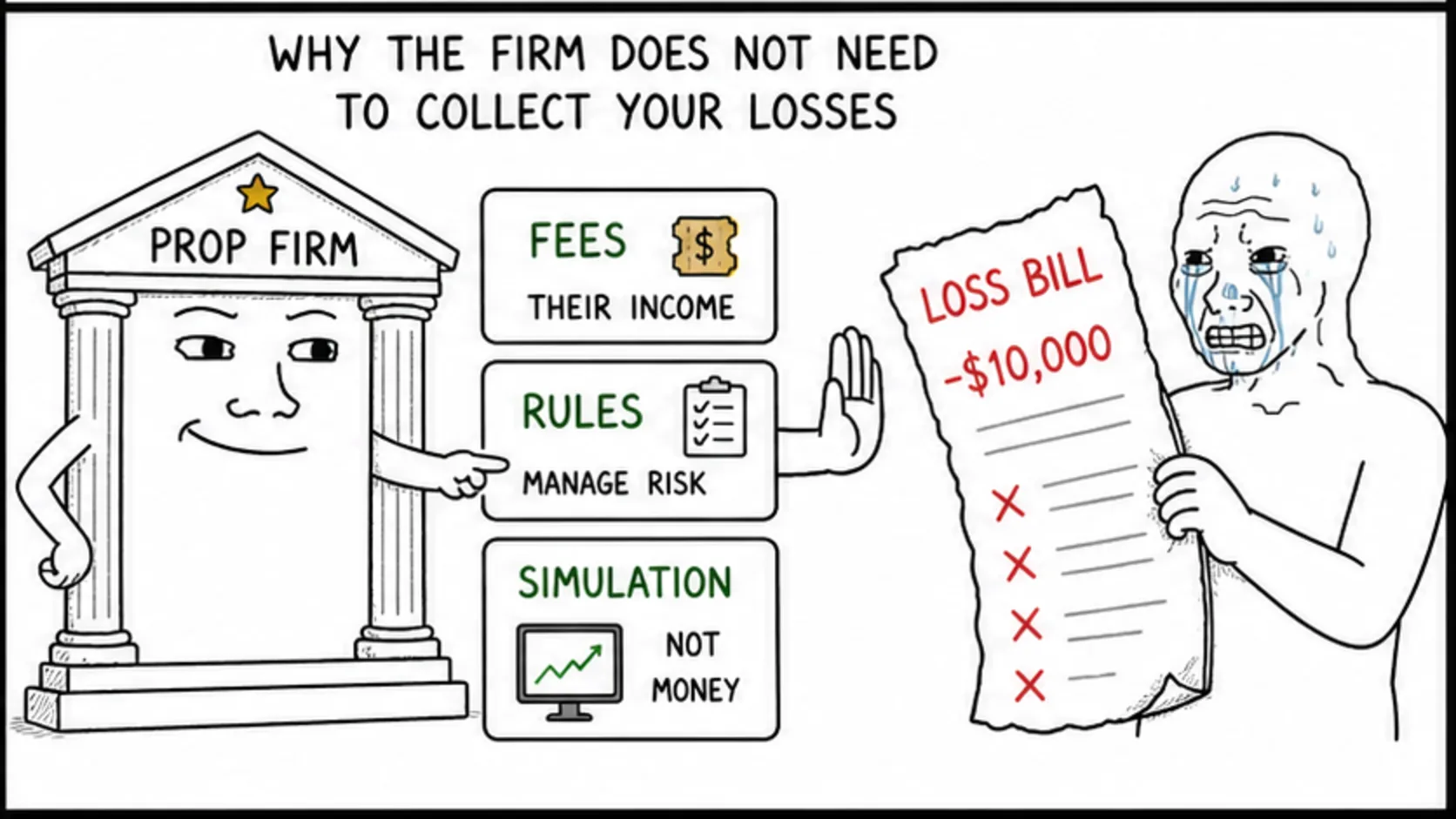
Do prop trading firms keep your loss as revenue? No, but they do not need to. They already collected their revenue when you paid the evaluation fee.
Think about the business model. The firm charges $300 for a $100,000 evaluation. Let us say 1,000 traders buy this evaluation in a month. That is $300,000 in revenue before a single trade is placed.
Of those 1,000 traders, roughly 100 will pass and get funded. Of those 100, maybe 30 will generate enough profit to request a payout. The firm pays out, say, $150,000 in total payouts that month.
The firm's net revenue is $300,000 minus $150,000 in payouts. That is $150,000 profit from one month of one account size. Your trading losses do not factor into this calculation at all.
The firm makes money from evaluation fees, not from collecting trader losses. Your blown account costs the firm nothing on a simulated server. It is just a reset button.
How Risk Rules Protect Both Sides
The reason the firm does not need to chase you for losses is that the rules prevent catastrophic losses in the first place.
Your daily loss limit caps how much you can lose in a single trading day. If you have a 5% daily loss limit on a $100,000 account, the maximum you can lose in one day is $5,000. The system will not let you lose more.
Your maximum drawdown caps your total loss from the starting balance or equity high. Hit that number and the account is done. No further trades. No further losses.
These rules are not there to punish you. They are there to protect the firm from the exact scenario you are worried about. The firm caps its downside before it ever becomes a problem. Your losses are bounded, predictable, and contained within the account structure.
According to the European Securities and Markets Authority, 85% of retail forex traders lose money on their own accounts. Prop firms flip this by capping your losses mechanically. Do prop trading firms keep your loss beyond the evaluation fee? They do not need to. The rules make it impossible for losses to accumulate unchecked.
The Prop Firm Evaluation Fee: What You Actually Lose
The evaluation fee is your real, tangible, gone-from-your-bank-account loss. That is the money the firm keeps regardless of outcome.
Understanding what do prop trading firms keep when you lose is crucial for managing your own expectations. The answer is simple: they keep your evaluation fee. They do not keep, collect, or pursue your trading losses.
Fail the evaluation, and the fee is gone. Pass the evaluation, get funded, blow the funded account, and the fee is still gone. There is no scenario where you get the evaluation fee refunded just because you lost money on the account.
Some firms refund the evaluation fee after your first payout as a funded trader. This is a nice incentive, but it does not change the basic dynamic. The prop firm evaluation fee is the cost of entry. Your trading losses are the firm's cost of doing business.
A standard $100,000 account evaluation costs between $400 and $600. That is your maximum total loss. Compare that to trading your own $100,000 account, where your maximum loss is, well, $100,000. The asymmetric risk profile is one of the strongest arguments for using prop firms in the first place.
What Happens on Simulated Accounts
Here is the part that makes this whole question almost philosophical.
Most retail prop firms use simulated trading accounts. Your funded account is a demo environment. The trades do not touch the real market. The losses do not cost the firm anything in real money.
When you blow a simulated $100,000 account, nothing happens in the real world. No real capital was destroyed. No real positions were liquidated. The prop firm account is blown, the server resets, and the firm moves on to the next trader.
So asking whether prop trading firms keep your loss is almost the wrong question. There is no loss to keep. The loss exists in a simulation. The fee you paid is real. The simulation reset costs the firm nothing.
This is why the model works. The firm collects real fees, pays out real cash to winners, and absorbs simulated losses that cost nothing. Do prop trading firms keep your loss? They never have it to begin with.
What This Means for Your Risk Decisions
Knowing that the firm absorbs your losses does not mean you should trade recklessly. It means you should trade with discipline because your payout depends on it. Can you owe money to a prop firm? No. But you can lose your funded status, and that costs you future income.
You have two missions. Mission one: protect the account. Do not hit the drawdown limit. Do not hit the daily loss limit. Do not blow up the account. This is non-negotiable because a blown account means no more funded status and no more payouts.
Mission two: generate consistent profits. Small, boring, repeatable profits. Not hero trades. Not lottery tickets. Just steady green days that compound over time into a payout request.
The firm is not your enemy here. The rules are not traps. They are guardrails that keep you from destroying your own chances. Your risk management strategy should be built around staying inside those guardrails, not testing their limits.
Trading losses on prop firm accounts are part of the game. You will lose on individual trades. That is guaranteed. What matters is whether your losses stay small enough to keep the account alive until your winners outweigh them.
The traders who succeed with prop firms are not the ones who never lose. They are the ones who lose small, manage their drawdown, and survive long enough to collect payouts consistently. Do prop trading firms keep your loss as a weapon against you? No. The loss is just a reset. Your next evaluation is a fresh start.
