
Are prop firms legit? Yes, most of them are. The established ones have been paying funded traders for years, have transparent rules, and operate as real businesses. But "most" is not "all", and the prop firm space has no shortage of companies that look legitimate until you try to withdraw your money. The trick is knowing exactly how to separate the firms that will pay you from the firms that will take your evaluation fee and find a reason to deny everything you earn.
Key Takeaways
- Most prop firms are legitimate businesses that make money from evaluation fees and profit splits, not from scamming traders.
- The prop firm industry is largely unregulated, which means there is no safety net if a firm behaves dishonestly.
- Legitimate firms have public payout records, clear rules, responsive support, and third-party reviews you can verify.
- Red flags include guaranteed pass rates, unrealistically low fees, no payout proof, and terms that let the firm change rules retroactively.
- Always research a firm before buying a challenge. Check Trustpilot, Reddit, and independent review sites for real trader experiences.
On This Page
What Makes a Prop Firm Legitimate
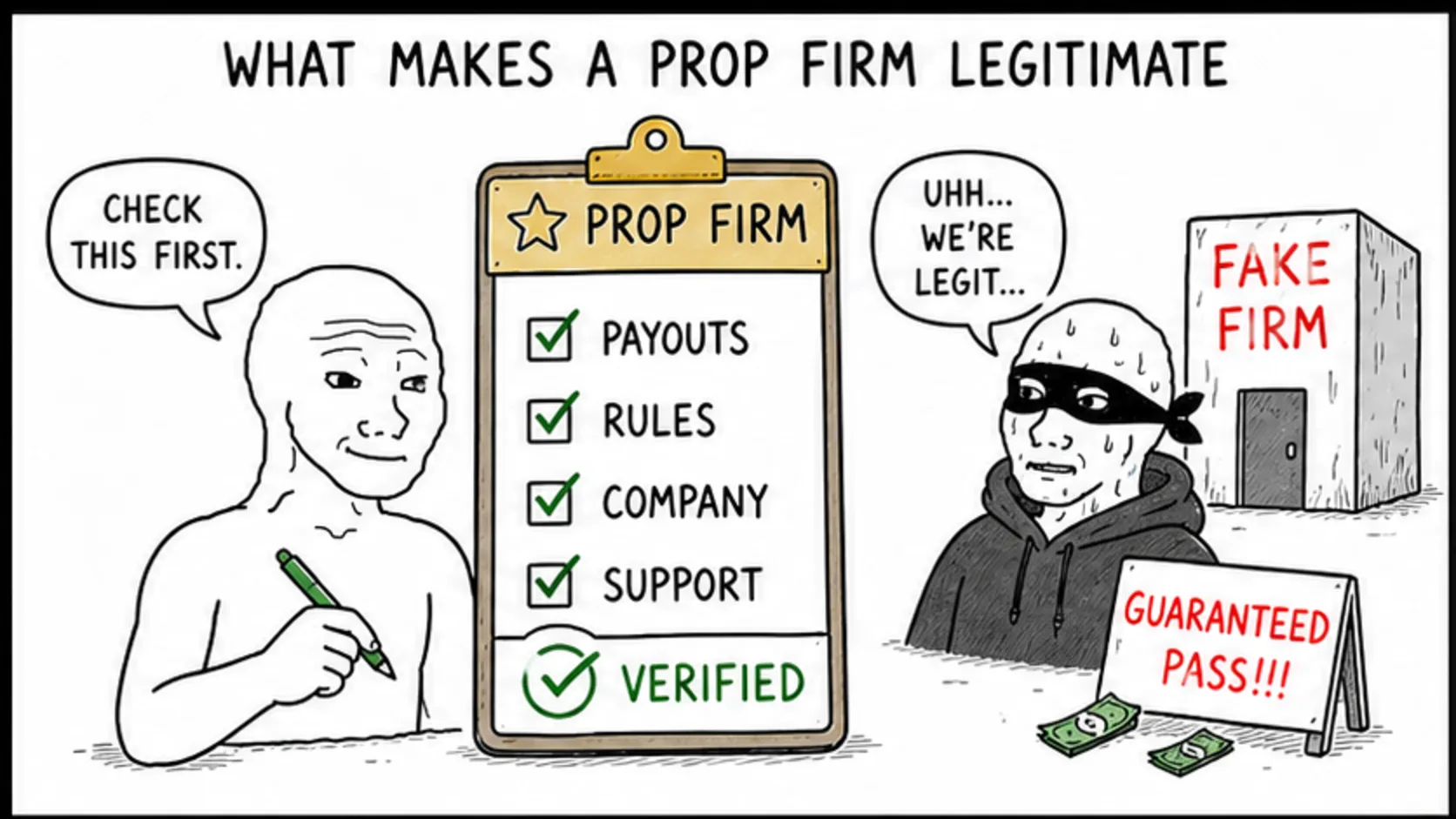
A legitimate prop trading firm operates a straightforward business model. They charge evaluation fees, fund traders who pass, and take a cut of the profits. That is the entire operation. Nothing hidden, nothing sneaky.
The firm makes money whether you pass or fail. If you fail, they keep your fee. If you pass, they fund your account and take 10% to 30% of your profits forever. It is a volume game. More challengers means more fees, more funded traders means more profit splits. A legitimate firm wants you to pass because a funded, profitable trader is worth more to them than a one-time fee from someone who washed out.
Here is what a legitimate firm actually looks like in practice. They have clear rules published on their website. Daily loss limits, maximum drawdown, profit targets, trading style restrictions. All of it visible before you pay a penny. The rules are the product. If you cannot find them, or if they are buried in fine print, that is a problem.
They process payouts on a regular schedule and publish proof. Not screenshots that could be fabricated. Actual payout records, community posts from funded traders, and consistent payment histories stretching back months or years.
They have customer support that responds. Not an email address that bounces, not a Discord server where questions go to die. Real humans who answer questions about rules, payouts, and account issues within a reasonable timeframe.
Why People Think Prop Firms Are Scams
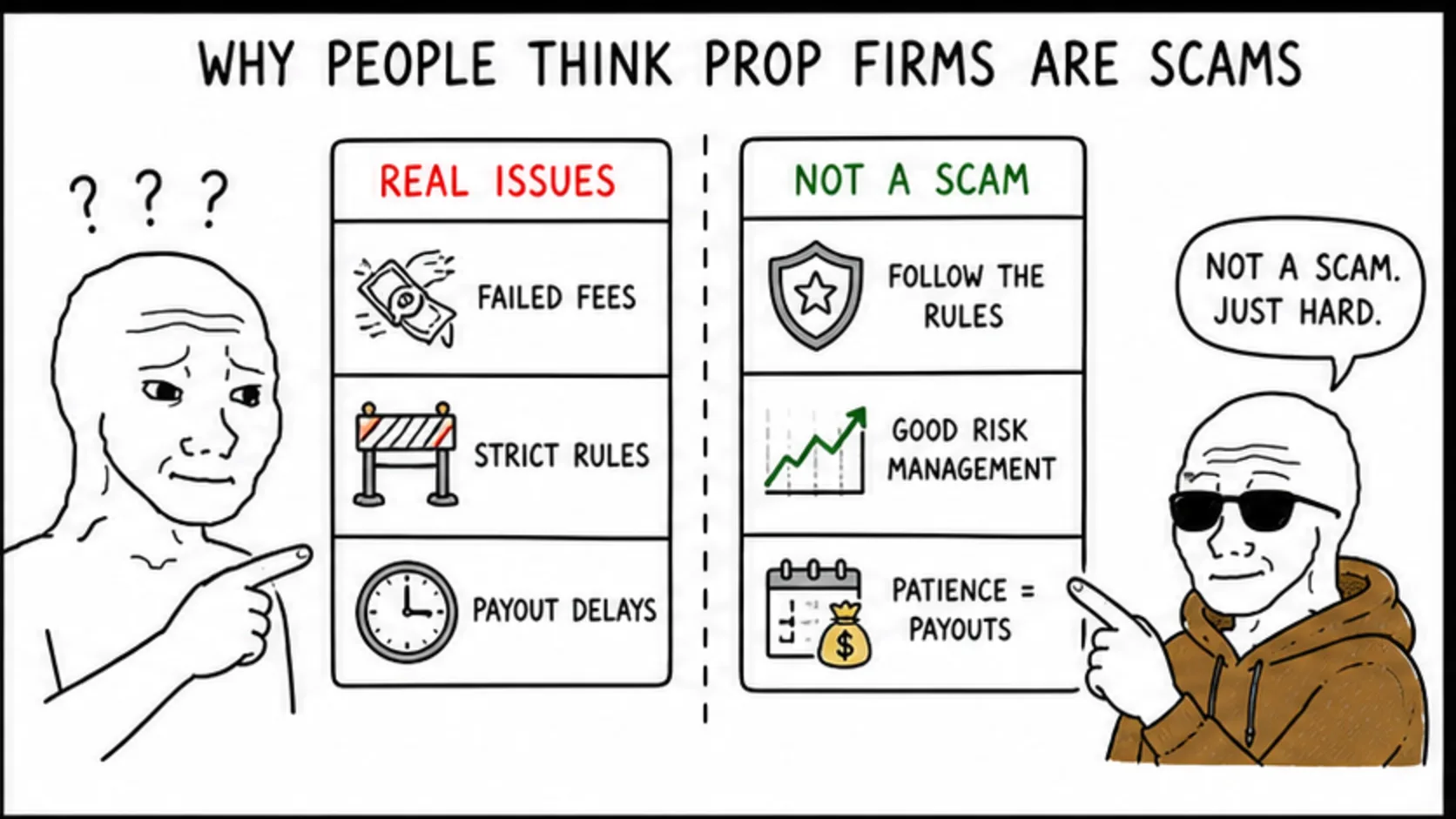
Here is where it gets interesting. When people ask are trading prop firms legit, a lot of the complaints come from traders who broke the rules and lost their accounts. Not always, but often.
You hit your daily loss limit on day 12 of your challenge. Your account gets closed. You go to Reddit and post that the firm scammed you. Except the firm did not scam you. You breached a rule that was clearly stated on the website before you paid. The daily loss limit does not care about your feelings. It is a hard number, and if you cross it, you are done.
That said, not every complaint is sour grapes. Some prop firms genuinely behave badly and their prop firm legitimacy deserves to be questioned. They change rules mid-challenge. They introduce new consistency requirements after you have already started trading. They deny payouts for "irregular trading activity" without explaining what that means. They take six weeks to process a withdrawal that was supposed to take five days.
According to the Commodity Futures Trading Commission, retail trading losses are already extremely high among individual traders. Prop firms add a layer of rules on top of an activity where most people already lose money. When a trader fails and the firm keeps the fee, it can feel like a scam even when it is not one.
The truth sits in the middle. Most prop trading firms are legit operations. Some traders complain because they broke rules. Some firms genuinely deserve the complaints. Figuring out which situation you are looking at is the whole game.
Are Prop Firms Regulated?
No. Not in the way you might think.
Prop firms are not brokerages. They do not hold client funds in the traditional sense. You are not depositing money into a trading account. You are paying a fee to access an evaluation, and if you pass, you trade on a simulated account that mirrors live market conditions. Most retail prop firms use demo accounts, not real money.
Because prop firms are not handling client funds or executing real trades on your behalf, they fall outside the scope of most financial regulators. The Financial Conduct Authority in the UK does not regulate prop firm evaluations. The European Securities and Markets Authority does not oversee them either. They exist in a regulatory grey zone.
This is important. It means there is no government body you can complain to if a prop firm denies your payout unfairly. There is no ombudsman. There is no compensation scheme. If a firm decides to close its doors tomorrow and keep everything, your recourse is essentially zero.
Does this mean prop firms are scams? No. It means you need to do your own due diligence. The lack of regulation is a risk factor, not a death sentence. Plenty of unregulated businesses operate honestly. But you need to go in knowing that nobody is watching your back except you.
Red Flags That Scream Stay Away
You have been warned about these. Now here they are in one place. Print this section. Tattoo it on your trading desk. Whatever works.
No payout proof. A firm that cannot show you evidence of actual payouts to real traders is not a firm you should trust. Every legitimate prop firm has funded traders who have received payments. If the only "proof" is a few blurry screenshots, run.
Rules that change after you pay. The terms and conditions say one thing when you sign up, then the firm updates them two weeks into your challenge. If the firm reserves the right to change rules retroactively and you agreed to those terms, you have no recourse.
Guaranteed pass rates or "easy" challenges. If a firm advertises that their challenge is easy to pass, they are either lying or their challenge is so easy that it attracts thousands of traders who all get funded, at which point the firm cannot afford to pay everyone. Both scenarios end badly.
Unrealistically low fees. A $100,000 challenge for $49. Think about that. What business gives you access to $100,000 for $49 with no credit check and no collateral? Either the firm is subsidising to build market share, or something does not add up. Proceed with extreme caution.
Zero online presence outside their own website. No Trustpilot page. No Reddit discussions. No YouTube reviews from independent creators. If the only information about a firm comes from the firm itself, you have no way to verify anything they claim.
Aggressive marketing with no substance. Lamborghinis, yacht photos, "financial freedom" language. If the marketing looks like a get-rich-quick scheme, the underlying business probably is one.
Slow or non-existent customer support. Send them an email before you buy. Ask a specific question about their rules. If you get no response, or a generic copy-paste answer that does not address your question, imagine what happens when you need help with a payout. These are prop firm scam signs that show up before you even hand over money.
How to Verify a Prop Firm Before You Buy
You have three missions before handing over your money.
Mission one: check independent reviews. Not the ones on the firm's website. Go to Trustpilot, sort by newest first, and read the one-star and two-star reviews. Those tell you more than the five-star reviews ever will. Look for patterns. If multiple traders complain about the same issue, denied payouts, slow withdrawals, changed rules, that is not coincidence. That is a pattern.
Check Reddit. Search the firm name in r/Daytrading, r/Forex, and r/PropTradingFirms. Reddit is unfiltered. People share real experiences, including screenshots of payout confirmations and denial emails. If a firm keeps your losses and your fee, someone on Reddit has probably posted about it.
Mission two: read the terms and conditions. Every word. Yes, it is boring. Do it anyway. Look specifically for clauses about payout conditions, rule changes, account termination, and dispute resolution. If the terms give the firm unlimited power to deny payouts for any reason, you need to know what those red flags look like before you pay.
Mission three: verify their track record. How long has the firm been operating? Firms that have been around for three-plus years and are still paying out are doing something right. Firms that launched six months ago with a slick website and zero history? Higher risk. Not necessarily bad, but higher risk.
Check if the firm has been featured or mentioned by reputable financial media or industry publications. Check if their founders are publicly known and have verifiable backgrounds. Anonymity is not automatically suspicious, but transparency is always preferable.
Which Prop Firms Actually Pay Out
I am not going to give you a list of firms and declare them all saints. That is not how this works. What I will tell you is what to look for in a firm that consistently pays its traders.
The best prop firms share a few traits. Our ranked list of the best prop firms is built on these criteria. They have been operating for at least two years. They have public payout statistics on their websites. They have active communities of funded traders who share their experiences openly. They respond to negative reviews with specific details rather than generic platitudes.
FTMO (Read the PassPropTradingFirms FTMO Review), for example, has published payout data showing they have paid out over $200 million to funded traders since their founding. That is a real number from a real company with a verifiable track record. Are the accounts real money? Not exactly. But the payouts are real. Funded traders receive actual cash payments, and the payout-focused guide explains which firms pay consistently and how to verify the proof.
The prop firm industry generated an estimated $8 billion in revenue in 2024, according to industry analysis. The legitimate firms in this space are running real businesses with real revenue. They do not need to scam you. They make plenty of money from the 90% of traders who fail challenges and the profit splits from the ones who pass.
The firms that cannot afford to pay out are the ones offering unrealistic profit splits, no proper risk management, and unsustainable growth. If a firm is offering 95% profit splits on challenge accounts with barely any rules, ask yourself how they stay in business. The answer might be that they do not plan to.
The Difference Between Legit Firms and Legitimate Complaints
Pay attention because this part actually matters.
A legitimate firm can still generate legitimate complaints. A trader gets funded, breaks a rule they did not fully understand, and loses their account. That trader posts a negative review. The review is real. The frustration is real. But the firm did nothing wrong.
At the same time, a sketchy firm can have positive reviews. They pay out just enough traders to maintain a decent Trustpilot score while denying payouts to the majority. The positive reviews are real. The firm is still problematic.
So how do you tell the difference?
Look at the ratio. A firm with 80% positive reviews and 20% negative reviews is probably legitimate. The 20% are mostly traders who broke rules or had unrealistic expectations. A firm with 60% positive and 40% negative is concerning. A firm with a pattern of the same specific complaint, denied payouts, delayed withdrawals, across multiple review platforms, is a firm you should avoid regardless of their total rating.
Look at how the firm responds to complaints. Legitimate firms engage with negative reviews, explain what happened, and sometimes resolve the issue publicly. Firms that ignore negative reviews or respond with copy-paste apologies are telling you everything you need to know about how they will treat you when something goes wrong.
So are prop trading firms legit? The established ones absolutely are. The ones that have been around for years, pay out consistently, and have transparent rules are running real businesses. But the barrier to entry for launching a prop firm is low. Anyone can build a website, set up a simulated trading environment, and start collecting fees. Your job is to separate the businesses from the schemes. Read the rules. Check the reviews. Verify the payouts. And never pay a fee you cannot afford to lose.
