
Are prop firms a scam? No, the established ones are not. But the prop firm space has a problem that makes scams inevitable. When new firms launch faster than regulators can keep up with them, and when the barrier to entry is basically a website and a MetaTrader server, some of those firms are absolutely going to be scams. Prop firm scams exist. That is a fact. The question is whether you can tell the difference before you hand over your money. That is what this page is for.
Key Takeaways
- Most established prop firms are not scams. They operate legitimate businesses funded by evaluation fees and profit splits.
- Scam prop firms often use a Ponzi-like model where payouts to existing traders come from new sign-up fees, not from trading revenue.
- The biggest warning signs are no payout proof, rules that change without notice, aggressive recruiting of affiliates, and a company history of less than one year.
- You can protect yourself by verifying payout records, reading independent reviews, and never paying more than you can afford to lose.
- If a firm has collapsed before, research whether the same operators have launched new firms under different names.
On This Page
- Why People Think Prop Firms Are Scams
- How Prop Firm Scams Actually Work
- The Ponzi Model: When Payouts Come From New Traders
- Prop Firms That Collapsed and What Happened
- Warning Signs You Are About to Get Scammed
- How to Protect Yourself Before Buying a Challenge
- What to Do If You Get Scammed
- Frequently Asked Questions
Why People Think Prop Firms Are Scams
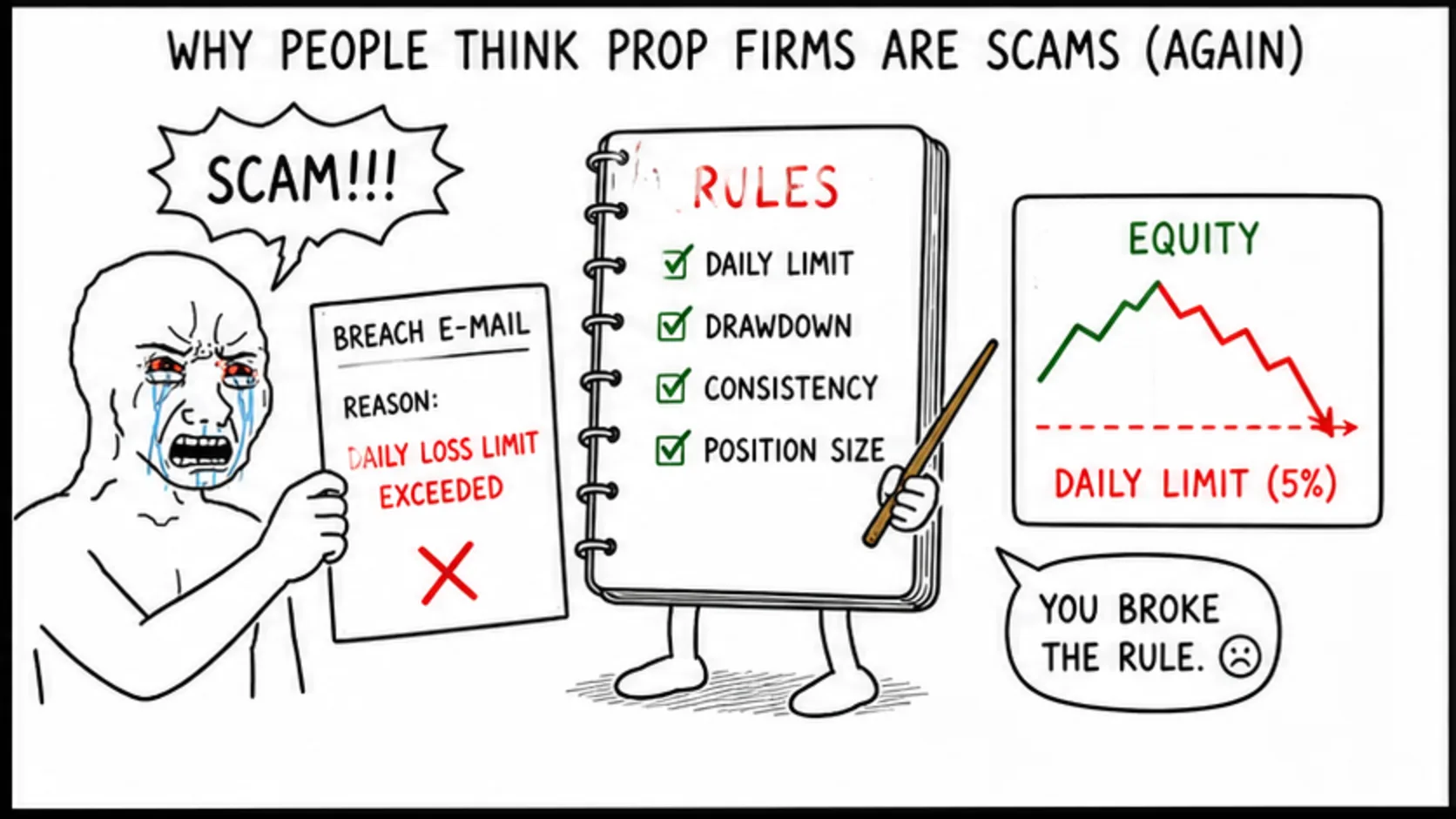
Before I get into the actual scams, let me deal with the false accusations. Because a lot of the "prop firms are a scam" noise on Reddit comes from traders who failed their challenges and are furious about it.
You bought a $500 challenge. You hit your daily loss limit on day nine. Your account got closed. You went straight to Reddit and typed a furious post about how the firm scammed you. Except it did not. You breached a rule that was published on the website before you paid. The daily loss limit is not a suggestion. It is a hard boundary, and if you cross it, the firm is doing exactly what it told you it would do.
The European Securities and Markets Authority reports that approximately 70% to 80% of retail traders lose money on their own accounts. Prop firms add rules on top of an activity where most people already lose. When the inevitable happens and someone fails, the firm keeps the fee, and the trader screams scam.
That is not what this page is about. This page is about the real scams. The firms that were designed to fail from day one. The ones that never intended to pay anyone. The ones that take your money, show you a fake trading dashboard, and disappear when too many people ask for withdrawals at the same time.
How Prop Firm Scams Actually Work
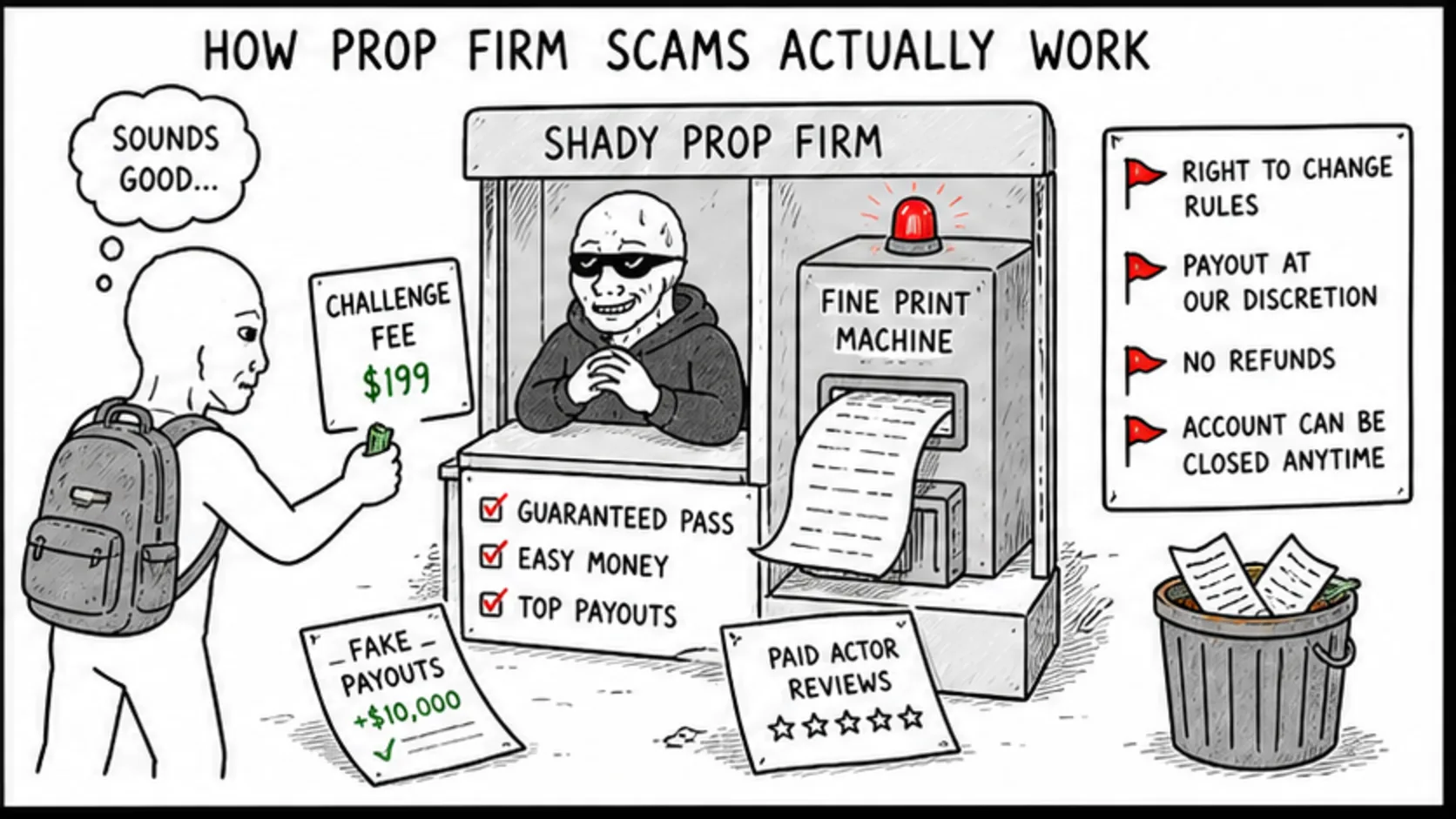
A genuine prop firm makes money from two sources: evaluation fees from traders who fail, and profit splits from traders who pass and get funded. Both revenue streams are sustainable because the firm only pays out a percentage of actual trading profits.
A scam prop firm makes money from one source: evaluation fees. That is it. There are no real trading profits because there is no real trading happening. The firm does not have capital to allocate. It does not have a risk management team. It has a website, a payment processor, and a MetaTrader license.
Here is how the scam works in practice. You pay $500 for a challenge. The firm gives you login credentials to a demo account. You trade. If you fail, the firm keeps your $500. If you pass, the firm gives you a "funded" account. Except the funded account is also a demo. You are still trading simulated money.
You make $2,000 in simulated profits and request a payout. The firm sends you $1,600 (your 80% cut) from its own bank account. Where did that money come from? Not from your trading, because you were trading a demo. It came from the next batch of evaluation fees paid by new traders signing up.
This works fine as long as new traders keep signing up faster than funded traders keep requesting payouts. The moment signups slow down, the math breaks. The firm cannot afford to pay everyone. It starts delaying withdrawals. Then it changes the rules to make payouts harder. Then it stops responding to emails. Then it disappears.
The Ponzi Model: When Payouts Come From New Traders
I need you to understand this part clearly, because this is where the real danger lives.
A legitimate firm can pay its funded traders from its own operating revenue. Evaluation fees, profit splits, and institutional backing provide enough cash flow that payouts are a business expense, not an existential threat.
A Ponzi-style firm cannot do this. Its only revenue is evaluation fees. Every dollar it pays to a funded trader must be replaced by a new evaluation fee from a new trader. The system requires constant growth to survive.
This is why scam firms spend so aggressively on marketing and affiliate programmes. They need a steady stream of new money coming in the front door to pay the people asking for money out the back door. Affiliate marketers get commissions for every trader they refer. Those affiliates then post YouTube videos and Twitter threads about how amazing the firm is, which brings in more traders, which brings in more fees, which pays for more payouts, which generates more YouTube videos.
The cycle continues until it cannot. Maybe a viral Reddit post exposes the firm. Maybe a few large payout requests hit at the same time. Maybe the firm's payment processor freezes their account. Whatever the trigger, the music stops and there are not enough chairs.
The prop firm industry generated approximately $8 billion in revenue in 2024. The legitimate firms are building sustainable businesses. The scam firms are racing to collect as many fees as possible before the house of cards collapses. You need to know which type you are dealing with.
Prop Firms That Collapsed and What Happened
The prop firm space has already seen several high-profile collapses. I am not going to name every firm that has ever failed, because some failures were genuine business failures rather than scams. But the pattern is worth understanding.
Firm launches with aggressive pricing and heavy affiliate marketing. Traders sign up in large numbers. The firm processes payouts quickly at first to build trust and generate positive reviews. Influencers promote the firm. More traders sign up.
Then something breaks. The firm introduces new rules without warning. Payouts start taking longer. Customer support stops responding. Traders post on social media that their withdrawals are stuck. The firm makes a vague announcement about "technical issues" or "platform upgrades."
Then the website goes down. The Discord server gets deleted. The social media accounts go silent. And every trader who had money with that firm, whether in an active challenge or a funded account, loses everything.
Some of these collapsed firms reappear months later under a new name with a new website and the same operators. Different branding, same business model. This is why you should always research who is behind the firm, not just what the firm looks like on the surface.
The Commodity Futures Trading Commission has issued warnings about fraudulent trading schemes that use the prop firm model as cover. The pattern they describe is consistent: promises of high returns, pressure to act quickly, and no verifiable track record of paying traders.
Warning Signs You Are About to Get Scammed
You have done this before. Don't lie. You have seen a flashy website, thought "this looks legit," and almost pulled out your credit card. Here are the signs that should stop you cold.
The firm has been operating for less than six months. New prop firms launch every week. Most of them will not survive their first year. Some of them are started by people who genuinely want to build a business. Some of them are started by people who ran the last firm that collapsed. Either way, giving your money to a firm with no track record is a gamble you do not need to take when established alternatives exist.
Payouts are delayed or inconsistent. If the firm's own community is full of posts asking "where is my payout?" and the responses from support are vague, that is the loudest alarm bell in the entire industry. A firm that cannot pay its traders on time is either poorly managed or running out of money. Neither is good for you.
The rules are buried or constantly changing. Legitimate firms publish clear terms and stick to them. If you cannot find the rules without digging through pages of fine print, or if the rules keep changing without notice, the firm is making it easy to deny payouts later.
Aggressive affiliate marketing with no substance. If every YouTube video about the firm is from an affiliate who gets paid when you sign up, and none of those videos discuss the firm's rules or drawbacks, you are watching advertising, not reviews.
The firm offers unrealistically generous terms. 95% profit split. No daily loss limit. Unlimited time. $100,000 challenge for $99. If the terms seem too good to be true, ask yourself how the firm stays profitable. The answer might be that it does not plan to.
No independent online presence. If the only information about the firm comes from its own website and its own social media, you have no way to verify anything. Check Reddit. Check Trustpilot. Check independent review sites. If there is nothing there, that silence is information.
How to Protect Yourself Before Buying a Challenge
You have three missions. Non-negotiable. Every single time.
Mission one: verify the firm's payout history. Look for payout certificates, community posts from funded traders showing payment confirmations, and consistent payment dates stretching back at least six months. If the firm cannot show you this, walk away.
Check Reddit and independent review sites for real experiences. Not the testimonials on the firm's website. Real people on real forums sharing what actually happened when they requested a withdrawal. Are prop firms legit? The ones with verifiable payout records generally are.
Mission two: read the terms and conditions. Every word. I know it is tedious. Do it anyway. Pay special attention to payout conditions, rule change clauses, and account termination policies. If the firm reserves the right to change rules at any time without notifying you, and you agreed to that by checking a box, you have no grounds for complaint later.
Mission three: never risk more than you can afford to lose. The evaluation fee is gone the moment you pay it. If you pass, great. If you fail, that money is not coming back. Prop firm costs range from $50 to thousands. Pick a fee that, if lost entirely, would not affect your life.
One more thing. Avoid firms that pressure you to buy immediately. "Limited time offer," "only 3 spots left," "price goes up at midnight." These are sales tactics designed to stop you from thinking clearly. A legitimate firm's pricing does not depend on whether you click the button in the next 15 minutes.
What to Do If You Get Scammed
If you paid for a challenge and the firm has disappeared, denied your payout without justification, or changed the rules retroactively to avoid paying you, here is what you can do.
First, document everything. Screenshots of your account, your trading history, the rules as they were when you signed up, any emails or chat logs with support, and proof of payment. If you ever need to file a dispute or a report, you will need this evidence.
Second, contact your payment provider. If you paid by credit card, you may be able to initiate a chargeback. Some payment processors offer buyer protection for goods and services not delivered. This is not guaranteed, but it is worth trying. The sooner you act, the better your chances.
Third, post publicly. Reddit, Trustpilot, Forex Peace Army. Share your experience with specific details. This helps other traders avoid the same firm and sometimes prompts the firm to resolve your issue to protect its reputation.
Fourth, report the firm to relevant authorities. In the US, you can file a complaint with the CFTC. In the UK, contact the Financial Conduct Authority. In Australia, reach out to the Australian Securities and Investments Commission. These agencies may not be able to recover your money, but complaints contribute to investigations and enforcement actions.
Be realistic about your chances of getting money back. If a firm has truly collapsed, your funds are probably gone. The best outcome is that your experience helps someone else avoid the same trap.
Are prop firms a scam? Not most of them. But the ones that are scams are very good at looking legitimate until they are not. The difference between a real firm and a scam is not in the marketing. It is in the payout history, the rule transparency, the support quality, and the track record over time. Do your research. Follow the checklist. And never pay a fee that would ruin you if it disappeared tomorrow.
