
How much do prop firms cost? A standard $100,000 challenge costs between $300 and $600. A $50,000 account runs $200 to $400. A $200,000 account will set you back $800 to $1,500. Those are the headline numbers. But the real cost includes hidden fees, monthly charges, and the cost of failing and buying again. Here is the complete breakdown so you know exactly what you are paying for before you click purchase.
Key Takeaways
- Prop firm challenge fees range from $50 for small accounts to over $2,000 for large accounts.
- The most popular $100,000 account size costs $300 to $600 at most firms.
- Hidden fees include activation fees, monthly subscriptions, and platform access charges.
- The fee is non-refundable if you fail. Budget for at least two attempts.
- Some firms refund the challenge fee after your first successful funded payout.
On This Page
How Much Do Prop Firms Cost by Account Size
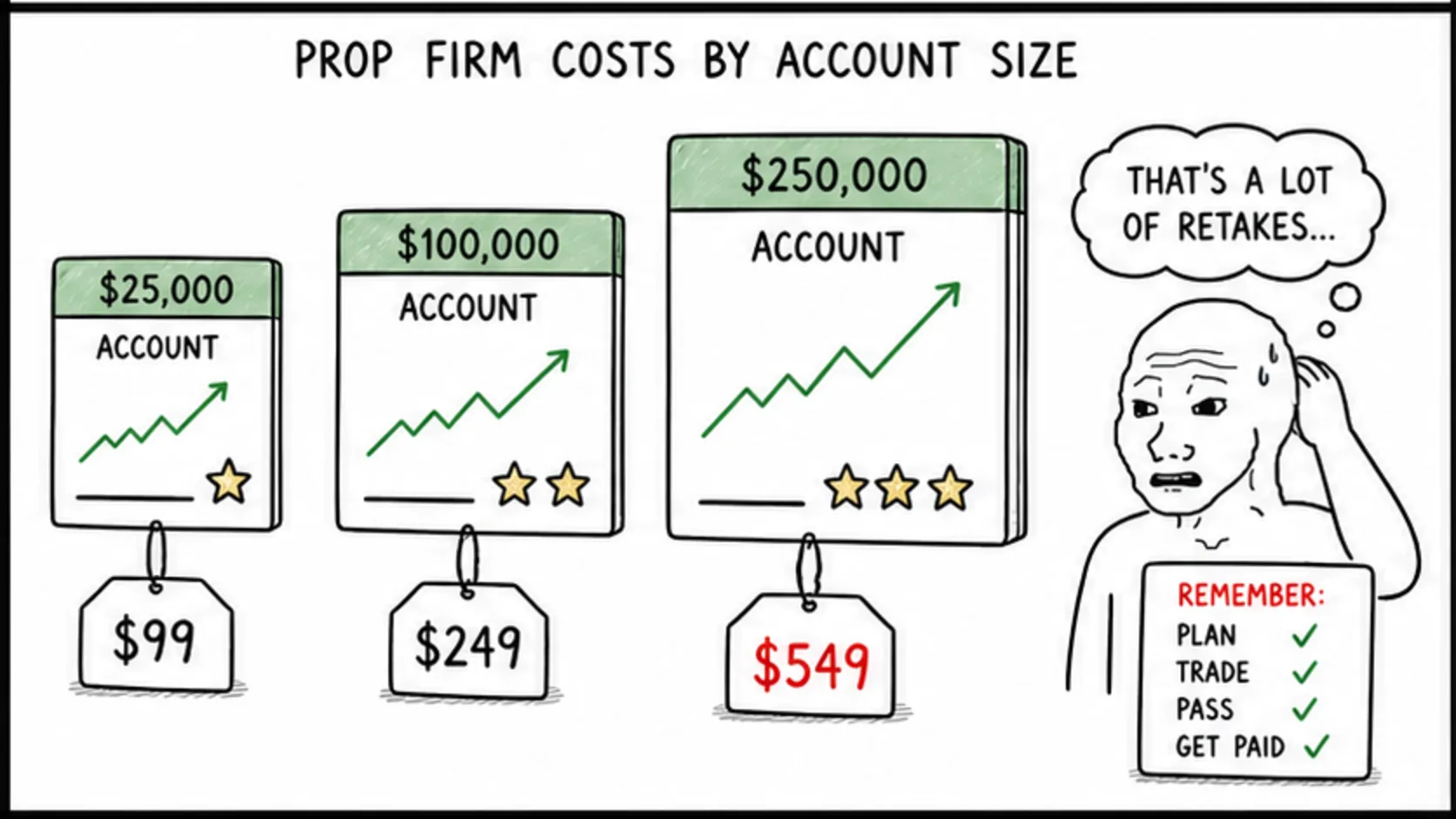
Here is what you will pay at the major firms for different account sizes. These are approximate ranges based on standard prop firm pricing in 2026.
| Account Size | Typical Fee Range | Cost as % of Account |
|---|---|---|
| $5,000 | $50 to $80 | 1.0% to 1.6% |
| $10,000 | $100 to $150 | 1.0% to 1.5% |
| $25,000 | $150 to $250 | 0.6% to 1.0% |
| $50,000 | $200 to $400 | 0.4% to 0.8% |
| $100,000 | $300 to $600 | 0.3% to 0.6% |
| $200,000 | $800 to $1,500 | 0.4% to 0.75% |
| $300,000 | $1,000 to $2,000 | 0.3% to 0.7% |
Notice the pattern. The cost as a percentage of the account stays roughly between 0.3% and 1.5% across most sizes. You are paying less per dollar of capital as the account gets larger, which makes larger accounts more cost-efficient per dollar.
But do not let that trick you into buying a $300,000 account if you are not ready for it. Larger accounts have larger drawdown targets, but they also have more psychological pressure. A $2,000 mistake on a $300,000 account feels different than a $20 mistake on a $5,000 account, even though both are the same percentage.
How Pricing Works
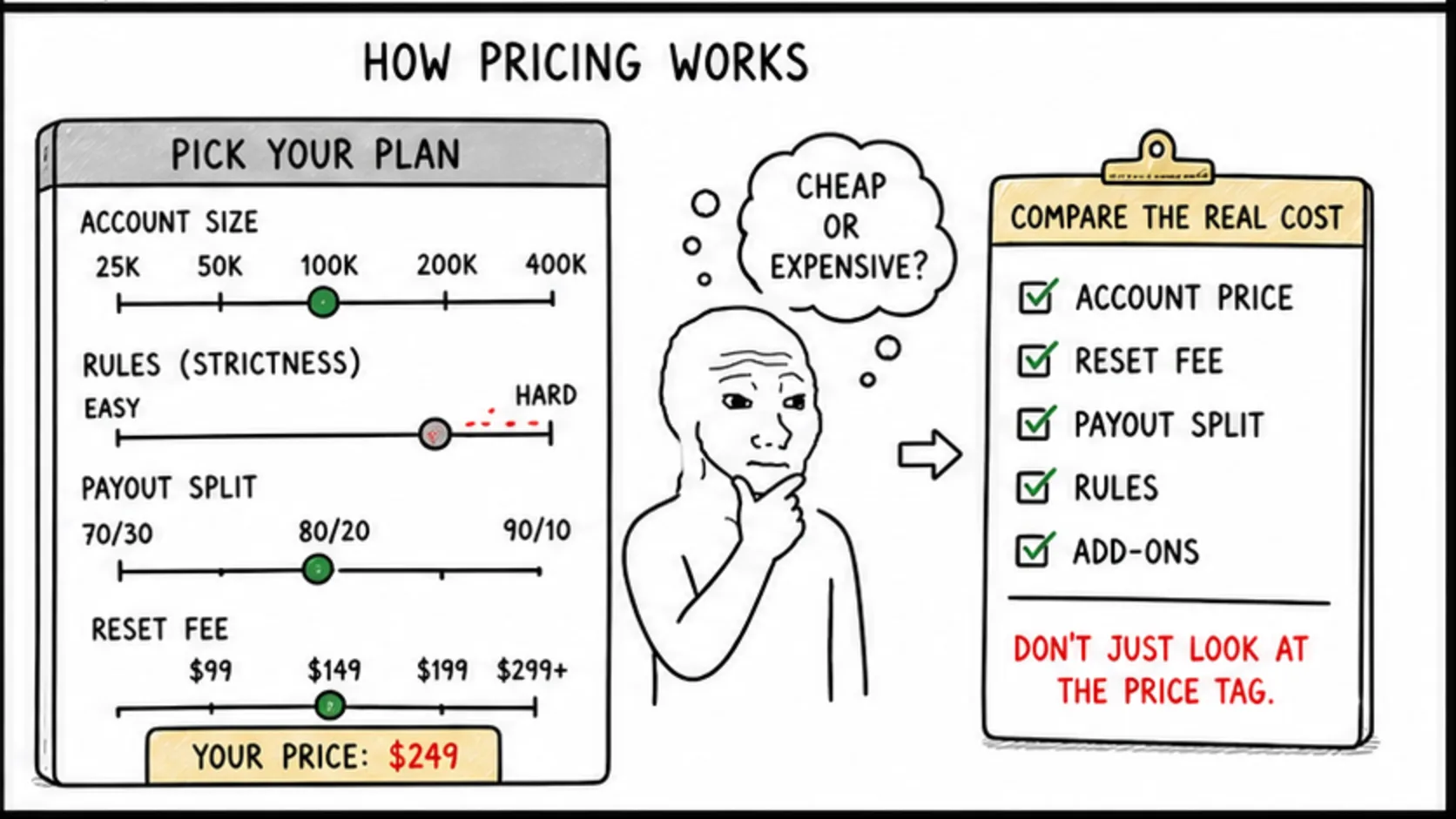
The challenge fee is a one-time payment. You pay it when you register for the evaluation. It covers the cost of your challenge period, typically 30 to 60 days, and gives you access to the trading platform.
What you are actually paying for is the opportunity to prove you can trade within the firm's rules. The fee is the firm's primary revenue source. Most traders fail, so most prop firm fees are pure profit for the firm. This is the business model.
Some firms offer discounts during promotions. You will see 20% to 50% off deals regularly, especially around holidays and trading events. If you are not in a rush, waiting for a promotion can save you $50 to $200 on a standard challenge.
Two-step challenges are usually cheaper than one-step challenges at the same account size. A two-step $100,000 might cost $400, while a one-step $100,000 at the same firm costs $500. One-step challenges are faster but harder, and the pricing reflects that.
When comparing prop firm costs across firms, always check whether the fee includes everything or if there are additional charges. The prop firm challenge cost is just the starting point.
Hidden Fees to Watch For
This is where things get interesting. The prop firm cost is the obvious part. The not-so-obvious costs can add up. Understanding the full prop firm fee structure before you buy is the difference between an informed decision and an expensive surprise.
Activation fees. Some futures prop firms charge an activation fee when you pass the challenge and become funded. This can be $50 to $150 on top of your challenge fee. The fee is usually deducted from your first payout, not charged upfront, but it reduces your initial earnings.
Monthly subscriptions. A few firms charge a monthly platform or data fee. This is more common with futures prop firms that need to cover exchange data costs. Expect $50 to $100 per month if the firm charges this.
Reset fees. If you fail a challenge and want to retry on the same account instead of buying a new one, some firms offer a reset at a reduced price, typically 50% to 75% of the original fee. This is cheaper than buying from scratch.
Payout fees. Most firms do not charge for standard payouts, but some have minimum payout thresholds or charge for expedited withdrawals. Read the payout rules carefully before you start trading.
Platform fees. If the firm uses NinjaTrader, Tradovate, or another premium platform, there may be platform licensing fees. Some firms include this in the challenge price. Others pass it on to you.
What Happens If You Fail
You lose the fee. That is the short answer.
The fee is non-refundable. Whether you fail on day one because you oversized your first trade, or on day 28 because you were $50 short of the profit target, the outcome is the same. The firm keeps your prop firm challenge fee and you get nothing.
According to industry estimates, roughly 90% to 95% of traders fail prop firm challenges. That means the firm keeps nine out of every ten fees collected. The European Securities and Markets Authority reports similar failure rates for retail traders in general. The prop firm model is built on this statistic.
This is why I tell people to budget for two attempts. If a $100,000 challenge costs $500, plan to spend $1,000. If you pass on the first try, great, you saved $500. If you fail, you already planned for it and you are not emotionally or financially wrecked.
Failing a challenge is not the end of the world. It is data. Figure out what went wrong, fix it, and try again. The problem is when traders fail, buy again immediately without fixing anything, and fail again. That is when it gets expensive.
Forex vs Futures Pricing
The pricing structure differs between forex and futures prop firms, and it matters for your budget.
Forex prop firms typically charge a single upfront fee for the challenge. No monthly fees, no activation fees (usually), no platform costs. You pay once and trade. FTMO (Read my full FTMO writeup on PassPropTradingFirms), FundedNext, and The5ers all work on this model.
Futures prop firms often have a more complex fee structure. The challenge fee might be lower, but there can be activation fees, monthly data fees, and platform costs. Topstep charges around $50 per month for its trading combine. Apex charges an evaluation fee plus activation.
The total annual cost of a futures prop firm can end up higher than a forex prop firm because of the recurring monthly charges. But the earning potential on futures accounts during volatile markets can be higher too.
When comparing firms, always calculate the total cost to get funded and receive your first payout. Do not just look at the headline challenge price. That $150 challenge might come with $100 in activation and $50 per month in fees.
How to Budget for Prop Firms
Here is the framework I recommend before you spend a single dollar on a challenge.
Step one: decide your account size. Start small if you are new to prop firms. A $25,000 or $50,000 account is enough to learn the process without risking $500 on your first attempt.
Step two: calculate the total cost. Challenge fee plus any activation fees, monthly fees, and platform fees. Add it all up before you buy.
Step three: multiply by two. This is your real budget. Plan for two attempts. If you only need one, you have extra money. If you need two, you planned for it.
Step four: can you afford to lose this money? If the answer is no, you are not ready. The most likely outcome of any single challenge attempt is that you fail and lose the fee. That is the statistical reality. Plan for it.
How much do prop firms cost? The answer is: whatever you are willing to lose. One challenge might cost $500. Two challenges might cost $1,000. A year of trying without fixing your strategy might cost $3,000 to $5,000. The cost is not just the fee. It is the fee multiplied by the number of times you try before you either pass or quit.
The traders who spend the least are the ones who prepare properly, pass on their first or second attempt, and start earning payouts. Preparation is the cheapest thing you can do. Everything else is expensive.
