
Are prop firms CFD? If you are trading forex on a prop firm platform, you are almost certainly trading CFDs. You are not buying and selling real currency. You are trading a contract for difference that tracks the price of a currency pair. Futures prop firms are different. They use actual futures contracts. But the vast majority of forex prop firms that retail traders use are built on CFDs, and most traders never even notice.
Key Takeaways
- Most forex prop firms use CFDs as the underlying trading instrument, not real currency.
- Futures prop firms use actual futures contracts on regulated exchanges like the CME.
- For your day-to-day trading, CFDs and real currency pairs look and behave almost identically.
- CFDs are not available to US residents, which is why US-focused prop firms tend to offer futures instead.
- The CFD vs futures question matters more for regulation than for your strategy.
On This Page
The Direct Answer
Are prop firms CFD? Let me be precise, because the answer depends on what type of prop firm you are talking about.
Forex prop firms, the ones offering EUR/USD, GBP/JPY, and all the major and minor pairs, are almost always using CFDs. You open MT4, MT5, or cTrader, you see the pairs, you click buy or sell. The platform looks and feels like forex. But underneath, you are trading a contract for difference.
Futures prop firms like Topstep, Apex, and Earn2Trade are different. Forex prop firms and futures prop firms operate on entirely different instruments. Futures prop firms offer actual futures contracts on regulated exchanges like the CME. E-mini S&P 500, crude oil, gold futures. These are real, standardised contracts.
So the answer is split. Forex prop firms are CFD. Futures prop firms are not. Crypto prop firms vary, some use CFDs, some use actual spot or derivatives. The distinction matters, but maybe not for the reasons you think.
What Is a CFD?
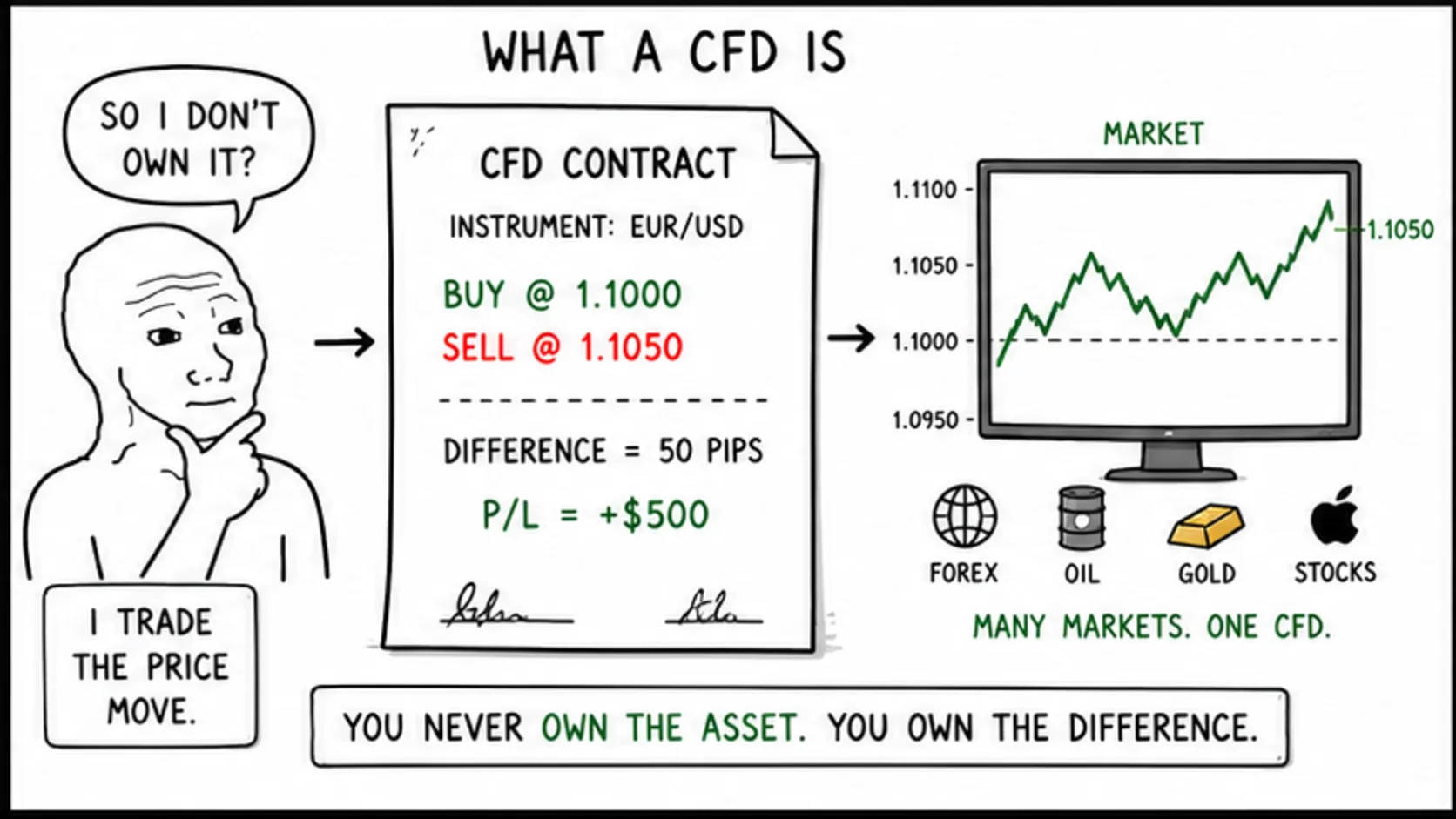
A CFD is a contract for difference. You and your broker agree to exchange the difference in price of an asset between when you open the trade and when you close it. No physical delivery. No actual currency changing hands.
Just a bet on price direction with your broker as the counterparty. When you buy EUR/USD as a CFD, you are not buying euros with dollars. You are entering a contract that pays you if EUR/USD goes up and charges you if it goes down.
The price tracks the real market, but the transaction exists only between you and the platform.
This sounds sketchy the first time you hear it. It is not. CFDs are widely used across Europe, the UK, Australia, and most of the world. According to the European Securities and Markets Authority, CFDs are one of the most common retail trading instruments in the EU. They are regulated, transparent, and the pricing is tied to real market data.
The key thing to understand is that CFDs are derivatives. They derive their price from an underlying asset. You never own the asset. You only own the contract.
This is why prop firms love them. They are easy to configure, easy to simulate, and easy to price without actually touching any real market.
Why Most Forex Prop Firms Use CFDs
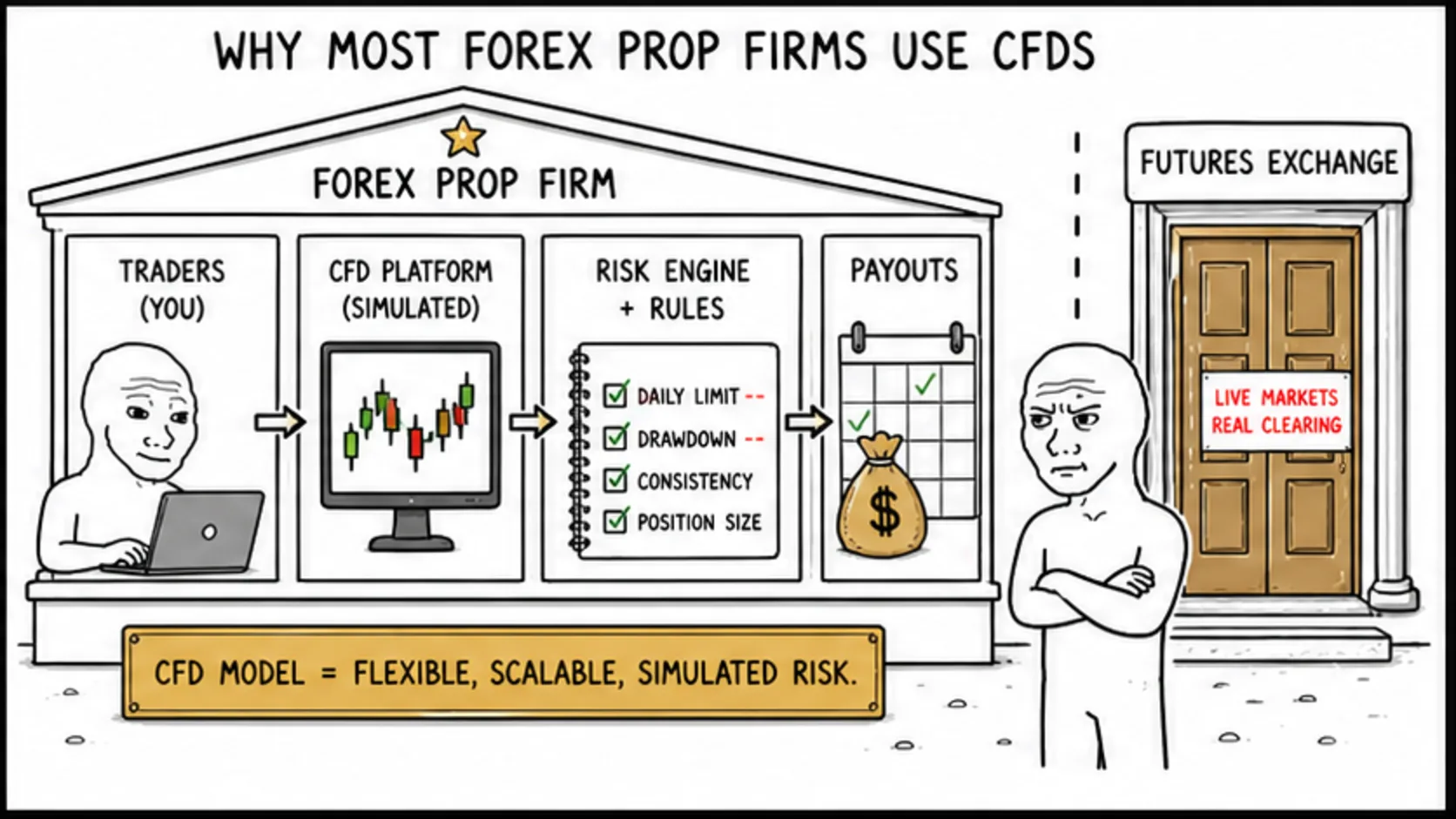
There are three reasons, and they are all practical, not sinister.
Reason one: flexibility. CFDs let the firm offer hundreds of instruments without needing separate broker relationships for each asset class. Forex pairs, indices, commodities, crypto, all on one platform. One CFD provider can cover everything.
Reason two: cost. Setting up real currency trading requires prime broker relationships, liquidity feeds, and serious infrastructure. Most retail prop firms use simulated accounts. CFDs are trivially easy to simulate because there is no physical settlement.
The price feed comes in, the platform matches trades internally, and the firm never touches a real liquidity pool.
Reason three: leverage control. CFDs allow the firm to set custom leverage per instrument, per account size, per trader level. This gives the firm fine-grained control over risk exposure.
They can offer 1:100 on EUR/USD and 1:20 on an exotic pair, all configured server-side without any exchange involvement.
The CFD structure is why these firms can offer $100,000 and $200,000 accounts for a few hundred dollars. The firm is not actually deploying $100,000 of real capital. It is configuring a CFD environment that simulates a $100,000 account. The cost to the firm is essentially the server hosting bill.
CFD Prop Firms vs Futures Prop Firms
This is the comparison that actually matters. Not "are prop firms CFD" in isolation, but what changes when you pick one over the other.
| Feature | CFD Prop Firms | Futures Prop Firms |
|---|---|---|
| Instrument | Contracts for difference | Real futures contracts |
| Exchange | No central exchange | Regulated exchanges (CME) |
| Counterparty | The prop firm or broker | The exchange clearing house |
| Pricing | Tracks market price | Centralised market price |
| Lot sizing | Flexible (micro lots common) | Fixed contract sizes |
| US traders | Generally not available | Yes, widely available |
| Regulation | Varies by jurisdiction | Highly regulated |
| Platforms | MT4, MT5, cTrader | NinjaTrader, Tradovate, Rithmic |
| Spreads | Set by the broker | Market-determined |
The biggest practical difference is counterparty risk. With a CFD, your counterparty is the firm or its broker. If the firm disappears, your position disappears with it.
With futures, the exchange clearing house is your counterparty. Your position exists independently of the prop firm.
This does not mean CFD prop firms are dangerous. It means you should know what you are signing up for. Check if the firm is legitimate, read the terms, and understand that your trades exist inside the firm's ecosystem.
Does It Change Your Trading?
For your day-to-day trading, CFDs and real currency pairs behave almost identically. The chart looks the same. The candlesticks are the same. Your support and resistance levels are the same. Your strategy works the same way.
There are a few subtle differences worth knowing.
Spreads on CFDs are set by the broker, not by the market. This means they can widen during news events more aggressively than real market spreads. Your stop loss might get slipped a bit more on a CFD during high volatility.
Execution is internal on CFD platforms. The firm or broker matches your trade internally rather than routing it to a market. This is usually instant, but it means there is no order book to read.
Scalping strategies that rely on order flow data will not work the same way on CFD platforms.
Swaps and overnight fees differ. CFDs charge a daily financing rate for positions held overnight. This can eat into profits on swing trades held for days or weeks.
Futures contracts have their own cost of carry built into the price structure, which works differently. None of these differences are dealbreakers. They are just things to be aware of.
Why CFDs Are Not Available in the US
This comes up constantly, so let me address it directly. CFDs are not available to US residents. The Securities and Exchange Commission and the Commodity Futures Trading Commission have not approved CFDs for retail trading in the United States.
The reason is not that CFDs are dangerous or fraudulent. The reason is structural. CFDs do not trade on a regulated exchange.
US regulators require retail trading products to be traded on approved exchanges with transparent pricing and clearing house backing. CFDs, by design, are over-the-counter instruments. They do not fit the regulatory framework.
This is why US-based traders tend to use futures prop firms. Topstep, Apex, Earn2Trade, these firms offer futures contracts traded on the CME and other regulated US exchanges. The instruments fit the regulatory requirements, and US traders can participate legally.
If you see a forex prop firm accepting US traders and offering CFD-based trading, proceed with caution. That is a potential red flag. The firm may be operating in a regulatory grey area, and your funds and payouts may not have the same protections.
What This Means for Choosing a Prop Firm
Now that you know the CFD landscape, here is how to use this information when picking a firm.
If you are outside the US and want to trade forex, CFD prop firms are your default option. FTMO (See my FTMO review on PassPropTradingFirms), FundedNext, The5ers, most of the big names use CFDs. Your trading experience will be fine. Just pick a reputable firm with a track record of paying out.
If you are in the US, futures prop firms are your main path. The trading is on regulated exchanges, the instruments are transparent, and the best prop firms for US traders tend to be futures-focused. See which prop firms rank highest across all categories.
You can still trade gold, oil, indices, and currencies through futures contracts.
If you are choosing between CFD vs futures prop firms and you have access to both, the decision comes down to your trading style. Forex prop firms and futures prop firms serve different types of traders.
CFD firms offer more flexibility on lot sizes and more currency pairs. Futures firms offer tighter spreads during liquid hours and centralised pricing.
Do not let the prop firm CFD question scare you away from prop firms. The instrument is less important than the firm's reputation, the fairness of the rules, and whether you can actually get paid. Focus on those three things first.
