
Are prop firms going away? No. But a lot of the bad ones already did. Between 2024 and early 2025, over 80 prop firms collapsed, rebranded, or simply vanished. The industry lost billions in trader deposits. Regulators started circling. MetaQuotes pulled the plug on unlicensed platforms. And somehow, the biggest firms kept growing. The prop firm space is not dying. It is being cleaned out. And that is a very different thing.
Key Takeaways
- Over 80 prop firms collapsed between 2024 and early 2025, but the industry is not dying. It is consolidating around stronger, more transparent firms.
- MetaQuotes cracked down on firms using unlicensed MT4 and MT5 servers, which triggered many closures overnight.
- Regulators in the US, UK, and Australia increased pressure on prop firms operating without proper authorisation.
- The surviving firms are shifting toward regulated models, real-money trading environments, and broker partnerships.
- For traders, the lesson is simple: stick with established firms that have verifiable payout histories and never risk money you cannot afford to lose.
On This Page
What Happened: Why 80+ Firms Collapsed
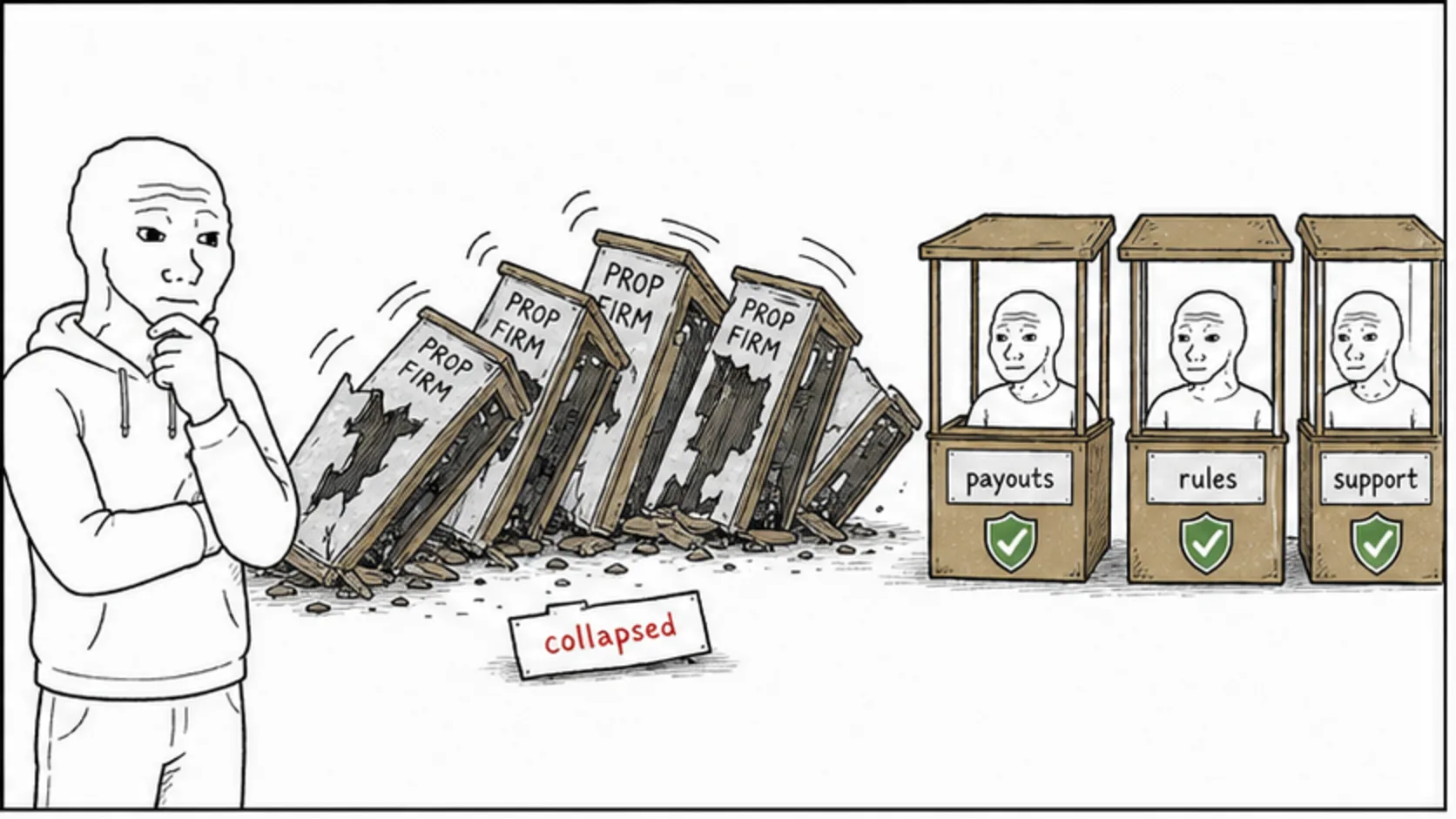
Let me set the scene. In 2023, anyone with a website and a MetaTrader white-label could launch a prop firm. The barrier to entry was essentially zero. You did not need a licence. You did not need capital reserves. You did not even need a real trading server. You just needed a slick landing page and the ability to collect challenge fees.
And collect they did. According to industry analysis, the retail prop trading market grew to an estimated $8 billion in revenue during 2024. Most of that revenue came from challenge fees, not from profitable trading. The model was simple: get as many traders as possible to buy evaluations, fund the ones who passed, and pay out from the pool of fees collected from everyone else.
Sound familiar? It should. Because when the majority of your revenue comes from new entrants paying fees rather than from actual trading profits, you are running something uncomfortably close to a pyramid structure. Not legally. But structurally. And structures like that collapse the moment new money stops flowing in.
The crash started in early 2024. Firms that had been offering $100,000 challenges for $49 suddenly could not pay their funded traders. Support emails went unanswered. Discord servers went quiet. Withdrawal requests sat pending for weeks, then months, then forever. Some firms posted "temporary pauses" on payouts that never ended. Others just deleted their websites overnight.
By the end of 2024, industry watchdogs had documented over 80 firm closures. The VeritasChain Standards Organization tracked the collapses and found that most shared a common pattern: unsustainable pricing, no real capital backing, and total dependence on challenge fee revenue.
The MetaQuotes Crackdown
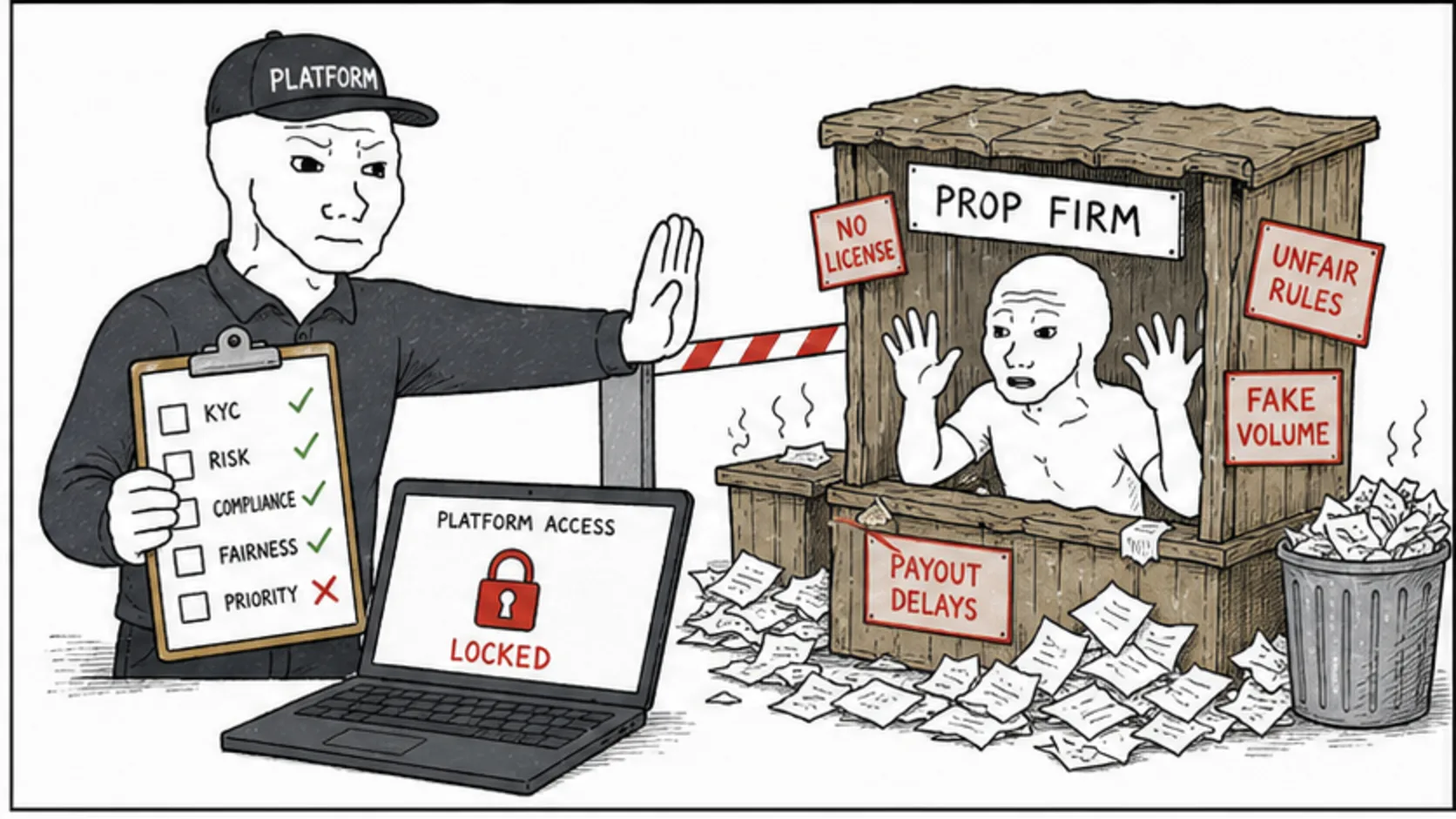
Here is the part nobody saw coming. MetaQuotes, the company behind MetaTrader 4 and MetaTrader 5, decided it had had enough.
Most retail prop firms were running on MT4 or MT5. But many of them were doing it without proper licensing. They were using grey-market server setups, sometimes sharing a single licence across dozens of firms. MetaQuotes had been looking the other way for years while the industry boomed. Then, in 2024, they stopped looking the other way.
Since most retail prop firms run on simulated accounts, they were heavily dependent on MetaTrader's platform to create those simulated environments. When MetaQuotes started revoking access for firms operating without proper licences, entire prop firms went dark overnight. Not gradual. Not slow. One day the platform worked, the next day it did not.
The firms that had proper broker partnerships and licensed server setups survived. The ones running on bootleg MetaTrader installations? Gone. Instantly. No appeal process, no grace period. Their trading environments literally stopped working.
This single action by MetaQuotes wiped out a huge chunk of the weak firms in one stroke. It was brutal if you were a trader with an active account at one of those firms. Your challenge progress, your funded account, your pending payout, all of it gone because the firm you chose was running on borrowed infrastructure.
Why Most of These Firms Deserved to Fail
You might be thinking this sounds harsh. It is not. These firms were not struggling businesses trying their best. They were structurally designed to fail from day one.
Consider the economics. A firm offers a $100,000 evaluation for $99. They promise an 80% profit split, no time limit, and payouts every two weeks. Sounds incredible. Now run the maths. If 1,000 traders buy that challenge in a month, the firm collects $99,000. If 10% of them pass and get funded, the firm now has 100 funded traders drawing on a $10 million pool of capital that does not actually exist. They are not trading real money. They are running simulated accounts and paying out from the fee pool.
As long as new traders keep buying challenges, the fee pool stays healthy enough to pay the funded traders. But the moment growth slows, or too many traders pass at once, or a few big winners request large payouts simultaneously, the whole thing collapses. The fee structure was never sustainable.
And that is before you factor in the operational costs. Customer support, trading servers, platform fees, marketing, staff, offices. Running a prop firm properly is expensive. The firms charging rock-bottom fees were not cutting costs through efficiency. They were cutting costs by not building anything that could survive a downturn.
Then there were the ones that were not even trying to be legitimate. Firms that collected fees for months, paid out just enough to maintain a decent Trustpilot score, and then vanished when the math caught up with them. The red flags were there the whole time. Traders just did not want to see them because the fees were cheap and the promises were big.
Regulators Finally Started Paying Attention
When 80 firms collapse and thousands of traders lose money, regulators notice. It took a while, because prop firms operate in a grey zone that most financial regulators had not bothered to define. But the sheer volume of complaints in 2024 forced their hand.
The Commodity Futures Trading Commission in the US started issuing warnings about prop firms offering contracts for difference without proper registration. The Financial Conduct Authority in the UK began investigating firms marketing to UK residents without authorisation. ASIC in Australia followed suit, issuing alerts about prop firms operating outside the regulatory framework.
This regulatory pressure did not kill the industry. What it did was accelerate the divide between legitimate firms and sketchy ones. The legitimate firms responded by tightening compliance, partnering with regulated brokers, and becoming more transparent about their operations. The sketchy ones either cleaned up fast or got shut down.
For traders, this is actually good news. The regulatory spotlight means the firms that survive are the ones willing to play by rules. Whether prop firms are legal depends on your jurisdiction, but the trend is clear: regulators want this industry to operate within defined boundaries, and the firms that adapt will be stronger for it.
Which Firms Survived and Why
Not every firm collapsed. The ones that survived share specific traits that the others lacked. Pay attention to these, because they are the same traits you should look for when checking if a prop firm is legitimate.
Real broker partnerships. The survivors had proper relationships with regulated brokers. They were not running on bootleg MetaTrader setups. When MetaQuotes cracked down, these firms barely blinked because their infrastructure was legitimate from the start.
Sustainable pricing. FTMO charges more than the collapsed firms did. So does Topstep. So do most of the survivors. Because real infrastructure, real compliance, and real support cost real money. The firms charging premium prices are often the ones worth paying.
Capital reserves. The best-funded firms could absorb payout obligations without relying solely on incoming challenge fees. They had actual capital behind them, not just a rolling pool of customer deposits.
Operational history. Every firm that survived the cull had been operating for at least two years. Many for longer. They had been through market volatility, regulatory changes, and competitive pressure before. A startup with a six-month track record has never been tested by anything.
Transparent payout records. The survivors publish payout data. Not screenshots. Not testimonials. Actual statistics showing how much they have paid, to how many traders, over what period. If a firm cannot show you payout proof, that is not a firm you want to trust.
What the Payout Numbers Actually Show
Here is the stat that matters. According to industry analysis, only about 7% of traders who buy a prop firm challenge ever receive a payout. Seven per cent. That means 93 out of 100 traders pay for an evaluation and walk away with nothing.
Now, does this mean the industry is a scam? No. Most prop firms are legitimate businesses. It means most traders are not profitable enough to pass. The challenge is designed to filter out people who cannot manage risk, and it works. Brutally well.
But that 7% figure also reveals something about the business model. If 93% of your revenue comes from people who fail, and those people never get anything back, your incentives are clear. You want as many challengers as possible. You make the challenge hard enough that most fail, but not so hard that nobody passes, because you need the funded traders for marketing credibility.
The firms that collapsed took this model too far. They made the challenge too easy to attract more buyers, funded too many traders, and then could not pay them. The survivors kept the challenge difficulty calibrated so that enough people fail to keep the fee pool healthy, but enough people pass to maintain credibility. It is a delicate balance, and the firms that found it are still standing.
For context, FTMO has paid out over $200 million to funded traders since launch. Topstep has paid out over $100 million. These are real numbers from real companies with verifiable track records. The firms that actually pay out are the ones that survived the cull.
What This Means for Traders Right Now
So are prop firms going away? No. The bad ones already went. The good ones got stronger. The industry is smaller, more concentrated, and more legitimate than it was two years ago. And that is exactly what needed to happen.
For you as a trader, three things matter right now.
First, choose established firms. This is not the time to take a punt on a new firm with a slick website and a $49 challenge. Stick with names that have been paying out for two or more years. Read their terms and conditions before you pay. Every word.
Second, never risk money you cannot afford to lose. I have said this before and I will say it again. The challenge fee is gone the moment you pay it. You might get funded. You might get paid. But you also might fail, or the firm might change rules, or something unexpected might happen. Budget accordingly.
Third, diversify if you are serious. Do not put all your capital into one firm's challenge. Firms can and do change their terms. Having accounts at two or three reputable firms spreads the risk. If one firm has issues, you still have the others.
The prop firm industry is not going away. It is growing up. The firms that survive the consolidation are the ones worth your time and money. The ones that collapsed were casualties of their own bad economics. Learn from their failures, protect yourself, and trade with firms that have earned the right to exist.
