
You have probably been told that forex prop firms are overseen by financial regulators, subject to the same rules as your broker, and legally required to protect your money. None of that is true. Most retail forex prop firms are not regulated by any financial authority anywhere in the world. The global forex market handles over $7.5 trillion in daily volume according to the Bank for International Settlements 2024 Triennial Survey, yet the firms giving you access to trade that market carry zero regulatory oversight. Here is what that actually means for you.
Key Takeaways
- Most retail forex prop firms are not regulated by any financial authority in any major jurisdiction.
- Prop firms avoid regulation by using simulated trading accounts and not holding client deposits or executing real trades on your behalf.
- The CFTC took enforcement action against several US-facing prop firms between 2023 and 2024, forcing many to stop accepting American traders.
- You have no access to compensation schemes, ombudsman services, or regulatory complaint processes if a prop firm wrongs you.
- Protect yourself by choosing established firms with proven payout histories, reading the terms carefully, and never risking more than you can afford to lose.
On This Page
- Why Forex Prop Firms Are Not Regulated
- The Regulatory Bodies That Could Step In
- The CFTC Crackdown That Changed Everything
- What Unregulated Actually Means for Your Money
- Regulated Brokers vs Forex Prop Firms
- Are Any Forex Prop Firms Actually Regulated?
- How to Protect Yourself Without Regulation
- Frequently Asked Questions
Why Forex Prop Firms Are Not Regulated
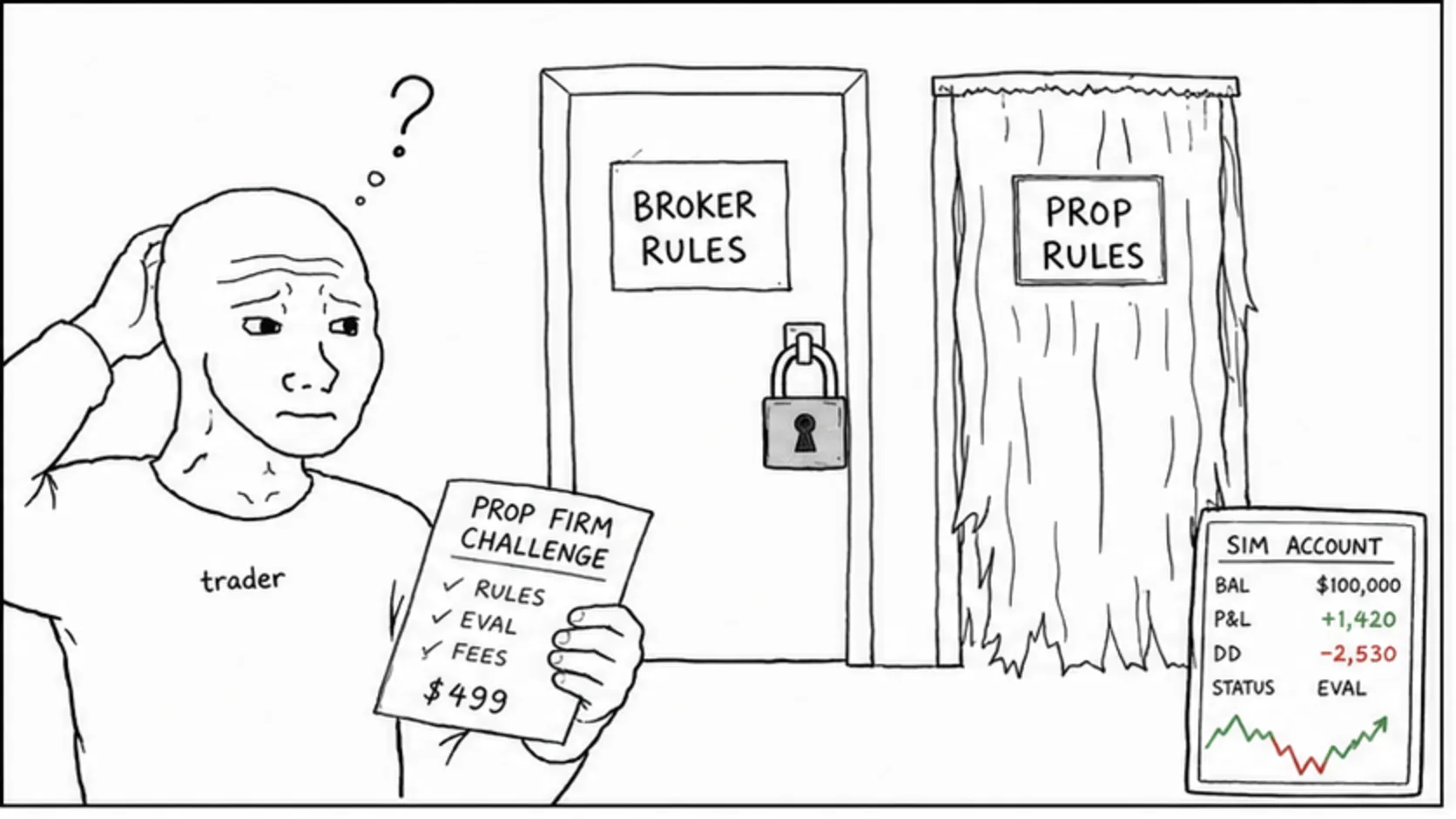
It comes down to structure. Forex prop firms do not take your money and invest it on your behalf. They sell you an evaluation, which is basically a trading test.
You pay a fee, trade on a simulated account, and if you hit the profit target without breaking any rules, you get a funded account. That funded account is also simulated in most cases. No real money changes hands during the evaluation.
The firm is not acting as a broker, an investment advisor, or a fund manager. It is running a skills assessment with a prize at the end. Financial regulation exists to protect people who hand over real money for investment purposes.
Prop firms do not do this. The fee you pay covers the evaluation, not a deposit into a trading account. This structural distinction is the entire reason the industry operates outside most regulatory frameworks.
Think about it this way. If you pay to take a driving test and then get access to a company car, the driving school is not regulated as a financial institution. The prop firm evaluation model is closer to a skills test than an investment product.
That is how they stay outside the regulatory perimeter. It is not a conspiracy. It is just a business model that does not fit neatly into existing regulatory categories.
The Regulatory Bodies That Could Step In
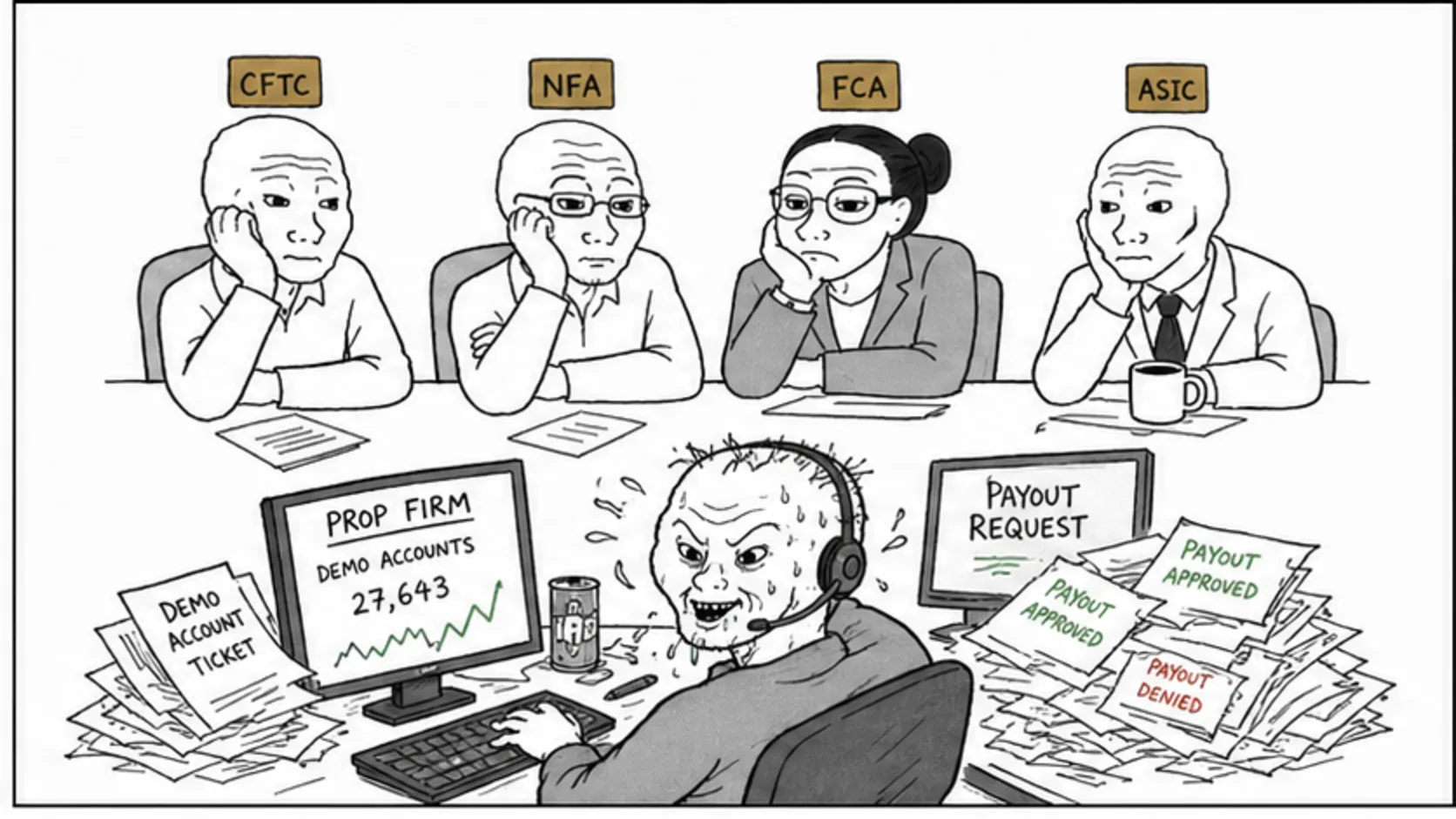
Several regulators have the authority to oversee prop firms if they choose to. Some already have, and the results were dramatic.
The Commodity Futures Trading Commission in the United States has been the most aggressive regulator in this space. Between 2023 and 2024, the CFTC issued enforcement actions against multiple prop firms for operating as unregistered futures commission merchants.
The Financial Conduct Authority in the UK has not directly regulated prop firms yet, but has issued public warnings. The FCA position is that firms offering certain types of trading services must be authorised.
Whether a specific prop firm falls under this definition depends on how it structures its accounts. The FCA has not provided definitive guidance on where the line is drawn.
The National Futures Association oversees futures commission merchants in the US. Prop firms themselves are not NFA members, but the brokers they use for live accounts are. This creates an indirect layer of oversight for firms that execute real trades.
The European Securities and Markets Authority sets rules for investment firms across the EU. Prop firms have not been a major focus for ESMA yet, but as the industry grows, European regulators are paying closer attention.
The CFTC Crackdown That Changed Everything
If you were trading prop firms before 2023, you watched this happen in real time. The CFTC moved against several firms simultaneously. The charge was operating as unregistered futures commission merchants.
The penalties were severe enough that firms restructured overnight. Firms that had been operating freely for years suddenly had to prove they were not holding client funds or executing real trades on behalf of traders.
Most pivoted to a fully simulated model. Some split their US and international operations. Others simply banned US traders altogether.
The irony is that the CFTC action made some things clearer and other things more confusing. Clearer because firms now had to be transparent about using simulated accounts rather than pretending they were offering live trading.
More confusing because US traders now face a patchwork of firms that accept them and firms that do not, with very little explanation of why.
If you are based in the United States, this affects you directly. Always check whether a firm accepts US clients before you pay for an evaluation. If they do not, your fee is wasted even if you pass the challenge.
What Unregulated Actually Means for Your Money
Pay attention here because this is where most traders get caught out.
Unregulated does not mean illegal. It means no government body is watching over the firm to ensure it treats you fairly. There is a big difference.
If a regulated broker goes bust in the UK, the Financial Services Compensation Scheme covers up to £85,000 per person. In the US, SIPC covers up to $500,000 for brokerage accounts. These are real, enforceable protections backed by law.
If a prop firm goes bust, you have nothing. No compensation. No ombudsman. No regulatory complaint process. Your evaluation fee is gone. Your unrealised profits are gone. Any pending payout is gone.
If a prop firm denies your payout unfairly, you cannot file a complaint with the FCA or the CFTC. You can hire a lawyer. Good luck taking legal action against a company registered in a jurisdiction you have never heard of.
Your maximum financial exposure is the evaluation fee. That is the one upside. You cannot lose more than you paid. But if the firm owes you a $5,000 payout and refuses to pay, you have almost no practical recourse for getting that money.
Regulated Brokers vs Forex Prop Firms
Let me make this comparison as simple as possible because most traders do not understand the difference between a forex prop firm and a forex broker.
Regulated brokers hold your money in segregated accounts. They execute your trades on live markets. They are overseen by financial authorities. They offer compensation if they fail.
They provide negative balance protection in many jurisdictions. Your money is legally separated from the broker's own operating funds. If the broker goes under, your money is still yours.
Prop firms do none of this. They do not hold your deposits. They do not execute your trades on live markets for most accounts. They are not overseen by financial authorities. They offer no compensation if they fail.
So why would anyone choose a prop firm over a regulated broker? Because prop firms give you access to capital you do not have.
A $100,000 funded account might cost you $500 in evaluation fees. Getting $100,000 of your own trading capital takes years of saving. The trade-off is straightforward.
You get capital access with no protection, or full protection with only your own capital. Neither is automatically better. They are different products for different situations.
Are Any Forex Prop Firms Actually Regulated?
Technically yes, but it is more complicated than a simple yes or no.
Some prop firms are registered companies in their home jurisdictions. FTMO is registered in the Czech Republic. MyFundedFutures is a US-registered LLC. Being a registered company is not the same as being regulated as a financial institution.
A few firms have obtained licenses from financial authorities. These tend to be newer firms operating in jurisdictions with lighter regulatory requirements. Having a license from a small island nation is not equivalent to being overseen by the FCA or the CFTC.
OANDA, which is a fully regulated forex broker, launched a prop trading offering. Because OANDA is already overseen by the CFTC, FCA, and multiple other regulators, their prop product has more regulatory oversight than most.
But OANDA's prop product is relatively new and uses a different structure from traditional prop firms. It is not a direct replacement for the FTMO or FundedNext model.
No major retail forex prop firm is regulated in the way that a broker like IG Index or OANDA is regulated. Some have company registrations. Some have minor licenses. None offer the level of protection that a regulated broker provides to its clients.
How to Protect Yourself Without Regulation
Three missions. You have seen this format before.
Mission one: only use firms with proven payout histories. Look for firms that have been operating for at least two years and have a consistent record of paying traders. Check their social media for payout screenshots from real users.
Look for independent reviews on third-party platforms, not just the testimonials displayed on the firm's own website. The same due diligence principles that apply to futures prop firms apply here.
Mission two: read the terms and conditions. I know, nobody does this. You should. The terms tell you exactly how the firm can deny your payout, terminate your account, or change the rules mid-challenge.
If the terms give the firm unlimited power to modify rules retroactively, walk away. That is a structural red flag that no amount of positive reviews can override.
Mission three: never risk more than you can afford to lose. The evaluation fee is your maximum exposure. Treat it like the cost of a certification exam.
If losing the fee would cause genuine financial stress, you should not be buying prop firm challenges. The absence of regulation means you need to do the due diligence that regulators would normally do for you.
The people who get burned by prop firms are the ones who skip all three missions, buy the biggest account they can find, and then act surprised when something goes wrong. Do not be that person.
Forex prop firms are not regulated. That is the reality right now. Some may become regulated in the future as the industry matures and regulators catch up, but today you are on your own. Pick established firms with real payout histories, read the fine print, and never put in money you cannot afford to walk away from. That is the system. Use it, or do not. Your money, your choice.
