
A prop firm challenge is not the same thing as opening a regulated brokerage account. The FCA warning list is useful when checking firms that market aggressively to retail traders.
A prop firm challenge is an evaluation you pay for to prove you can trade without blowing up an account. Pass it, and the firm gives you capital to trade and a cut of the profits.
That sounds simple. The reality is that most traders fail these challenges because they treat them like a normal trading account. They are not. Prop firms designed these evaluations to filter out anyone who cannot follow rules, manage risk, or control their emotions.
Key Takeaways
- A prop firm challenge is a paid evaluation where you trade a demo account under strict rules to prove you can manage capital responsibly.
- Most challenges require hitting a profit target (usually 8-10%) without breaching daily loss limits or maximum drawdown rules.
- Challenge types include one-step, two-step, and instant funding, each with different difficulty levels and fee structures. See the full one step vs two step comparison.
- Industry pass rates sit around 5-10%, meaning 9 out of 10 traders fail and lose their evaluation fee.
On This Page
What Exactly Is a Prop Firm Challenge?
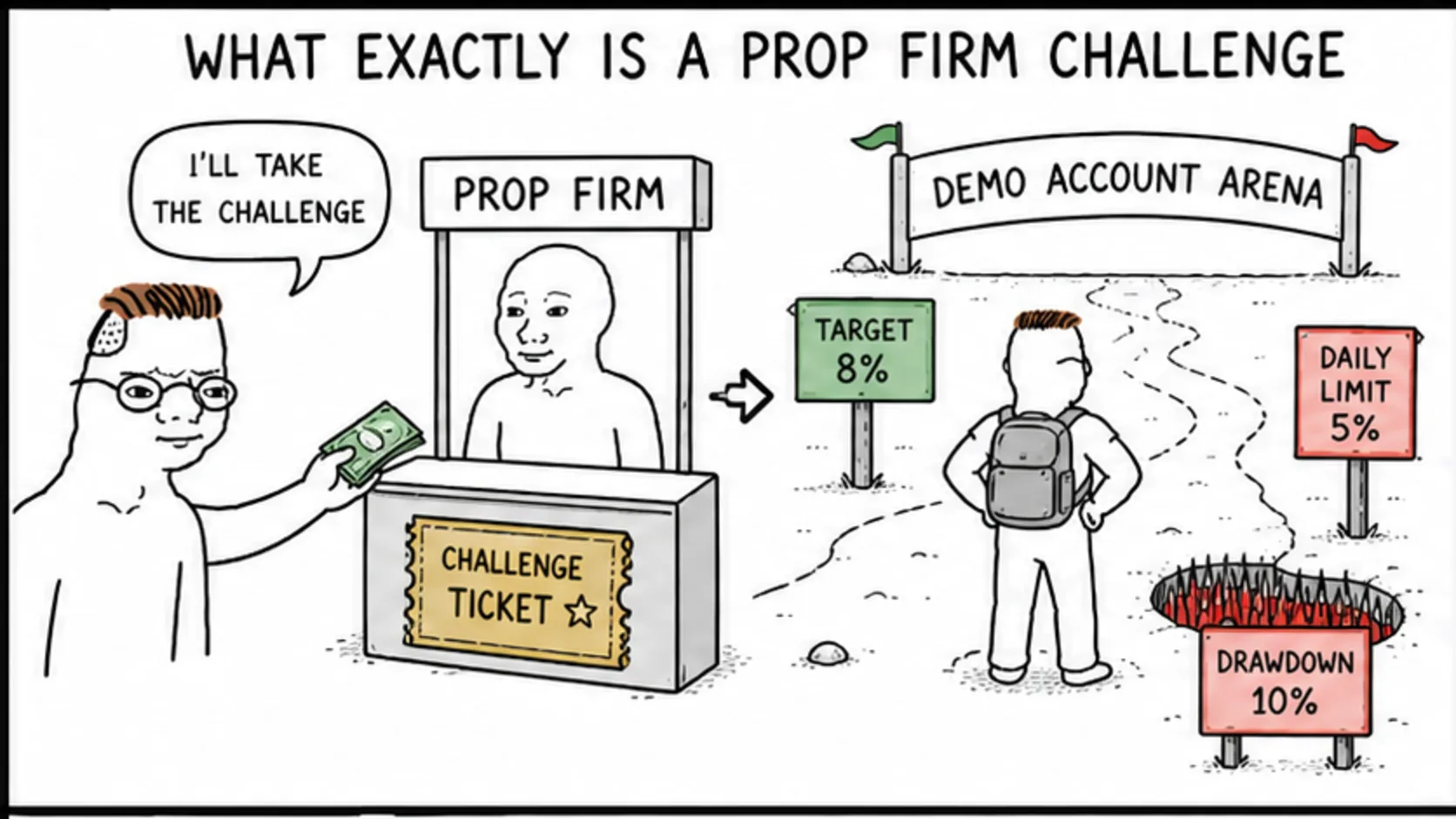
A prop firm challenge is a standardised evaluation that tests whether you can trade profitably within a set of risk rules. You pay a fee, receive platform credentials, and trade on a simulated account that mirrors live market conditions.
The firm sets a profit target, usually 8-10% of the account value, and a collection of risk parameters you must not breach. Hit the target without breaking any rules and you advance to the next stage or receive a funded account.
Break a rule, any rule, and the evaluation ends immediately. No appeals, no second chances, no phone call from support. The software detects the breach and terminates your account in milliseconds.
The challenge is not testing whether you are a good analyst. It is testing whether you can follow instructions under financial pressure. That is a different skill entirely.
How a Prop Firm Challenge Works Step by Step
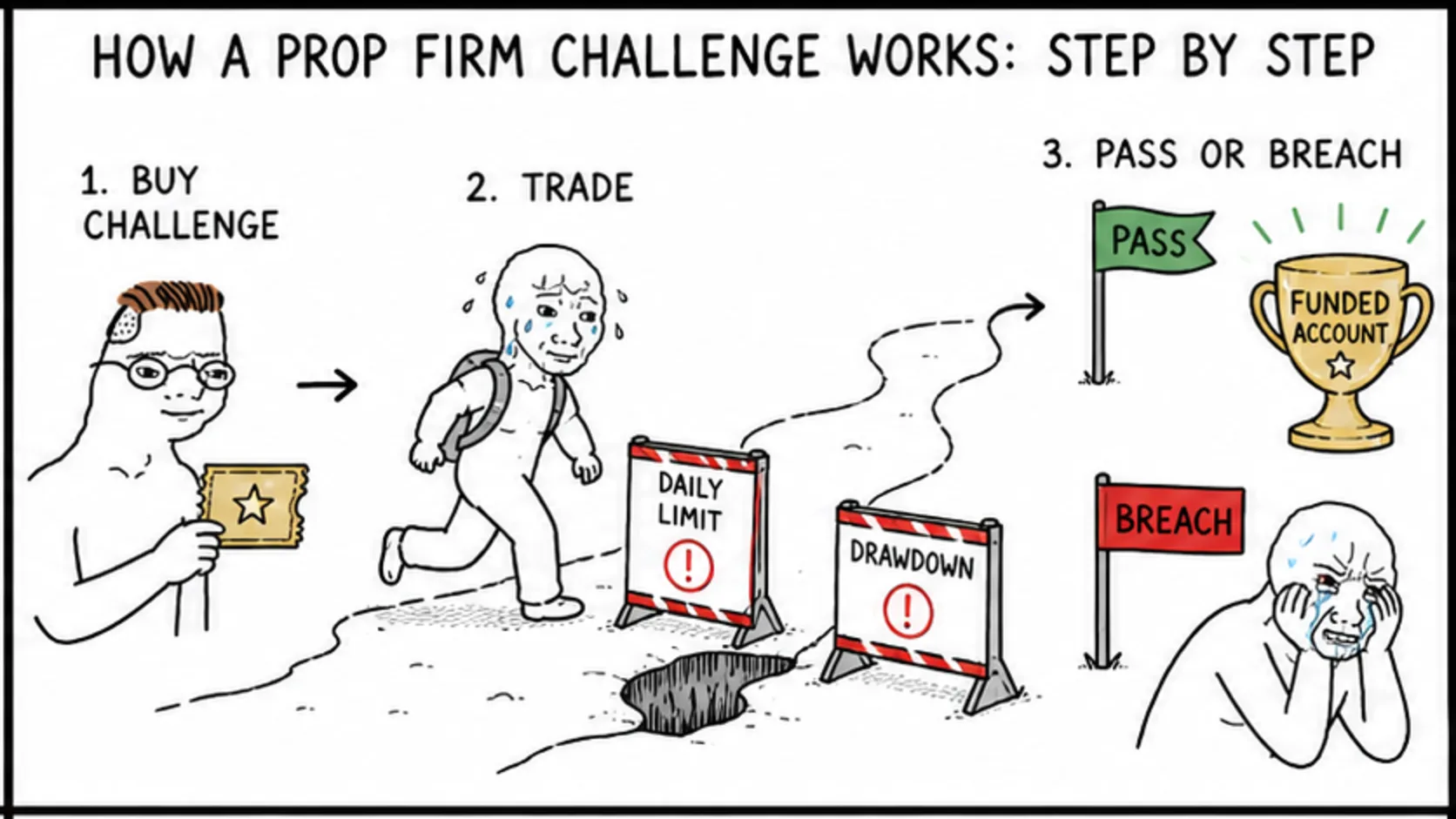
Step one: choose a firm and account size. Accounts range from $5,000 to $200,000. Fees scale with size.
Step two: pay the evaluation fee and receive your platform credentials. The clock starts.
Step three: trade toward the profit target while following every rule. This is where 90% of traders fail.
Step four: if you pass, advance to verification (at most firms) or go straight to funded trading.
Step five: trade the funded account, earn profit splits, and request payouts on the firm's schedule.
The process is straightforward. Executing it under pressure is where things get interesting.
The Key Elements of Every Challenge
Every prop firm challenge has these core components, regardless of which firm you choose.
Profit target. The percentage gain you need to achieve. Typically 8-10% for phase one, 5% for verification.
Daily loss limit. The maximum you can lose in a single day, usually 4-5% of the account. Hit this and your day is over.
Maximum drawdown. The total loss allowed from your starting balance or peak equity. Typically 8-12%. Breach this and the account closes permanently.
Time limit. Usually 30 days per phase. Some firms offer unlimited time with no extra charge.
Minimum trading days. 4-10 days to prevent single-trade gambling passes.
Different Types of Prop Firm Challenges
Not all challenges are structured the same way. Here is the breakdown.
One-step challenges. One phase, hit the target, get funded. Faster but often with stricter rules. Good for experienced traders who do not want to prove themselves twice.
Two-step challenges. The industry standard. Phase one (evaluation), phase two (verification with a smaller target), then funded. More steps but usually more forgiving rules.
Instant funding. Pay a higher fee and skip the evaluation entirely. You start trading a funded account immediately but with stricter ongoing rules.
The type you choose should match your experience and confidence level. Beginners should stick with two-step challenges. Experienced traders can consider one-step or instant funding. The one step vs two step comparison breaks down exactly which one fits your trading style.
Why Prop Firms Use Evaluations
The evaluation exists for one reason: to filter out traders who cannot manage risk. The firm makes money from evaluation fees, so there is a financial incentive to have a challenging evaluation. But the rules themselves test real skills.
A trader who consistently follows risk parameters, avoids revenge trading, and maintains discipline under time pressure is exactly who the firm wants trading their capital. The evaluation identifies those traders.
Common Rules and Restrictions
The rules vary by firm but share common patterns. Full rule breakdowns are available here, but the key ones are daily loss limits, maximum drawdown, minimum trading days, consistency rules, news trading restrictions, and weekend holding policies.
Read every rule before you pay. If you cannot explain the daily loss limit, maximum drawdown, and trailing drawdown to a friend, you are not ready.
What Happens When You Pass
After passing the evaluation (and verification if required), you receive a funded account. You trade with firm capital under ongoing rules and earn profit splits, typically 80/20 in your favour.
Payouts happen every 14-30 days. You request a withdrawal, the firm verifies compliance, calculates the split, and sends you your share.
The funded phase is where the money gets made. But staying funded requires the same discipline that got you through the evaluation.
Pros and Cons of Prop Firm Challenges
Pros. Access to large capital without saving for years. Limited downside risk. Structured rules that force discipline. Real profit potential for skilled traders.
Cons. High failure rate. Non-refundable fees. Psychological pressure from rules and time limits. Largely unregulated industry.
The prop firm challenge is a legitimate path to funded trading for people who have the skill and discipline. For everyone else, it is an expensive education.
