
Finding the best trading Discords is harder than it should be. There are thousands of Discord servers for traders. A handful are genuinely useful. The rest exist to extract monthly subscription fees from people who think copy-pasting someone else's trades counts as a strategy.
I have been in dozens of these servers. Some helped me. Most did not. This tier list is based on actual educational value, community quality, and whether they are worth your time or your money.
Quick context. Discord became the default home for trading communities because it is free to use, supports real-time chat and voice channels, and lets creators monetise through subscription bots. The Discord platform itself is solid. The problem is that anyone can spin up a server and start charging. Low barrier to entry means low barrier to garbage.
Key Takeaways
- Most paid trading Discords are not worth the subscription. The few that are focus on education, not trade alerts.
- Free communities on Reddit and prop firm-run Discords often provide more value than expensive paid groups.
- Red flags: guaranteed returns, no free preview, fake P&L screenshots, and owners who never interact with members.
- The best Discord for you depends on what you trade, your experience level, and whether you want alerts or education.
On This Page
Why Discord Became the Trading Hub
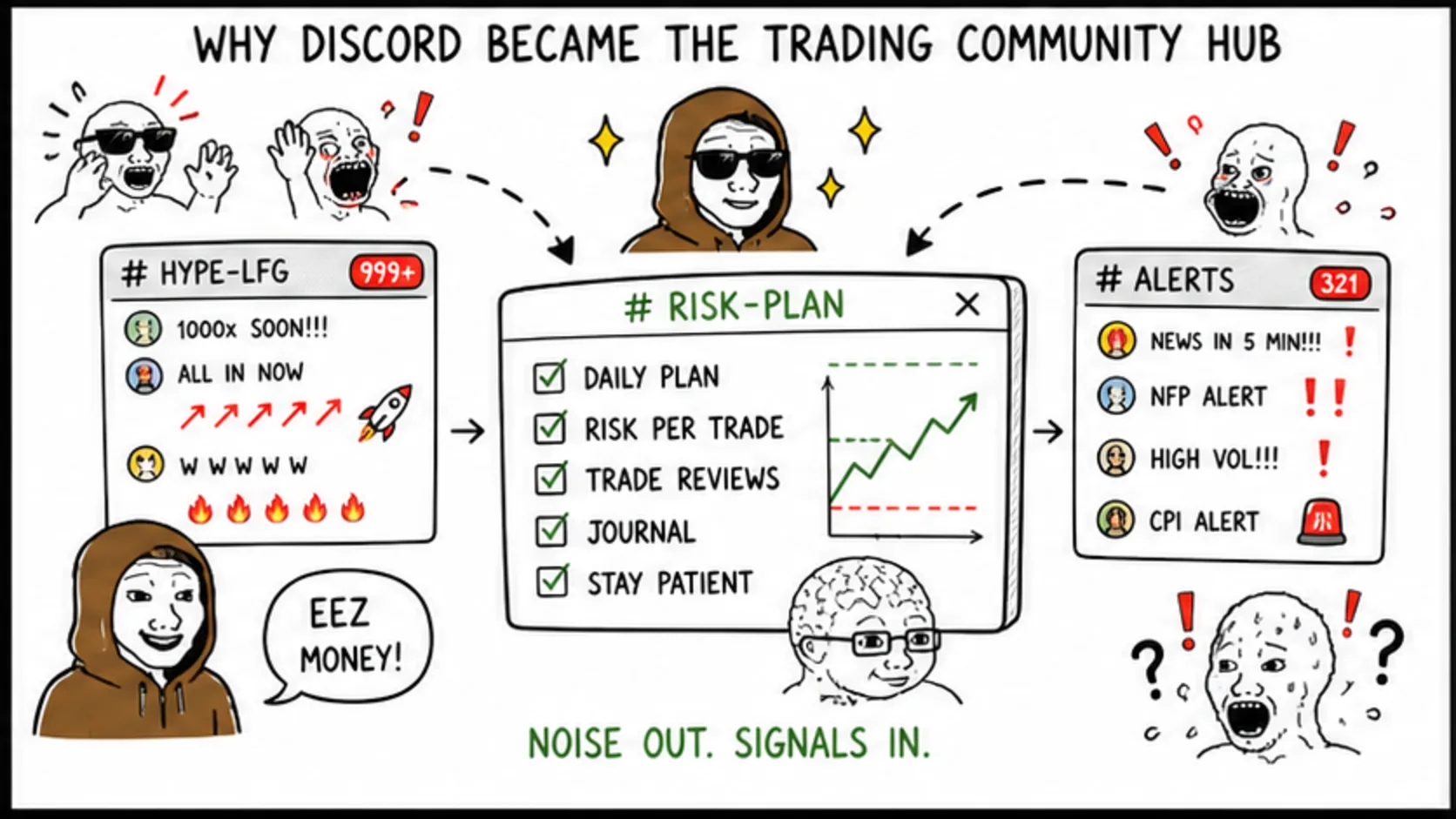
Discord took over trading communities because it does everything a trading group needs. Real-time text chat, voice channels for live market commentary, screen sharing for chart walk-throughs, and subscription bots that let creators charge for access without building their own payment system.
The problem is that low barriers to entry mean low barriers to garbage. Anyone can create a trading Discord, slap a price tag on it, and start collecting subscriptions. Many people do exactly that.
The good servers share specific characteristics. Active moderators, educational content, transparent track records, and members who actually discuss strategy rather than just posting green or red emojis in a channel.
The bad servers share characteristics too. Endless trade alerts with no context, hype-driven marketing, and a community owner who is more influencer than trader.
There is even a Reddit thread titled "Leaving Discord servers was the best decision for my trading" on r/FuturesTrading. The poster's argument? Too much noise, too many conflicting signals, and too much time spent watching other people trade instead of doing their own analysis. That thread has a point. But it also misses the point. The right Discord accelerates your learning. The wrong one destroys it. Knowing the difference is everything.
The Tier List: Best Trading Discords
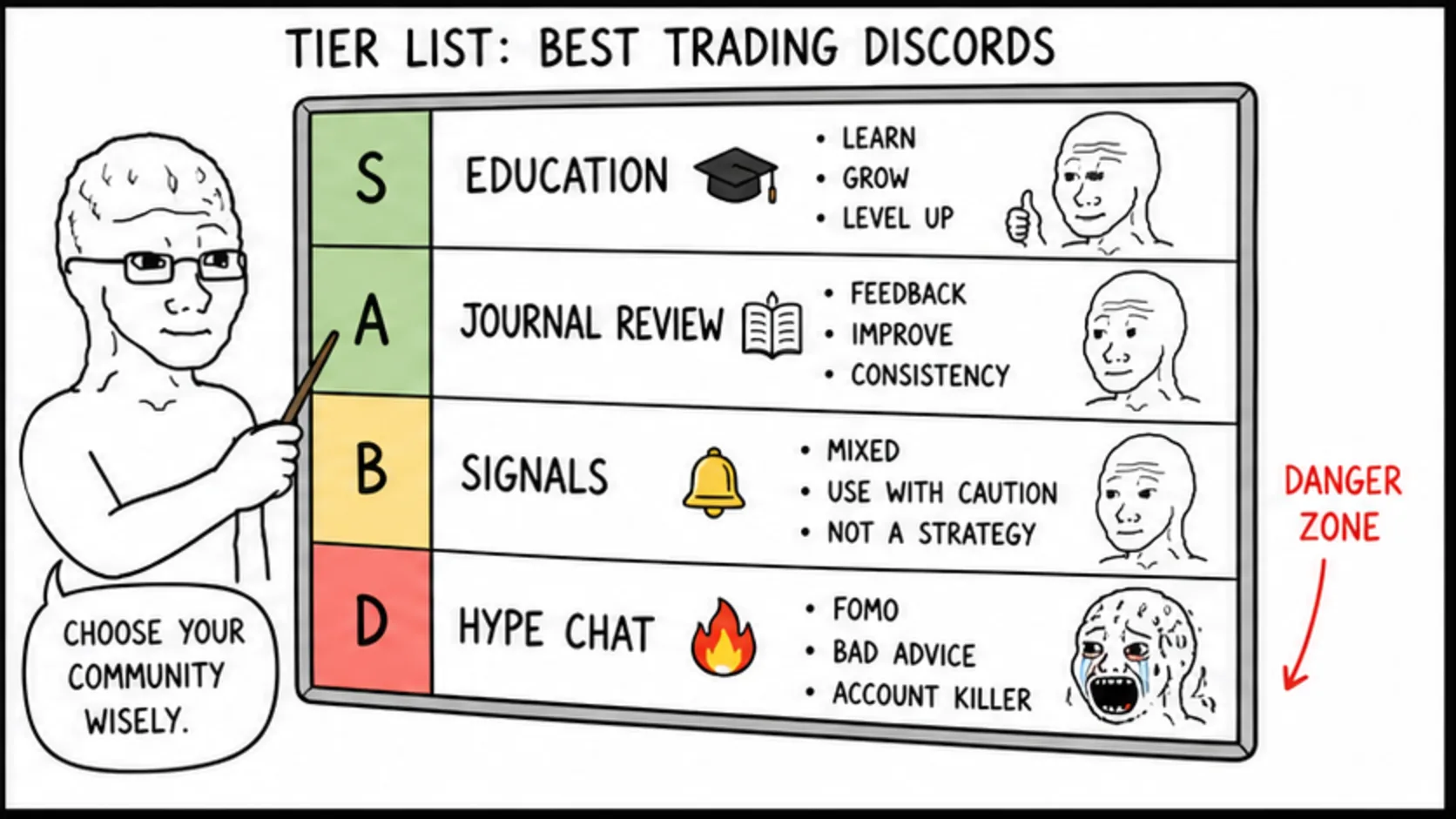
Here is the ranking. I am judging on four criteria: educational value, community quality, transparency, and whether it is actually worth the price of admission if there is one.
Legendary Tier
Reddit Communities (r/Daytrading, r/Forex, r/FuturesTrading, r/Options). Free. Active. Sharp. These subreddits are not Discords technically, but they function as trading communities and they are more valuable than 90% of paid servers. Real traders discussing real results, calling out bad ideas, and sharing actual experience. No subscription. No agenda. If you want unfiltered opinions on whether a setup works, Reddit delivers.
Prop firm official Discords. Firms like Topstep run their own Discord servers for funded traders. The quality is high because members are actual funded traders, not wannabes pretending. The discussions are practical, focused on rules and risk management, and free from the hype that plagues paid groups. If you are working through a prop firm challenge, these servers are gold because everyone inside understands the exact constraints you are dealing with.
TradingView community. The social features on TradingView are underrated. Real chart analysis, published ideas with track records, and a community that actually discusses methodology. Free to use with a TradingView account. You can follow specific traders, see their hit rate, and learn from their analysis without paying a cent.
The Hive Index trading communities. The Hive Index curates and ranks investing and trading Discord servers by member count, activity, and reviews. Useful as a discovery tool. Think of it as a directory, not a community itself. It helps you find servers worth investigating without stumbling through garbage.
Solid Tier
Wealth Group. One of the most active trading communities on Whop and Discord. Covers stocks, options, and futures. The educational content is structured, the moderators engage regularly, and there is a genuine attempt to teach strategy rather than just blast alerts. Paid, but transparent about what you get.
Kaizen. Focused on options trading with a strong educational backbone. The community is smaller than the mega-groups, which is actually a good thing. You get more interaction, more accountability, and less noise. The moderators explain their reasoning, not just their entries.
Stock VIP. One of the larger Discord trading communities. Good for stock and options traders. The alert quality is reasonable, the educational content exists, and the community is active enough to get value. Paid, but transparent about what you get.
Investors Underground. One of the older trading communities that predates Discord but has adapted. Strong educational foundation, active chat rooms, and a track record that predates the current influencer wave. Not cheap, but not a scam either. They have been around since the chat room era, which gives them credibility most new servers lack.
Team Bull Trading. Active community with a focus on small cap stocks and options. The live trading room gets real engagement, and the moderators share their process. The educational library has genuine depth, not just a few YouTube links thrown into a channel.
Options-focused communities with transparent moderators. A few options trading Discords run by actual former floor traders or people with verifiable backgrounds. These are rare. When you find one where the moderator explains why they are taking trades, not just what they are taking, that is worth paying attention to.
Mid Tier
RakeTrades. A Whop-listed group with a decent following. The alerts are there, the community is active, but the educational depth is thin. You get signals. You do not get the reasoning behind them. Fine if you want trade ideas. Not fine if you want to learn to fish.
Generic forex signal groups. Not terrible, not great. You get trade alerts with entry, stop loss, and take profit levels. The problem is you never learn why those levels were chosen. Copy-pasting signals is not trading. It is dependency dressed up as productivity.
Large Whop-listed trading groups (Crystal Academy, Stock Hours, Scarface Trades). Some are genuinely trying. The content exists, the community is there, but the value proposition is thin. You pay $50-$100 per month for alerts that win sometimes and lose sometimes, with no clear edge that you could replicate on your own. Fine if you want trade ideas alongside your own analysis.
Crypto trading Discords. A mixed bag. Some have legitimate technical analysis and risk management discussions. Others are pump-and-dump vehicles disguised as educational communities. The SEC has issued multiple investor alerts about crypto trading groups making unrealistic promises. Be careful here.
Garbage Tier
"Guaranteed results" Discords. Any server promising guaranteed returns is lying to you. Trading does not have guaranteed anything. If they need to promise results to get you to subscribe, the results are not real.
Lambo-marketing influencer servers. You know the type. Profile picture in front of a rented car. Discord link in the bio. Thumbnail with a shocked face. These exist to collect monthly fees from people who confuse confidence with competence.
Servers with no free channel. If a community will not let you see even a preview of what goes on inside before you pay, that is not confidence. That is a trap. Every legitimate community offers at least a glimpse.
"We have 50,000 members" flex servers. Member count means nothing. Most of those members are inactive free accounts or bots. Five hundred engaged, honest traders is worth more than 50,000 silent accounts.
Pump-and-dump crypto groups. These are not communities. They are coordinated schemes where the owner buys a token, pumps it in the Discord, and dumps on the members. The CFTC has warned about these specifically. If the group focuses on low-cap tokens with sudden "alerts," run.
Free vs Paid Trading Discords
This is the question Reddit argues about constantly. Are paid trading Discords ever worth it, or is free always better?
Most paid servers are not worth it. A small minority are. The difference comes down to what you actually get for your money.
Free Discords and Reddit communities give you discussion, honesty, and a wide range of perspectives. What they do not give you is structure. Nobody is holding you accountable. Nobody is reviewing your journal. Nobody is walking you through a specific setup step by step.
Paid Discords that are worth the money offer structure. They offer educational sequences that build on each other. They offer direct access to a moderator who will explain why a trade was taken, not just what the entry was. They offer accountability, which most traders desperately need and never get.
Paid Discords that are not worth the money offer trade alerts. Just alerts. Entry, stop, target. Sometimes they win. Sometimes they lose. You learn nothing either way, and you keep paying because you are hooked on the alerts like a crutch.
If you are a beginner, start free. Every time. Learn the basics, understand price action, figure out your risk management, and develop a strategy first. A paid Discord will not teach you what a support level is. That is free knowledge. Pay for community only when you know exactly what gap you are trying to fill.
What Do the Top 1% Day Traders Make?
People ask this constantly in trading Discords, Reddit threads, and Quora questions. The answer is going to disappoint you.
The top 1% of day traders make consistent money. Not millions. Not Lambos. Consistent, boring, repeatable money. We are talking about people who grind out 5-10% per month on their accounts, manage their risk religiously, and treat this like a business, not a casino.
According to research cited by the Bank for International Settlements and various academic studies, the vast majority of retail traders lose money. The ones who survive and profit consistently are doing something different from the rest. They are not smarter. They are more disciplined.
For prop firm traders specifically, a funded trader making 5-8% per month on a $50,000 account is pulling $2,500 to $4,000 monthly. That is real money. That is also not "top 1% of all traders everywhere" money. That is "I learned the rules, I respect my drawdown, and I do not do stupid things" money.
The top 1% are not the ones posting screenshots of $100,000 days. They are the ones who never blow their accounts and compound slowly. That is less exciting but far more profitable over time.
What Is the #1 Day Trading App?
There is no single best day trading app. Anyone telling you there is one is either selling you something or has not traded enough instruments to know better.
TradingView dominates for charting and technical analysis. If you are a discretionary trader, this is your primary tool. The social features, custom indicators, and multi-device support make it the default for a reason.
ThinkorSwim (Charles Schwab) is the heavy hitter for US equities and options. Powerful, free with an account, and deep enough that you will never outgrow it. The learning curve is real, but the payoff is worth it.
MetaTrader 4/5 is the forex standard. Most prop firms that offer forex evaluations use MetaTrader as their platform. If you are trading forex, you need to know this platform inside out.
NinjaTrader and Rithmic dominate the futures prop firm space. If you are taking a futures prop firm challenge, chances are you will be on one of these. Learn the platform before you start the evaluation, not during it.
The best trading app is the one your prop firm gives you, or the one that matches your market. Pick the market first, then pick the platform. Not the other way around.
Red Flags That Every Server Shows
Before joining any trading Discord, paid or free, check for these warning signs.
- No verifiable track record for the server owner
- Heavy focus on screenshots of winning trades with no losing trades shown
- Affiliate links everywhere, especially to prop firms with discount codes
- Pressure to upgrade to a higher tier within days of joining
- Members who only post emojis and never discuss strategy
- A server owner who never actually trades live or explains their process
If a community ticks three or more of these boxes, save your money. The best education in trading is learning to identify who is genuine and who is selling you a story.
What to Actually Look For in a Trading Discord
The right trading Discord for you depends on what you need. Different traders are looking for different things, and the wrong community for your stage is worse than no community at all.
Trade ideas. If you want trade ideas and alerts, look for communities where the moderator explains the setup, the context, and the reasoning. Not just "buy here, target there." You should be able to take that idea, understand why it was formed, and eventually find similar setups yourself. If you cannot, the community is creating dependency.
Education. If you want to learn, find communities that have structured educational content. Recorded webinars, written lessons, strategy breakdowns, and Q&A sessions where you can actually ask questions. Random live streams where someone trades and narrates are not education. They are entertainment.
Accountability. Some of the best communities are the ones where members post their daily journal, share their P&L, and get honest feedback from peers. Accountability partners matter more than most traders realise. If you are the type who needs external pressure to stay disciplined, find a group that enforces journaling.
Alerts. If you want alerts as a supplement to your own analysis, make sure the community is clear about the role alerts play. They are a starting point, not a complete trading plan. You should still do your own confluence check before blindly following any alert.
If you trade prop firm challenges specifically, look for communities where funded traders hang out. Prop firm communities have a different vibe because the members are actually managing funded accounts and dealing with real trading rules.
Free is usually better than paid for beginners. Not because paid is always bad, but because beginners have not yet developed the filter to separate useful information from noise. Learn on the free stuff first. Pay for community only when you know exactly what you need from it.
The best trading Discord is the one that makes you a better independent trader. If a community creates dependency, where you cannot trade without it, it has failed you even if the alerts are profitable. The goal is to learn enough to not need the community anymore. That is the only honest measure of whether it was worth your time.
