
Whop has become the go-to marketplace for trading communities, and half of them are not worth the monthly fee. The other half range from genuinely useful to "fine, I guess." This article separates the signal from the noise so you stop paying for communities that teach you nothing.
Full disclosure. I have been in more Whop trading groups than I care to admit. Some I learned from. Most I cancelled within the first month. Here is what I know.
Key Takeaways
- Whop is a marketplace platform where creators sell access to trading communities, usually via Discord servers.
- Most paid trading groups on Whop are overpriced signal services with minimal educational value.
- The best groups teach you to think independently. The worst create dependency on their alerts.
- Price does not equal quality. Some free groups outperform $100/month communities.
On This Page
- What Is Whop and Why Does It Matter for Traders?
- The Tier List: Whop Trading Groups
- Legendary Tier
- Solid Tier
- Mid Tier
- Garbage Tier
- Free vs Paid Trading Groups on Whop
- What Do the Top 1% Day Traders Make?
- What Is the Best Discord Group for Trading?
- How to Evaluate Any Whop Trading Group
- Better Alternatives to Paid Groups
What Is Whop and Why Does It Matter for Traders?
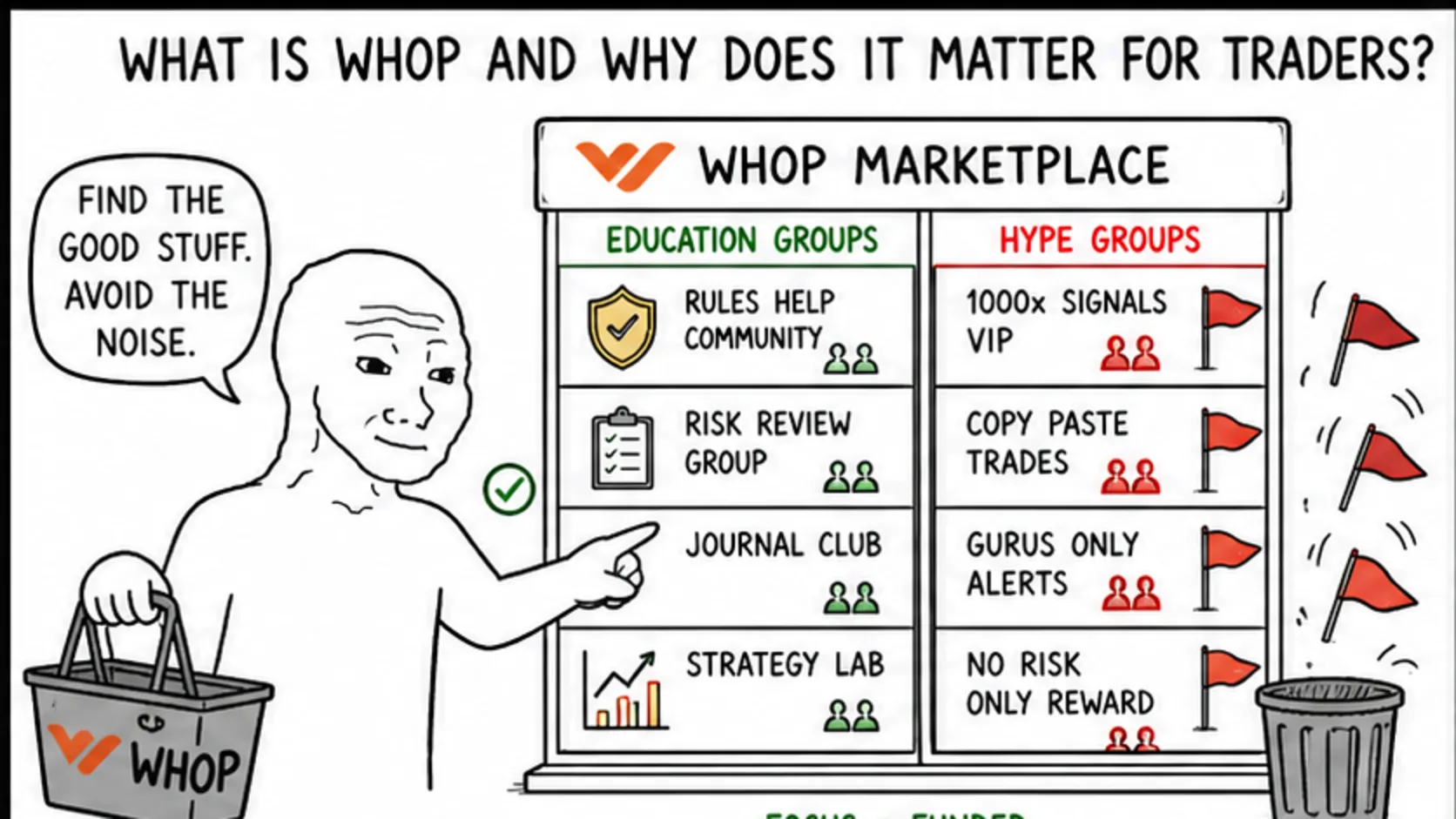
Whop is an online marketplace where creators sell digital products and community access. For trading, this usually means you pay a monthly subscription to join a Discord server run by someone who claims to be a profitable trader.
The platform itself is legitimate. Whop handles payments, reviews, and dispute resolution. The problem is not the platform. The problem is that anyone can list a trading group on Whop, regardless of whether they can actually trade.
The barrier to entry is a Discord server and a sales page. That is it. No verification of trading results. No proof of funded accounts. No background check. You are trusting the creator's word, their screenshots, and their marketing.
Some creators are genuine traders sharing real knowledge. Others are marketers who figured out that trading communities are a lucrative subscription business. The FTC has guidance on spotting deceptive business claims that applies perfectly here. Telling the difference between real educators and skilled marketers is the entire challenge.
The Tier List: Whop Trading Groups
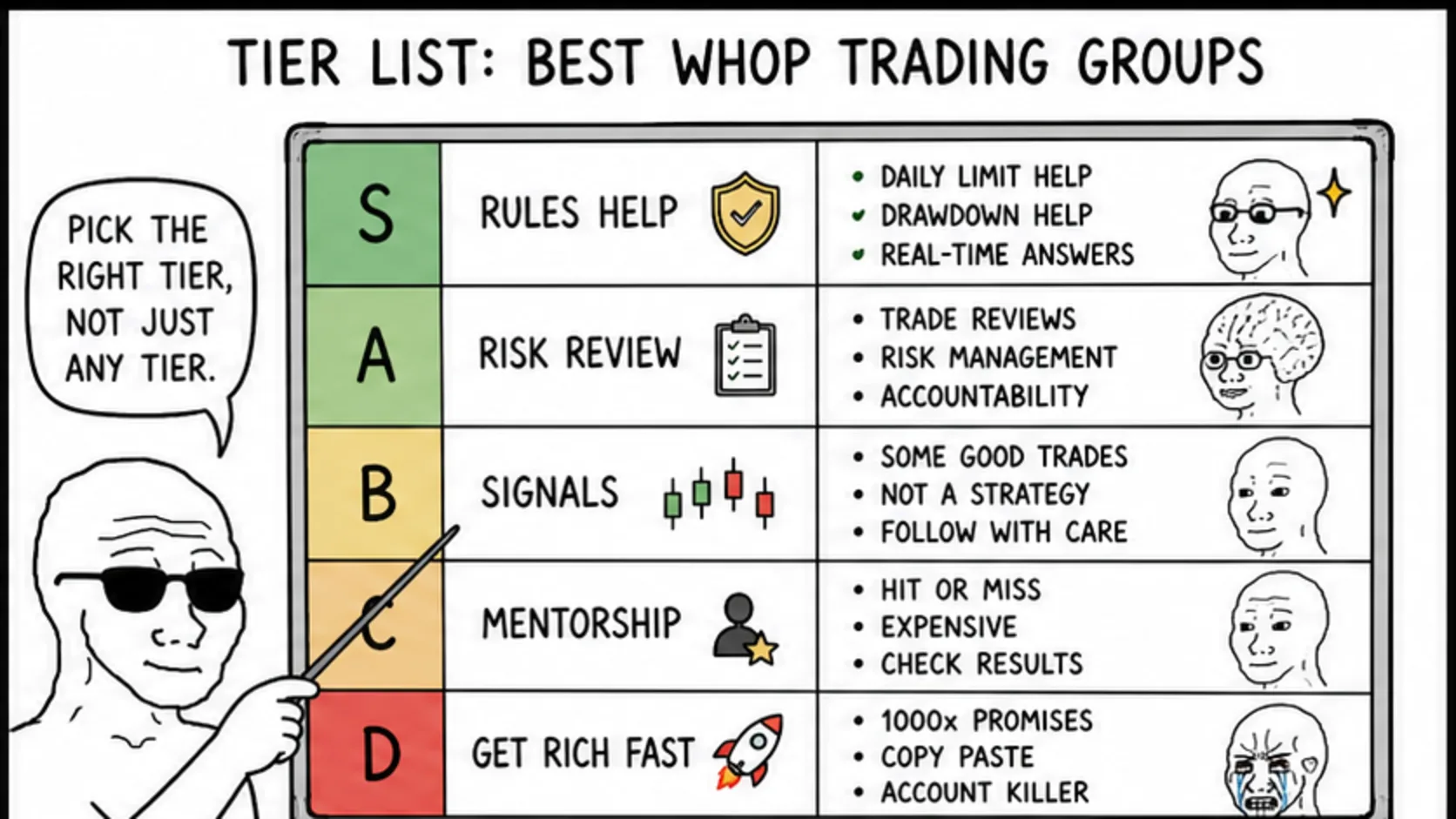
Here is the ranking based on actual value delivered, educational content, community quality, and whether you will learn something that makes you a better trader independently.
Legendary Tier
Free educational communities. Yes, the best tier is free. Several high-quality trading educators run free Discord servers as a lead-in to their paid courses. The free content in these servers is often better than what you get in $100/month paid groups. Look for communities where the owner posts educational content, explains their reasoning, and lets you evaluate before committing.
Prop firm community servers. Some prop firms run active Discord communities for their traders. These are gold because the members are actual funded traders dealing with real rules, real drawdowns, and real payouts. The conversations are practical and grounded. These communities are covered in more detail here.
American Dream Trading. One of the most established trading groups on Whop. Focuses on stocks and options with a strong educational component. The free tier alone provides enough value to justify joining. The moderators are active, the community is engaged, and the content goes deeper than "buy this, sell that."
Solid Tier
The Whale Room. Known for options and futures trading with a focus on risk management. The group keeps its member count manageable, which means you get actual interaction rather than shouting into a void. The educational content has genuine depth.
Front Runners. Focused on momentum and small cap stocks. The alerts are there, but more importantly, the moderators explain their process. You learn the setup logic, not just the entries. That is the difference between a signal service and a community that teaches.
Kaizen. Options-focused with a structured educational path. The community is smaller than the mega-groups, which is a feature, not a bug. More interaction, more accountability, less noise. The moderators walk through their decision-making process in detail.
OnlyOptionsTrades. One of the more established options groups on Whop. Offers a mix of trade alerts, educational webinars, and active community discussion. The moderators engage, the content is updated regularly, and the results are trackable. They also offer a free tier that gives you a genuine preview.
Strategy-specific communities. Groups focused on one specific approach, like ICT concepts, supply and demand, or London breakout strategies, tend to be more valuable than general "we trade everything" groups. Specialisation forces depth, and depth is what you actually learn from.
Mid Tier
The Traveling Trader. A popular group with decent content. The marketing is strong, the brand is polished, but the educational depth is thinner than the legend suggests. Good for trade ideas and general market commentary. Not ideal if you want to learn a specific methodology deeply.
Stock Dads and Stock Hours. Both are large, active groups with reasonable content. The problem is scale. When a community gets this big, the personal interaction disappears. You get alerts, you get some educational content, but you do not get the kind of direct engagement that makes a community transformative.
Generic signal groups. Entry, stop loss, take profit. Every day. No explanation of why. You follow the signals, sometimes they work, sometimes they do not. You learn nothing about how to trade independently. These groups create dependency, which is exactly what the subscription model depends on.
Garbage Tier
Groups with fabricated track records. If every screenshot shows massive wins and zero losses, you are being lied to. Real traders have losing trades. Real traders have losing weeks. If a group owner cannot show you a single red trade, they are editing their history.
Groups that push prop firm affiliate links constantly. Some Whop groups exist primarily to funnel you into buying prop firm evaluations through their affiliate links. The trading content is secondary to the commission income. If every other message contains a discount code for a prop firm, you are the product, not the customer. Check whether the group owner is pushing funded accounts through their own links before trusting their "reviews."
Groups that promise passive income from trading. Trading is not passive. Anyone selling you passive income from day trading is either confused about what passive means or deliberately misleading you. Either way, avoid.
Brand new groups with no track record. Whop makes it easy to launch a group. If a trading group has been around for less than three months, has no verifiable history, and is already charging premium prices, the owner is testing whether the subscription model works, not whether their trading works.
Free vs Paid Trading Groups on Whop
Reddit is full of threads asking "are paid trading groups worth it?" The consensus from actual traders is the same every time. Most are not. A few are. The hard part is figuring out which few.
Free groups on Whop give you a taste. The good creators use free tiers as a genuine preview, not a trap. You can see the content style, the moderation quality, and the community vibe before committing money.
Paid groups that are worth it offer something specific that free groups cannot match. Structured learning paths, direct moderator access, accountability systems, and a curated community of serious traders. The price is paying for those systems, not for trade alerts.
Paid groups that are not worth it charge $50-$200 per month for alerts that you could generate yourself with basic technical analysis skills. What keeps most subscribers paying is fear of trading alone, not the quality of the content. The Whop trading group economy runs on that fear.
If you are thinking about a paid group, try the free tier for at least two weeks. If the free content does not impress you, the paid version will not either. The best groups put their best foot forward for free.
What Do the Top 1% Day Traders Make?
This question comes up constantly in trading groups, on Reddit, and in Quora threads. The real answer is less exciting than the screenshots suggest.
The top 1% of day traders are not the ones posting $50,000 green days. Those exist, but they are not representative. The actual top 1% are traders who compound consistently, manage their drawdown, and survive long enough for the math to work in their favor.
A consistently profitable day trader making 5-10% per month on a funded account is doing better than 95% of retail traders. On a $100,000 funded account, that is $5,000 to $10,000 per month. Solid money. Real money. Not "quit your job and buy a yacht" money, but "this is a real income stream I can rely on" money.
Academic research, including studies referenced by the Bank for International Settlements, consistently shows that the majority of active retail traders lose money. The ones who win are not using a secret strategy. They are executing a known strategy with better discipline than everyone else.
The top 1% are the people who stopped trying to hit home runs and started hitting singles. Consistently. Boringly. Profitably.
What Is the Best Discord Group for Trading?
The best Discord group for trading depends entirely on what you trade, what stage you are at, and what you actually need from a community.
If you are a prop firm trader, the best Discord is the one run by your prop firm. You get real traders, real rule discussions, and real accountability. Our full Discord tier list covers this in detail.
If you want education, look for groups where the moderator explains their reasoning, not just their entries. Kaizen, American Dream Trading, and a handful of others fit this profile. The education-first groups tend to be smaller and more expensive, but they actually teach you something.
If you want trade alerts, be honest with yourself about why. Alerts are useful as a supplement to your own analysis. They are dangerous as a replacement for it. If you cannot explain why a trade was taken, you are not trading. You are following.
If you are a complete beginner, do not pay for a trading group. Start with free educational resources, build a foundation, and only consider paid communities once you have enough knowledge to evaluate whether the content is actually good. Beginners lack the filter to separate useful information from confident nonsense.
How to Evaluate Any Whop Trading Group
Before subscribing to any paid trading group, run through this checklist.
- Does the owner show verifiable trading results, not just screenshots?
- Is there a free channel or trial period to evaluate the content?
- Does the group teach strategy and reasoning, or just post alerts?
- How active is the owner in the community? Daily engagement or ghost mode?
- Are there real members discussing real trades, or just emoji reactions?
- What do independent reviews on Reddit and Trustpilot say?
If a group fails three or more of these checks, keep your money. The best trading group is the one that teaches you enough to eventually leave it.
Better Alternatives to Paid Groups
Before spending $50-$200 per month on a Whop trading group, consider these alternatives that cost nothing.
Reddit trading communities are free, honest, and surprisingly educational. TradingView's social network lets you follow real traders and see their published ideas with track records. Free Discord servers run by prop firms and trading educators often provide more value than paid alternatives.
YouTube channels from actual funded traders, not influencers, provide detailed strategy breakdowns for free. The information is out there. What is not out there is someone to force you to study it and apply it, and no paid group can do that for you.
Most traders join paid groups hoping the group will do the work for them. It will not. No Discord server, no matter how expensive, will make you a better trader unless you put in the work yourself. Buy the education if you need structure. But do not confuse buying access with buying skill.
What to Do After Joining a Whop Trading Group
You just paid your monthly fee and got your Discord invite link. Now what? Most traders lurk for three days, skim a few channels, then cancel. Here is the playbook I wish someone had given me when I joined my first paid group.
First, spend your first week reading, not trading. Go through the educational channels, study the pinned messages, and read the moderator's trade recaps. Every good group has a backlog of explained trades. That backlog is worth more than any live alert you will ever follow.
Second, pick one strategy the group teaches and commit to it for 30 days. Not three strategies. Not "I'll try this and that." One approach, one set of rules, one market. Specialisation is where learning actually happens. I bounced between four different strategies in my first paid group and learned nothing from any of them.
Third, journal every trade, whether it came from the group or from your own analysis. Write down why you entered, what the group said, what the outcome was, and how you felt. After 30 days, you will have a clear picture of whether the group's approach works for your personality and schedule.
Fourth, engage with the community. Ask questions in the channels. Respond to other people's trade ideas. The moderators in good groups actually respond to thoughtful questions. The ones who ignore you are running a broadcast, not a community.
Fifth, set a hard cancellation date. Before you join, decide exactly when you will evaluate whether the group is worth continuing. If you have not learned something actionable within the first month, cancel. No sunk cost fallacy. No "maybe next month will be better." It will not.
Red Flags Specific to Whop Trading Groups
Whop groups have their own flavour of scam that you will not find on regular Discord servers. Here are the red flags I have personally encountered and what to watch for.
Pump and dump signal services. Some groups build a following, then use that following to move thinly traded stocks or low-cap crypto. The moderator buys in first, posts the "signal" to the group, the members pump the price, and the moderator exits at a profit while the members are left holding bags. If a group only signals small cap stocks or micro-cap crypto, and the price always spikes right before the alert goes out, you are the exit liquidity.
Fake P&L screenshots. This is rampant. Some group owners post daily profit screenshots that would make a hedge fund jealous. The trick is to look for consistency. Real traders have losing days, breakeven weeks, and occasional drawdowns. If every single screenshot shows green, you are being sold a fantasy. I have seen group owners post screenshots from demo accounts while claiming they were live.
Affiliate loops. Some Whop groups exist entirely to funnel you into buying other products. The group owner earns a commission every time you click through to a prop firm challenge, a trading course, or another Whop group. The trading content is thin because the real business is the affiliate income. If every other message contains a referral link or a discount code, the group owner's incentive is your continued purchasing, not your trading improvement.
Churn and rebrand. A group launches, underdelivers, gets bad reviews, then the owner shuts it down and reopens under a new name with the same content. Check the owner's history on Whop. If they have multiple closed groups with similar names, they are cycling through customers rather than building something lasting.
Pressure tactics. Limited time offers that never actually expire. Countdown timers on discounts that reset every week. "Only 5 spots left" when the group has 2,000 members and growing. These are marketing tricks designed to make you buy before you think. Legitimate educators do not need artificial urgency to sell their product.
