
Any challenge strategy has to respect leveraged-market risk first. The Commodity Futures Trading Commission warns traders not to underestimate how quickly losses can build.
prop firm challenge strategy what actually matters in a challenge strategy. This is the core topic and we are going to break it down properly.
Most traders search for a magic strategy that guarantees a pass. It does not exist. What does exist is a systematic approach to challenges that dramatically improves your odds when you follow it.
Key Takeaways
- Your strategy for a challenge should be simpler than your normal trading. Focus on your highest-probability setups only.
- Position sizing is more important than entry timing. Risk 0.5-1% per trade and let the math do the work.
- Break the profit target into daily goals. On a $50K account with 8% target, you need roughly $200 per day over 20 days.
- The best challenge strategy is boring. If it feels exciting, you are probably risking too much.
On This Page
What Actually Matters in a Challenge Strategy
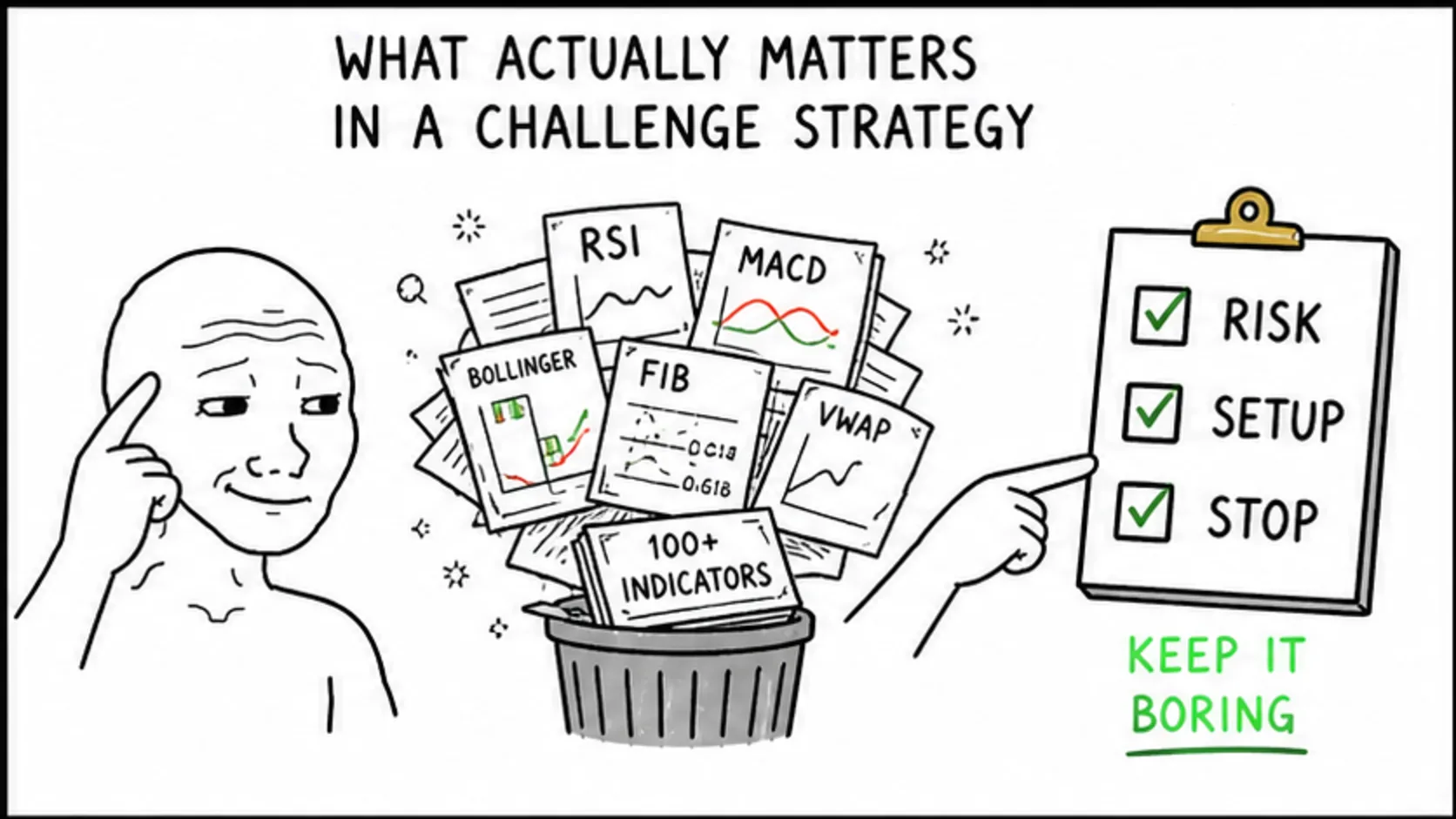
The most important thing about a prop firm challenge strategy is not the specific entries or exits. It is the framework around them.
Before you even think about placing a trade, you need to understand the rules, the math, and the psychology of what you are about to do. Most traders skip this part and fail on day three.
Read every rule the firm publishes. Know your daily loss limit, your maximum drawdown, and whether the drawdown is trailing or static. If you cannot explain these to a friend, you are not ready.
Position Sizing: The Strategy Within the Strategy
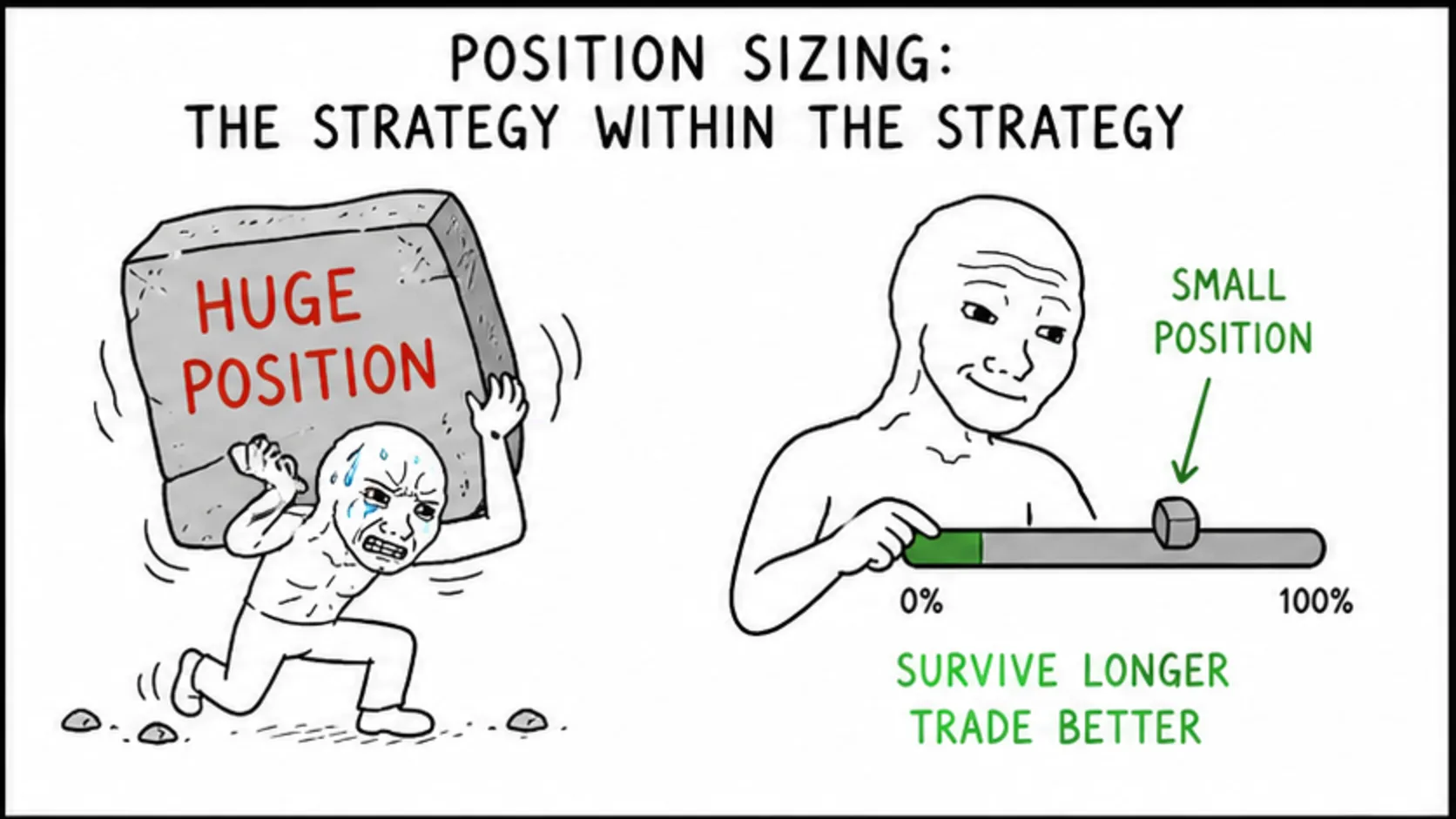
Position sizing is the strategy within the strategy. Get this right and you can pass with almost any reasonable trading approach. Get it wrong and the best analysis in the world will not save you.
Risk 0.5-1% per trade. On a $50,000 account, that is $250-$500 per position. With this sizing, you can take ten consecutive losses and still be well within your risk limits.
That is the margin of safety you need. The market does not care about your analysis. It cares about your position size relative to your account.
Trade Selection: Only Your Best Setups
During a challenge, you should only be trading your A+ setups. Not B setups. Not C setups with a good feeling. Your absolute best entries.
If your A+ setup does not appear on a given day, do not trade. There is no penalty for zero trades. There is a huge penalty for forcing suboptimal entries.
The challenge is a marathon, not a sprint. You have 20-30 trading days to hit an 8% target. Missing one day of trading is infinitely better than taking a bad trade that costs you 2% of the account.
Daily Targets: The Math That Makes It Work
Break the profit target into daily goals. On a $50,000 account with an 8% target, you need $4,000 total.
Over 20 trading days, that is $200 per day. Over 25 days, $160 per day. These are not intimidating numbers. $200 on a $50K account is 0.4%.
One decent trade with conservative sizing can hit that. The key is stringing together consistent days without the bad ones wiping out the good ones.
Handling Losing Streaks
Losing streaks are inevitable. What separates funded traders from failed evaluations is how they respond.
When you hit three losses in a row, stop trading for the day. Do not try to make it back. Do not increase your size. Close the platform and come back tomorrow.
Three small losses on a well-sized account means almost nothing. Three losses followed by a revenge trade that blows your daily loss limit means your challenge is over.
The difference between those two outcomes is not skill. It is self-control.
Adapting to Market Conditions
Market conditions change. Your challenge strategy needs to account for that without abandoning your core approach.
If volatility spikes, reduce position size. If the market goes quiet and your setups are not appearing, wait. Do not invent new setups because you are bored.
Risk management adapts to conditions. Your entry criteria should not. If the setup meets your criteria, take it. If it does not, do not.
The Recipe for Passing Every Time
The recipe is simple. Risk small, trade your best setups, protect the account above all else, and let time do the work.
Most traders know this. Most traders do not do it. That is the gap between passing and failing.
The traders who get funded are not smarter than you. They just execute the boring stuff consistently. Now you know it too.
Which Strategy Types Actually Work for Challenges?
This comes up constantly on Reddit: "What strategy works best for prop firms, scalping, day trading, or swing?" Let us rank them.
Day trading. Solid tier. Open positions during your session, close them before you sleep. You control overnight risk, you can manage your daily loss limit, and you get clean data on your session performance. This is what most funded traders do.
Scalping. Mid tier for challenges. Works great if you have a tested edge and tight execution. But scalping generates more trades, which means more chances to revenge trade after a loss. The emotional discipline requirement is higher. If you scalp, you need an iron-clad daily stop limit.
Swing trading. Garbage tier for most challenges. Not because swing trading is bad. It is not. But most challenges have 20-30 day limits and trailing drawdowns that punish overnight holds. One bad gap and your challenge is over while you were sleeping. Some firms are better for swing traders, but they are the minority.
The verdict. Day trading is the sweet spot for most prop firm challenges. You are awake, you are in control, and you can react to drawdown situations in real time.
What Win Rate Do You Actually Need?
A question nobody answers honestly. Let us fix that.
If your strategy has a 1:1 risk-to-reward ratio, you need a 50%+ win rate to be profitable. If your strategy has a 1:2 risk-to-reward, you only need 34% to break even. These are mathematical facts, not opinions.
For prop firm challenges, a win rate between 40-60% with a risk-to-reward of 1:1.5 or better is the sweet spot. This gives you enough winning trades to build consistent equity while keeping individual losses small enough to survive losing streaks.
Do not fixate on win rate alone. A trader winning 70% of trades with tiny profits and huge losses will blow a challenge faster than a trader winning 40% of trades with proper risk management.
The metric that matters is expectancy: (win rate x average win) minus (loss rate x average loss). If that number is positive, your strategy has an edge. If it is not, no amount of discipline will save you.
