
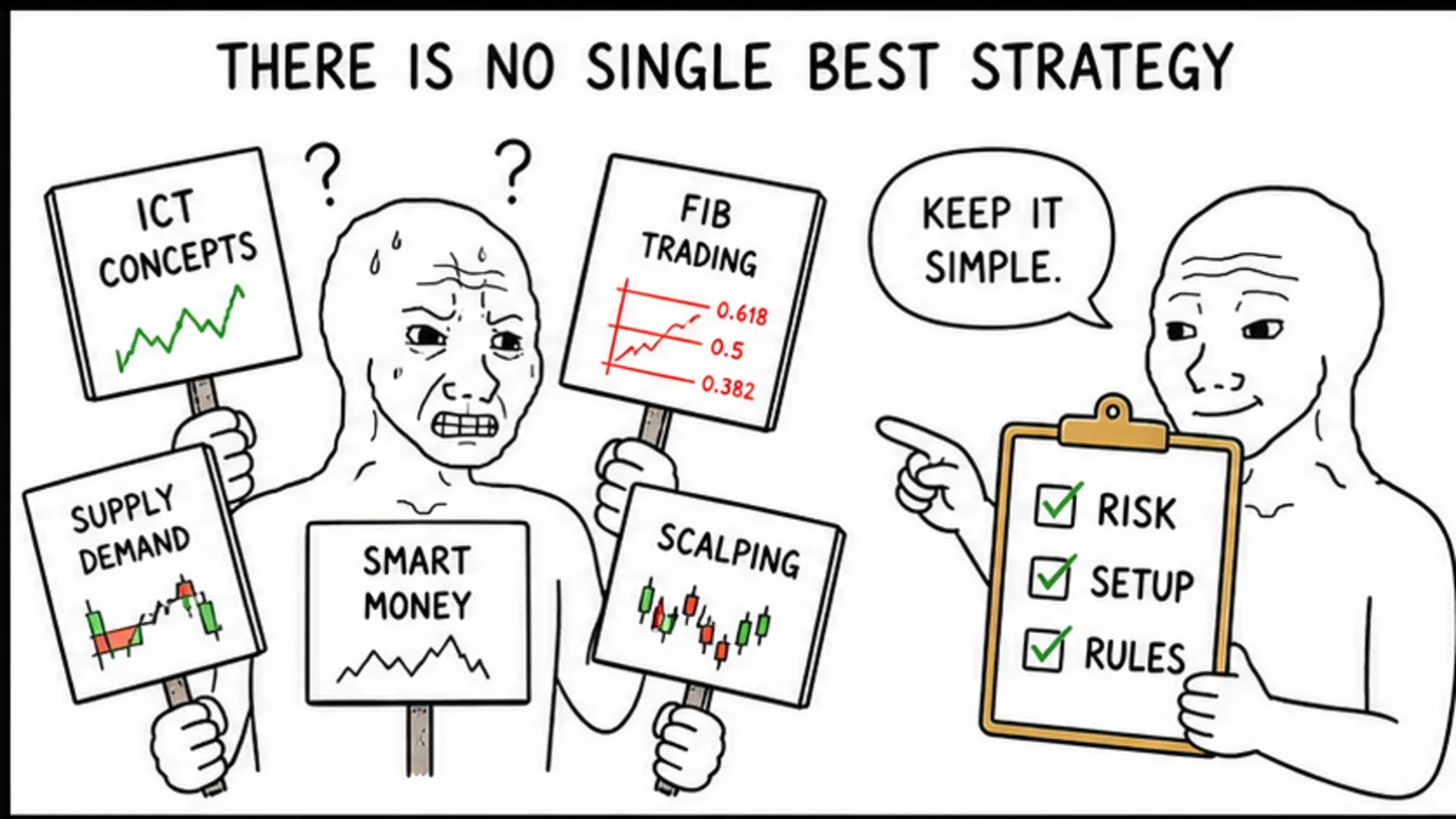
Let us settle the prop firm strategy debate once and for all. There is no single best prop firm trading strategy. There is only the best strategy for you, under the specific constraints of a timed evaluation with drawdown limits and a profit target staring at you from your dashboard.
But some strategies work better than others for prop firm conditions. Way better. And some strategies are basically designed to fail under evaluation pressure. I am going to rank them all.
Key Takeaways
- The best prop firm trading strategy is the one you have already tested and proven profitable. Do not learn a new strategy for a challenge.
- Strategies that produce consistent, moderate gains with controlled drawdowns beat strategies that aim for home runs every session.
- The 5-3-1 rule (5 pairs, 3 strategies, 1 session) is an excellent framework for prop firm challenges because it prevents overtrading.
- Trend following and open range breakout are the most reliable strategies for passing evaluations. Scalping and news trading are the least reliable.
- Your risk management is more important than your strategy. A mediocre strategy with great risk management beats a great strategy with terrible risk management.
On This Page
The Strategy Tier List for Prop Firm Challenges
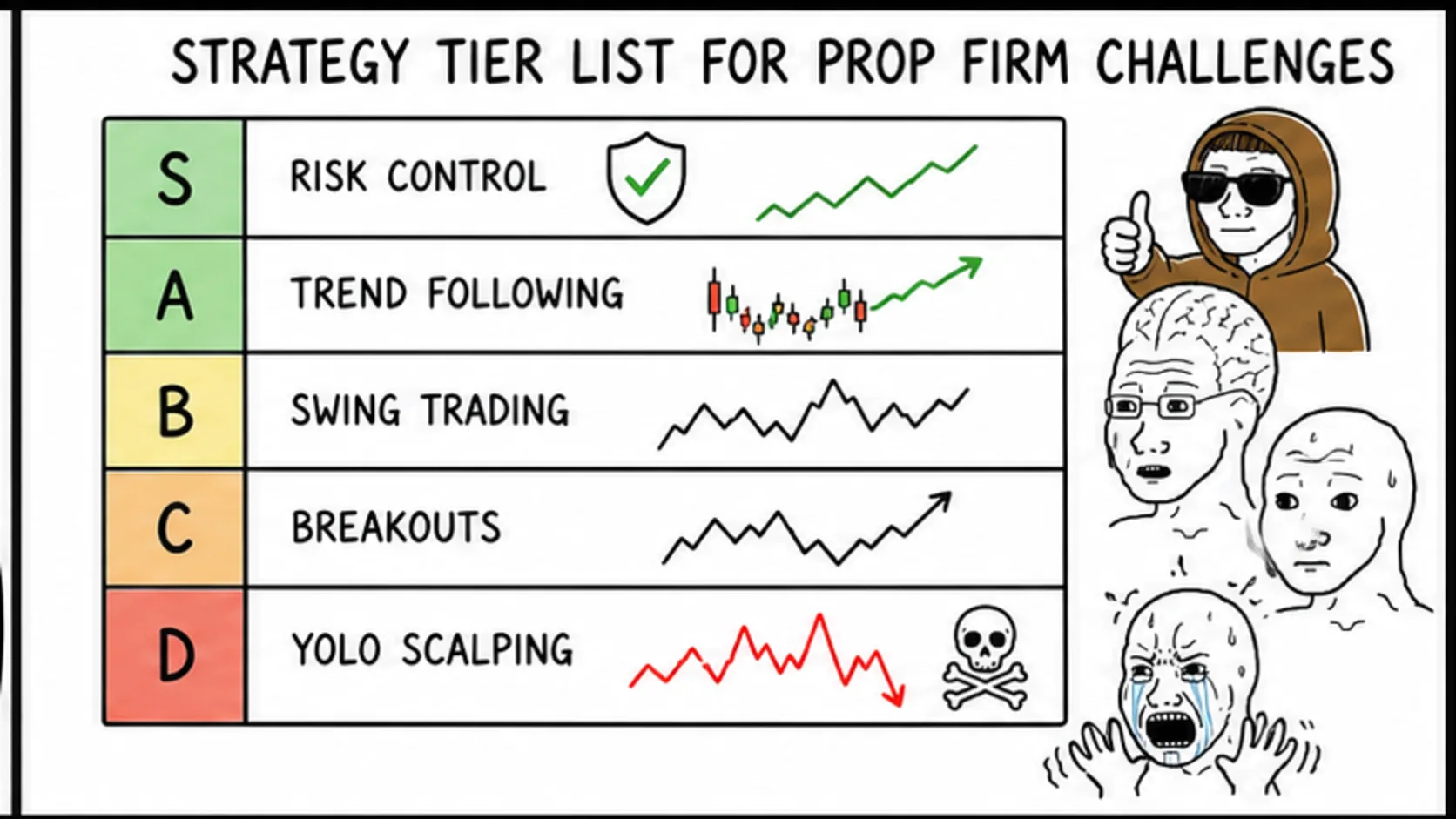
For context, regulators like the Commodity Futures Trading Commission keep warning retail traders about leverage, volatility, and unrealistic return expectations. That is why the best prop firm strategy is boring first and profitable second.
Legendary Tier
Trend following during London or New York session. Simple, effective, no drama. You wait for a clear trend to establish, enter on a pullback to a key level, and ride it until the trend breaks. This works for prop firm challenges because the trades are clean, the stops are logical, and you do not need to be at your screen all day.
Why it works so well: trend following produces asymmetric risk/reward. Your winners are bigger than your losers. In a challenge where you need to hit a fixed profit target, having a few 2R or 3R winners makes a massive difference. You do not need to win 70% of your trades. You need your winners to outpace your losers.
The 5-3-1 rule fits perfectly here. Trade 5 pairs maximum, use 3 setups maximum, and focus on 1 session. This keeps you disciplined, prevents overtrading, and lets you develop a deep understanding of how your pairs move during your chosen session.
Open range breakout. Mark the first 30-60 minutes of the session. When price breaks above or below the range with momentum, you enter. Stop goes at the opposite side of the range. Target is 1.5-2x the range height.
This strategy is tailor-made for prop firm challenges because it gives you one or two clean setups per day during a defined time window. You are not sitting there all day looking for trades. You get your setup, you take it or you do not, and then you are done. Less screen time means less temptation to do something stupid.
Solid Tier
Supply and demand / order blocks. Identify fresh zones where institutional orders likely sit. Wait for price to return to the zone. Enter on confirmation with a tight stop behind the zone. Solid strategy, reliable, but requires patience because you might wait 2-3 days for a zone to be tested.
Fine for unlimited-time challenges. Potentially frustrating for 30-day challenges where you feel the clock ticking. If you are patient enough to wait for your zones, this works. If you are the type to force entries because "I need to make progress today," this strategy will expose that weakness.
Fibonacci retracement with confluence. Pull fibs on a clear swing. Wait for price to retrace to the 61.8% or 78.6% level. Check for confluence: structure, support/resistance, session timing. If it lines up, enter. If not, pass.
This is a respectable strategy that works well for prop firm conditions because it forces you to wait for specific conditions. The confluence requirement acts as a natural filter against impulse trades. Respectable. Fine. Nothing to write home about.
Swing trading on higher timeframes. H4 and daily charts. Fewer trades, wider stops, bigger targets. The advantage is you are not glued to the screen all day, which reduces emotional trading. The disadvantage is each trade takes days to play out, so a losing streak takes weeks to resolve.
Mid Tier
VWAP pullback (stocks and futures). Works well on instruments with a strong VWAP reference point. Price pulls back to VWAP during the session, you enter in the direction of the trend. Simple enough. The issue for prop firm challenges is that VWAP resets daily, so you only get a few opportunities per session and if you miss them, you are waiting until tomorrow.
Fine if you are already a VWAP trader. Not worth learning from scratch just for a challenge.
Mean reversion / range trading. Buy at support, sell at resistance, repeat. Works beautifully in ranging markets. Gets destroyed in trending markets. The problem is you never know which market you are in until after the fact. For prop firm challenges, you need a strategy that works in both conditions, or you risk going 10 days without a setup during a strong trend.
Garbage Tier
Scalping during prop firm challenges. Get out of here. Scalping means high trade frequency, tight stops, and tiny profits per trade that get eaten by spread and slippage. One bad scalping session where you take 15 trades, lose 8, and win 7 can still end up negative because the spread ate your winners.
Scalping does not work for most people because the execution requirements are brutal. You need near-perfect entries and exits with zero hesitation. In a prop firm challenge where emotions are running high, scalping amplifies every psychological weakness you have.
If you are already a consistently profitable scalper, keep doing what you do. Do not start scalping just for a prop firm challenge.
News trading during evaluations. The spread during news time is not your friend. It has never been your friend. It does not care about you. During NFP, CPI, or rate decisions, spreads widen to 10-20 pips on pairs that normally have 0.5-1 pip spreads. Your stop gets jumped. Your fill is terrible. And then price whipsaws both directions before picking a trend.
Most prop firms restrict or discourage news trading for a reason. It is unpredictable, the execution is garbage, and one bad news trade can blow your daily loss limit. Avoid it during challenges entirely.
Why does this exist Tier
Grid trading / martingale. If you even think about using a martingale strategy in a prop firm challenge, just donate your challenge fee to charity instead. At least someone benefits.
Grid and martingale strategies add positions as the trade goes against you. In a prop firm with a fixed drawdown limit, this is suicidal. Your max drawdown is capped. Martingale guarantees you will hit it.
No. Get out. Do not do this.
What Actually Matters in a Prop Firm Strategy
Pay attention because this part actually matters. The strategy itself is maybe 30% of the equation. The other 70% is how you manage it under pressure.
What matters:
- Consistency. Can you execute the same setup the same way 50 times in a row? If yes, you can pass a challenge. If no, no strategy will save you.
- Risk management. A mediocre strategy with 0.5% risk per trade and strict daily stops will survive a challenge. A great strategy with 3% risk per trade and no daily stop will not. Risk management is not optional. It is the strategy.
- Patience. The best strategy for prop firms is one that lets you wait. Fewer setups, higher quality, lower stress. If your strategy requires you to take 10 trades a day, you are giving yourself 10 chances to make an emotional mistake.
- Known edge. You should have backtested your strategy and forward tested it on a demo or small live account before you spend real money on a challenge. If you are learning a new strategy while doing the challenge, you are gambling.
What does not matter:
- Win rate. A 40% win rate with 2.5R average wins is profitable. A 70% win rate with 0.5R average wins might not be.
- Complexity. The best prop firm strategies are stupid simple. One indicator. Two rules. Clear entry, clear stop, clear target.
- How it looks on YouTube. Strategies that look impressive in a 10-minute edited video are not necessarily what works in a 30-day pressure test.
The 5-3-1 Rule: Built for Prop Firm Challenges
The 5-3-1 rule is one of the best frameworks for prop firm trading. It goes like this.
5 currency pairs maximum. Pick your 5 and stick with them. Learn how they move. Learn their average ranges, their session behavior, their news sensitivity. When you focus on 5 pairs, you start to recognize patterns you would never see if you were scanning 30 pairs looking for "opportunities."
3 strategies maximum. Not 10. Not "I use whatever looks good today." Three specific, written-down, tested strategies. Each with defined entry criteria, stop placement, and target rules. If a setup does not match one of your three strategies, you do not take it.
1 session per day. Pick the London open, the New York open, or the London-New York overlap. Trade that session. Be done. Do not sit there all day looking for trades. The longer you sit, the more tempted you are to force something.
This framework prevents overtrading, keeps you focused, and produces the kind of consistency that passes prop firm challenges. Simple, effective, no drama.
The 3-5-7 Rule and Risk Management
You might have heard of the 3-5-7 rule. It works like this.
- 3: Never risk more than 1-3% of your account on a single trade.
- 5: Aim for a minimum reward-to-risk ratio of 1:3 or better, so your winners outpace your losers.
- 7: Never have more than 5-7% of your account at risk across all open positions combined.
For prop firm challenges, I would tighten this even further. Risk 0.5-1% per trade. Aim for 2R minimum on winners. Never have more than 3% at risk across open positions. The constraints of a prop firm evaluation demand tighter risk management than you would use on a personal account.
Both the 5-3-1 and 3-5-7 rules give you structure. Structure is what you need when the pressure is on and your brain is trying to talk you into a bad trade.
How to Pick Your Strategy
If you are just starting out with prop firms, here is the simplest advice I can give you. Use what you already know.
If you trade supply and demand on your personal account, do that in the challenge. If you are a London breakout trader, do that. If you swing trade on H4, keep doing it. The challenge is not the time to learn a new strategy. It is the time to execute your existing strategy with discipline.
If you do not have a strategy yet, start with trend following on the London or New York session. It is the most forgiving, the easiest to execute, and the most aligned with the constraints of a prop firm evaluation.
If you are scalping and passing challenges consistently, keep doing what works. But if you are scalping and failing repeatedly, the strategy might not be the problem. The frequency might be exposing psychological weaknesses you would not have with a slower approach.
If you are swing trading on higher timeframes, make sure your challenge has enough time. A 30-day challenge with a swing trading strategy that produces 2-3 setups per week means you get about 8-12 trades total. That is enough if your win rate and risk/reward are solid. It is not enough if you are barely profitable.
The Recommendation
If you want my actual recommendation for the best prop firm trading strategy, here it is.
Trend following during the London session. 5 pairs. 0.75% risk per trade. Written trading plan with exact entry, stop, and target rules. Daily stop at 2.5%. No news trading. No revenge trading. Two losses in a row means the session is over.
This is not the most exciting strategy. It is not going to make you a YouTube compilation video. It is going to get you funded. Consistently. Reliably. Boringly.
The people getting funded are not using secret strategies. They are using boring strategies with great execution and iron discipline. Now you know what those strategies are. Go use one.
