
You are looking for futures prop firms that allow EAs, and the short answer is the list is shorter than you think. Most of the conversation around EAs and prop firms focuses on forex and MetaTrader. Futures is a different world with different platforms, different execution models, and different rules about what automated trading actually means.
This page covers which futures prop firms allow algorithmic trading, how futures EAs work on platforms like NinjaTrader and Tradovate, and what you need to know before you try to automate your way through a futures prop firm challenge.
Key Takeaways
- Futures prop firms use different platforms than forex firms. NinjaTrader, Tradovate, and Rithmic are the main futures platforms, and each handles automation differently.
- Some futures prop firms explicitly allow EAs and algorithmic trading. Others prohibit it entirely. There is no standard rule across the industry.
- Futures EAs are not the same as forex EAs. Different platforms, different programming, different execution models.
- Running an EA on a futures prop firm challenge requires understanding the firm's drawdown rules, daily loss limits, and position size restrictions.
- Low-latency VPS hosting near the exchange data center is important for automated futures trading but adds cost to your setup.
On This Page
- How Futures EAs Differ from Forex EAs
- Which Futures Trading Platforms Support Automation
- Futures Prop Firms That Allow EAs
- Rules for Running EAs on Futures Prop Firm Challenges
- VPS and Latency for Automated Futures Trading
- Risks Specific to Automating Futures Challenges
- How to Choose the Right Setup
How Futures EAs Differ from Forex EAs
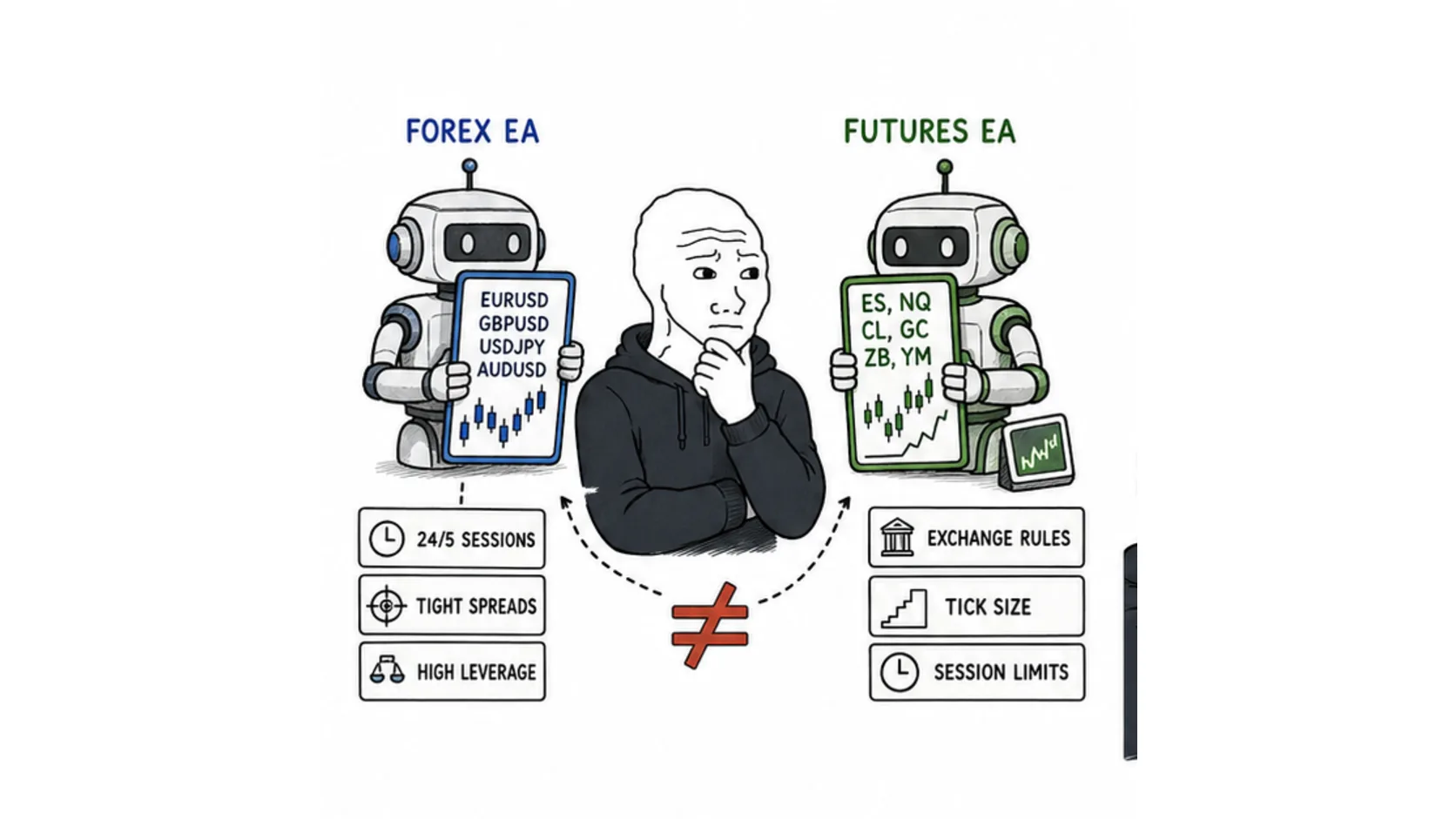
If you are coming from forex trading, forget most of what you know about EAs. Futures EAs work differently in almost every way.
Forex EAs run on MetaTrader 4 or 5. They are written in MQL4 or MQL5. The platform handles everything, from charting to order execution to the programming environment. You download an EA, drop it on a chart, configure the settings, and it runs.
Futures EAs are a different animal. The main futures platforms are NinjaTrader, Tradovate, Rithmic, and occasionally MetaTrader 5 for firms that offer both forex and futures. Each platform has its own automation system.
NinjaTrader uses C# for its automated strategies. Tradovate has a more limited API. Rithmic offers an API that professional algorithmic traders use for low-latency execution. These are not drag-and-drop EAs. Building a futures prop firm EA requires actual programming knowledge in most cases.
The other key difference is market structure. Futures markets trade on centralized exchanges like the CME Group, not over-the-counter like forex. This means execution is transparent, order book data is real, and slippage is generally lower. But it also means the Commodity Futures Trading Commission and the exchange itself monitor all trading activity, including automated strategies.
Which Futures Trading Platforms Support Automation
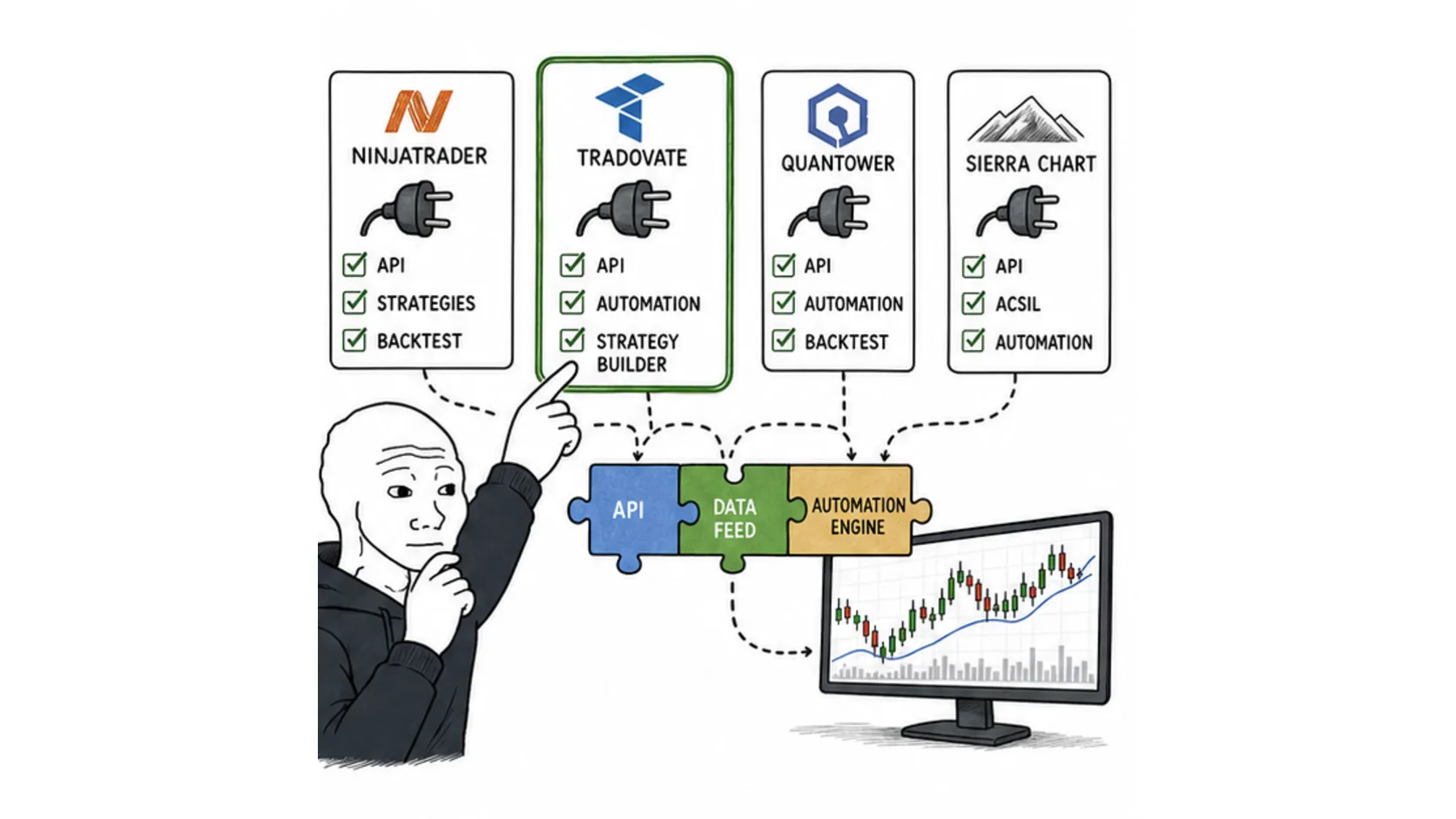
Not all futures platforms that prop firms offer support automated trading. Here is the breakdown.
NinjaTrader 8. This is the most popular platform for futures automation. NinjaTrader supports C# strategies that you build using their development environment. You can create fully automated strategies with custom indicators, risk management, and order management. NinjaTrader strategies can be as simple or as complex as you want to make them.
Tradovate. Tradovate is a cloud-based futures platform. It has some automation capabilities through its API, but it is not as flexible as NinjaTrader for building custom strategies. Tradovate is popular with prop firms because it runs in a browser and requires no local installation.
Rithmic. Rithmic is a professional-grade futures execution platform. It offers a full API for algorithmic trading. This is the platform used by serious futures algorithmic traders who need sub-millisecond execution. Rithmic is available through several prop firms.
MetaTrader 5. Some futures prop firms offer MT5, which supports EAs written in MQL5. If the firm offers futures on MT5, the EA experience is similar to forex, just trading futures contracts instead of currency pairs.
Futures Prop Firms That Allow EAs
The list of futures prop firms that explicitly allow EAs and algorithmic trading is not long. Here is the current landscape.
| Firm | Platform | EA/Algo Allowed | Notes |
|---|---|---|---|
| Apex Trader Funding | NinjaTrader, Tradovate, Rithmic | Yes | Algo trading permitted. Standard rules apply. |
| Topstep | NinjaTrader, Tradovate | Limited | Some automation allowed. Check current terms. |
| Earn2Trade | NinjaTrader | Yes | Algorithmic trading permitted on funded accounts. |
| Uprofit | NinjaTrader, Tradovate | Varies | Check specific plan restrictions. |
Notice something. The big names in futures prop trading, Apex and Topstep, generally allow some form of automated trading. This is because the futures market structure supports algorithmic trading better than forex. Centralized exchanges, transparent order books, and reliable execution make it more viable.
But here is the catch that most traders miss. Allowing EAs does not mean anything goes. These firms still have strict rules about daily loss limits, position sizes, and buffer requirements. Your EA must be configured to respect every single one of those rules, or your account gets closed regardless of whether automation was permitted.
Rules for Running EAs on Futures Prop Firm Challenges
Running an EA on a futures prop firm challenge is not the same as running one on your personal account. The firm's rules constrain everything your futures prop firm algo does.
Daily loss limit. Your EA must have a hard stop that triggers before the firm's daily loss limit. Set your EA to stop trading at 60-70% of the firm's daily loss limit. That buffer protects you against gap opens, slippage, and execution delays that can push you past the limit before the EA can react.
Trailing drawdown. Many futures prop firms use a trailing drawdown that follows your account high. Your EA needs to track the equity high in real time and stop trading when the drawdown from that high reaches 80% of the firm's limit. The trailing drawdown is the number one EA killer on futures prop firm challenges because most EAs are not designed to handle it.
Position size limits. Some futures prop firms restrict the maximum number of contracts you can trade. Your EA must respect these limits. An EA that sizes up to 10 contracts when the firm allows 5 will get your account flagged immediately.
Trading hours. Futures markets have specific trading sessions. Some prop firms restrict trading during the overnight session or around economic news. Your EA must have time filters that match the firm's permitted trading hours.
No martingale, no grid. Same rules as forex prop firms. Martingale and grid strategies are almost universally banned. If your futures EA uses either of these approaches, it will not survive a compliance review.
VPS and Latency for Automated Futures Trading
Latency matters more in futures than in forex. The CME Group's data center is in Aurora, Illinois. If your trading server is in London or Singapore, your orders travel thousands of miles before they reach the exchange. That delay can be the difference between a filled order and a missed one, and slippage from execution delays eats directly into your challenge results.
For futures prop firms that allow EAs, you need a VPS located near the exchange's data center. The CME recommends less than 1 millisecond latency for optimal execution. In practice, anything under 5 milliseconds is fine for most futures automated trading prop firm strategies.
The cost of a futures VPS is higher than a standard forex VPS. Expect to pay $30-80 per month for a VPS in the Chicago area with low-latency connectivity to the CME. This is an additional cost on top of your evaluation fee.
If your strategy is not latency-sensitive, like swing trading with daily bars, a standard VPS might work. But for intraday strategies executing on 1-minute or 5-minute charts, latency directly affects your fill quality and your profitability.
Risks Specific to Automating Futures Challenges
Futures EAs on prop firm challenges face risks that manual traders do not have to worry about.
Platform-specific bugs. Your NinjaTrader strategy might work perfectly in backtesting but behave differently on the prop firm's server configuration. Different data feeds, different execution speeds, different margin calculations. Test everything on demo first.
Contract rollover. Futures contracts expire. Your EA needs to handle contract rollover automatically. If your EA is still trading the expired contract while the market has moved to the new front month, your orders will not fill. This sounds basic, but it catches people off guard every quarter.
Margin requirements. Futures margin requirements change based on volatility. The exchange can increase intraday margins during volatile periods. Your EA must account for variable margin or risk getting positions liquidated.
Exchange-imposed limits. The CME Group has position limits and price limits that your EA must respect. A limit down or limit up move halts trading in that contract. Your EA needs to handle these halts gracefully, not queue up orders that will execute when the market reopens at a dramatically different price.
According to CME Group data, daily futures volume regularly exceeds 50 million contracts across all products. That volume means the market can move fast, and your EA needs to keep up. An automated strategy that works in calm markets might fail spectacularly during high-volume events like employment reports or Federal Reserve announcements.
How to Choose the Right Setup
If you want to use an EA on a futures prop firm challenge, here is the decision framework.
Pick the platform first. Decide whether you are building your strategy on NinjaTrader, Tradovate, or Rithmic. This determines what programming language you use and what automation features are available.
Then pick the firm. Choose a futures prop firm that offers your chosen platform and explicitly allows algorithmic trading. Do not assume. Verify on their website or email their support.
Build or buy the strategy. If you can code in C#, build your own NinjaTrader strategy. If you cannot code, you are buying a pre-built strategy from someone else. Be extremely skeptical of anyone selling a "guaranteed pass" futures EA. There is no such thing.
Configure the risk parameters. Set your daily loss limit, trailing drawdown stop, and position size limits to conservative values. 60-70% of the firm's limits across the board. This is not the time to push boundaries.
Test on demo first. Run the strategy on the prop firm's demo platform for at least 2 weeks before going live on a paid evaluation. This catches platform-specific issues that backtesting will not reveal.
Monitor constantly. Do not set it and forget it. Check the EA at least twice a day. Verify that it is respecting the rules, not accumulating hidden risk, and performing within expected parameters.
The traders who succeed with futures prop firms that allow EAs treat the EA as a tool, not a shortcut. They understand the strategy, they configure the risk parameters conservatively, and they watch it like a hawk. The ones who fail treat the EA as a magic bullet, configure it aggressively, and go play video games. Choose wisely.
