
You are about to start a prop firm challenge and the firm offers you a choice between MT4 and MT5. You pick one, you trade on it for a month, and then you realize you picked wrong. That is the situation most traders find themselves in because nobody actually explains the real differences between these two platforms in the context of prop trading. MT4 is not just the old version of MT5. They are different platforms with different capabilities, and which one you use at a prop firm matters more than you think.
Key Takeaways
- MT4 and MT5 are both made by MetaQuotes, but MT5 is not just an upgrade. It is a different platform built for different markets.
- Most forex prop firms still offer MT4, but MT5 adoption is growing fast, especially for firms that support futures and stocks.
- MT4 has more custom indicators and EAs available. MT5 has better built-in tools, depth of market, and multi-asset support.
- Your choice of platform can affect which prop firms you can trade with, especially if you are a US-based trader.
- For most prop firm challenges, either platform works fine. Pick based on your trading style, not hype.
The Real Difference Between MT4 and MT5 for Prop Trading
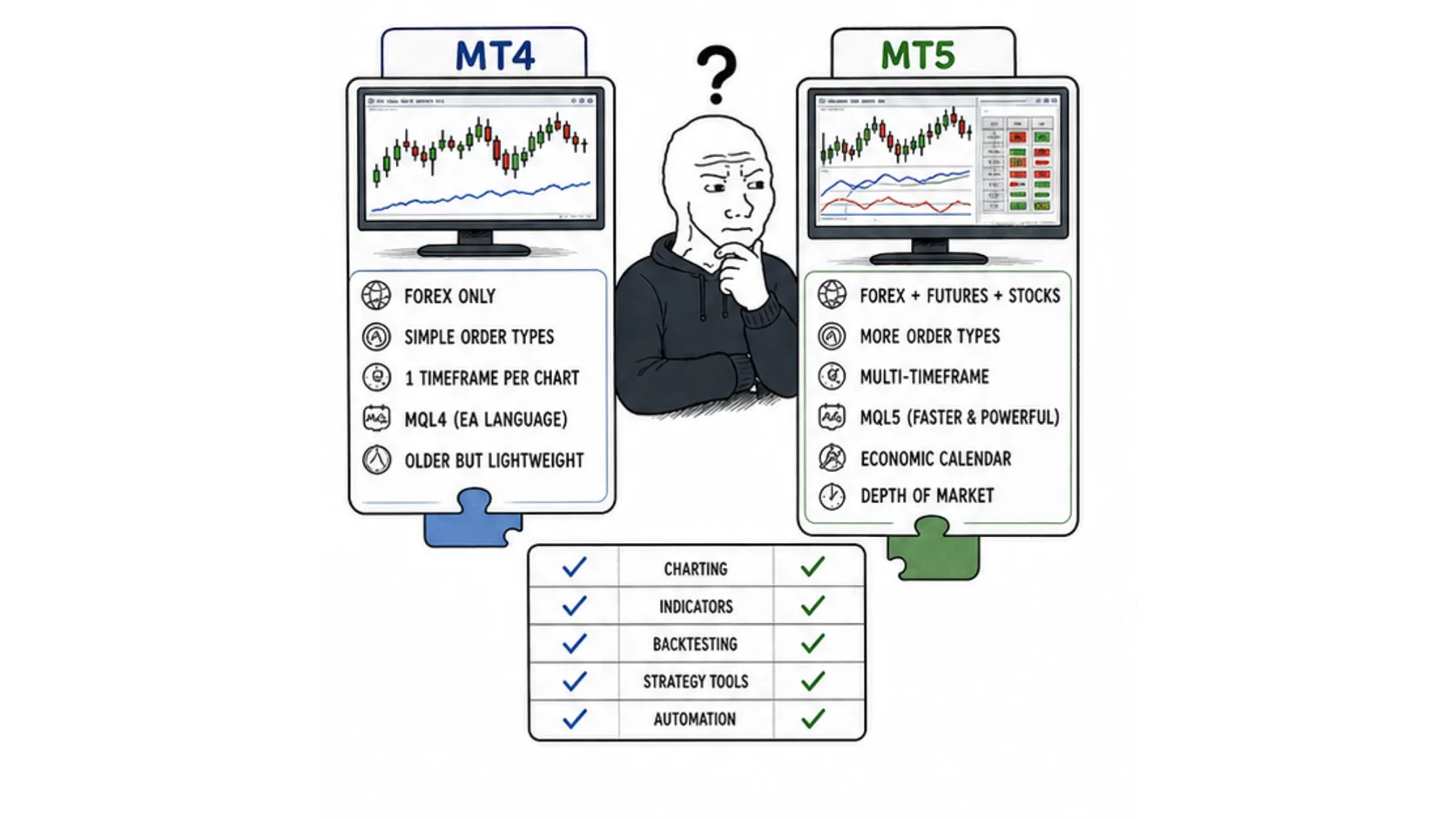
Here is the short version. MT4 was built for forex trading in 2005. MT5 was built as a multi-asset platform in 2010. They look similar, they are made by the same company (MetaQuotes Software), and they share some interface elements, but under the hood they are completely different platforms.
MT4 uses a scripting language called MQL4. MT5 uses MQL5. Your custom indicators and EAs from MT4 do not work on MT5. They are not backwards compatible. If you spent three years building the perfect MT4 EA, you are rewriting it from scratch for MT5.
For prop trading, the key difference comes down to this. MT4 is forex-only. If your prop firm lets you trade currency pairs, MT4 handles it perfectly. MT5 handles forex plus futures, stocks, and commodities on the same platform. Prop firms that offer MT5 can give you access to a wider range of markets on a single login.
Why This Choice Actually Matters at a Prop Firm
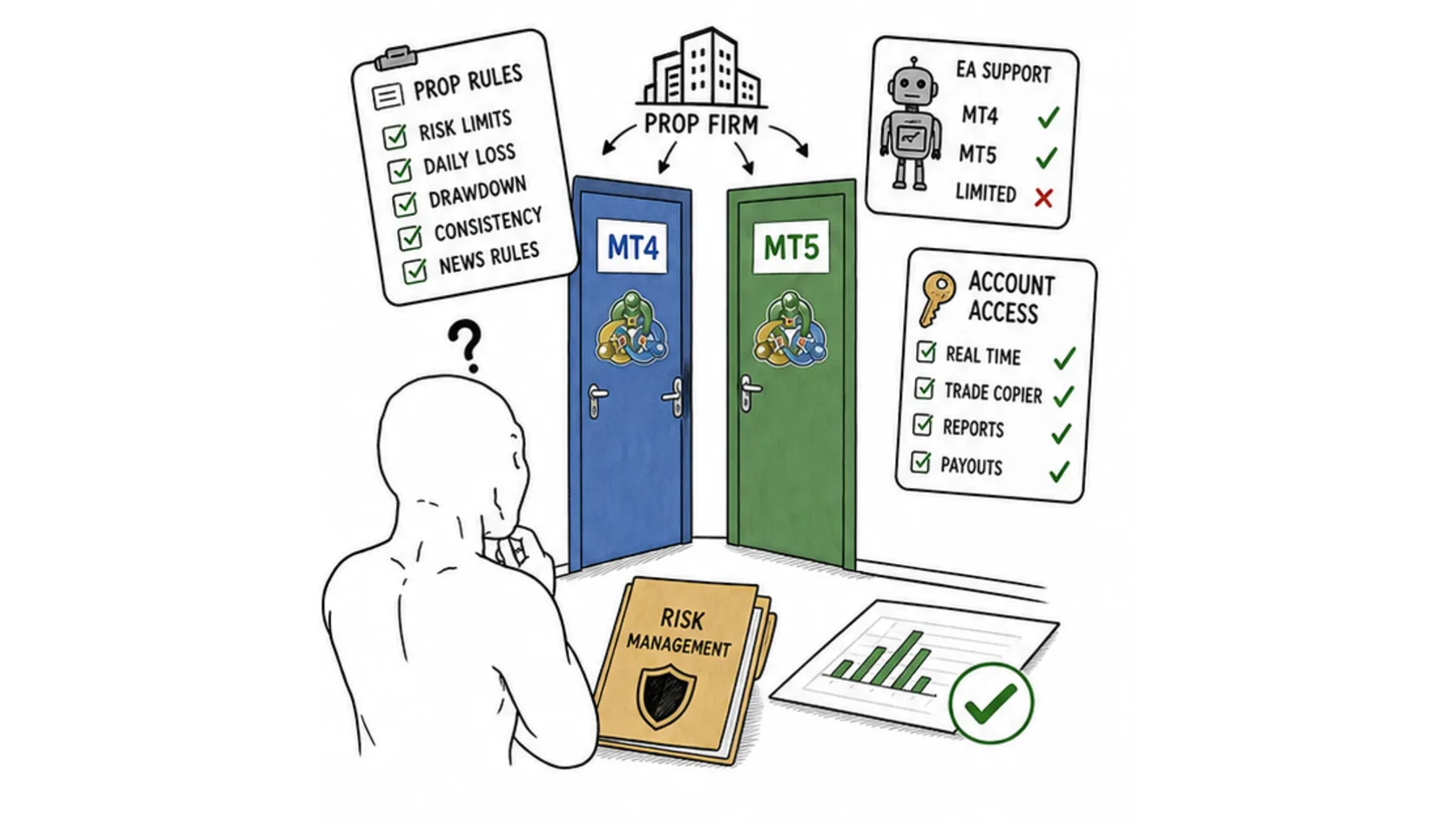
You might think the platform does not matter as long as you can place trades. Wrong. The platform affects your charting, your order execution, your EA compatibility, and even which firms you can use. which platforms each ranked prop firm supports.
When you are taking a prop firm challenge, every detail counts. You need to hit a profit target within specific rules, and your platform is the tool you use to do it. Trading on a platform you are uncomfortable with is like running a marathon in someone else's shoes. You can do it, but you will not perform at your best.
The platform also determines what data you see. MT5 has a built-in economic calendar, depth of market (DOM) for futures, and more timeframe options. If your strategy relies on seeing 12 different timeframes at once, MT4 maxes out at 9. MT5 gives you 21.
Then there is the execution model. MT4 uses a request-based execution where orders go through a dealing desk flow. MT5 supports both dealing desk and exchange execution, which matters if your prop firm routes futures orders through an actual exchange.
Feature-by-Feature Breakdown: MT4 vs MT5
Let me lay this out clearly so you can see exactly what you are getting with each platform.
| Feature | MT4 | MT5 |
|---|---|---|
| Markets | Forex, CFDs | Forex, CFDs, futures, stocks, bonds |
| Timeframes | 9 | 21 |
| Order types | 4 | 6 (plus stop limit orders) |
| Depth of Market | No | Yes |
| Economic calendar | No | Built-in |
| EA/indicator language | MQL4 | MQL5 |
| Custom indicators available | Thousands (20+ years) | Smaller library (growing) |
| Hedging | Yes | Yes (and netting) |
| Strategy tester | Single-thread | Multi-thread, faster |
| Mobile app | Yes | Yes |
The numbers tell a story. MT5 is objectively more capable on paper. More timeframes, more order types, multi-asset support, faster backtesting. But capability is not the same as usability, and this is where the comparison gets interesting.
MT4 has had 20 years of community development. There are thousands of free and paid custom indicators, scripts, and EAs available for it. The MQL4 community is massive. If you need a specific tool, someone has probably already built it for MT4.
MT5's ecosystem is smaller but growing. MetaQuotes has been pushing developers toward MQL5 for years, and the library is catching up. Still, if you rely on a specific third-party indicator, check whether it exists on MT5 before committing.
Which Platform Do Prop Firms Actually Offer?
This is where the rubber meets the road. It does not matter which platform you prefer if your prop firm only offers one of them.
Forex-only prop firms mostly offer MT4 as their primary platform. FTMO (See my PassPropTradingFirms FTMO review), for example, offers both MT4 and MT5 for forex trading, but a significant chunk of their traders still use MT4. MyForexFunds, before their issues, was primarily MT4. The forex prop world grew up on MT4.
Multi-asset prop firms tend to push MT5 because it supports more markets. If a firm lets you trade forex and futures on the same account, they are almost certainly using MT5 or another multi-asset platform.
Futures-focused prop firms usually do not use either platform. Apex, TopStep, and most US futures prop firms use NinjaTrader, Tradovate, or Rithmic. MT4 and MT5 are primarily forex platforms, and the futures prop world runs on different software entirely.
Here is the quick breakdown by firm type:
- Forex prop firms (forex focus): MT4 primary, MT5 available at some
- Multi-asset prop firms: MT5 primary
- Futures prop firms: Neither. NinjaTrader, Tradovate, Rithmic
- Forex + crypto firms: MT5 or cTrader
If you plan to use EAs during your prop firm challenge, check which platform the firm supports before you build or buy your EA. An EA written for MT4 will not work on MT5, and vice versa.
MT4 vs MT5 for Prop Firm Challenges
When you are in the middle of a challenge, the platform affects you in three specific ways.
Charting and analysis. MT5's extra timeframes give you more flexibility. If you trade off the 2-hour or 8-hour chart, MT4 does not have those built in. You need a custom indicator or workaround. MT5 has them natively. For challenge trading, being able to see the exact timeframe your strategy needs without workarounds is a real advantage.
Order execution. MT5 has two extra order types: stop-limit orders and trailing stops that actually work properly on the server side. MT4's trailing stop only works if your terminal is running. Close your laptop and your trailing stop disappears. MT5 handles it server-side, so it works even when you are offline. During a challenge where every tick counts, this matters.
Backtesting and strategy development. MT5's strategy tester is multi-threaded and dramatically faster. If you are developing or optimizing an EA to pass a challenge, MT5 will test your strategy in a fraction of the time. We are talking 10x faster for complex strategies. That is not a small difference when you are iterating on parameters.
If you are using an EA to pass your prop firm challenge, MT5 is the better development environment. Period.
The US Problem: MetaTrader Restrictions
If you are a US-based trader, this section is for you. MetaTrader platforms have a complicated relationship with US regulators. The Commodity Futures Trading Commission has strict rules about which platforms brokers can offer to US clients.
In September 2022, Apple removed MT4 and MT5 from the US App Store. They were later restored, but the situation spooked a lot of traders and prop firms. Some forex prop firms that previously offered MetaTrader to US clients pivoted to cTrader, DXtrade, or Match-Trader.
The current landscape for US traders looks like this. Some prop firms still offer MT4 and MT5 to US clients through international entities. Others have moved away from MetaTrader entirely for US traders. A few offer both MetaTrader and alternative platforms.
Before you sign up for any prop firm as a US trader, verify that they offer MetaTrader in your jurisdiction. Do not assume. The rules change, and what was available last month might not be available this month.
The National Futures Association maintains a list of registered entities. Cross-reference your prop firm's broker partner with the NFA registry if you are unsure about platform availability.
Performance and Speed Comparison
MT5 is faster. Not in a "slightly better" way, in a genuinely noticeable way. The platform architecture uses a 64-bit design that can handle more data, more charts, and more indicators without slowing down.
MT4 is 32-bit. It works fine for most forex trading scenarios, but open 10 charts with 5 indicators each and you will start to feel it. MT5 handles that load without breaking a sweat. On a modern multi-core machine, MT5 uses all available cores for calculations while MT4 is stuck on one.
For prop firm trading specifically, the speed difference shows up most during news events. When volatility spikes and every millisecond counts, MT5's faster order processing can mean the difference between getting filled at your price and getting slipped 5 pips on NFP.
That said, the actual execution speed at a prop firm is usually determined by the firm's server infrastructure, not your local platform. Both MT4 and MT5 connect to the same broker servers. Your platform's speed matters for charting and analysis, but the order routing is handled server-side.
Which One Should You Actually Use?
Here is the verdict, broken down by trader type.
If you trade forex only and you have existing MT4 indicators and EAs: Stay on MT4. Your tools work, the platform is proven, and there is no reason to switch if you are not hitting limitations. The prop firm does not care which platform you use, only that you hit the profit target without breaching rules.
If you trade multiple asset classes: MT5 is your only option between the two. MT4 cannot handle futures or stocks. If your prop firm gives you access to both forex and futures, you need MT5.
If you are developing EAs: MT5. Faster backtesting, MQL5 is a more modern language, and MetaQuotes is clearly focused on MT5 as their future platform. New features go to MT5 first.
If you are a manual trader who just needs clean charts: Either one works. Pick whichever interface you are more comfortable with. MT4 is simpler and more familiar. MT5 has more built-in tools. Both get the job done.
If you are a US-based trader: Check what your prop firm offers first. You might not have a choice. Many US-accessible prop firms have moved away from MetaTrader entirely.
The platform is a tool. Your strategy, your risk management, and your discipline are what actually determine whether you pass the challenge. I have seen traders pass funded evaluations on MT4, MT5, cTrader, and even browser-based platforms. The platform matters, but it is not the deciding factor.
