
You want a prop firm that runs on cTrader and lets you copy trade. That narrows your options down fast. Most prop firms run on MetaTrader. Of the ones that offer cTrader, only a subset allow copy trading. And of that subset, even fewer have clear, written policies saying you can actually do both at the same time.
This page covers which prop firms support cTrader and copy trading, how the cTrader Copy feature works, what the rules actually say, and what happens if you get it wrong. No fluff. No affiliate sales pitch. Just the facts you need before you spend money on an evaluation.
Key Takeaways
- Most prop firms do not offer cTrader as a platform option. The ones that do include FundedNext, IC Markets, and a handful of smaller firms.
- cTrader has built-in copy trading through cTrader Copy, but whether your prop firm allows you to use it depends entirely on their terms.
- Internal copy trading between your own accounts at the same firm is sometimes permitted. External copy trading between different firms is almost always prohibited.
- Getting caught copy trading at a firm that prohibits it means account termination and loss of all profits.
- Always verify both the platform support and copy trading policy before purchasing an evaluation.
On This Page
- What Is cTrader and Why Prop Traders Want It
- Which Prop Firms Offer cTrader
- How cTrader Copy Trading Works
- Prop Firms That Support cTrader AND Copy Trading
- The Rules Around Copy Trading at Prop Firms
- Setting Up Copy Trading on cTrader: The Process
- Risks of Copy Trading at Prop Firms
- What to Check Before You Start
What Is cTrader and Why Prop Traders Want It
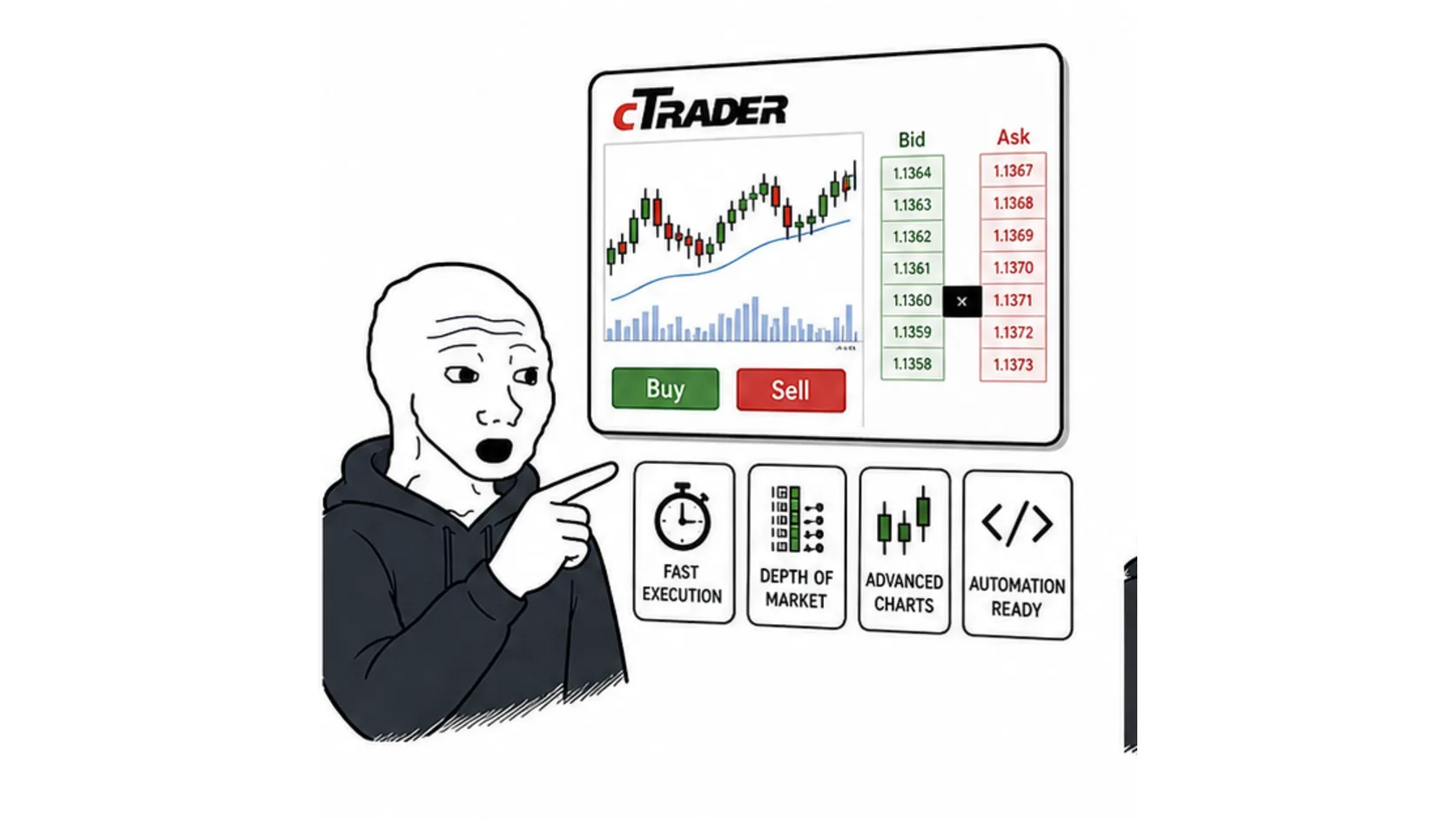
cTrader is a trading platform built by Spotware Systems. Think of it as the cleaner, faster, more transparent alternative to MetaTrader 4 and 5. It shows you actual market depth, has better charting tools, and executes orders faster.
For prop traders, cTrader matters for three reasons. First, it has native copy trading built right into the platform. No plugins, no third-party bridges, no duct-taping a trade copier to your MT4 setup. Second, it gives you level II pricing, which means you can see the order book and not just bid/ask spreads. Third, the interface is not stuck in 2005 like MT4.
cTrader was built by Spotware, a company that specifically designed the platform for brokers and prop firms who wanted something more modern than MetaTrader. It is used by brokers and prop firms worldwide, though still far less common than MT4 or MT5 in the prop firm space.
The catch is simple. Most prop firms do not offer cTrader. They run on MetaTrader because that is what most traders already know. Finding a prop firm that supports cTrader narrows your choices significantly.
Which Prop Firms Offer cTrader
The list of prop firms offering cTrader changes. Firms add and remove platform support regularly. Here is the landscape as it stands right now.
FundedNext offers cTrader as one of its platform options alongside MT4 and MT5. They are one of the bigger names in the space that supports cTrader, and they have historically been open to copy trading between your own accounts on their platform.
IC Markets is technically a broker, but they offer prop-style funded accounts and cTrader is one of their core platforms. Their execution speed on cTrader is well-regarded.
Vantage offers cTrader alongside MT4 and MT5 for their funded trading programs.
Smaller firms including some newer entrants like Hola Prime and a few others have started adding cTrader support. The trend is moving toward more platform choice, but the adoption is slow.
Here is the thing most people miss. Just because a prop firm offers cTrader does not mean they allow copy trading on it. The platform support and the copy trading permission are two separate rules. You need both.
How cTrader Copy Trading Works
cTrader has a feature called cTrader Copy. It is built directly into the platform. You do not need to install anything extra or buy a third-party trade copier.
Here is how it works. You pick a strategy provider on the cTrader Copy platform. You allocate a portion of your account balance to follow that strategy. From that point on, every trade the strategy provider opens gets replicated on your account, proportional to your allocation.
The position sizing is automatic. If the strategy provider is trading a $100,000 account and you allocated $25,000, your positions will be roughly 25% of theirs. The platform handles the math.
You can also stop copying at any time. Close the copy relationship, and your account goes back to manual trading instantly. No lag, no orphaned positions (usually).
There is a critical distinction here though. cTrader Copy is designed for retail broker accounts where you are copying other traders' strategies. In a prop firm context, you are usually copying between your own accounts, not following a stranger's strategy. Some firms that use cTrader disable the public cTrader Copy feature entirely and only allow private copy trading between your own accounts.
The beauty of cTrader's approach is transparency. You can see exactly what is being copied, the latency, the execution stats, and the performance of the strategy you are following. Compare that to MT4, where copy trading usually requires a separate EA or bridge plugin, and you can see why prop traders who copy trade prefer cTrader.
Prop Firms That Support cTrader AND Copy Trading
This is where the list gets short. You need a firm that offers cTrader as a platform AND explicitly allows copy trading. Having one without the other is useless for what you are trying to do.
| Firm | cTrader Support | Copy Trading Policy | Notes |
|---|---|---|---|
| FundedNext | Yes | Internal copy allowed | Copy between your own accounts only |
| IC Markets | Yes | Varies by account | Check current terms |
| Vantage | Yes | Limited | Internal copy may be available |
Notice something. The table is small. That is intentional. Most prop firms that support cTrader do not explicitly allow copy trading in their terms. And most firms that allow copy trading do not offer cTrader. The overlap is narrow.
FundedNext is the strongest option here. They offer cTrader, they have historically allowed internal copy trading between your own accounts, and their challenge structure is relatively straightforward. If you are specifically looking for prop firms that support cTrader and copy trading, start here.
But remember this. Policies change. What FundedNext allowed six months ago might be different today. Always, always check the current terms on the firm's website before you purchase an evaluation based on copy trading plans.
Firms that do not make this list are not necessarily bad firms. They just do not support this specific combination. Plenty of legitimate prop firms run exclusively on MetaTrader and have zero copy trading support.
The Rules Around Copy Trading at Prop Firms
Here is where most traders get themselves into trouble. The rules around copy trading at prop firms are strict, and they are getting stricter.
Internal copy trading means copying trades between accounts you own at the same firm. This is the version that some firms allow. You are the master account holder. You copy your own trades to your own slave accounts. The firm can see everything, they control the infrastructure, and they generally do not have a problem with it if they have explicitly permitted it.
External copy trading means copying trades between accounts at different firms. This is almost universally banned. You trade on Firm A, and a trade copier sends those trades to Firm B. Even if both firms individually allow copy trading, copying between them is almost certainly prohibited by at least one of their terms.
Copy trading from someone else's account is completely different from copying your own trades. Following another trader's strategy, even through cTrader Copy's public feature, is prohibited at nearly every prop firm. Firms want to evaluate your trading skill, not your ability to follow someone else.
Prop firms track IP addresses, device fingerprints, and execution timing patterns to detect copy trading. They run automated correlation analysis on every account. If your trades match another account with statistically improbable precision, you get flagged.
The penalty for violating copy trading rules is severe. Account termination, profit forfeiture, and potentially a ban from the platform. Some firms share compliance data with other firms, so getting caught at one firm can follow you.
Setting Up Copy Trading on cTrader: The Process
If you have found a prop firm that supports cTrader and explicitly allows copy trading, here is how you set it up. This assumes internal copy trading between your own accounts at the same firm.
Mission one: confirm the firm's policy in writing. Do not rely on a Reddit post or a YouTube comment. Check the firm's official terms and conditions page. If the policy is unclear, email their support and get a written response confirming copy trading is permitted. Save that response.
Mission two: set up your master account first. Your master account needs to be fully verified, funded, and active before you start copying. Some firms require the master account to have passed the evaluation before you can enable copy trading on slave accounts.
Mission three: configure proportional sizing. If your master account is $100,000 and your slave is $50,000, the slave should take half the position size. Equal sizing on unequal accounts distorts risk and can trigger the consistency rule if your largest position is disproportionately large compared to your average.
On cTrader specifically, the platform handles proportional sizing automatically through cTrader Copy. You allocate a percentage of your slave account balance to follow the master, and the platform calculates the correct lot sizes. Test this on demo first.
Monitor latency between the master and slave accounts. Even on the same firm's infrastructure, there can be execution delays. In fast-moving markets, slippage on the slave account can turn a winning trade on the master into a losing trade on the slave.
Risks of Copy Trading at Prop Firms
Let me be honest about what can go wrong, because the downside is bigger than most traders realize.
Payout denial. This is the most common outcome when copy trading goes wrong. You pass the challenge, build profits, request a payout, and the compliance team reviews your trading history during the payout process. If they find copy trading patterns that violate their terms, your payout gets denied and your profits are confiscated.
You spent weeks building the account. You followed every other rule. The one copy trading issue voids everything. The firm keeps the evaluation fee and the profits.
Rule changes mid-stream. Prop firms update their terms. What was allowed when you started your evaluation might be prohibited by the time you reach payout. This is why you document everything. Screenshot the terms page. Save support tickets confirming permission. If the firm changes the rules retroactively, having evidence protects you (or at least gives you grounds to argue).
Latency and execution gaps. Copy trading introduces a delay between the master account execution and the slave account execution. During high volatility, that delay can be the difference between a filled order and a requoted one. On the slave account, you might enter at a worse price, widening your effective risk on that position.
Drawdown compounding. If your master account hits a rough patch, both accounts take the hit simultaneously. You are not diversifying risk by copy trading. You are multiplying it. Your daily loss limit and max drawdown apply to each account independently, so a bad day on the master can breach limits on both accounts.
Detection risk even when allowed. Even if your firm explicitly permits copy trading, their automated systems still flag correlated accounts. You might get a compliance review or a temporary account freeze while they verify that the copy trading is authorized. This is annoying but not fatal if you have documentation.
What to Check Before You Start
Before you spend money on a cTrader prop firm evaluation with plans to copy trade, run through this checklist.
Does the firm offer cTrader? Check their platform options on the sign-up page. If cTrader is not listed, it is not available. Do not assume.
Does the firm allow copy trading? Search their terms and conditions for "copy trading," "trade copying," and "account mirroring." If none of these terms appear in their rules, assume it is prohibited.
Is copy trading restricted to internal accounts only? Most firms that allow it restrict it to accounts you own at their firm. External copy trading is almost never allowed.
Do you need to pass the evaluation on your master account first? Some firms require the master account to be funded before copy trading can begin on slave accounts.
Is proportional position sizing handled automatically? cTrader Copy does this natively. If you are using a different method, calculate the sizing manually and verify it matches.
Have you documented the firm's permission? Screenshot the terms. Get a support ticket confirmation. Store it somewhere you can find it six months from now when your payout is under review.
The traders who succeed with copy trading at prop firms are not the ones with the best trade copier or the fanciest setup. They are the ones who read the rules, followed them exactly, and kept records proving they did.
Copy trading at prop firms that support cTrader is possible. It is not easy, the options are limited, and the consequences of getting it wrong are severe. But if you do the homework, pick the right firm, and follow their rules to the letter, it works.
