
You want to know if an EA can pass a prop firm challenge. The short answer is yes, technically, some EAs have passed challenges at firms that allow automated trading. The real answer is more complicated. Most EAs are not designed for prop firm rules. The ones that claim to be are often overoptimized garbage that looks great in backtests and falls apart the second the market does something it has not seen before.
This page covers what you actually need to know about using an EA to pass a prop firm challenge. Which firms allow automated trading, what kind of EA has a chance of working, and why most traders who try this approach end up right back where they started.
Key Takeaways
- Some prop firms allow EAs during evaluations, but you must check the firm's specific rules before using one.
- An EA to pass a prop firm challenge must have conservative risk management, respect daily loss limits, and avoid martingale strategies.
- There is no guaranteed EA that passes every challenge. Any product claiming a 100% pass rate is lying to you.
- Prop firms can detect EA usage through trade patterns and platform logs. Never try to hide it from firms that require disclosure.
- The real risk is not whether the EA works, but whether you understand what it does when the market does something unexpected.
On This Page
- Do Prop Firms Actually Allow EAs on Challenges?
- What Kind of EA Can Pass a Prop Firm Challenge
- What Kind of EA Gets You Killed
- Which Prop Firms Allow EAs on Evaluations
- How Prop Firms Detect EA Usage
- EA Settings That Matter for Prop Firm Rules
- The Real Risks of Using an EA for Your Challenge
- The Assessment
Do Prop Firms Actually Allow EAs on Challenges?
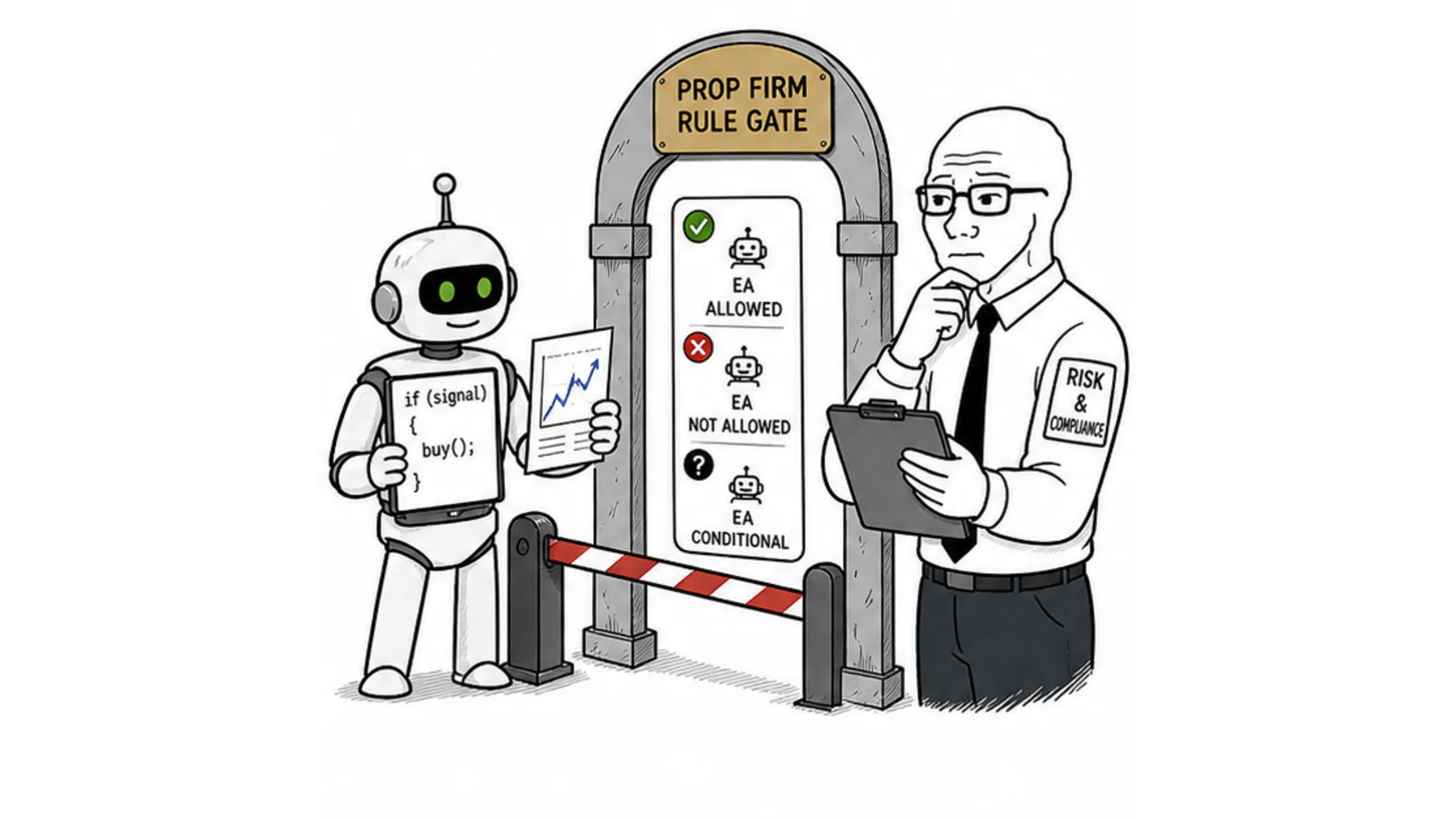
Yes, many of them do. But "allow" does not mean "do not care." Firms that permit EAs during their evaluation phases still have rules about what kind of automated trading is acceptable.
FTMO allows EAs on their challenges. FundedNext allows them. Several other firms do too. The key distinction is between using an EA as a trading tool and using one as a way to game the system.
Firms that allow EAs typically prohibit specific strategies. Martingale is almost universally banned. Grid trading is restricted or banned at many firms. Any strategy that averages down indefinitely and ignores drawdown limits will get your account closed regardless of whether the firm "allows EAs" in general.
Some firms require you to declare that you are using an EA. Others do not. Either way, they can tell. Prop firms have full visibility into your trading activity, including whether your orders are being placed by an algorithm. Trying to hide EA usage at a firm that requires disclosure is a fast track to account termination.
What Kind of EA Can Pass a Prop Firm Challenge
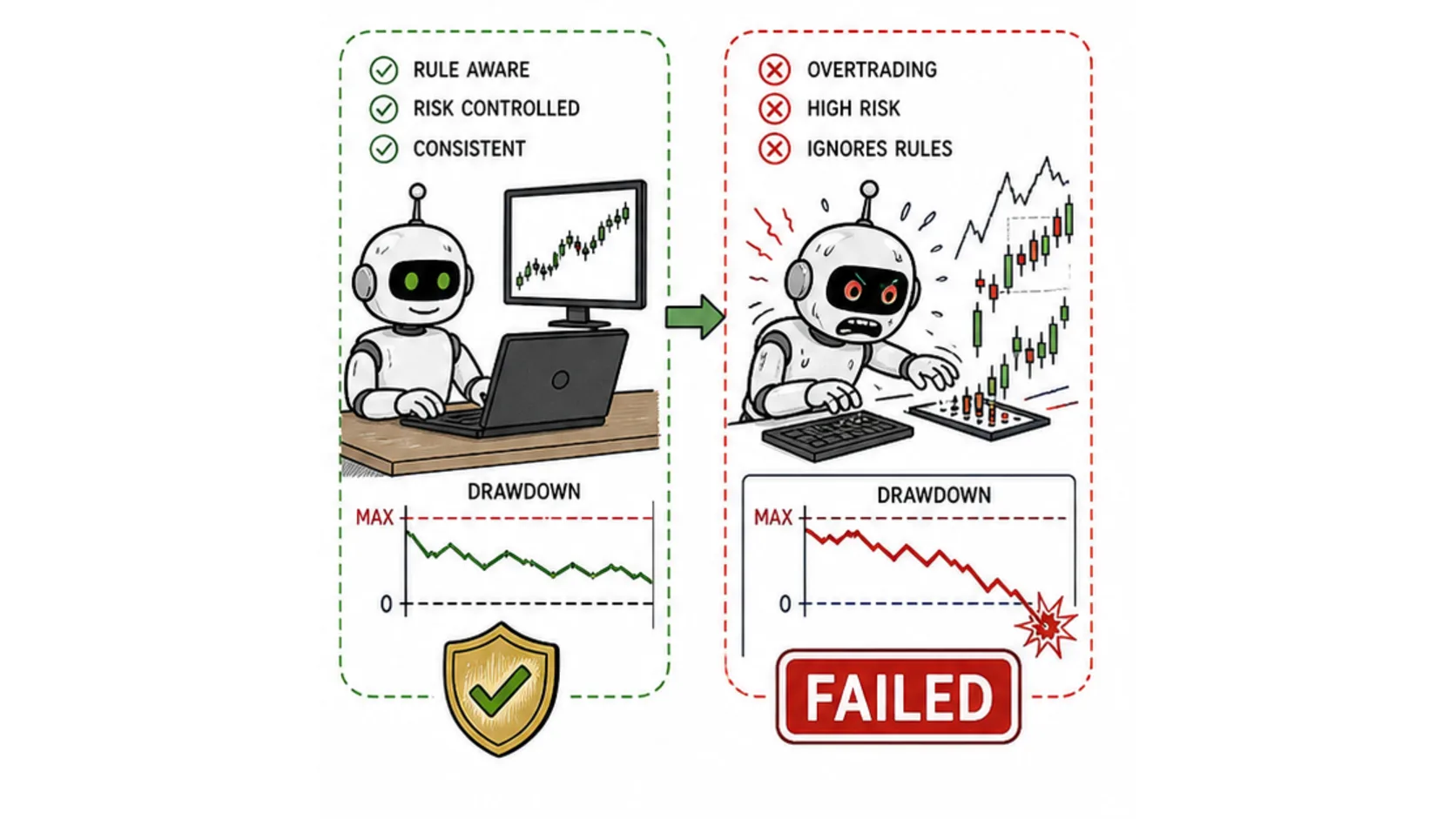
Let me be specific about what an EA to pass a prop firm challenge actually needs. It has to meet every single one of these criteria. Miss one and your evaluation is done.
Conservative risk per trade. The EA must risk no more than 0.5% to 1% per trade. This is non-negotiable. An EA risking 2% or 3% per trade on a prop firm challenge is a certified account-nuke moment waiting to happen. A few consecutive losses and you have breached your daily loss limit before lunch.
Respect for the daily loss limit. The EA must have a hard-coded daily loss limit that is lower than the firm's actual limit. If the firm allows 5% daily drawdown, your EA should stop trading at 3-4%. You need a buffer, because execution slippage, spread widening, and gap opens can push you past the limit before the EA can react.
Max drawdown protection. Same principle. The EA must stop trading when your total drawdown reaches 80% of the firm's maximum. If the firm uses a trailing drawdown, the EA needs to account for that. The trailing drawdown follows your equity high, not your balance. An EA that does not track equity high in real time is going to get caught off guard.
No trading during high-impact news. Many prop firms restrict trading during news events. Your EA must either have a news filter built in or be manually disabled during news windows. Trading through NFP or CPI with an EA on a prop challenge is a good way to get your account destroyed by spread widening alone.
Verified track record over months, not days. If the EA's backtest shows 30 days of perfect results and nothing else, it is overfitted. You want to see at least 6 months of forward-tested results on a demo account with realistic slippage and spread assumptions. The best EA for prop firm trading has a boring, steady equity curve, not a rocket ship.
Low trade frequency. An EA that takes 50 trades per day is scalping. Scalping EAs are extremely sensitive to execution conditions. On prop firm servers, where execution might not be as fast as your personal broker, the slippage kills your edge.
An EA taking 2-5 trades per day with a decent risk-reward ratio has a much better chance of surviving a full challenge period without hitting a drawdown limit.
What Kind of EA Gets You Killed
Now let me tell you what does not work. This is where 90% of traders go wrong when they try to use an EA to pass a prop firm challenge. Pay attention because this part actually matters.
Martingale EAs. These double the position size after every loss. In theory, one win recovers all losses. In practice, a 5-loss streak on a martingale EA blows past your max drawdown and your daily loss limit simultaneously. Prop firms hate martingale. If they detect the pattern, they will close your account even if you are technically profitable.
Grid trading EAs. These place buy and sell orders at fixed intervals above and below the current price. In a ranging market, they print money. In a trending market, they accumulate increasingly large losing positions until your drawdown exceeds the firm's limit. Grid EAs have no concept of max drawdown because they never close losing trades voluntarily.
Overoptimized backtest champions. You have seen these. An EA that shows a beautiful equity curve with 95% win rate and 0.3% max drawdown on a backtest. The developer optimized the parameters to fit historical data perfectly. The moment the market deviates from the backtest period by even a little bit, the EA falls apart completely.
News-trading EAs. These try to trade the spike during major economic events. The problem is that spread widening during news makes execution unreliable. Your EA places an order at one price and gets filled 10 pips worse. On a prop firm challenge, that slippage can be the difference between passing and failing.
Any EA sold with "100% pass rate" marketing. Run. If someone is selling an EA with a guaranteed pass rate for prop firm challenges, they are lying. No EA passes every challenge under every market condition. The market does not care about the developer's marketing claims.
Which Prop Firms Allow EAs on Evaluations
The list of prop firms that allow EAs changes. Firms update their policies regularly. Here is the current landscape for using an EA to pass a prop firm challenge.
| Firm | EAs Allowed | Restrictions |
|---|---|---|
| FTMO | Yes | No martingale, no grid. Must respect all drawdown rules. |
| FundedNext | Yes | General restrictions on high-risk strategies apply. |
| The5ers | Yes | Some strategy restrictions. Check current terms. |
| Surge Trader | Varies | Platform dependent. Check before purchasing. |
This is not an exhaustive list. New firms enter the market regularly and existing firms change their terms. Always verify directly with the firm before purchasing an evaluation based on EA plans.
Also notice something important. Firms that allow EAs during the challenge phase might have different rules for funded accounts. Some firms allow EAs during the evaluation but restrict or prohibit them once you are funded. Read both sets of rules, not just the evaluation terms.
How Prop Firms Detect EA Usage
Prop firms know when you are using an EA. They do not need you to tell them. Here is how they figure it out.
Execution timing patterns. An EA places orders with millisecond precision. Human traders do not. If your orders are consistently placed at exact intervals or with identical timing relative to candle closes, the pattern is obvious in the trade log.
Order characteristics. EAs tend to use specific order types, consistent lot sizing, and identical stop-loss and take-profit distances across all trades. A human trader varies these naturally. An EA does not.
Platform logs. On MetaTrader, the platform records whether an order was placed manually or by an EA. This information is available to the prop firm through their server-side infrastructure. You cannot hide it.
Trading hours. If your account is active 24 hours a day, 5 days a week, with no breaks and no variation in activity patterns, that screams automation. Human traders sleep, eat, and take breaks. EAs do not.
None of this is a problem if the firm allows EAs. The detection only becomes an issue if you are trying to hide EA usage at a firm that prohibits or restricts it. Firms monitor accounts for compliance, and lying about EA usage is treated as a rule violation.
EA Settings That Matter for Prop Firm Rules
If you are running an EA on a prop firm challenge, these are the settings that actually determine whether you pass or fail.
Maximum daily loss setting. Set your EA's daily loss limit to 60-70% of the firm's actual daily loss limit. If the firm allows a 5% daily loss, set your EA to stop at 3-3.5%. This gives you a buffer for slippage, spread widening, and gap risk.
Maximum total drawdown setting. Same approach. Set the EA's max drawdown to 70-80% of the firm's limit. You want the EA to stop trading before the firm's auto-liquidation kicks in.
Position sizing method. Use fixed fractional sizing, not fixed lot sizing. Fixed fractional adjusts your position size based on your account balance and stop distance. If you use a drawdown calculator alongside your EA, you can verify that the sizing stays within safe parameters.
Stop-loss on every trade. This should be obvious, but some EAs use "virtual" stop-losses that only exist in the EA's logic, not on the broker's server. If your internet disconnects or the EA crashes, that virtual stop-loss disappears. Real stop-losses on every single trade are non-negotiable for prop firm risk management.
News filter. Either use an EA with a built-in news filter or manually disable the EA before major economic events. The 30 minutes before and after NFP, CPI, FOMC, and similar events are where most EA-driven prop accounts get destroyed.
Time filters. Restrict trading to the London and New York sessions only. The Asian session has lower liquidity and wider spreads, which is worse for most EA strategies. Many prop firm breaches happen during low-liquidity periods where the EA keeps trading but execution quality drops.
The Real Risks of Using an EA for Your Challenge
Here is the part nobody selling you an EA wants to talk about.
Market regime changes. Your EA was optimized for a specific market condition. Trending, ranging, volatile, calm. The market does not care. It will change conditions mid-challenge, and your EA will not adapt because EAs do not adapt. They execute the same logic regardless of what the market is doing.
According to data from the Bank for International Settlements, forex daily turnover exceeds $7.5 trillion. That kind of liquidity means the market can shift behavior quickly and without warning. Your EA's backtest did not account for the exact conditions you will face during your challenge.
Execution differences. Your EA was probably tested on a specific broker with specific execution speed and specific spreads. Prop firm servers use different infrastructure. The execution might be slower. The spreads might be wider. The slippage might be different. All of these small differences compound over dozens of trades and can turn a profitable EA into a losing one.
Server downtime and disconnects. If your internet drops or the EA platform crashes, your EA stops managing open positions. If you have trades running without stops, or if the EA was in the middle of a multi-step trade management sequence, you are exposed. This happens more often than people admit.
Overconfidence in automation. This is the psychological risk. Traders who use EAs tend to set them up and walk away. They stop monitoring. They stop paying attention. And then something goes wrong at 3 AM and they wake up to a blown account. The EA is a tool, not a replacement for your attention.
Firm policy changes. Prop firms update their rules. An EA strategy that was compliant when you started your challenge might violate a new rule by the time you reach the payout phase. This is especially true for drawdown calculation methods and news trading restrictions.
The Assessment
Can an EA pass a prop firm challenge? Yes. Some traders have done it. Some do it regularly.
Is it easy or guaranteed? No. The same risks that apply to manual trading apply to automated trading, plus additional risks around execution, market regime changes, and technical failures.
The traders who successfully use an EA to pass prop firm challenges treat it the same way they would treat manual trading. They understand the strategy inside and out. They monitor the EA constantly. They intervene when market conditions change. They set conservative risk parameters. They test on demo first.
The traders who fail are the ones who buy the first prop firm EA they find on a forum, load it onto a $500 challenge, set it to aggressive mode, and go on holiday. That approach is not trading. That is gambling with extra steps.
If you are going to use an EA for a prop firm challenge, do the work. Understand what the EA does. Test it thoroughly. Configure it conservatively. Monitor it daily. And have a plan for what to do when (not if) something goes wrong.
