
Payout denial is where vague terms become expensive. The FCA scam protection guidance is useful when a firm makes promises but hides the conditions.
Nothing will ruin your month faster than hitting your profit target, requesting a payout, and getting an email saying your payout has been denied. It happens to traders every single day. Sometimes it is fair. Sometimes it is borderline. Sometimes it is outright wrong. But the one thing every payout denial has in common is that the trader did not fully understand the rules that govern payouts before they started trading. Let me fix that for you right now.
Key Takeaways
- Most payout denials come from specific, identifiable rule violations, not arbitrary decisions by the firm. If you believe yours was unjust, here is how to appeal a payout denial.
- The consistency rule is the single most common reason for payout denials, and many traders do not even know it exists until they breach it.
- Prohibited strategies like grid trading, martingale, latency arbitrage, and copy trading will get your payout denied at most firms.
- News trading restrictions, weekend holding rules, and position size limits can trigger denials even if your trading is profitable in total.
- Reading the full terms and conditions before buying a challenge is the single most effective way to avoid a payout denial. The complete payout rules guide covers every condition you need to meet.
On This Page
- The Hard Truth About Payout Denials
- Reason 1: Consistency Rule Violations
- Reason 2: Daily Loss Limit Breaches
- Reason 3: Prohibited Trading Strategies
- Reason 4: News Trading Violations
- Reason 5: Position Size and Lot Size Breaches
- Reason 6: Copy Trading and Signal Following
- Reason 7: Weekend and Overnight Holding Violations
- Reason 8: Account Sharing and Identity Issues
- Reason 9: Multi-Account Abuse
- Reason 10: Retroactive Rule Changes
- What to Do If Your Payout Gets Denied
- Frequently Asked Questions
The Hard Truth About Payout Denials
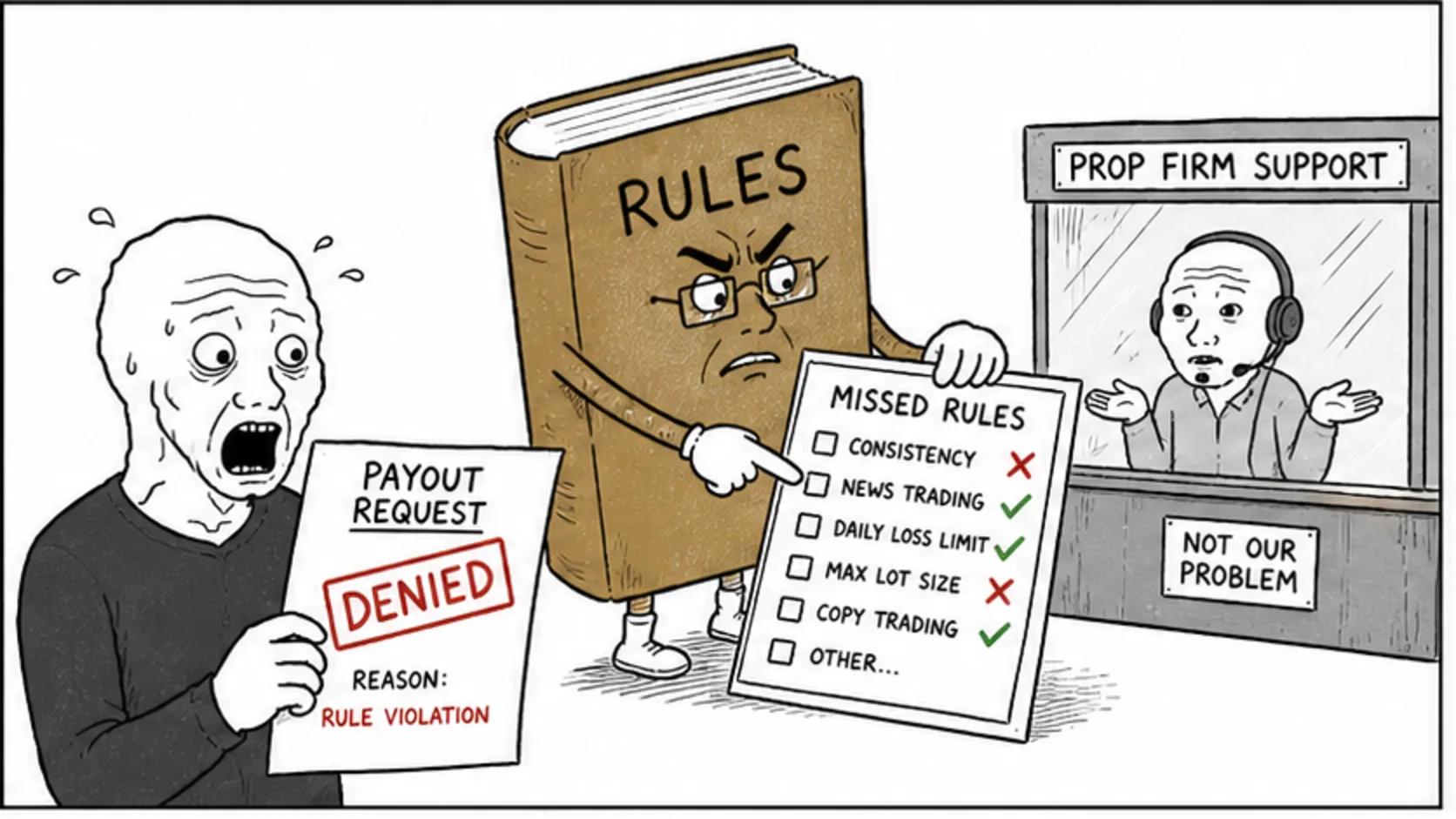
Let me separate the legitimate denials from the shady ones before we go any further.
The reality, confirmed by traders across Reddit, Trustpilot, and prop firm communities, is that most payout denials come from actual rule violations. The trader broke a rule. The firm caught it. The payout was denied. The trader was furious. The firm was right. For FTMO-specific payout denials including the hidden 1% risk rule and slippage cases, read our FTMO payout denied guide. Understanding what percentage of traders actually get paid puts these denials in context.
Not always. Some firms have been caught using vague or retroactively applied rules to deny large payouts. Apex Trader Funding has faced accusations of retroactive rule enforcement. Some smaller firms have denied payouts and then changed their terms to justify the denial after the fact. This happens, and it is garbage.
But the vast majority of denials fall into specific categories that you can understand, track, and avoid. That is what the rest of this page covers.
Reason 1: Consistency Rule Violations
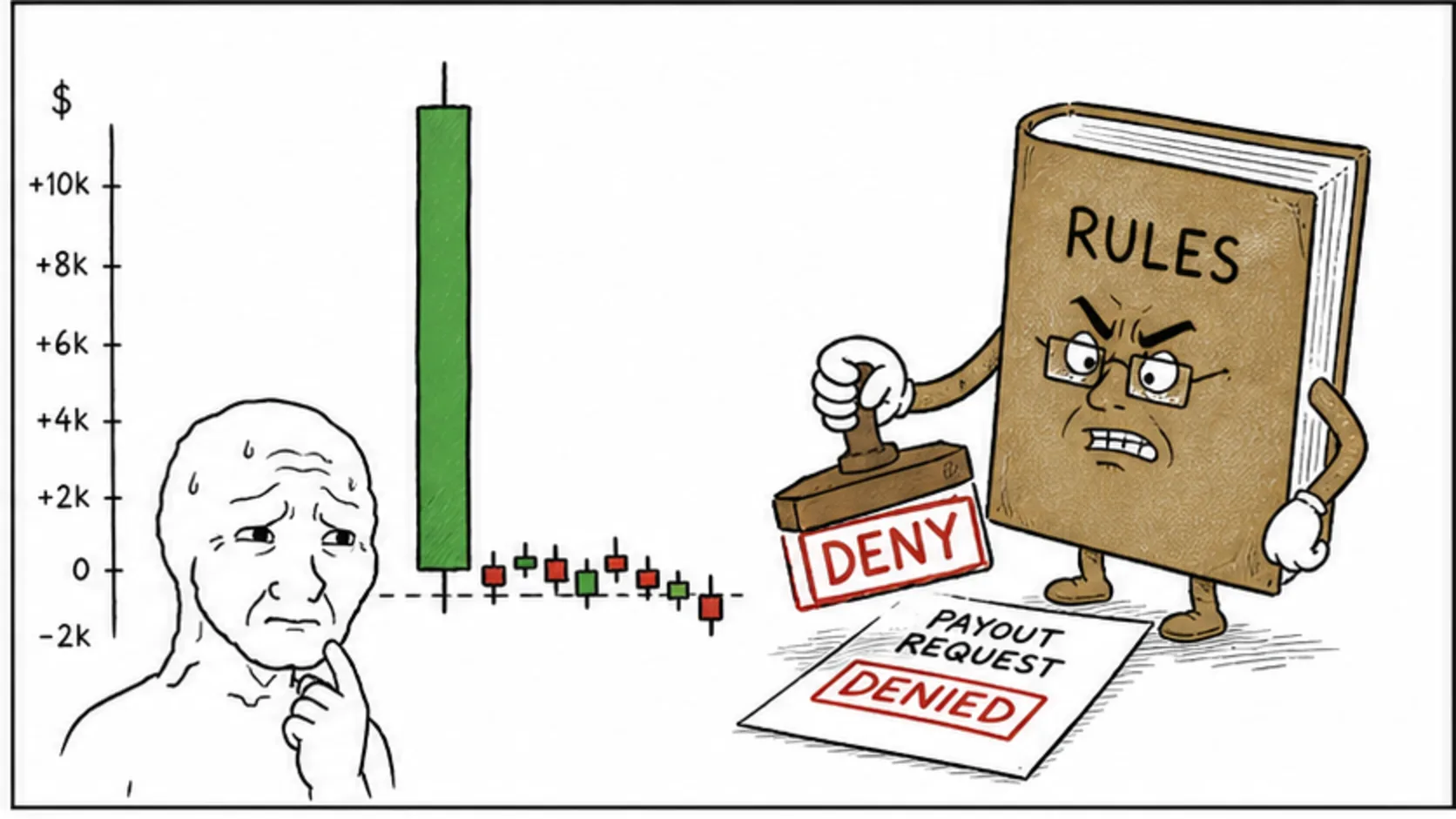
This is the big one. The consistency rule is the number one reason traders get their payouts denied, and half of them do not even know the rule exists until they breach it.
The consistency rule limits how much of your total profit can come from a single trading day or a single trade. The exact percentage varies by firm, but it usually falls between 25% and 40%. If your best day or best trade accounts for more than that percentage of your total profit, you fail the consistency check.
Example. You made $2,000 total profit over 20 trading days. On one particularly good day, you made $800. That is 40% of your total profit from a single day. If the firm's consistency limit is 35%, you just failed. Your payout is denied, and you might lose your funded account.
Little do they know, the trader was not trying to game anything. They just had one really good setup that worked. But the rule exists because the firm wants to see consistent, repeatable trading, not one lucky trade that saved the month.
How to avoid this: spread your profits across multiple days. If you have a massive winning day, consider not requesting a payout immediately. Keep trading smaller positions to dilute the impact of that one big day on your consistency ratio.
Reason 2: Daily Loss Limit Breaches
The daily loss limit is a hard ceiling on how much you can lose in a single trading day. Cross it, even by a fraction, and your account gets closed. No warnings. No second chances.
The tricky part is how different firms calculate the daily loss limit. Some calculate it from your starting balance at the beginning of the day. Others calculate it from your equity high of the day, which means if you make $500 in the morning and then lose it all plus more in the afternoon, your daily loss calculation might be different from what you expect.
Pay attention because this part actually matters. You need to understand exactly how your specific firm calculates the daily loss limit before you start trading. If the calculation is equity-based, your morning profits give you more room in the afternoon. If it is balance-based, your morning profits do not change your daily loss ceiling at all. Getting this wrong is a certified account-nuke moment.
Reason 3: Prohibited Trading Strategies
Every prop firm has a list of trading strategies it considers prohibited. These are not suggestions. They are hard bans, and using them will get your payout denied faster than anything else on this list.
The most commonly prohibited strategies include:
- Grid trading. Opening multiple positions at fixed price intervals without stops. The firm sees this as uncontrolled risk.
- Martingale strategies. Doubling your position size after each loss. The firm sees this as a guaranteed blowup waiting to happen.
- Latency arbitrage. Exploiting price delays between the firm's simulated feed and real market prices. This is essentially cheating, and firms will ban you permanently for it.
- Tick scalping. Very short-term trades designed to exploit price feed inconsistencies. Different from legitimate scalping, which most firms allow.
- Hedging across accounts. Taking opposite positions on the same instrument across multiple prop firm accounts to guarantee profit on one side.
If any of these strategies show up in your trade history, your payout is gone. The firm does not care whether you knew the strategy was prohibited. Their terms say it is, you agreed to the terms, and that is the end of the conversation.
Reason 4: News Trading Violations
News trading restrictions catch a lot of traders off guard, especially forex traders who trade around NFP, CPI, and central bank announcements.
Some firms ban all trading during high-impact news events. Others restrict trading within a specific time window around the release, usually 2 minutes before to 2 minutes after. A few firms allow news trading but with modified conditions.
The violation happens when you have an open position that was opened before the news window but is still active during the restricted period. Some firms count this as a news trading violation even if you opened the trade hours earlier. Read the specific rule. Every firm handles this differently.
Reason 5: Position Size and Lot Size Breaches
Lot size limits exist to prevent traders from taking oversized positions that could blow past the daily loss limit in a single trade. Some firms set a maximum number of lots per trade. Others set a maximum total exposure across all open positions.
The breach usually happens in one of two ways. Either the trader deliberately sizes up beyond the limit to accelerate their progress toward the profit target, or the trader does not realise that their total exposure across multiple positions exceeds the limit.
Both are your fault. Track your position sizes in real time, and always know your total exposure before opening a new trade.
Reason 6: Copy Trading and Signal Following
Most prop firms prohibit copy trading from external signal services, and many also restrict copy trading between your own accounts at different firms.
The firm wants to fund traders who can trade independently, not traders who mirror someone else's decisions. If your trade entry times, sizes, and directions match another trader's or a signal service's activity too closely, the firm will flag you.
This does not mean you cannot learn from other traders. It means you cannot copy their trades directly. If your entries are consistently within seconds of a signal alert, the firm's software will detect the pattern.
Reason 7: Weekend and Overnight Holding Violations
Some firms prohibit holding positions over the weekend. Others restrict overnight holding. These rules exist because weekend gaps and overnight volatility can cause losses that blow past the daily loss limit before the next session opens.
If you close a position at 4:59 PM on Friday and the firm's cutoff is 5:00 PM, you are fine. If you close at 5:01 PM, you just violated the weekend holding rule. These boundaries are exact, and the firm's server time might be different from your local time. Verify the timezone.
Reason 8: Account Sharing and Identity Issues
Prop firms are serious about account ownership. Only the person who registered the account can trade on it. Sharing login credentials, having someone else trade your account, or trading from multiple IP addresses that suggest account sharing will trigger a payout denial.
This becomes an issue for traders who use VPS services, trade from multiple locations, or share devices with other traders. If your account shows logins from different countries within a short time frame, the firm's fraud detection will flag it.
If you use a VPS, make sure the IP address is consistent. If you travel, notify the firm in advance. If someone else in your household also trades with the same prop firm, make sure you are on different accounts and preferably different devices.
Reason 9: Multi-Account Abuse
Some traders buy multiple challenges at the same firm to increase their chances of passing. This is usually allowed. What is not allowed is using those multiple accounts to hedge against each other, coordinate trades to exploit the consistency rule, or game the system in any way.
If the firm detects that your accounts are being used in coordination rather than independently, they can deny payouts on all of them. Trade each account as if it were your only one.
Reason 10: Retroactive Rule Changes
This is the one that is not your fault, and it is the most infuriating.
Some firms change their rules and then apply those new rules to trades you already placed. You traded on Monday under Rule Set A. On Wednesday, the firm changes to Rule Set B. On Friday, they deny your payout because your Monday trades violate Rule Set B, even though Rule Set B did not exist on Monday.
This is not common at established firms. FTMO (Read the FTMO writeup on PassPropTradingFirms) and Topstep generally apply rule changes prospectively. But it has happened at other firms, and it is one of the biggest red flags in the industry. If a firm retroactively changes rules to deny payouts, get your money out and never go back.
What to Do If Your Payout Gets Denied
Your payout was denied. Now what?
First, do not panic. Read the denial email carefully. The firm should cite a specific rule violation. If they do not cite a specific rule, ask for one. You have the right to know exactly which rule you supposedly broke.
Second, check the rule against your trade history. Log into your account and review every trade. Look at the timestamps, position sizes, and profit distribution. Does the firm's claim match what actually happened?
Third, if you genuinely did not breach the rule, gather evidence. Screenshots of your trade history, the rule as it was written when you started trading, and any communications with the firm. If the firm cannot provide specific evidence of a violation, this is a red flag.
Fourth, post publicly. Reddit, Trustpilot, and Forex Peace Army are where the prop firm community discusses these issues. If your denial was legitimate, other traders will tell you. If it was not, public pressure sometimes resolves the issue.
Fifth, learn from it. Even if the denial was unfair, understanding why it happened helps you avoid the same situation at a different firm. Choose firms with clear, specific, transparent rules. The ones that actually pay out consistently tend to have the clearest rules because they want to avoid disputes.
Payout denials are not random. They follow patterns. The traders who never get denied are the ones who read every rule before they started, tracked their compliance in real time, and never assumed they could remember the details without checking. Be that trader.
