
Yes, prop firms use leverage. Every single one of them. The real question is not whether they use it, but whether the leverage ratio even matters when your drawdown limit is the thing actually controlling how much risk you can take. Spoiler: it does not matter nearly as much as people think. Here is how leverage actually works at prop firms, what ratios you can expect, and why obsessing over the number is the wrong move entirely.
Key Takeaways
- Yes, prop firms use leverage. Forex prop firms typically offer 1:30 to 1:100, futures prop firms use intraday margin.
- Leverage ratios matter less than your drawdown and daily loss rules, which cap your actual risk regardless.
- Higher leverage does not help you pass faster. It helps you fail faster.
- Prop firm leverage is set by the firm's liquidity provider or broker, not by the firm itself.
- Most traders should ignore the leverage number and focus on position sizing relative to their drawdown limit.
On This Page
The Direct Answer
Do prop firms use leverage? Yes. Every prop firm that offers forex, futures, or CFD trading uses leverage. Without it, a $100,000 account could only control $100,000 worth of currency, which in forex terms is basically one standard lot. That is not enough to make the numbers work for either the trader or the firm.
The leverage is baked into the trading platform. When you open a position on your prop firm account, the leverage is already applied. You do not request it. You do not toggle it. The firm's broker or liquidity provider sets it, and you trade within whatever ratio they have configured.
What you need to understand is that the leverage in prop trading is not the same beast as leverage on your personal retail account. On your own account, leverage is your choice and your risk. On a prop firm account, the rules constrain your actual exposure so tightly that the headline leverage number becomes almost irrelevant.
How Leverage Works at Prop Firms
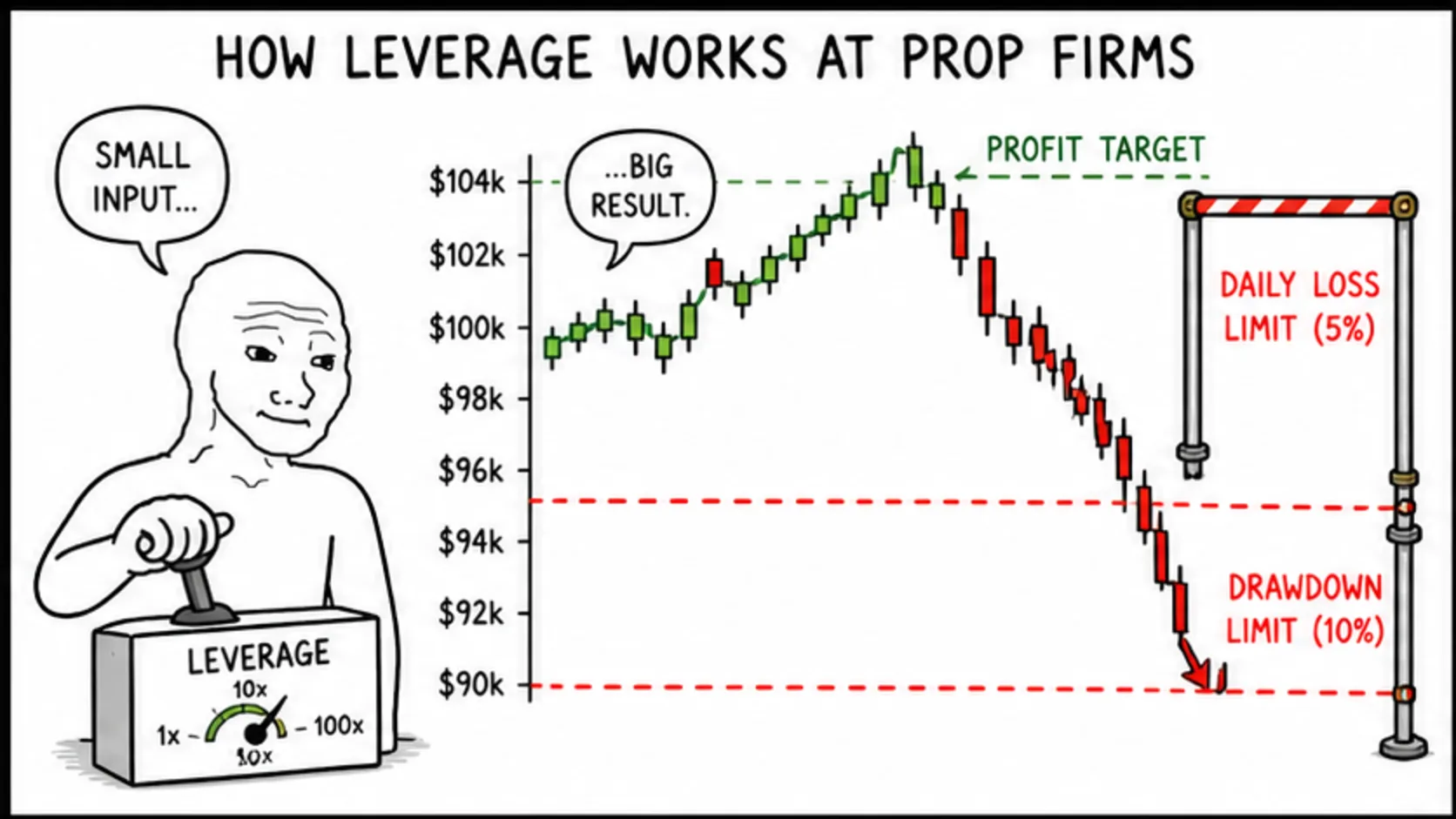
Leverage is borrowed buying power. When a prop firm gives you 1:100 leverage on a $100,000 account, you can control positions worth up to $10 million. That sounds insane written out like that, and in isolation, it is.
But here is the part nobody mentions. You will never actually use anything close to that full buying power, because your maximum drawdown and daily loss limit make it physically impossible.
Let me walk you through the math. You have a $100,000 account with a 10% maximum drawdown. That means you can lose $10,000 total before the account is closed. With 1:100 leverage, a single standard lot on EUR/USD is $10 per pip. If you open five lots and price moves 200 pips against you, you have lost $10,000. Account breached.
Five lots on a $100,000 account is only 5:1 effective leverage. You never came close to the 1:100 available to you. The drawdown rule killed you at 5:1, not 100:1. This is why the headline number does not matter.
According to the European Securities and Markets Authority, retail forex leverage in the EU is capped at 1:30 for major pairs. Prop firms operating under different jurisdictions can offer more, but the practical impact on your trading is identical because the risk rules, not the leverage, define your maximum position.
Typical Leverage Ratios by Prop Firm Type
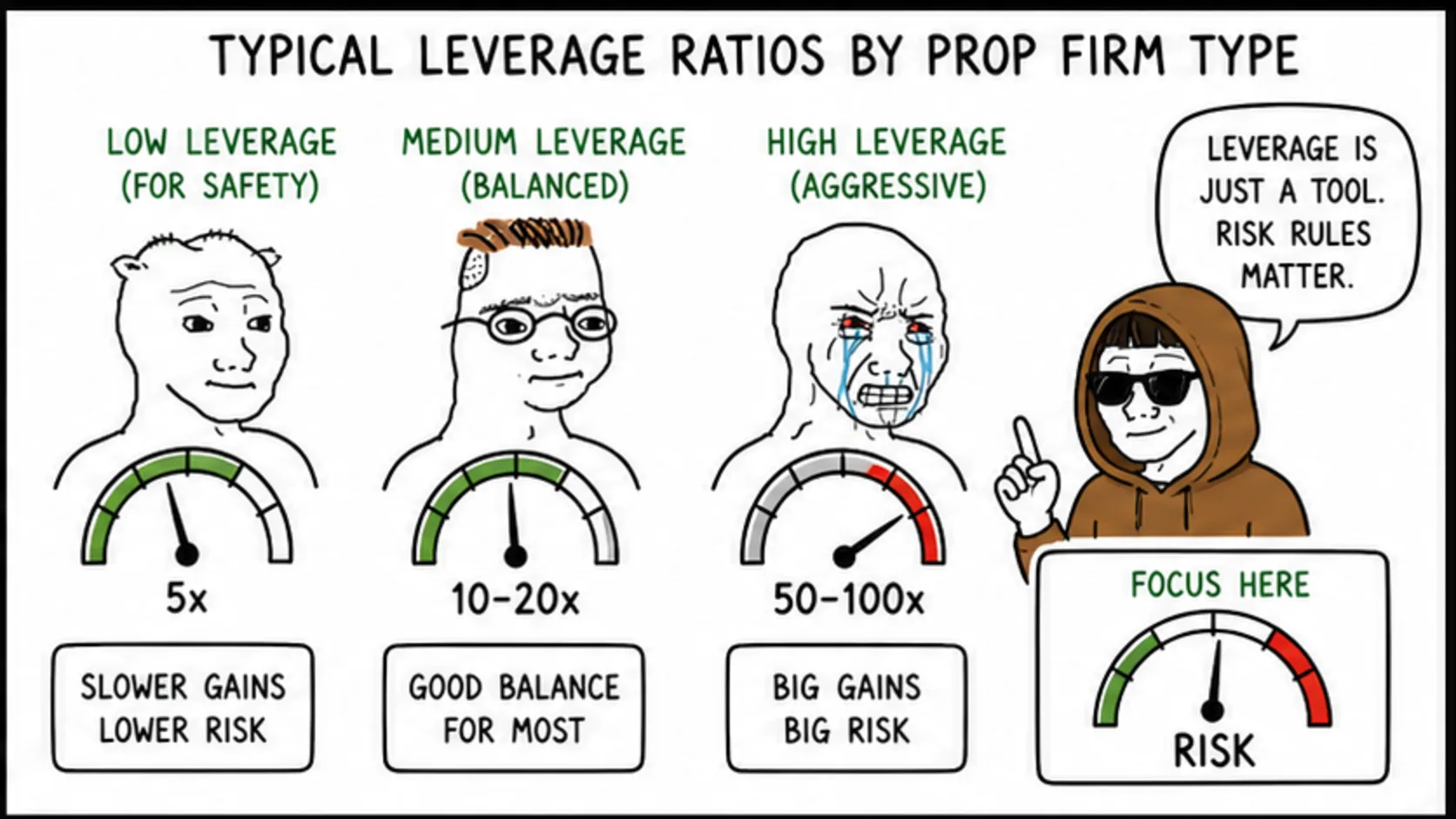
Not all prop firms offer the same leverage. The prop trading leverage ratio varies by firm type, instrument, and jurisdiction. Here is how it breaks down.
Forex prop firms. Most offer between 1:30 and 1:100 on major pairs. Some go as high as 1:200, though this is increasingly rare. Exotic pairs get lower leverage, typically 1:10 to 1:20, because the spreads are wider and the volatility is higher.
Futures prop firms. These do not really advertise leverage in the same way. Instead, they set margin requirements per contract. A typical E-mini S&P 500 contract might require $500 in intraday margin.
That means a $50,000 account could theoretically hold 100 contracts. But again, your drawdown rule will stop you long before you get anywhere near that.
Crypto prop firms. Leverage here varies wildly, from 1:1 up to 1:50. Crypto is already volatile enough that most firms keep leverage conservative. Some restrict you to spot trading only, which means no leverage at all.
The table below shows typical ranges you will see across the industry.
| Prop Firm Type | Typical Leverage | What Actually Matters |
|---|---|---|
| Forex | 1:30 to 1:100 | Your daily loss limit and drawdown cap your real exposure |
| Futures | Intraday margin rates | Contracts you can hold within drawdown, not the margin itself |
| Crypto | 1:1 to 1:50 | Crypto volatility already amplifies risk significantly |
| CFD | 1:20 to 1:100 | Same drawdown constraints apply regardless of instrument |
Why Leverage in Prop Firms Is Different From Retail
This is where most traders get confused, so pay attention because this part actually matters.
On your retail account, leverage is a choice. You pick your lot size. You decide whether to use 1:10 or 1:500. Your broker does not care as long as you have margin. You can blow the entire account in a single trade if you want to. Nobody stops you.
On a prop firm account, leverage exists inside a cage. The firm sets the leverage ratio, but then it builds walls around it with drawdown limits, daily loss caps, and position size restrictions. You cannot trade through the walls. The system will close your positions before you can cause real damage.
Think of it this way. Retail leverage is a sports car with no speed limit and no seatbelt. Prop firm leverage is the same sports car, but the firm has installed a governor that caps the speed at 40 mph and the engine cuts out if you swerve too hard. The car has the same theoretical top speed, but you will never reach it.
This is also why the question of whether prop firms use real money connects to leverage. On simulated accounts, the leverage is configured in the server software. The firm can set whatever ratio it wants because no real capital is being leveraged. On firms that trade live capital, the leverage comes from their broker and reflects actual market conditions.
How Leverage Interacts With Drawdown Rules
This is the relationship that determines whether you pass or fail your challenge. Not the leverage by itself. The leverage plus the drawdown rules together.
Here is a scenario. You have a $50,000 account with 5% maximum drawdown and 1:100 leverage. Your maximum loss is $2,500. On EUR/USD, one standard lot is $10 per pip.
If you open two lots, a 125-pip move against you wipes out your entire drawdown allowance. Two lots on a $50,000 account. That is 4:1 effective leverage. You had 100:1 available. You used 4:1. And you still got stopped out by the drawdown rule. This is the reality for almost every prop trader.
Now flip it. Same account, but the firm only offers 1:10 leverage. Your maximum position size is $500,000 instead of $5 million. Two lots on EUR/USD is still $20 per pip.
The 125-pip move still costs you $2,500. The lower leverage did not save you. The drawdown rule killed you in exactly the same place.
The leverage ratio and the drawdown rule operate on different axes. Does leverage matter in prop firms? Only in the sense that it needs to be high enough to let you trade. Beyond that, your position sizing should be calculated from your drawdown allowance, not from your leverage ratio. Anything beyond that is irrelevant.
The Commodity Futures Trading Commission in the US caps retail forex leverage at 1:50 for major pairs. Prop firms that serve US traders work within these same regulatory frameworks or operate in jurisdictions with different rules. Either way, the drawdown constraint dominates.
Does Higher Leverage Help You Pass Faster?
No. And if you think it does, you have already diagnosed yourself with the exact mindset that causes challenge failures.
Higher leverage lets you take larger positions. Larger positions generate larger profits when you are right. This is true. But larger positions also generate larger losses when you are wrong, and you will be wrong often because that is how trading works.
The average prop firm challenge requires an 8% to 10% profit target. On a $100,000 account, that is $8,000 to $10,000. You have a daily loss limit of roughly 4% to 5%, which is $4,000 to $5,000.
That means two bad days can wipe out a week of good trading. Higher leverage does not change the profit target. It does not change the drawdown limit. It does not change the daily loss cap. All it changes is how fast you reach those boundaries, in either direction.
You know what actually helps you pass faster? Smaller positions, more consistent results, fewer drawdown spikes. The traders who pass challenges reliably are the ones who treat their 1:100 account like it is 1:5.
They size down, grind out steady gains, and never come close to their drawdown ceiling. The firms know this. They offer high leverage because it looks attractive on the marketing page, not because they want you to use it. The trader who maxes out their leverage on day one is the trader who donates their fee and disappears. That is revenue for the firm.
The firms know this. They offer high leverage because it looks attractive on the marketing page, not because they want you to use it. The trader who maxes out their leverage on day one is the trader who donates their fee and disappears. That is revenue for the firm.
Safe Leverage Habits for Prop Traders
You have three missions when it comes to leverage on a prop firm account.
Mission one: know your effective leverage. This is your actual position size divided by your account balance, not the maximum the firm offers. If you have $100,000 and you are holding $200,000 in positions, your effective leverage is 2:1.
Track this number. It is the only one that matters.
Mission two: size from your drawdown, not from your leverage. Calculate your maximum position based on how many pips you can afford to lose before hitting your drawdown limit. Then cut that in half. That is your working position size. Anything larger is gambling.
Mission three: reduce exposure during volatile conditions. News events, low-liquidity sessions, and gap risk can all amplify the effect of leverage beyond what your stop loss can protect against.
Your risk management plan should account for slippage, not just the clean stop loss you set in your head.
The $7.5 trillion daily forex market volume reported by the Bank for International Settlements in their 2024 Triennial Survey means there is plenty of liquidity for normal trading conditions.
But during news events, spreads widen, slippage increases, and your effective leverage spikes because your stops cannot be guaranteed.
Here is a simple rule of thumb. If your prop firm offers 1:100 leverage, trade like you have 1:5. If it offers 1:30, trade like you have 1:3. The extra capacity is there for flexibility, not for you to test the limits.
Most funded traders I know use between 1:1 and 1:3 effective leverage on any given trade. That is it. They are not the ones asking about the maximum ratio. The people obsessing over whether they can get 1:200 instead of 1:100 are the ones still buying challenges.
