
A prop firm risk management plan template is a structured framework that defines every risk parameter before you start trading. It locks in your daily loss limit, position size, drawdown ceiling, and session rules so you make decisions when you are calm, not when you are staring at a red screen with your finger on the buy button.
Most traders fail prop firm challenges not because they cannot trade, but because they never wrote down a plan. This is that plan. Copy it, adapt it, and use it before every session.
Key Takeaways
- A prop firm risk management plan defines your exact risk parameters before you start trading, not during.
- The five pillars are: daily loss limit, maximum drawdown, position sizing, risk per trade, and session management.
- Your plan must be specific to the firm you trade with, because each firm calculates drawdown differently.
- Writing the plan down and reading it before every session is what separates funded traders from challenge donors.
- This template works for forex and futures prop firms with any account size.
On This Page
What Is a Prop Firm Risk Management Plan?
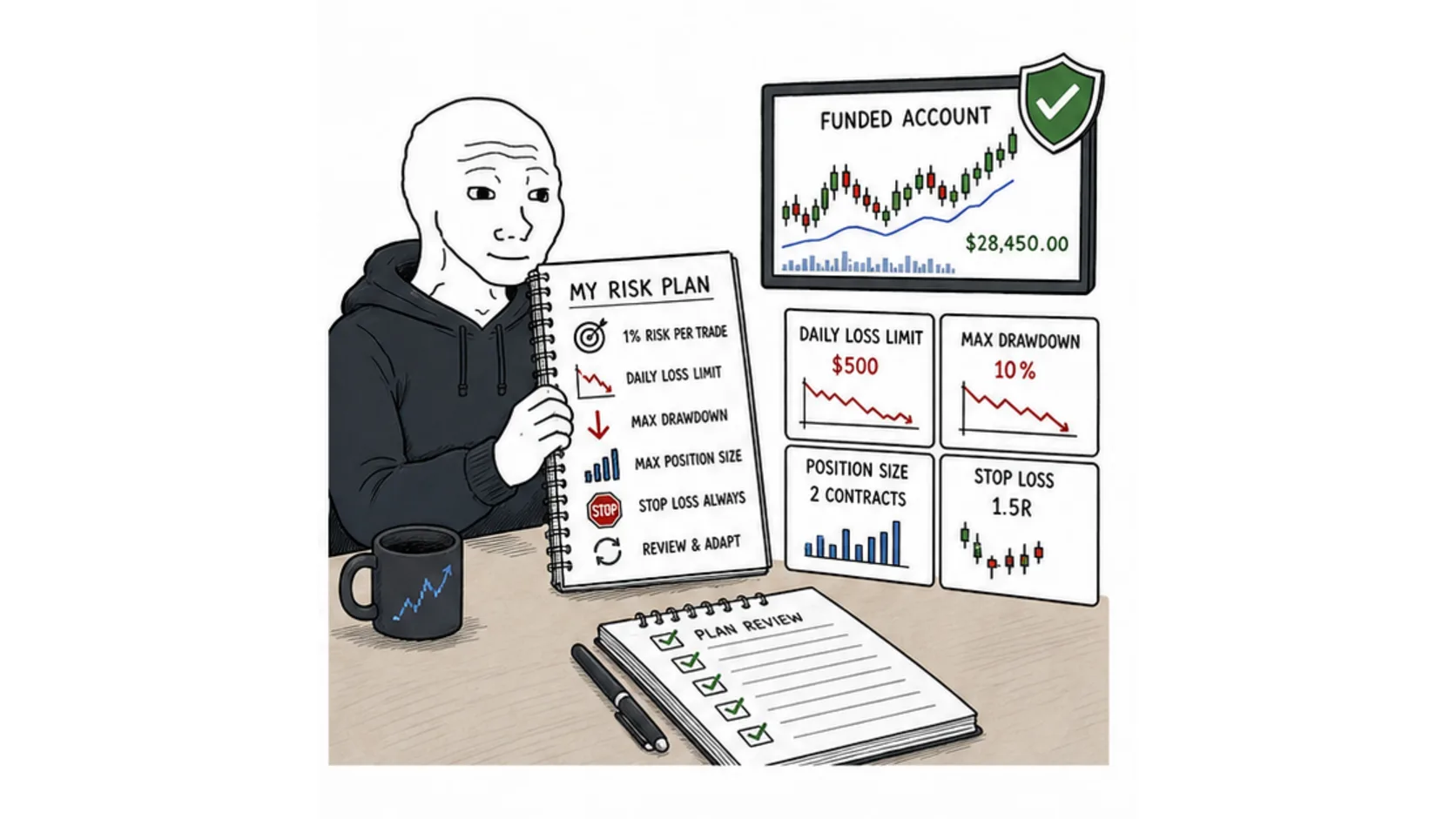
A risk management plan for prop trading is a written document that sets your maximum risk on every level: per trade, per day, per week, and per challenge. It turns vague ideas about being careful into specific, numbered rules you can follow without thinking.
Trading your own money, you can afford to be loose with risk. Lose 5% today, make it back tomorrow, no big deal. Prop firms do not work like that. The daily loss limit is a hard ceiling that terminates your account if you cross it.
Your prop firm risk management plan template needs to account for firm-specific rules that personal account risk plans ignore. Trailing drawdowns, consistency requirements, news trading windows, and maximum position sizes are all constraints that exist only in the prop firm world.
Think of it this way. Your trading strategy tells you what to buy and when. Your risk management plan tells you how much, how often, and when to stop. One without the other is useless.
Why Most Traders Fail Without a Written Plan
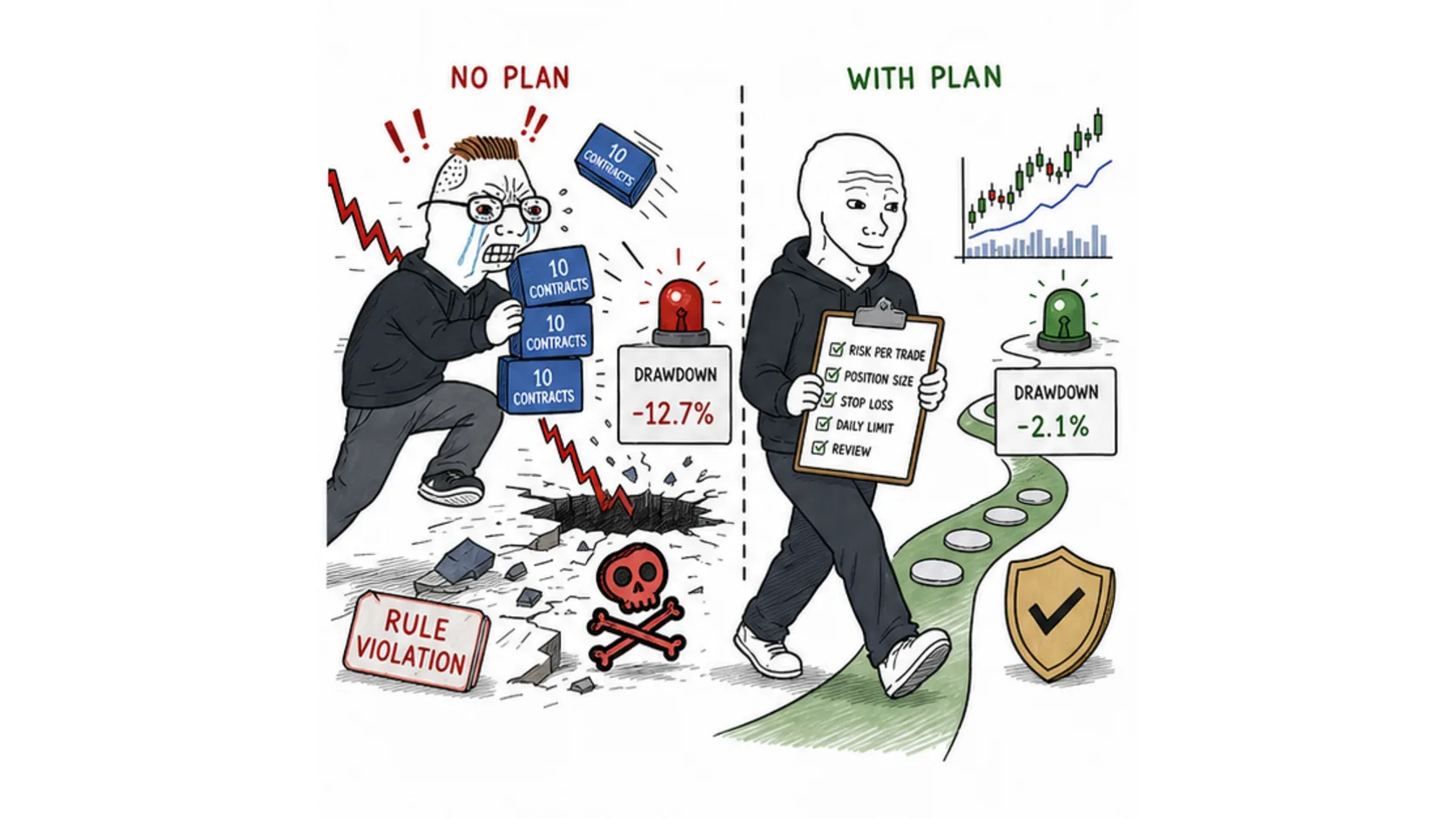
According to the European Securities and Markets Authority, approximately 70-80% of retail traders lose money trading CFDs. That number climbs even higher in prop firm challenges, where strict drawdown rules punish every mistake.
The average funded trader blows their first funded account within six weeks. Not because the market destroyed them, but because they started trading like they owned the place the second they got the green light.
Most challenge failures are not strategy failures. They are risk management failures. A trader risks 3% per trade when their plan says 1%. They move a stop loss because the trade feels wrong. They add to a losing position hoping it turns around. Every single one of these is a risk rule violation, not a market problem.
A written risk management plan does not prevent emotion. Nothing does that. What it does is give you a pre-committed set of rules to fall back on when your brain is screaming at you to take one more trade.
You already know this. You just do not do it. That is the problem. The traders who write down their plan and read it before every session are the ones who pass. The ones who keep it in their head are the ones who keep buying challenges.
The 5 Pillars of Your Risk Management Plan
Every prop firm risk management plan template needs five core components. Miss one and the whole structure falls apart. Here are the five pillars, ranked by importance.
Pillar 1: Daily Loss Limit
Your daily loss limit is the most important number in your entire plan. It is the maximum amount you are allowed to lose in a single trading day before you close the platform and walk away.
Most prop firms set this at 4-5% of the account balance. Your plan should set your personal daily loss limit below the firm's hard limit. If the firm allows 5%, cap yourself at 3%. That buffer keeps you alive when you have a bad day, which you will.
The daily loss limit is sitting there, watching you, waiting for you to make one stupid decision. Respect it like your life depends on it, because your challenge does.
Pillar 2: Maximum Drawdown
The maximum drawdown is the total amount your account can fall from its peak before the firm closes it permanently. This is the account-killer. Cross this and you are done, no appeals, no second chances.
Most firms set max drawdown at 8-12% of the starting balance. Your risk management plan needs to track your current distance from this limit every single day. Not roughly. Exactly.
Use the drawdown calculator before every trading session. Know your remaining room to the dollar. If you have less than 3% drawdown room left, reduce your position sizes by half until you rebuild the buffer.
Pillar 3: Position Sizing
Position sizing determines how much money you put on the line per trade. Get this wrong and nothing else matters. You can have the best strategy in the world and still blow your account if your positions are too large.
Calculate your position size based on your stop loss distance and your risk per trade. Never size based on how confident you feel. Confidence is a liar.
For forex prop firms, most funded traders risk 0.5-1% per trade during challenges and 0.25-0.5% on funded accounts. For futures prop firms, calculate risk per contract using tick values and point risk.
Pillar 4: Risk Per Trade
Risk per trade is the maximum dollar amount you are willing to lose on a single trade. This is your seatbelt. You wear it every time, no exceptions, no matter how good the setup looks.
Set your risk per trade at 0.5-1% of the account balance. On a $100,000 account, that means $500-$1,000 maximum risk per trade. Not per position. Per trade. There is a difference.
The risk per trade calculation must account for slippage. If your stop is 20 pips away and your risk is $500, but you know slippage during volatile periods can add 3-5 pips, reduce your position size accordingly.
Pillar 5: Session Management
Session management defines when you trade, how long you trade, and when you stop trading. This is the pillar most traders ignore completely, and it is the one that causes the most damage.
Your prop firm risk management plan template should specify your trading hours, maximum trades per session, and a hard stop time. When the clock hits your end time, you close the platform. No exceptions.
The best setups at the end of a session are the ones that cause late-day rule breaches. Your brain is tired, your discipline is depleted, and the market is showing you something that looks too good to pass up. Pass it up.
How to Calculate Your Risk Parameters (Real Example)
Here is a worked example using a $100,000 prop firm account. Grab a calculator and follow along, because you need to do this for your own account before your next challenge.
First, find your firm's rules. Assume a standard setup: 5% daily loss limit, 10% maximum drawdown, 8% profit target, trailing drawdown from peak.
Daily loss limit: 5% of $100,000 = $5,000 firm hard limit. Set your personal limit at 3% = $3,000. If you hit negative $3,000 for the day, you stop trading. Period.
Maximum drawdown: 10% of $100,000 = $10,000. Your account cannot fall below $90,000 at any point. Track this daily after each session.
Risk per trade: 0.75% of $100,000 = $750 maximum risk per individual trade. This is the dollar amount between your entry and your stop loss, multiplied by your position size.
Position size calculation: If your stop loss is 30 pips on EUR/USD and your risk is $750, each pip is worth $25 ($750 / 30 pips). That means a standard lot (pip value $10) is too large. You need 2.5 mini lots, or round down to 2 mini lots for safety.
Profit target pace: 8% of $100,000 = $8,000 target over roughly 30 trading days. That is approximately $267 per day. Spread across 2-3 trades per day at $100 average profit each. Reasonable for most strategies.
The Prop Firm Risk Management Plan Template
Copy this section into a document. Fill in every field. Read it before every trading session. This is your prop firm risk management plan template, ready to use.
Section A: Account Information
- Prop firm name: [fill in]
- Account size: $[fill in]
- Challenge type: [one-step / two-step / instant funding]
- Profit target: $[fill in] ([%] of account)
- Time limit: [fill in] calendar days
- Start date: [fill in]
Section B: Firm Rule Limits
- Daily loss limit (firm): $[fill in] ([%] of account)
- Maximum drawdown (firm): $[fill in] ([%] of account)
- Drawdown type: [static / trailing / end-of-day]
- News trading allowed: [yes / no / restricted windows]
- Weekend holding allowed: [yes / no]
- Maximum position size: [fill in] lots / contracts
- Consistency rule: [yes / no, details]
Section C: My Personal Risk Rules
- My daily loss limit (personal): $[fill in] ([%] of account, set below firm limit)
- My risk per trade: $[fill in] ([%] of account)
- My maximum trades per day: [fill in]
- My maximum open positions: [fill in]
- My trading hours: [start time] to [end time]
- My hard stop time: [time, no trading after this]
Section D: Daily Checklist
- Check current account equity
- Calculate remaining drawdown room
- Calculate remaining daily loss room
- Check economic calendar for restricted news events
- Calculate position size for first trade
- Review trading plan and session goals
- Set alarm for session end time
Section E: Emergency Protocols
- If I hit my personal daily loss limit: close platform immediately, no exceptions
- If I lose 3 trades in a row: take a 30-minute break minimum
- If my drawdown reaches 70% of the firm maximum: reduce risk per trade by 50%
- If I feel emotional after a trade: close platform for the day
- If I am unsure about a setup: do not take it. Missed money is better than lost money
Your Risk Checkpoint Schedule
A prop firm risk management plan template is useless if you write it once and never look at it again. You need scheduled checkpoints to review your performance and adjust your parameters.
Daily Checkpoint (5 minutes, end of session)
- Record today's PnL in your trading journal
- Update your running drawdown tracker
- Note how many rules you followed or broke
- Rate your emotional state from 1-10
- Write one sentence about what went well and one about what did not
The trading journal is the single most impactful tool for improving your performance over time. After 100 entries, patterns emerge that reveal exactly where you are leaking money.
Weekly Checkpoint (15 minutes, end of trading week)
- Calculate your weekly PnL
- Review your win rate and average risk-reward ratio
- Check whether you hit any personal limits
- Identify your best and worst trade of the week
- Adjust position sizes for next week if drawdown room has changed
Monthly Checkpoint (30 minutes, end of trading month)
- Review all journal entries for recurring patterns
- Calculate your actual risk per trade vs your planned risk
- Assess whether your strategy is working within the firm's constraints
- Decide whether to continue, adjust, or pause
The European Securities and Markets Authority reports that consistent risk monitoring is the single strongest predictor of trading account survival. Not strategy. Not intelligence. Discipline.
Risk Mistakes That End Challenges Fast
You have done these. Do not lie. You have done exactly these. Here are the mistakes that kill prop firm challenges before they even get started, and what your risk management plan should say about each one.
Revenge Trading After a Loss
You take a loss. Your brain says, "I know where it is going now, I will get it back." You enter again, bigger size, no stop. This is a certified account-nuke moment. Your plan should state: after any loss, wait at least 15 minutes before the next trade. No exceptions.
Oversizing Because a Setup Looks Perfect
There is no such thing as a guaranteed trade. Every setup has a failure rate. When you double your position size because "this one is a certainty," you are not trading, you are gambling. Your plan's risk per trade rule exists for exactly this situation. Follow it.
Ignoring the Trailing Drawdown
The trailing drawdown is literally following you around. You cannot shake it. Every profit you make, it catches up. It is a dog that bites you when you are winning. Track it daily and never assume your drawdown room is what it was yesterday.
Trading Past Your Session End Time
Your plan says stop at 4pm. It is 4:15pm and you see a clean setup.
You take it. It goes wrong.
Now you are in a hole you would not be in if you followed your own rule. The rule exists because late-session trades have worse outcomes for most traders. Stop when you said you would stop.
Not Accounting for Slippage
Your stop loss is at 30 pips. During a news spike, your fill comes at 38 pips. That extra 8 pips just pushed you past your daily loss limit. Your plan should calculate position size with a slippage buffer of 3-5 pips on volatile pairs and 1-2 ticks on futures contracts.
How to Adapt Your Plan for Different Prop Firms
Not every prop firm calculates risk the same way. Your prop firm risk management plan template needs to be adapted for the specific firm you are trading with. Here are the key differences to watch for.
Drawdown calculation method: Some firms calculate drawdown at end of day, others track it in real time including unrealized losses. Intraday drawdown is much stricter. Your plan needs to account for floating losses, not just closed ones.
Trailing vs static drawdown: A static drawdown stays fixed at the starting balance. A trailing drawdown moves up with your peak equity, reducing your room as you profit. Your plan must track which type applies and calculate accordingly.
News trading restrictions: Some firms ban all trading during high-impact news. Others restrict only specific currency pairs. Your plan should include a daily calendar check and a list of restricted events for your specific firm.
Position size limits: Futures prop firms often cap position sizes by contract count. Forex firms may limit lot sizes. Your plan must respect these caps even if your risk calculation would allow a larger position.
The Commodity Futures Trading Commission requires futures brokers and prop firms to disclose risk parameters clearly. Always read the firm's full rule set before building your plan, not just the marketing page summary.
Passing a prop firm challenge is not about having the best strategy. It is about having a risk management plan that keeps you alive long enough for your edge to play out. Copy this template, fill in your numbers, read it every morning, and stick to it even when your brain tells you to do something stupid. The funded traders are not smarter than you. They just follow their plan.
