
Futures prop firms hand you a funded account and then immediately tell you how many contracts you are allowed to trade. That limit is the max position size rule, and it is one of the most misunderstood rules traders hit during evaluations and funded trading. You would think bigger account means bigger positions, right? Sometimes yes, sometimes no, because every firm calculates this differently and some are way stricter than they look on the sales page.
Key Takeaways
- Max position size is the maximum number of contracts or lots a prop firm lets you hold at one time, and it is not optional.
- Different firms calculate the limit differently: some use account size percentages, others use fixed contract counts per instrument.
- Exceeding the max position size can be a soft breach (warning) or hard breach (account loss) depending on the firm.
- Your position size limit interacts directly with your daily loss limit and trailing drawdown.
- Most funded traders stay well below the max to avoid accidental breaches during volatile moves.
What Max Position Size Actually Means in Futures Prop Firms
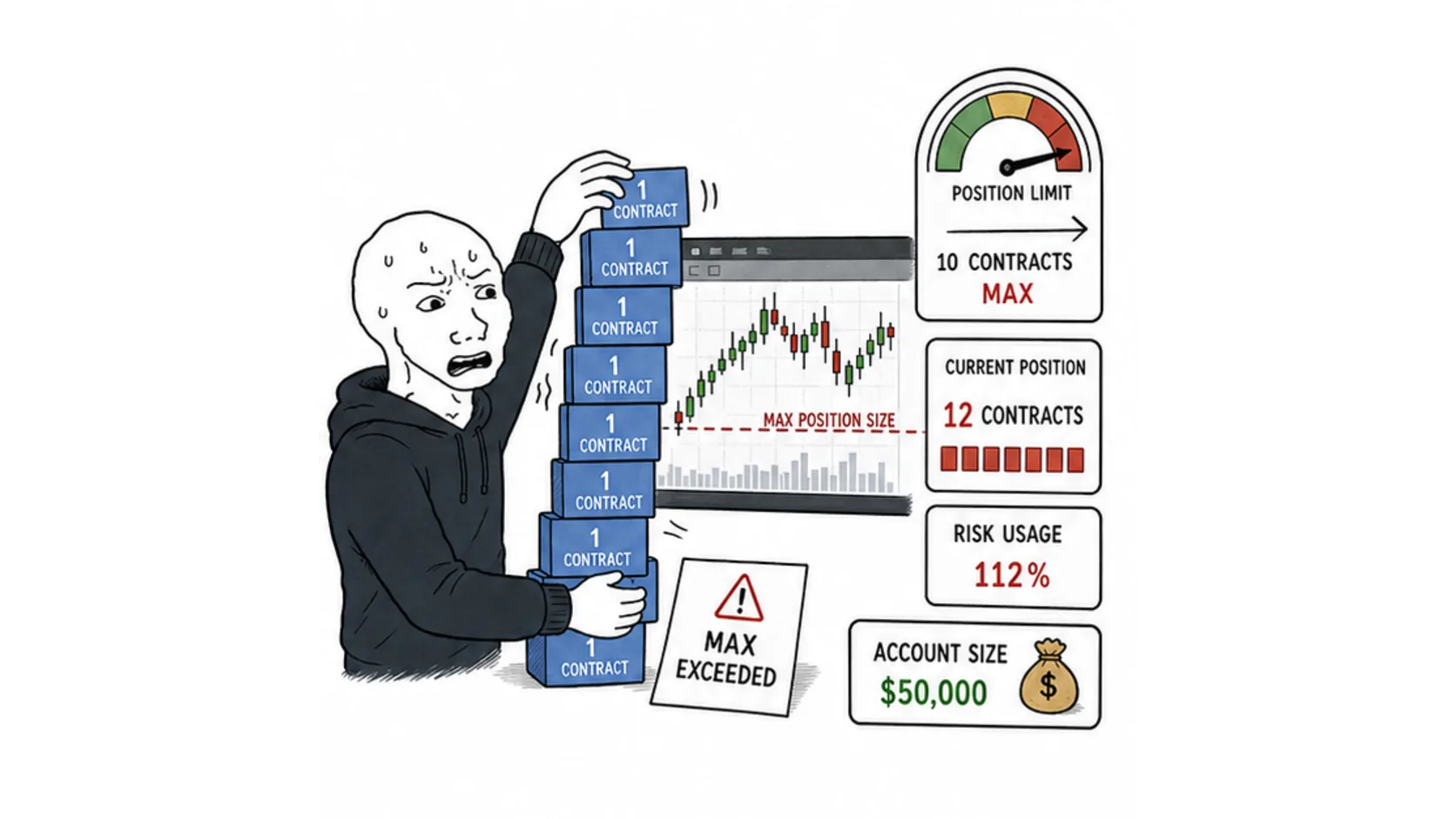
Max position size is the hard ceiling on how many futures contracts you can have open at any given moment. The firm sets this number when they issue your account, and it is non-negotiable.
If your account has a max position size of 3 ES contracts, that means 3. Not 3.5, not "approximately 3," not 4 during a really good setup. Three. Go to 4 and you have breached a rule.
This is not the same as your own risk management calculation, where you decide how many contracts to trade based on your stop loss. The prop firm has its own set of rules that sit above your personal strategy. Your position sizing decision must fit inside their limit, regardless of what your strategy says.
Some traders confuse max position size with margin or buying power. They are different things. Buying power is how much capital you can deploy in total. Max position size is how much you can deploy in a single position, or sometimes across all positions at once.
Why Futures Prop Firms Cap Your Position Size
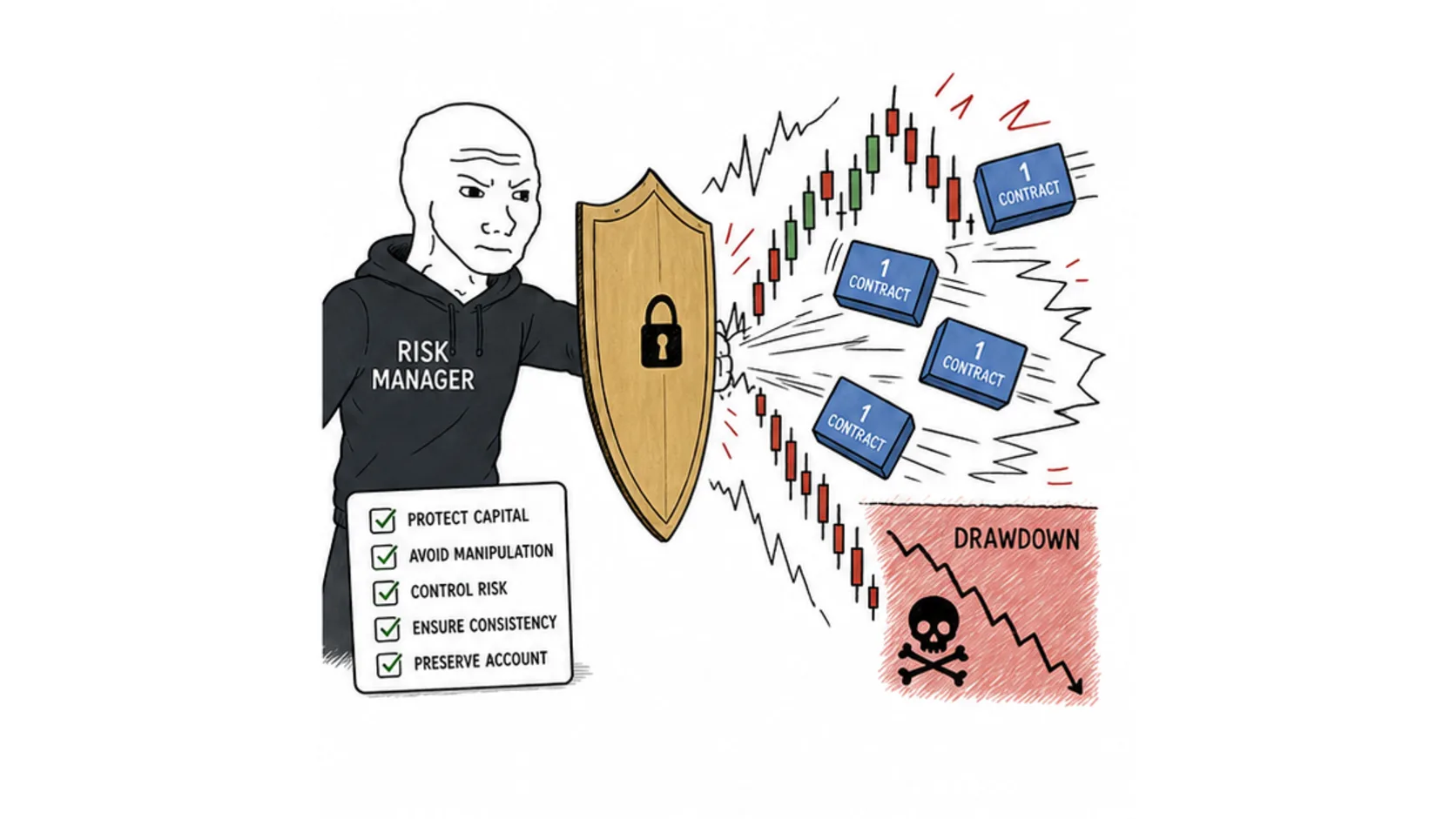
Prop firms are not being annoying for the sake of it. They cap your position size because they are the ones carrying the actual risk on the other side of your trades. Every contract you open is their capital on the line, not yours.
One oversized position on a volatile NFP release can blow through a $5,000 drawdown limit in minutes. The daily loss limit exists to protect the firm from exactly this scenario, but the position size cap stops it before it starts.
Think of it this way. The firm gives you $50,000 of buying power. If they let you put all $50,000 into a single ES trade and the market gaps against you overnight, that account is gone. The position size rule is the seatbelt. You might not like wearing it, but it keeps you alive.
The Commodity Futures Trading Commission sets position limits at the exchange level for extremely large traders. Prop firms apply similar thinking at the account level, just with much smaller numbers. Same principle, different scale.
How Major Firms Calculate the Position Size Limit
Not every firm uses the same method, and this is where traders get caught out. You sign up for a $50K account assuming you know the rules, then discover the position size limit is way lower than you expected.
Here are the three main methods firms use:
Fixed contract count. The firm says your $50K account can hold a maximum of 3 ES contracts, full stop. Simple, predictable, easy to track. Apex Trader Funding uses this approach on many of their accounts. You always know exactly where the line is.
Percentage of account. Some firms calculate your max position size as a percentage of your account balance. A $50K account with a 2% risk cap means your maximum risk per position is $1,000. That translates to roughly 2 ES contracts with a 10-point stop, or more if your stop is tighter.
Notional value cap. A few firms limit your total notional exposure. Your account might have a $250,000 notional cap, meaning the total value of all your open positions cannot exceed that figure across all contracts. This is less common in futures prop but shows up occasionally.
| Account Size | Fixed Limit (ES) | % Risk Method (2%) | Typical Max Lots |
|---|---|---|---|
| $25,000 | 1-2 contracts | 1 contract | 1-2 |
| $50,000 | 2-3 contracts | 2 contracts | |
| $100,000 | 4-6 contracts | 3-4 contracts | 4-6 |
| $150,000 | 6-8 contracts | 5-6 contracts | 6-8 |
| $250,000 | 8-12 contracts | 8-10 contracts | 8-12 |
These numbers are rough guides. Every firm sets their own limits, and some are more generous than others. Always check the specific rule document for your account before trading.
Position Size Rules vs Your Drawdown Ceiling
Here is where most traders get into trouble. They think about the position size limit in isolation, without connecting it to the trailing drawdown or the maximum drawdown rules.
Imagine this. You have a $50K account with a 3-contract max on ES and a $2,500 max daily loss. You open 3 contracts, and the S&P 500 drops 15 points against you in an hour. That is $225 per contract, times 3 contracts, equals $675 down. Manageable.
But what if you were allowed 6 contracts? That same 15-point move is now $1,350. Still within your daily loss, but you have eaten through more than half your daily budget on a single trade. One more bad trade and you are done for the day, or worse.
The position size cap is there to keep any single trade from destroying your account before the drawdown rules can save you. Both rules work together. Ignore either one and the other one does not matter anymore.
The difference between end-of-day and intraday drawdown also affects how aggressively you can size. Intraday drawdown tracks your equity in real time, which means a large position can trigger a breach mid-session before you even realize what happened.
What Happens When You Exceed the Max Position Size
This depends entirely on the firm and the type of breach. Let me break it down.
Soft breach. Some firms will simply reject the order that would put you over the limit. You try to open a 4th contract when your max is 3, and the platform blocks it. No penalty, no warning, just a declined order. Annoying, but your account survives. Many futures prop firms use this approach on their evaluation accounts.
Warning breach. A few firms allow the trade through but flag it. You get an email or a dashboard notification saying you exceeded the position size limit. Accumulate too many warnings and your account gets reviewed. Not ideal, but not immediately fatal.
Hard breach. The worst case. You exceed the max position size and the firm treats it the same as blowing your drawdown. Account closed, challenge failed, start over. This is the outcome most traders do not see coming, because they assume position size is a soft rule like it is at some firms.
The trick is knowing which type of breach your firm uses before you start trading. This information is always in the rules document. Read it. Do not guess.
The 1% Rule and Why Most Traders Ignore It
The 1% rule says you should never risk more than 1% of your account on a single trade. On a $50K account, that is $500. If your stop loss on an ES trade is 5 points ($250 per contract), you can trade 2 contracts and stay within your $500 risk budget.
Most traders hear this rule and immediately ignore it, because 2 contracts on a $50K account does not feel like enough. They want 4 or 5 contracts to make the numbers work faster, especially during a challenge where the clock is ticking on their profit target.
Here is the thing. The 1% rule is not just conservative hand-holding. It is math. If you risk 1% per trade and have a 50% win rate with a 2:1 reward-to-risk ratio, you can survive a 15-trade losing streak and still have 86% of your account left. At 3% risk per trade, that same streak leaves you with 63%. At 5%, you are at 46% and probably already breached your drawdown.
The math does not care about your feelings. Your consistency rule also penalizes oversized winners, which means loading up on big positions can actually hurt you even when the trade works. The firm wants to see steady, controlled trading, not one massive gamble that happened to pay off.
How to Size Positions Without Hitting the Limit
You have three missions when it comes to position sizing at a futures prop firm.
Mission one: know your firm's exact max position size before you place a single trade. Not what you think it is. Not what some Reddit thread said. The actual number from your rules document. Write it on a sticky note and put it on your monitor.
Mission two: calculate your own position size based on your stop loss, not your account size. This is the mistake almost everyone makes. They look at their $50K account and think "I can afford 3 contracts." But if your stop loss is 20 points on ES, 3 contracts is $3,000 of risk on a single trade. That is 6% of your account. On a $2,500 daily loss limit, one bad trade and you are done for the day.
Mission three: always leave a buffer between your actual size and the max. If your firm allows 4 ES contracts, trade 2 or 3. The max is a ceiling, not a target. Buffer rules exist in prop trading for exactly this reason. The best funded traders I know consistently trade below the limit because the extra room saves them during unexpected volatility.
Use the position size calculator before every session. Plug in your account size, stop loss in points, and risk percentage. The calculator tells you exactly how many contracts to trade. No guessing, no "feeling" your way through it.
Comparing Position Size Rules Across Top Futures Prop Firms
Not all futures prop firms handle position size the same way. Here is a quick comparison of how the major players approach this rule.
Apex Trader Funding. Uses fixed contract limits based on account size. A $50K account typically gets 3-4 ES contracts. Clear, simple, no surprises. The firm also allows you to hold positions overnight on most accounts, which is rare in futures prop. Solid tier for transparency.
TopStep. Uses a combination of position limits and daily loss limits that work together. A $50K Combine account lets you trade up to 3 ES contracts. They also enforce a strict daily loss limit, so even if you are within the position size, you can still get stopped out for the day if losses pile up. Respectable tier.
Elite Trader Funding. Offers some of the most generous position size limits in the industry for the price. A $50K account can hold 4-5 ES contracts depending on the specific plan. The tradeoff is they have stricter consistency requirements, so bigger positions can trigger consistency rule flags even on winning trades. Mid tier for risk-tolerant traders.
MyFundedFutures. Uses a scaled approach where your position size limit increases as you prove consistency. Start at 2-3 contracts on a $50K account, scale up over time. This is actually one of the smarter approaches because it forces you to prove you can handle small size before giving you more firepower.
The key difference between these firms is not just the number of contracts. It is how the position size rule interacts with their other rules. A firm that gives you 5 contracts but has a tight trailing drawdown is more dangerous than a firm that gives you 3 contracts with a static drawdown. Always read the full rules package, not just the headline number.
