
Common prop firm terms. You have seen them scattered across firm websites, challenge descriptions, and Reddit threads. The problem is that firms do not explain them properly. A firm says "10% maximum drawdown" and you think you understand it, until you are three weeks into a challenge and your account gets closed for something you did not realise counted. These funded trading terms are not complicated. But they are specific, and the specifics are what separate traders who pass from traders who donate their challenge fee and complain on Reddit afterwards.
Key Takeaways
- The four terms that cause most challenge failures are daily loss limit, maximum drawdown, profit target, and consistency rule.
- Trailing drawdown is more dangerous than static drawdown because your threshold tightens as you make profits.
- Every prop firm defines terms slightly differently. Read the specific firm's rules before buying.
- Equity drawdown counts unrealised losses, balance drawdown only counts closed positions. Know which one your firm uses.
- The consistency rule prevents you from passing with one lucky trade. Your profits need to come from multiple sessions.
On This Page
- Drawdown: The Term That Ends More Accounts Than Anything
- Trailing vs Static Drawdown: Why It Matters
- Equity vs Balance Drawdown: The Hidden Trap
- Daily Loss Limit: Your Allowable Damage Per Day
- Profit Target: What You Need to Earn to Pass
- Consistency Rule: Why One Good Day Is Not Enough
- Minimum Trading Days and Time Limits
- Account Breach: What Happens When You Break a Rule
- Why Every Firm Defines These Terms Differently
- Frequently Asked Questions
Drawdown: The Term That Ends More Accounts Than Anything
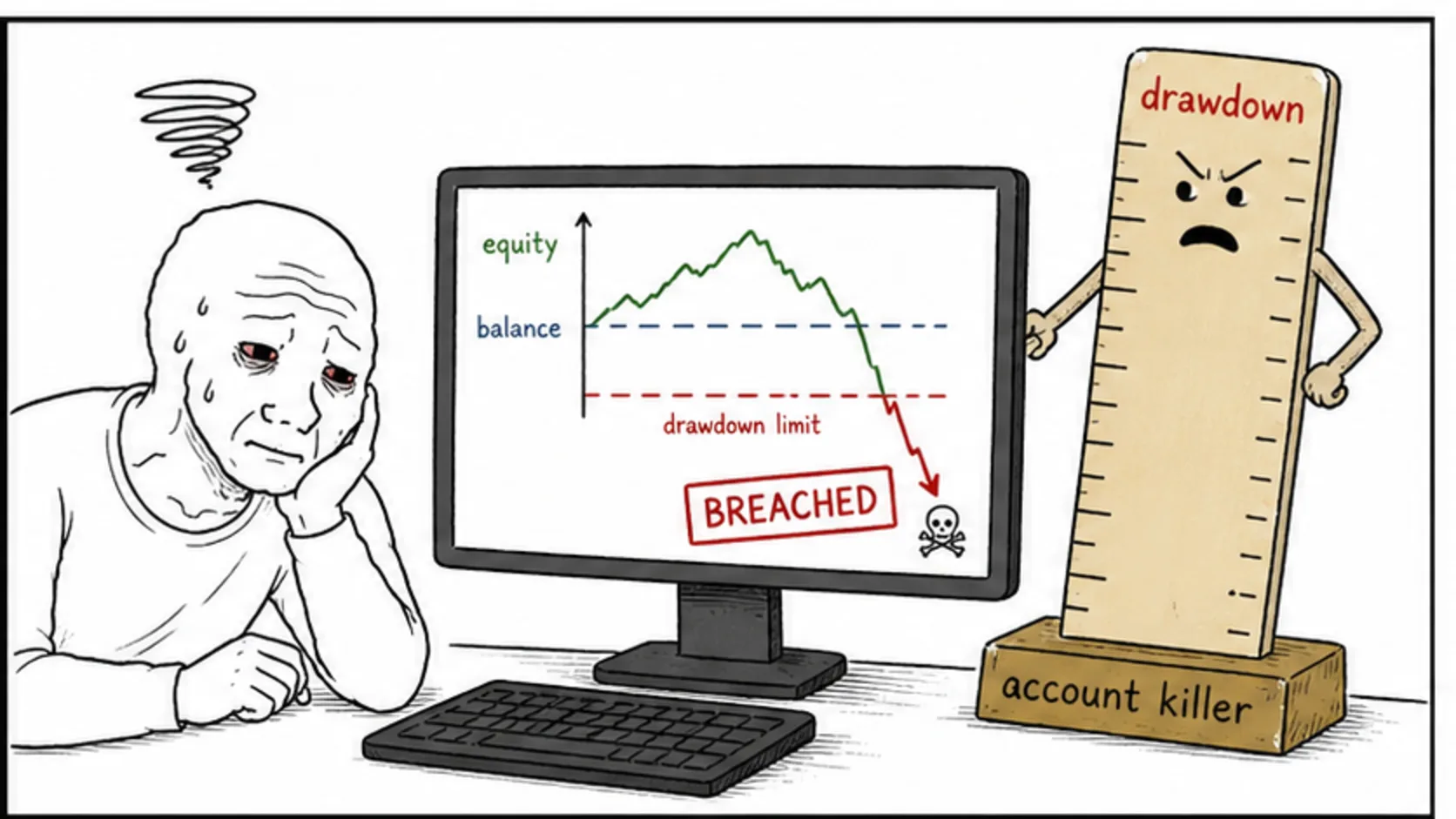
If there is one prop firm term you need to understand perfectly, it is this one. Drawdown is the decline in your account from its highest point. Not from where you started. From the peak. That distinction is the difference between passing a challenge and losing everything.
Drawdown in prop firms works differently from how most retail traders think about it. You might think "I am only down 3% from my starting balance, I am fine." But if your account peaked at $108,000 and is now at $99,000, your drawdown is $9,000 or 9% of the starting balance. That is dangerously close to the typical 10% maximum drawdown limit, even though you are still technically in profit.
The drawdown clock starts the moment your account reaches a new high. Every new high resets the peak. The gap between the peak and your current balance is your drawdown. Prop firms use drawdown to measure whether you can manage risk. If your drawdown is always near the maximum, you are not managing risk. You are surviving on borrowed time.
Trailing vs Static Drawdown: Why It Matters
This is where traders get caught out. And by "caught out" I mean "lose their account on day 18 because they did not read the rules carefully enough."
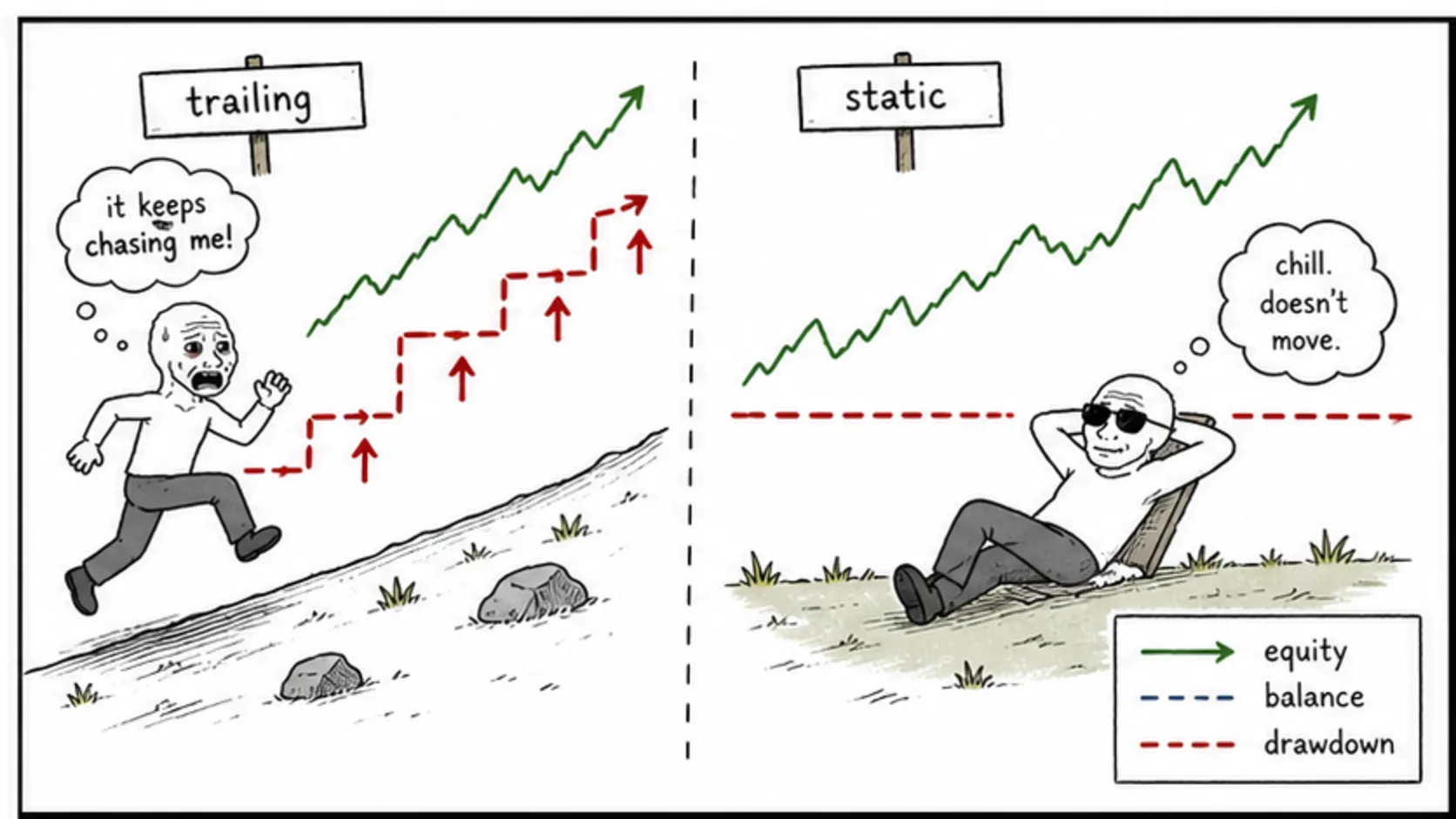
Static drawdown is fixed. Your $100,000 account has a 10% maximum drawdown. That threshold is $90,000. It stays at $90,000 forever, whether your balance goes to $110,000 or back to $95,000. Your drawdown zone never moves. Profit all you want. The safety net stays in the same place.
Trailing drawdown follows you up. Same $100,000 account with 10% trailing drawdown. Your starting threshold is $90,000. But if your account grows to $110,000, the threshold trails up to $99,000. You can now never let the account drop below $99,000. The profits you made? They are now part of the protected zone. You cannot spend them and you cannot lose them.
The trailing drawdown is a dog that follows you everywhere. Every step forward you take, it catches up. You make $5,000 in profit, the threshold moves up by $5,000. You are always exactly 10% away from account closure, no matter how much you have earned. This is why traders feel like they are "almost there" on a challenge and then suddenly get breached. The target moved while they were running towards it.
For a $100,000 account with 10% trailing drawdown, if you grow the account to $105,000, your threshold is now $94,500. If you then have a bad day and drop to $94,400, your account is closed. You are still $5,600 above the starting balance. You are still profitable. But the trailing drawdown does not care. It only cares about the distance from the peak.
Equity vs Balance Drawdown: The Hidden Trap
Little do most traders know, there are two ways prop firms measure drawdown, and the difference can catch you mid-trade.
Balance drawdown only counts closed positions. Your floating unrealised losses do not count against this metric until you close the trade. Your account balance shows $102,000, but you have a $4,000 floating loss on an open position. Your balance drawdown is zero because that loss has not been realised yet.
Equity drawdown includes floating losses. Same scenario. Your balance is $102,000, floating loss is $4,000, equity is $98,000. If your firm measures equity drawdown, you are already at a 2% drawdown on a $100,000 account, even though the trade is still open. The maximum drawdown rule watches your equity, not just your balance.
Most firms measure drawdown from equity, not balance. But not all of them. This is one of those details buried in the terms and conditions that you absolutely must check. If your firm measures equity drawdown, you need to account for floating losses when managing your risk. A position that is $500 away from triggering your stop loss is also $500 away from potentially breaching your drawdown limit.
Daily Loss Limit: Your Allowable Damage Per Day
The daily loss limit is the maximum amount your account can lose in a single trading day. Usually 4% to 5% of the starting balance. On a $100,000 account with a 5% daily loss limit, you can lose up to $5,000 in one day before your account gets closed.
Here is the part most traders miss. The daily loss limit resets at a specific time, usually midnight server time or the start of the trading day. It does not reset when you close your browser. It does not reset when you feel better about the market. It resets on the clock.
And here is the real trap. If you are in a hole at 2pm, down 3.5% for the day, the responsible move is to stop trading. The tempting move is to "make it back" before the reset. You already know which one most traders choose. And you already know how that ends.
Some firms calculate the daily loss from the starting balance of the day. Others calculate it from the equity at the start of the day. If you made $2,000 earlier in the day, your starting equity is $102,000, and a 5% daily loss limit means you can lose $5,100 before breaching. But if the firm calculates from the original starting balance, you can only lose $5,000 regardless of profits earned that day. Check which method your firm uses.
Profit Target: What You Need to Earn to Pass
The profit target is straightforward on the surface. You need to make X% profit to pass the challenge phase. Typically 8% to 10% for phase one, 5% for phase two.
On a $100,000 account, an 8% target means you need to grow the account to $108,000. Simple maths. But there are nuances that catch people.
First, the profit target is calculated from your starting balance, not your current balance. If you lose 2% early in the challenge, you now need to make back that 2% plus the 8% target. You are not working from where you are. You are working from where you started.
Second, some firms calculate the target based on closed profits only. Others include floating equity. If your firm requires closed profits, you cannot count open positions towards the target. You need to close the trades first.
Third, the profit target works alongside every other rule. You cannot ignore drawdown limits, daily loss limits, and consistency requirements just because you are close to the target. Passing a challenge means hitting the profit target while staying within all the rules. Not just the profit part.
Consistency Rule: Why One Good Day Is Not Enough
The consistency rule is the prop firm's way of saying "we do not want to fund someone who got lucky once." It limits how much of your total profit can come from a single trading day, usually to 30% or 40% of the total.
Example. You need to make $8,000 on a $100,000 account to hit an 8% profit target. You trade for 15 days and make $800 per day consistently. On day 16, you catch a massive move and make $5,000 in one session. Your total profit is $17,000. But $5,000 is 29% of $17,000. You pass the consistency rule because no single day exceeds the threshold.
Now flip it. You struggle for 14 days, making $200 per day. On day 15, you hit a huge trade for $5,200. Total profit is $8,000. Target hit. But $5,200 is 65% of $8,000. The consistency rule says no single day can be more than 30% or 40%. You fail. Despite hitting the profit target, you fail because one trade carried the entire challenge.
The consistency rule exists for a reason. A trader who makes $5,200 on one trade and $200 on fourteen others has not demonstrated consistency. They demonstrated one good trade. The firm wants to fund traders who can produce repeatable results, not traders who got lucky. The rule protects the firm. It also tells you something important about whether your trading is actually ready for a funded account.
Minimum Trading Days and Time Limits
Two separate concepts that traders constantly confuse.
Minimum trading days means you must place trades on at least X different calendar days during the challenge. Usually 5 to 10 days. A day counts when you open or close at least one position. You cannot pass the challenge in a single session, no matter how profitable it is. This rule forces you to demonstrate that you can trade across different market conditions.
Maximum trading days (time limit) is the deadline for completing the challenge. Some firms have no time limit, others give you 30, 60, or 90 days. If you run out of time without hitting the profit target, the challenge ends and you lose the fee.
The interaction between these two rules matters. If you have a 30-day time limit and a 5-day minimum, you could theoretically pass in 5 days if you hit the profit target and satisfy the consistency rule. But if you trade conservatively and take 25 days to hit the target, you have used most of your time window. Plan accordingly.
Account Breach: What Happens When You Break a Rule
An account breach is when you violate one of the firm's hard rules. The result is almost always immediate account closure. No refund. No appeal. No second chance.
Common breach triggers:
- Exceeding the daily loss limit
- Exceeding the maximum drawdown
- Trading during restricted news events
- Holding positions over the weekend when the firm bans it
- Using prohibited trading strategies like martingale or grid trading
- Copy trading when the firm bans it
Some firms distinguish between hard breaches and soft breaches. A hard breach closes the account permanently. A soft breach might give you a warning, reset your challenge, or reduce your account size. But most firms treat all breaches as hard breaches, especially during the challenge phase. Assume every rule is a hard rule until you confirm otherwise.
The Financial Conduct Authority has been pushing for clearer disclosure of breach rules, and the better firms now spell out exactly what happens in each scenario. If a firm's breach policy is vague, that vagueness is not an accident. It gives them wiggle room to close your account whenever they want.
Why Every Firm Defines These Terms Differently
You would think "daily loss limit" means the same thing everywhere. It does not. One firm calculates it from the starting balance. Another from the day's opening equity. A third from the highest equity reached that day. Same term, three different calculations, three different outcomes for the same trading activity.
This is why reading the terms and conditions is non-negotiable. Not the marketing page. Not the FAQ summary. The actual terms document that defines exactly how each metric is calculated.
Drawdown is the worst offender. "10% maximum drawdown" sounds standard. But is it trailing or static? Is it measured from equity or balance? Does it include commissions and swap fees? Does the daily loss limit calculation include swap costs? Some firms include these costs in the drawdown calculation. Others do not. A 4.8% loss before commissions becomes a 5.2% loss after commissions, and suddenly you have breached a 5% daily loss limit you thought you were safely under.
The terms also change. Firms that reserve the right to change rules retroactively are a red flag. But even legitimate firms update their terms periodically. Check for updates before each challenge attempt, especially if you have not traded with the firm in a while.
For the full A-Z list of every prop firm term with definitions, see the prop firm glossary. This page covers the terms that cause the most confusion and the most account closures. The glossary covers everything else.
