
Every industry has its own language, and prop trading is worse than most. You have got drawdown types, challenge phases, account rules, payout structures, and a mountain of jargon that gets thrown around like everyone already knows what it means. Problem is, most traders do not know what it means. They buy a challenge, hit a term they do not understand, break a rule they did not know existed, and lose their account. This prop firm glossary fixes that. Every term, defined plainly, with the context you actually need.
Key Takeaways
- This glossary covers 50+ prop firm terms from account breach to withdrawal, grouped by category so you can find what you need fast.
- The terms that matter most for passing challenges are daily loss limit, maximum drawdown, profit target, and consistency rule.
- Understanding trailing versus static drawdown is the difference between keeping and losing a funded account.
- Every prop firm defines these terms slightly differently. Always read the specific firm's terms before buying a challenge.
- Bookmark this page. You will reference it constantly during your first few challenges.
On This Page
Account Types and Phases
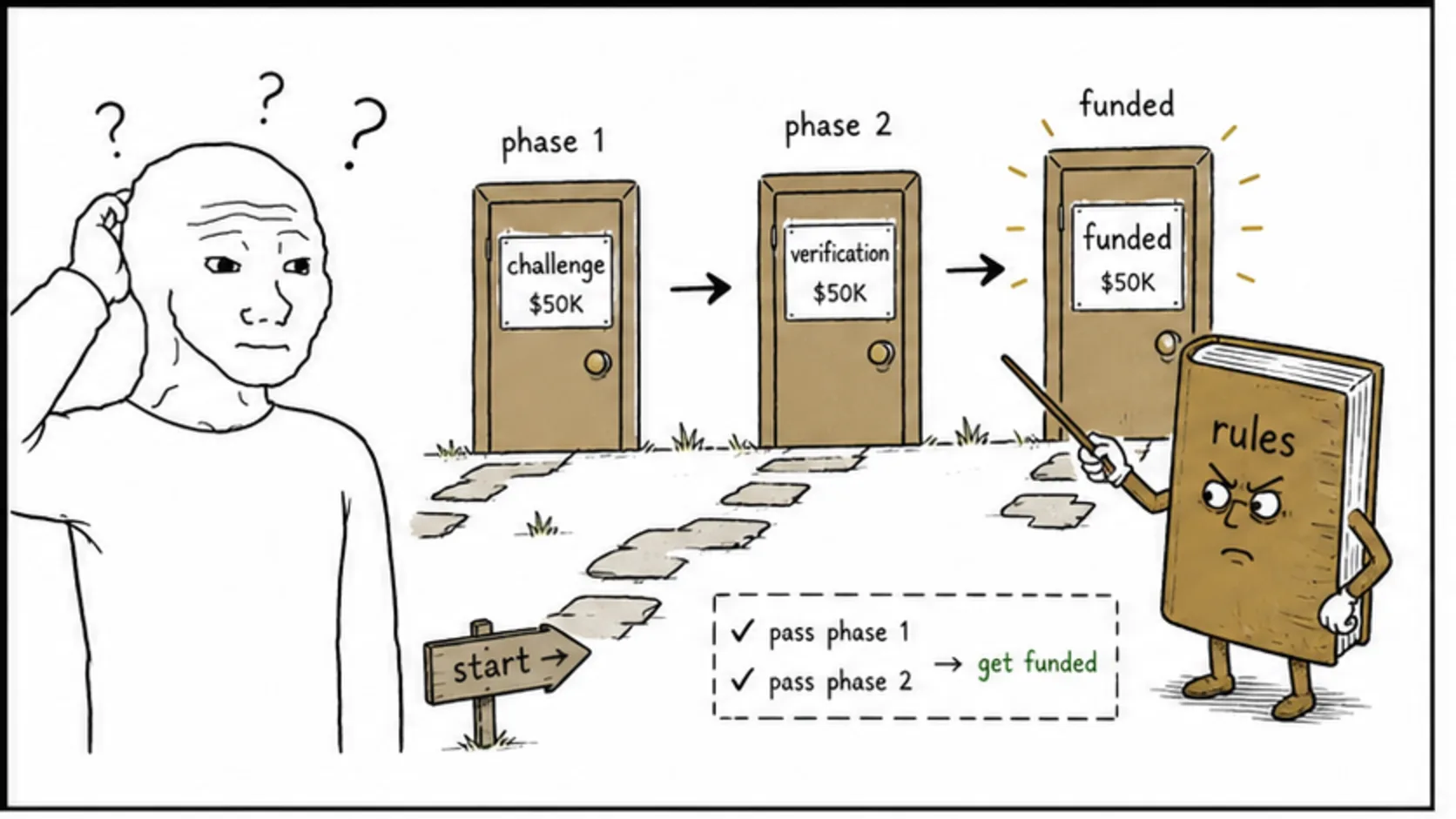
Challenge Account. The evaluation account you trade during the assessment phase. You must hit the profit target without breaching any rules. This is the gate you need to pass before getting funded.
Phase One (Phase 1). The first stage of a two-step evaluation. Usually requires a higher profit target, typically 8% to 10%.
Phase Two (Phase 2). The verification stage in a two-step evaluation. Lower profit target, usually around 5%, but the same rules apply. Think of it as the firm double-checking that your phase one performance was not a fluke.
Funded Account. The account you receive after passing all evaluation phases. You trade with the firm's capital and keep a percentage of the profits. This is the prize.
Live Account. A funded account that trades with real money on live markets, as opposed to a simulated account. Some firms offer both. Most retail prop firms use simulated accounts, not live ones.
Simulated Account. A demo trading environment that mirrors live market conditions. Your trades are not executed on a real exchange. Most retail prop firms use simulated accounts for both challenges and funded trading.
Instant Funding. A model where you skip the evaluation and get funded immediately after paying a fee. Higher fees, stricter rules, lower profit splits.
Direct Funding. Similar to instant funding. You pay a larger upfront fee and receive a funded account without passing an evaluation. The trade-off is cost versus time.
Scaling Plan. A programme that increases your account size over time as you demonstrate consistent profitability. Example: trade profitably for three months on a $100,000 account, and it scales to $125,000.
Challenge Rules and Restrictions
Profit Target. The amount of profit you need to make during a challenge phase to pass. Typically 8% to 10% for phase one, 5% for phase two. Expressed as a percentage of the starting account balance.
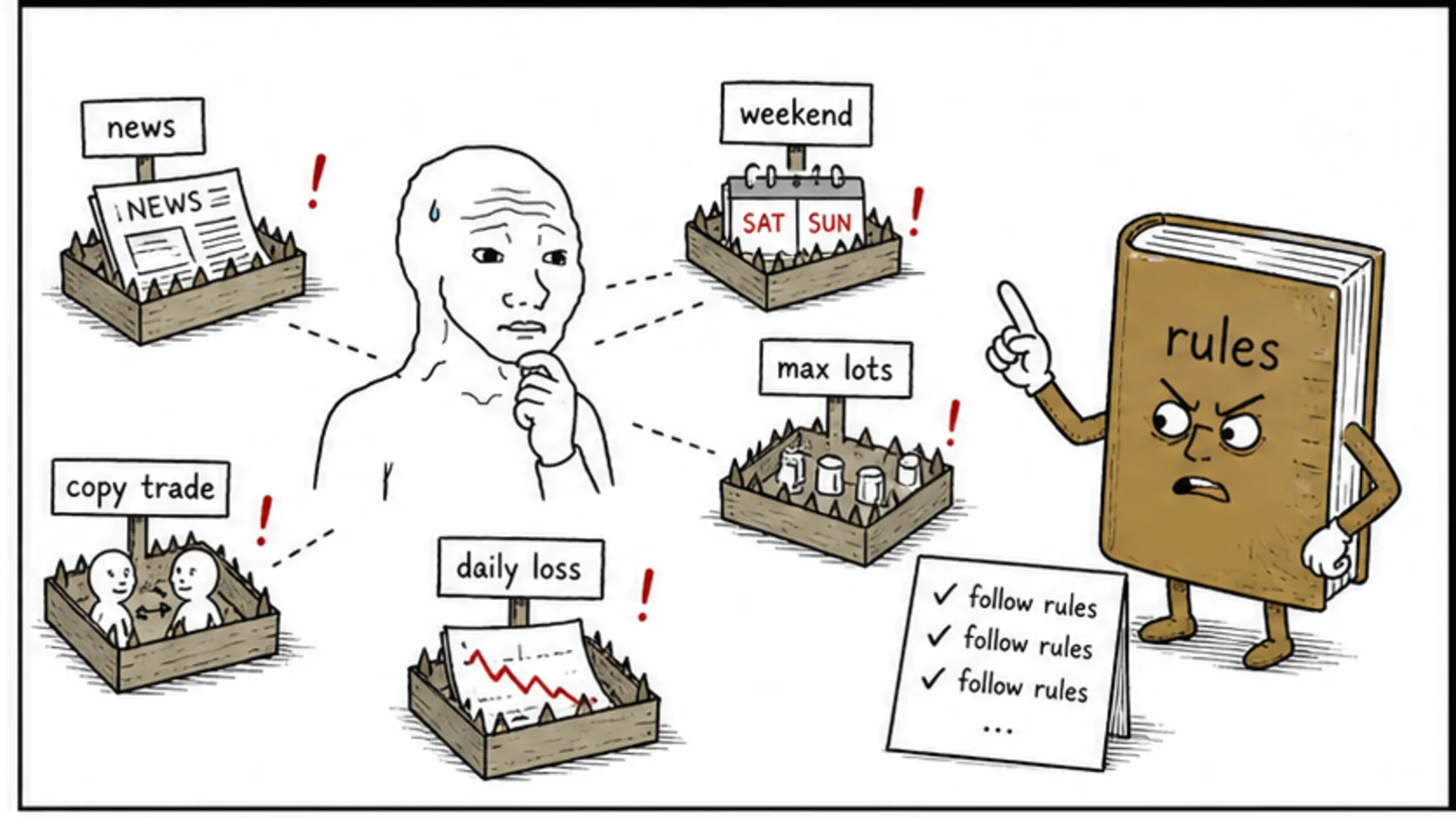
Daily Loss Limit. The maximum you can lose in a single trading day, usually 4% to 5% of the starting balance. Exceed this and your account is closed. No appeal. No refund.
Maximum Drawdown (Max DD). The maximum amount your account can drop from its starting balance (static) or its peak (trailing). Usually 10% to 12%. Hit this and you are done.
Minimum Trading Days. The minimum number of days you must place trades during the challenge. Typically 5 to 10 days. This prevents someone from passing in a single lucky session.
Maximum Trading Days. The time limit to complete the challenge. Some firms have unlimited time, others set 30, 60, or 90 day limits. No time limit challenges give you more flexibility but cost more.
Consistency Rule. Limits how much of your total profit can come from a single trading day, usually 30% to 40%. Without this, one lucky trade could pass the challenge and the firm would fund a trader with no real edge.
Account Breach. A violation of any hard rule that results in immediate account closure. Breaching the daily loss limit, exceeding max drawdown, or trading during restricted news events.
Prohibited Trading Strategies. Specific trading methods the firm bans. Common examples include martingale strategies, grid trading, latency arbitrage, and news exploitative trading.
News Trading Restriction. A rule preventing you from opening or closing positions around major economic news events, usually within 2 to 5 minutes of the release. Some firms ban it entirely.
Overnight Holding Rule. Restricts holding positions overnight or through the weekend. Some firms require all positions to be closed before the daily rollover.
Weekend Holding Rule. Prohibits holding open positions over the weekend. The gap risk on Sunday open is the reason this rule exists.
Drawdown and Risk Terms
Drawdown. The decline in your account balance from its peak value. If your account peaks at $105,000 and drops to $98,000, you have a $7,000 drawdown. This is the number that follows you around like a shadow during every challenge.
Static Drawdown. Measured from the original starting balance and never moves. A $100,000 account with 10% static drawdown means your balance can never go below $90,000, regardless of how much profit you make.
Trailing Drawdown. Follows your account equity as it rises. If your account grows to $110,000, the 10% trailing drawdown threshold moves up to $99,000. You can lose profits you already made. This is the one that catches people off guard.
Equity Drawdown. Measured from the peak of your account equity, including floating profits and losses. More aggressive than balance drawdown because unrealised gains count.
Balance Drawdown. Measured only from closed positions. Your floating unrealised losses do not count against this metric until the position is closed.
Risk Per Trade. The percentage of your account you risk on a single position. Smart challenge traders risk 0.5% to 1.5% per trade. Anything above 2% is asking for trouble.
Lot Size. The volume of your position, which determines how much each pip or point is worth. Standard lot in forex is 100,000 units. Mini lot is 10,000. Micro lot is 1,000.
Position Sizing. The process of calculating how large a trade to take based on your stop loss distance, account size, and risk tolerance. Get this wrong and nothing else matters.
Payout and Compensation Terms
Profit Split. The percentage of trading profits you keep. Typical splits range from 70% to 90%. The firm keeps the rest. Some firms offer increasing splits under their scaling plans.
Payout. A withdrawal of your earned profits from a funded account. Payouts follow the firm's schedule and rules, which can range from bi-weekly to monthly.
Payout Period. The time between payout requests. Some firms pay every 14 days, others monthly. The first payout usually has a longer waiting period, typically 30 days.
Challenge Fee. The upfront cost of buying an evaluation. Ranges from $50 for small accounts to $1,000+ for large ones. The fee is non-refundable in most cases.
Activation Fee. A one-time fee some firms charge when you pass the evaluation and activate your funded account. Not all firms charge this. Read the fine print.
Refund Policy. Whether and when you get your challenge fee back. Some firms refund the fee with your first payout. Others do not refund at all. This is a significant cost difference between firms.
Drawdown Buffer. Some firms offer a buffer zone before a hard breach. You get a warning or a soft breach before the account is fully closed. Not common, but valuable when available.
Trading Strategy and Behaviour Terms
Copy Trading. Copying another trader's positions automatically. Most prop firms restrict or ban copy trading because it defeats the purpose of evaluating individual skill.
EA (Expert Advisor). An automated trading programme that runs on MetaTrader platforms. Some firms allow EAs, others ban them. Check the rules before running any automated strategy.
Trading Bot. Any automated trading system, not limited to MetaTrader EAs. Same rule: some firms allow them, most restrict what they can do.
Scalping. A strategy of opening and closing positions quickly for small profits. Works for challenges if the firm does not restrict trade duration.
Swing Trading. Holding positions for days to capture larger price moves. Compatible with most prop firms, but watch out for overnight and weekend holding rules.
Hedging. Opening opposing positions on the same instrument to reduce risk. Many prop firms ban this practice because it can be used to circumvent drawdown rules.
Martingale. A strategy of doubling your position size after each loss to recover. This is almost universally banned by prop firms because it blows accounts spectacularly.
Grid Trading. Placing multiple orders at fixed intervals above and below a set price. Banned by most firms because it creates unlimited exposure if the market trends in one direction.
Account Churning. Opening and closing positions excessively to generate commission or volume. Firms monitor for this and may flag your account.
Platform and Technical Terms
MT4 (MetaTrader 4). The legacy forex trading platform. Still used by many prop firms but being phased out. A handful of firms still support it.
MT5 (MetaTrader 5). The successor to MT4. Supports more asset classes, better backtesting, and more order types. The current standard for most forex prop firms.
cTrader. A trading platform by Spotware with a cleaner interface and better charting than MetaTrader. Gaining popularity among newer prop firms.
TradingView. A charting platform that some prop firms integrate for trade execution. Not all firms support TradingView for direct trading.
Rithmic. A futures trading platform known for fast execution. Popular with futures prop firms like Topstep and Earn2Trade.
Tradovate. A cloud-based futures trading platform. Used by several futures prop firms as an alternative to Rithmic.
Project X. A newer futures trading platform gaining adoption. Several firms now offer it as their primary platform.
VPS (Virtual Private Server). A remote server that runs your trading platform 24/7. Essential for running EAs or maintaining low-latency connections.
Slippage. The difference between your expected entry price and the actual fill price. More common during volatile market conditions and news events.
Spread. The difference between the bid and ask price. Your effective cost of entering a trade. Wider spreads during news events can trigger rule breaches.
Leverage. The amount of borrowed capital you can use to control a larger position. Prop firm leverage varies from 1:10 to 1:500 depending on the firm and asset class.
Market and Execution Terms
CFD (Contract for Difference). A derivative product that lets you speculate on price movements without owning the underlying asset. The European Securities and Markets Authority regulates CFDs in the EU. Many forex prop firms use CFDs rather than actual currency trading.
Pip. The smallest standard price move in forex. For most currency pairs, one pip equals 0.0001. The fourth decimal place.
Point. Similar to a pip but used in futures markets. One point equals one full unit of price movement. In some contexts, one point equals 10 pips.
Lot. A standardised unit of trading volume. In forex, a standard lot is 100,000 units of the base currency. In futures, one contract equals one lot.
Stop Loss. An order to close a position at a predetermined price to limit losses. The single most important order type for prop firm traders. Use it or lose your account.
Take Profit. An order to close a position at a predetermined price to lock in gains. Not required by all firms, but essential for risk management.
Risk-Reward Ratio. The ratio of how much you risk versus how much you stand to gain on a trade. A 1:2 ratio means you risk $100 to make $200.
Confluence. When multiple technical indicators or analysis methods point to the same conclusion. The more confluence at a trade setup, the stronger the signal.
Liquidity. How easily an asset can be bought or sold without significantly affecting its price. Higher liquidity means tighter spreads and better execution.
Volatility. How much and how fast prices move. High volatility means bigger swings in both directions. Manage your sizing accordingly, because volatility can eat through your daily loss limit fast.
That is the complete prop firm glossary. Every term you will encounter in evaluations, funded accounts, and trading communities. For a deeper breakdown of the most commonly confused terms, see the companion page. Bookmark this. You will need it.
